Illustrating Poe #1: Aubrey Beardsley

beardsley_poe1.jpg

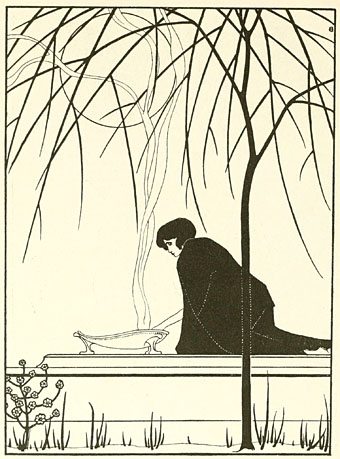
The Black Cat.

Halloween approaches, as if you needed reminding. In honour of that event it’s Poe Week here at {feuilleton}, and we’ll be skating through some favourite depictions of stories and poems by the Boston genius.

Aubrey Beardsley’s four Poe illustrations were commissioned by Herbert S. Stone and Company, Chicago, in 1894 as embellishment for a multi-volume collection of the author’s works. The Black Cat is justifiably the most reproduced of these. The other drawings are fine in themselves but not very successful illustrations of Poe’s tales. Aubrey wasn’t really suited to this kind of horror atmosphere; looking at his ear-ringed orangutan and the spotless furnishings surrounding it you’d never guess the scene of murderous simian frenzy which lies at the heart of the story.

beardsley_poe2.jpg

The Murders in the Rue Morgue.

Herbert Stone’s company had begun publishing The Chap-Book in the same year, a witty American equivalent of British periodicals like The Yellow Book, and Beardsley’s work was featured in the early issues. Looking through some of these at the Internet Archive I was surprised to see the following illustration in a short appraisal of Beardsley’s art. If this is by the artist, as the credit implies, it’s a drawing I haven’t seen in any books of his work. If anyone can confirm this is a genuine Aubrey then please leave a comment. The other Poe illustrations follow.
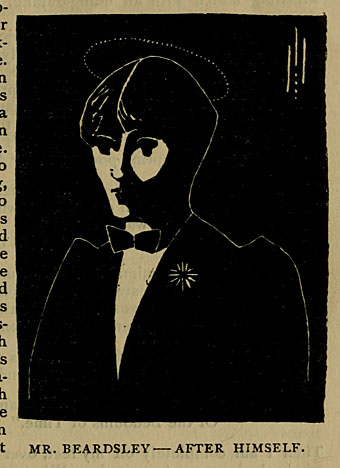
beardsley_portrait.jpg

From The Chap-Book, May 15th, 1894.
Continue reading “Illustrating Poe #1: Aubrey Beardsley”
Will Bradley’s Fringilla

bradley1.jpg

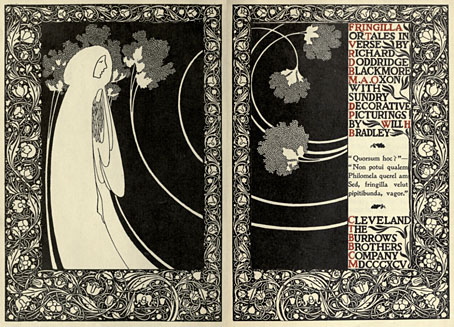
Title spread.

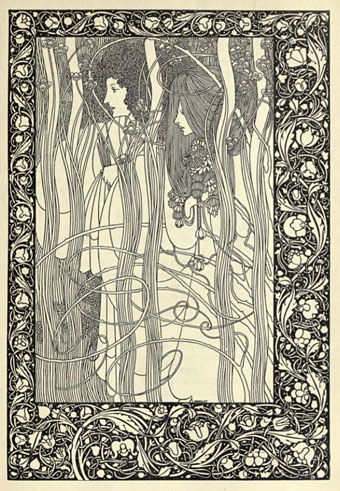
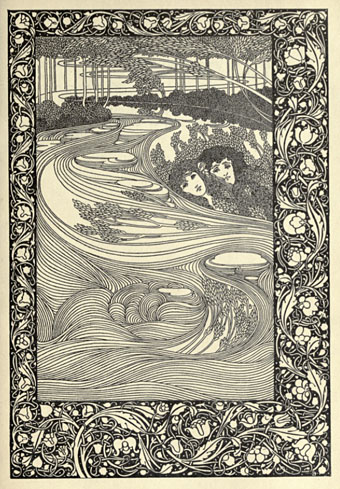
Like Marcus Behmer, another Beardsley follower from the Internet Archive, Will Bradley‘s work has been featured here before and should be familiar to anyone interested in illustrators of the 1890s. As well as being one of the great American illustrators, Bradley was also a very accomplished and successful practitioner of what we now call graphic design, and you see some of his design sensibility at work in these pages which illustrate RD Blackmore’s “tales in verse”, Fringilla (1895). The page borders are in the William Morris style which Beardsley imitated for Le Morte Darthur; Aubrey dropped this kind of heavy decoration when he moved to other books but Bradley made the borders his own for a while, using them in unlikely places such as adverts for that new-fangled transport device, the bicycle.

bradley2.jpg

Pausias and Glycera.

The Internet Archive also has A Booklet of Designs by Bradley, a collection of motifs and very cartoony advertising illustrations from 1914. As art it’s a lot less worthwhile than Frangilla but for anyone interested in early design methods it’s worth a look for the insight it offers into how things were done in the days of scissors and paste.

bradley3.jpg

Kadisha.

Elsewhere on { feuilleton }
The illustrators archive

Previously on { feuilleton }
Bradley does Beardsley

The art of Marcus Behmer, 1879–1958

behmer05.jpg

Salomé: Der Wunsch.

Back in March I wrote something about Alex Koch’s art periodical, Deutsche Kunst und Dekoration, a guide to German arts, crafts and architecture founded in Darmstadt in 1897. The Internet Archive has a nearly complete run of these and I’ve recently been working my way through their scans, a process which takes a while as there’s more than 10,000 pages to be looked at. When I find the time I’ll be posting some of the finds from this wonderful publication, the early issues of which are devoted to the best examples of the Art Nouveau style in Germany and elsewhere.

behmer06.jpg

Salomé: Die Erfüllung.

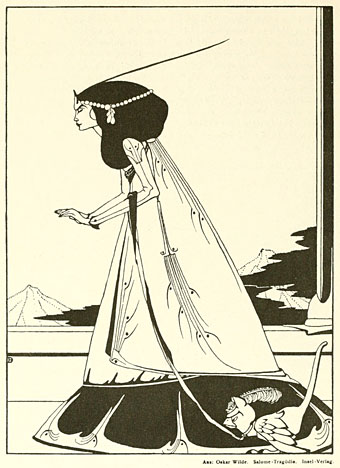
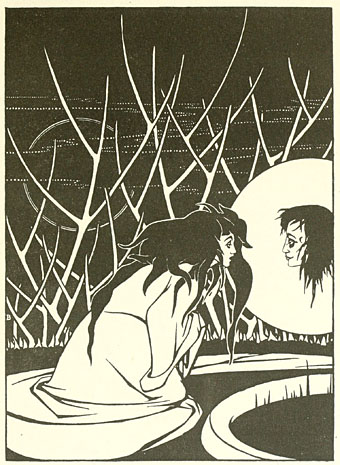
For now, however, I can’t resist posting these pictures from volume 18 (April–Spetember 1906) which form part of a feature about German illustrator Marcus Behmer. I’ve only seen one or two of Behmer’s drawings before and they didn’t really show him at his best. What’s immediately apparent is the great debt his work owed at this point to Aubrey Beardsley, right down to the treatment of foliage and a deliberately grotesque approach to character. It’s also good to find another treatment of the Salomé theme in black-and-white, and the pictures here are credited as being based on Wilde’s play.

behmer07.jpg

Salomé: Das Opfer.

Wikipedia has a page about the artist but it’s all in German, unfortunately, so a crude translation has to suffice. As with Beardsley, the grotesquerie extended to the sexual sphere and it would be nice to know more about the byways of Behmer’s career if only to see where his curious erotic drawings pieces come from. Wikipedia notes that “Behmer was already since 1903 member in the first homosexual organization of the world in Berlin” so I assume that means he was part of Adolf Brand’s circle, and may have contributed to Brand’s publication Der Eigene. A few examples of the erotic work can be found here and here. Further examples from Deutsche Kunst und Dekoration follow.
Continue reading “The art of Marcus Behmer, 1879–1958”

The art of Karel de Nerée tot Babberich, 1880–1909

babberich1.jpg

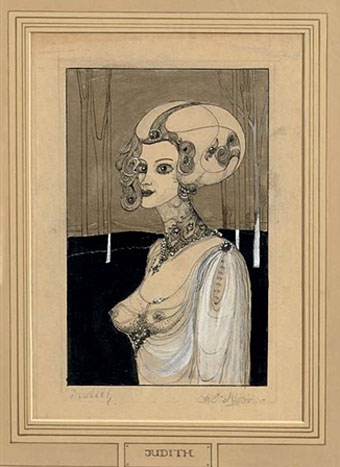
Judith (no date).

Another Decadent type who died young, de Nerée was a Dutch artist and illustrator whose work in these pictures owes a great deal to Aubrey Beardsley. As Beardsley-influenced pieces go they’re rather crude, although it’s unfair to be too judgemental since there’s so little of his work available to see online. Following yesterday’s post, it’s inevitable that he produced a Salomé picture of his own but there’s no sign of that, the curiously space-age (or alien) Judith above is the closest you’ll get.

babberich2.jpg

Introduction to Extaze (1900-01).

On the strength of these drawings I’d probably have de Nerée down as a post-Beardsley pasticheur similar to Alastair (aka Hans Henning Voigt) but there’s another side to his output evident in his painted works which show a far more assured Symbolist style, with a figurative approach closer to another Dutch artist of the period, Jan Toorop. It’s a shame the photos there are little more than snapshots, I’d like to see more of these. The Wikipedia article has a couple more drawings, and there’s another Beardsley-esque piece here.

babberich3.jpg

La musique (1904).

Elsewhere on { feuilleton }
The illustrator’s archive

Previously on { feuilleton }
More decorated books from the Netherlands

Several Salomés

fowler.jpg

The Dance of Salomé (1885) by Robert Fowler.

There’s always more to find… Unfortunately, Robert Fowler’s academic tableaux is a prime example of bad Victorian art: carefully modelled but overlit, dull and lifeless. And worst of all for the subject at hand: deeply unerotic. We’re supposed to believe that this woman wrapped in a bedsheet would exude enough eros to drive her father to lustful recklessness. This was the bloodless “good taste” against which Oscar Wilde and the Aesthetes set themselves.

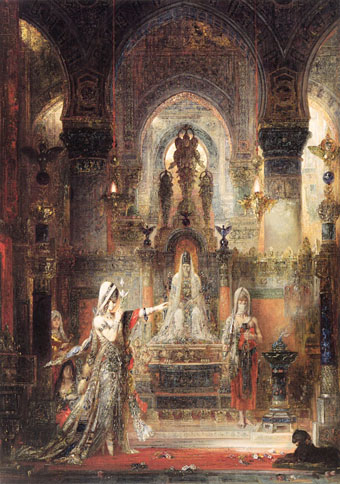
moreau.jpg

Salomé Dancing before Herod (1876) by Gustave Moreau.

Wilde’s idea of Salomé can be seen here in one of Gustave Moreau‘s many paintings on the theme. Wilde would have preferred Moreau’s paintings, or something similar, to adorn his published play but he ended up with Aubrey Beardsley instead. You only have to compare Beardsley’s Stomach Dance with Fowler’s painting to see why Aubrey’s art made such a dramatic impression in the 1890s.

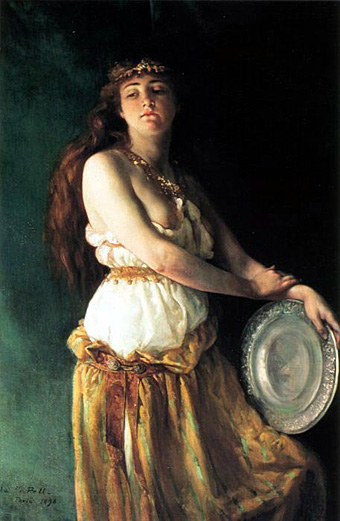
pell.jpg

Salomé (1890) by Ella Ferris Pell.

Ella Ferris Pell’s painting isn’t the only portrait of Salomé by a female artist of this period but it’s the one which Bram Dijkstra chose as the cover image for his excellent study Idols of Perversity: Fantasies of Feminine Evil in Fin-de-Siècle Culture (1986). Of this work Dijkstra writes:

In Pell’s painting a number of the most characteristic turn-of-the-century attributes of the biblical temptress are absent. She does not glare at us with a look of crazed sexual hunger; she does not have the wan, vampire features of the serpentine dancer; nor does she show herself to be a tubercular adolescent … Pell’s Salomé, a real life-woman, independent, confident, and assertive, was far more threatening, far more a visual declaration of defiance against the canons of male dominance than any of the celebrated viragoes and vampires created by turn-of-the-century intellectuals could ever have been. Such a woman could not be disposed of in as cavalier a fashion as the evil women in man’s mind. Her indomitable reality was this feminist Salomé’s most formidable weapon, far more dangerous than any imaginary decapitating sword.

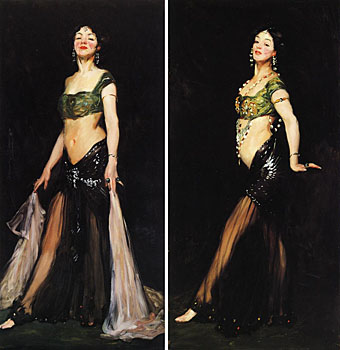
henri.jpg

Salomé (1909), two paintings by Robert Henri.

Finally, there’s this pair of paintings by American artist Robert Henri whose work resembles John Singer Sargent’s in its shadowed backgrounds and light brushstrokes. Salomé was no longer a perennial theme by this point but Maud Allan’s improvised dance performance, Vision of Salomé, was proving enormously popular at the time Henri painted these pictures which may explain his choice of subject. There’s little in the rest of his oeuvre along similar lines.

Elsewhere on { feuilleton }
The Salomé archive