Suspiria details

suspiria01.jpg

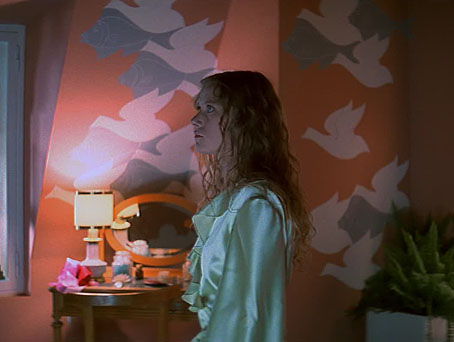
Wall decor based on MC Escher’s Study of Regular Division of the Plane with Fish and Birds (1938).

A few screen grabs from the weekend’s viewing of a German Blu-ray disc of Suspiria (1977). My old DVD didn’t look too bad but this is one film where high-definition is required to do justice to the vivid lighting and to Giuseppe Bassan’s marvellous production design. The Art Nouveau splendour of the cursed ballet school contains some notable art references but elsewhere there’s the Escher decoration on the walls of the apartment at the beginning, not the kind of decor you expect to find in a horror film. All these images are details cropped from widescreen frames.

suspiria02.jpg

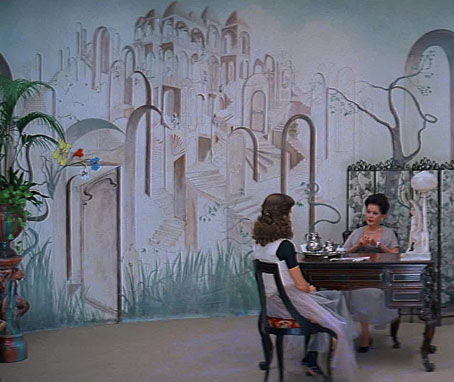
Suzy (Jessica Harper) and Madame Blanc (Joan Bennett) in the madame’s office. The mural always fascinated me for being a strange confection of Escher motifs, all winding staircases and architecture borrowed from Belvedere (1958).

suspiria03.jpg

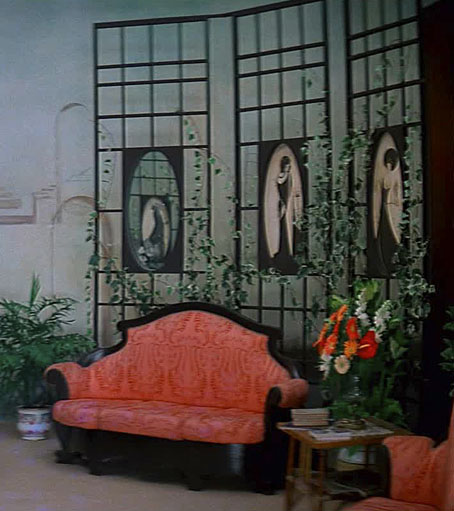
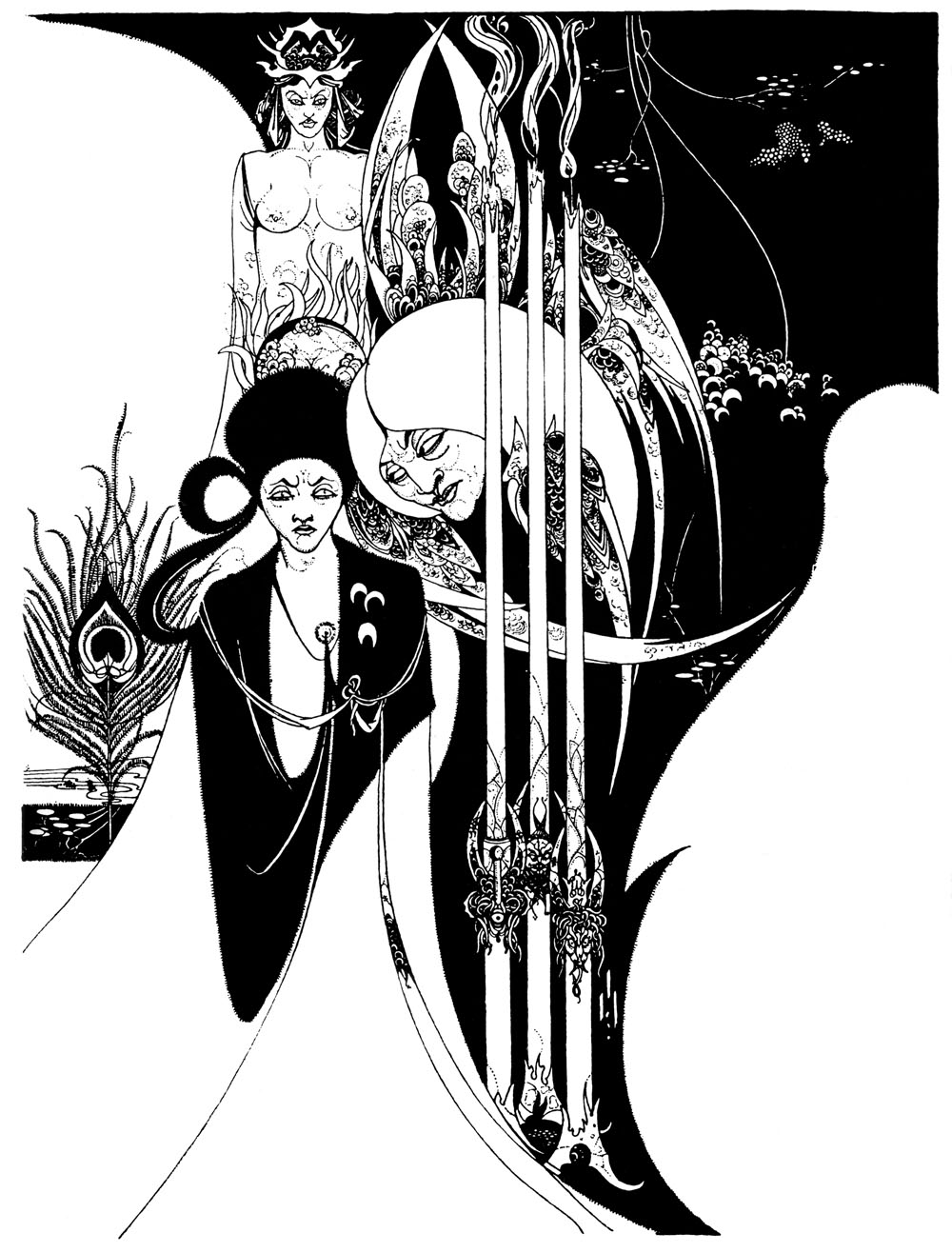
The far right of the same shot showing some of the Beardsley figures that fill the panels of Madame Blanc’s screens.

Continue reading “Suspiria details”

Excuse My Beauty

jjj1.jpg

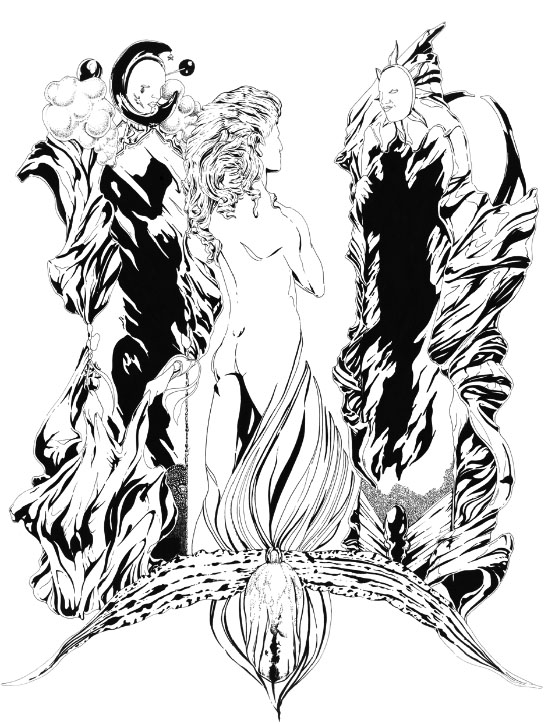
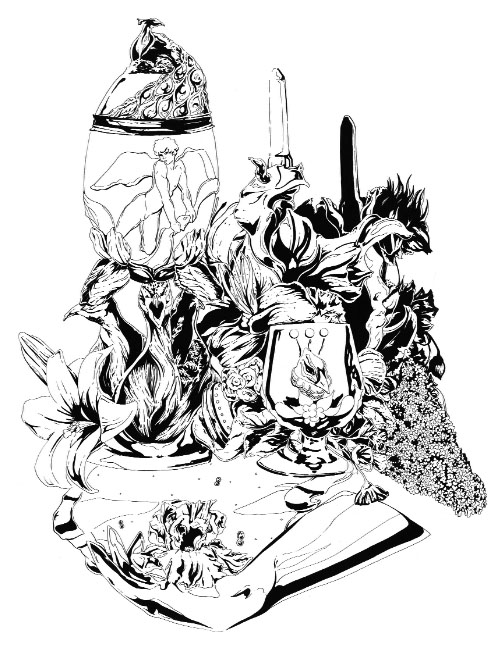
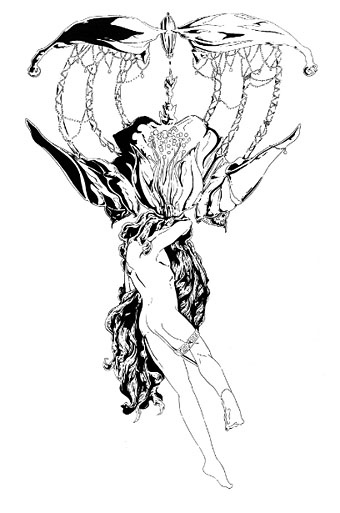
With perfect timing, considering the illustrational direction of the week, David Siferd was in touch to pass on these drawings by Jesse James Johnson for Goddess, David’s unisex streetwear label. The drawings provide the decorative elements of a new collection, Excuse My Beauty, which will be launched later this week. David referred to Harry Clarke and Aubrey Beardsley as inspiration but the combination of figures, flowers and elegant line work reminds me of the enigmatic Didier Moreau. There’s more of Jesse James Johnson’s vibrant ink drawings at this Tumblr page.

jjj2.jpg

jjj5.jpg

Continue reading “Excuse My Beauty”

After Beardsley by Ryan Cho

cho.jpg

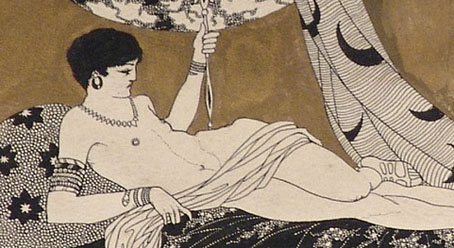
One of the posts last week concerned a swipe from Harry Clarke by an unknown illustrator. This Beardsley pastiche came to my attention shortly after the Clarke discovery, not a swipe but a deliberate exercise by American illustrator Ryan Cho in adopting the Beardsley style. It took some effort to trace the origin of Cho’s drawing since this is one of many similar works proliferating via Tumblr and Pinterest in which the credit goes to Beardsley himself. Cho’s exercise was one of a series following the styles of different artists and illustrators. In addition to another Beardsley drawing there’s also a couple of less successful attempts to pastiche Harry Clarke; having attempted a Clarke pastiche myself I can testify to the scale of the challenge. More of Ryan Cho’s work may be seen here.

Elsewhere on { feuilleton }
The Aubrey Beardsley archive
The illustrators archive

René Gockinga revisited

gockinga1.jpg

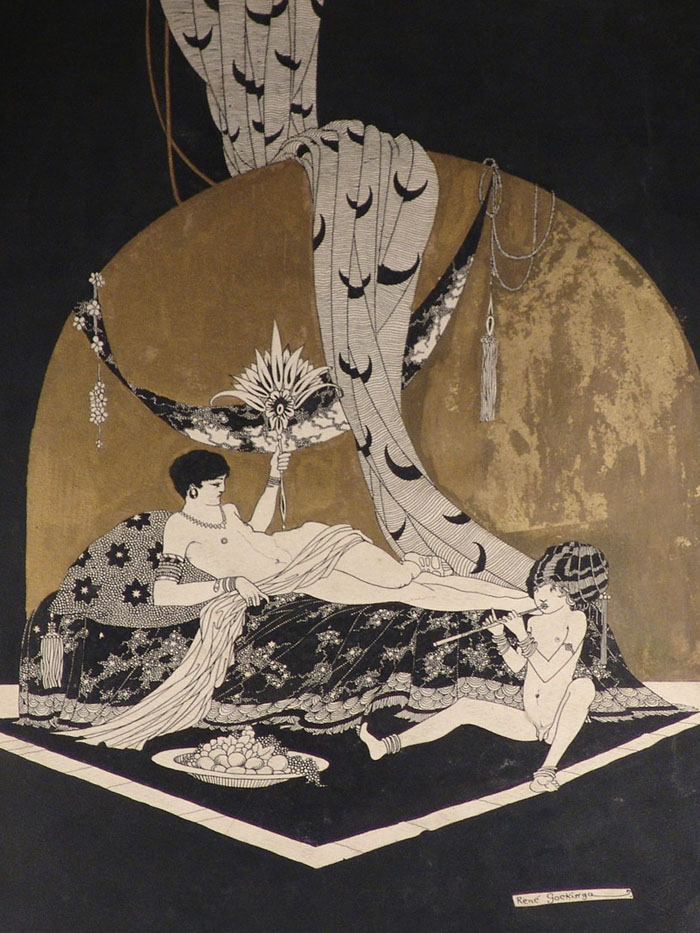
Presenting another guest post by Sander Bink concerning drawings by Dutch artists from the early decades of the 20th century, several of which show a distinct Beardsley influence. There’s also more than a little Harry Clarke in some of the details, especially the large Salomé picture below. Sander examines the provenance.

* * *

In our ongoing research into the influence of Aubrey Beardsley and Carel de Nerée in Dutch art of the early twentieth century, René Gockinga must be one of the most elusive. We wrote about him earlier but in the meantime we spoke to someone who has known him in the latter years of his life (he died 1962 in Amsterdam), she could not tell us more about the whereabouts of his early Beardsley-esque works. His more traditional Indonesian paintings from the 1930s sometime turn up at auction and I have also seen some samples of his post-WWII abstract paintings.

But of course, it’s the early, ‘decadent’ work, we’re most interested in. The RKD (Netherlands Institute of Art History) has pictures of about five of these, for the time being, lost drawings. So the Klein portrait was of course a great find. We were quite content and never dreamed of finding more unknown Gockinga’s (we do not know the whereabouts of the Salomé reproduced in the earlier post).

So one can image our surprise when we recently received an email from an art lover from Florida who had stumbled upon three drawings by Gockinga. At an Atlanta, Georgia antique show of all places! But then again: Gockinga has lived in New York from 1924 till 1932 or possibly 1938. At some point he might have sold his early work?

However it is, these are great and as far as we know never before seen examples of a quite talented but also quite obscure and neglected Dutch artist from the period. I suspect the main reason for this neglect could be due to the nature of his work which was probably too homo-erotic and pornographic for the (Dutch) public. As far as we know, he only had one exhibition where his Beardsley- and De Nerée influenced work was shown. That took place summer 1917 at the d’Audretsch gallery, The Hague. This  gallery which owned a large collection of work by De Nerée and Gockinga must have seen his work there. Otherwise they could have seen his work someplace else at the early De Nerée exhibitions which took place 1910–1917.

gockinga2.jpg

In the first drawing presented here the De Nerée influence is apparent in the use of the golden painted background, a technique De Nerée applied in several works from around 1903, like La Promeneuse (below; collection Meentwijck).

Continue reading “René Gockinga revisited”

Weekend links 256

beardsley.jpg

Of a Neophyte, and How the Black Art Was Revealed unto Him by the Fiend Asomuel. Aubrey Beardsley for the Pall Mall Magazine, 1893.

• The occult preoccupations of the 1970s appear to be in the ascendant just now. Whether this is mere nostalgia or something in the zeitgeist remains to be seen but BBC Radio 4 aired an hour-long documentary on the subject this weekend entitled Black Aquarius. The guest list implies an inevitable focus on film and television but Matthew Sweet covered a lot of ground, taking in the Hermetic Order of the Golden Dawn, Aleister Crowley, Dennis Wheatley, The Process Church, and Alex Sanders, the public face of British witchcraft in the 1960s and 70s. Earlier this week at AnOther the focus was on Maxine Sanders, High Priestess of the Alexandrian coven and putative fashion icon even though she was generally photographed naked. Maxine and husband Alex are unavoidable when reading about UK occultism in the 1970s; among other things they were occult advisors to Satanic rock band Black Widow, and also released an album of their own in 1970, A Witch Is Born. Of more interest is Sacrifice by Black Widow, a 55-minute concert for German TV’s Beat Club.

• Jacques Rivette’s OUT 1 (1971) is a film more talked about than seen, in part because of a running time that exceeds 12 hours. So news of a Blu-ray release later this year is very welcome.

• “Bruce LaBruce: taking zombie porn and gay homophobic skinheads to MoMA”. The director goes through his filmography with Nadja Sayej.

• “Art is anarchistic, and when it becomes categorized, it loses impact.” RIP Bernard Stollman, founder of the amazing ESP-Disk record label.

• Magickal (and pseudonymous) synth music by Mort Garson: Black Mass (1971) by Lucifer, and The Unexplained (1975) by Ataraxia.

Kevin Titterton on Angelo Badalamenti and the soundtrack that made Twin Peaks.

• Mix of the week: Secret Thirteen Mix 149 by Robert Aiki Aubrey Lowe.

Rare Decay, a free bonus track from Aurora by Ben Frost.

Alan Garner is celebrated in a new collection, First Light.

• At Dangerous Minds: The Residents’ radio special, 1977.

Black Sabbath (1969) by Coven | Black Sabbath (1970) by Black Sabbath | Her Lips Were Wet With Venom (Satan Oscillate My Metallic Sonatas 1 & 2) (2006) by Boris & Sunn O)))