Can esoterics

aumgn.jpg

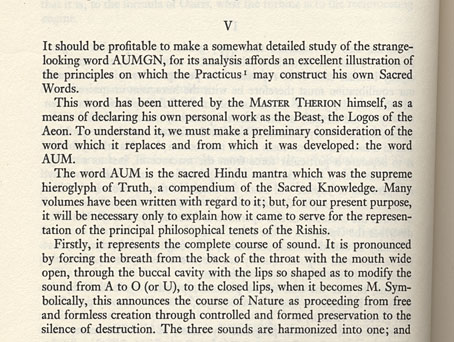
As usual, one thing leads to another. Most people who listen to Tago Mago (1971), the third album by Can, won’t be aware of the Aleister Crowley reference in the long improvisation that fills side three (track 5 on the CD). Aumgn was a spontaneous creation that includes one member of the band intoning an OM-like mantra while the other musicians clatter their way around the studio. The Crowley connection is in the unusual spelling of the title which is Crowley’s own amendment of the more familiar AUM. He explains the reasoning over several pages in Magick in Theory and Practice (1929), some of which involves the numerical values of the five letters. Not that this marks Can as Crowleyans but anyone unacquainted with Crowley’s augmented word would simply have used OM or AUM instead.

Update: I’ve been re-reading the book that came with the Can Box (1999), and came across this forgotten passage in Michael Karoli’s interview:

At the time I was very interested in magic spells, and Irmin knew of the spell “Aumgn” through me. But I had a completely different concept of what one could do with it, than to irreverently quote it in a piece of music. At the age of 21, I wouldn’t have dared to put this recklessly on an album. For me it was black magic. It was Aleister Crowley and all of that, and it gave me the creeps. I told Irmin to stop pronouncing magic spells in the room, but Irmin naturally overrode that with his arrogant grin.
futuredays.jpg

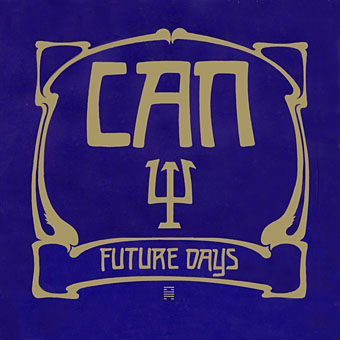
Design by Ingo Trauer & Richard J. Rudow.

The fifth studio album, Future Days (1973) has another esoteric detail on the front and back of its elegant Art Nouveau sleeve: Hexagram 50 from the I Ching, translated in the Richard Wilhelm edition as Ting / The Cauldron. The same text has the judgement for Ting as “great good success”, and the album happens to be considered one of their best musically, although it was also the end of an era when vocalist Damo Suzuki left after its release. On a more mundane level, a cauldron is a container, as is a can.

There’s also the unexplained Greek letter in the centre of the sleeve: Psi is the 23rd letter of the Greek alphabet, and is commonly used as a symbol for psychology although it’s also used as a symbol in quantum mechanics. This last reference might be relevant given that the piece that ends their next album, Soon Over Babaluma (1974), is entitled Quantum Physics.

flowmotion.jpg

Design by Wagner Design Unit. Cover photos by Michael Karoli & Peter Hehner.

There are more I Ching hexagrams on the back of Flow Motion (1976), the group’s eighth album. Hexagram 29 is K’an / The Abysmal (Water) also known as “gorge” or “abyss”. Hexagram 59 is Huan / Dispersal (Dissolution). Taken together these could be interpreted as “flow motion” (and may well be the origin of the title—interviews with the group have seldom discussed these things) although they might also be seen as ominous signs for Can’s future. Flow Motion gave them a hit single in the UK (I Want More) but it’s also the last album that’s musically satisfying throughout. Can persevered for another two years (minus Holger Czukay) before disbanding in 1978. As to the esoterics, Rob Young is apparently writing a biography of the band so we may learn more about all of this when his book is published.

Previously on { feuilleton }
Can soundtracks
Can’s Lost Tapes

Aleister Crowley: Wandering The Waste revisited

ac1.jpg

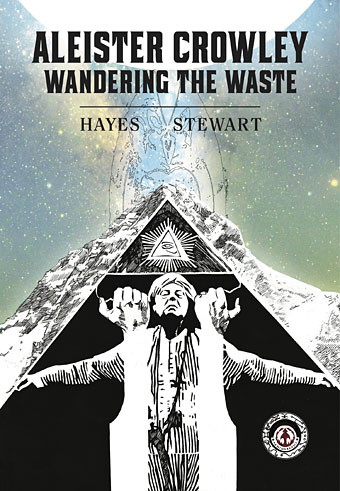
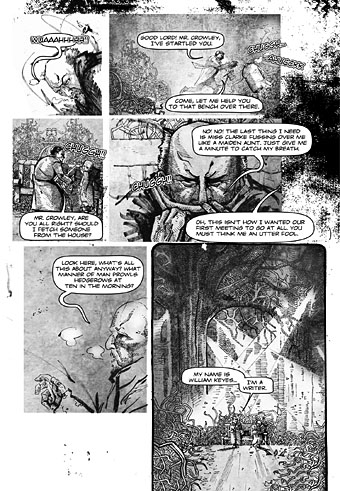
Martin Hayes was in touch this week with news of a reprint of his commendable comic-book biography of Aleister Crowley. Martin was the writer of Aleister Crowley: Wandering The Waste, and RH Stewart the artist. The first edition, which I reviewed in 2013, was a paperback whereas the new volume from Markosia will be a hardback with revised text and some new content:

Aleister Crowley: Wandering the Waste, the critically-acclaimed graphic novel by Martin Hayes, Roy Huteson Stewart, and Paul McLaren is re-launching at LSCC 2016. A meticulously researched exploration of the life of Aleister Crowley, with a foreword by renowned Crowley scholar Richard Kaczynski. This new edition has been revised and completely redesigned with a new cover and additional bonus content—fully annotated and complete with bibliography and rarities.

Aleister Crowley: Wandering the Waste is published by Markosia and will launch at London Super Comic Con in the Excel Centre on Saturday 20th of February, 2016.

Written by Martin Hayes, whose previous projects include the graphic novels Project Luna: 1947 and Abominable Glory, along with several serials for Aces Weekly. With art by Roy Huteson Stewart, who has illustrated for Vincent Price Presents and FutureQuake. Lettered by Paul McLaren. Aleister Crowley: Wandering the Waste is a meticulously researched, intricately illustrated autopsy on the life of the Great Beast. 140 pages.

Martin and Roy will be signing at the Markosia booth from 2–3pm on the Saturday of LSCC. Martin will be there from 11–12 on the Sunday.

ac2.jpg

Previously on { feuilleton }
Konx om Pax
Aleister Crowley: Wandering The Waste
Brush of Baphomet by Kenneth Anger
Rex Ingram’s The Magician
The Mysteries of Myra
Aleister Crowley on vinyl

Language of the Birds: Occult and Art

laffoley.jpg

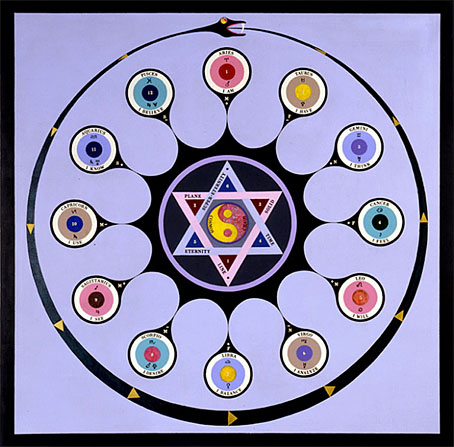
Astrological Ouroboros (1965) by Paul Laffoley.

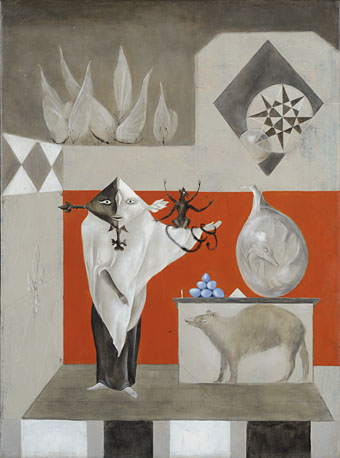
Language of the Birds is an occult-themed art show at 80WSE, New York University, that opened this week and runs to 13 February, 2016. Curator Pam Grossman has assembled a stunning collection of work by artists, occultists, and occult-artists old and new:

Kenneth Anger * Anohni * Laura Battle * Jordan Belson * Alison Blickle * Carol Bove * Jesse Bransford * BREYER P-ORRIDGE * John Brill * Robert Buratti * Elijah Burgher * Cameron * Leonora Carrington * Francesco Clemente * Ira Cohen * Brian Cotnoir * Aleister Crowley * Enrico Donati * El Gato Chimney * Leonor Fini * JFC Fuller * Helen Rebekah Garber * Rik Garrett * Delia Gonzalez * Jonah Groeneboer * Juanita Guccione * Brion Gysin * Frank Haines * Barry William Hale * Valerie Hammond * Ken Henson * Bernard Hoffman * Nino Japaridze * Gerome Kamrowski * Leo Kenney * Paul Laffoley * Adela Leibowitz * Darcilio Lima * Angus MacLise * Ann McCoy * Rithika Merchant * William Mortensen * Rosaleen Norton * Micki Pellerano * Ryan M Pfeiffer & Rebecca Walz * Max Razdow * Ron Regé, Jr. * Rebecca Salmon * Kurt Seligmann * Harry Smith * Kiki Smith * Xul Solar * Austin Osman Spare * Charles Stein * Shannon Taggart * Gordon Terry * Scott Treleaven * Panos Tsagaris * Charmion von Wiegand * Robert Wang * Peter Lamborn Wilson * Lionel Ziprin

carrington.jpg

El Nigromante (1950) by Leonora Carrington.

More details for lucky New Yorkers may be found here. In addition, there’s an Occult Humanities Conference that runs through the weekend of February 5th.

Weekend links 280

crisafi.jpg

Keepers of the Moon by Bill Crisafi.

• More Thomas Ligotti for obvious reasons: Weird Fiction Review now has two Ligotti interviews, one from 2011, and a new one prompted by the Penguin edition of his stories. Also at Weird Fiction Review, two Ligotti narratives: The Night School, and The Red Tower. The latter demonstrates how weird fiction can dispense with character and story and still have a powerful effect.

• Related to the above: Terrors supernatural and psychological: Laird Barron on Ray Russell’s The Case Against Satan; Russell’s novel is also being reprinted by Penguin this month. And at Dangerous Minds: a collection of vintage dolls and ventriloquist dummies.

• “Time and again his books—even as they tell of remote planets and their inhabitants—foresee something perplexingly close to our present-day society, from visionary constructions to machines of destruction.” Strange Flowers on Paul Scheerbart.

Coil’s out-of-print discography gets a career-spanning reissue through Threshold Archives. Related: Russell Cuzner interviews Thighpaulsandra.

• Mixes of the week: The Ivy-Strangled Path Vol. XI by David Colohan, and Sounds From Beyond (October 2015) by Glossop Record Club.

Bill Crisafi: Artist, Dreamer, Feral Mystic. An interview with the artist by S. Elizabeth for Dirge magazine.

• Also being given the revenant treatment, out-of-print short stories by Aleister Crowley.

Alex Mar on the powerful appeal of modern witchcraft—even for a skeptic.

A Rest Before The Walk is a new album by Keith Seatman.

The Wounded Kings set out their stall at Bandcamp.

The Witch Queen Of New Orleans (1971) by Redbone | Witch (1977) by Goblin | Ditch Witch (2009) by Pink Mountain

Occult gestures

dunwich1.jpg

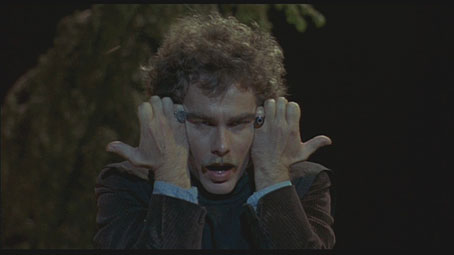
Dean Stockwell freaks out: The Dunwich Horror (1970).

I’m off to the NecronomiCon later this month so HP Lovecraft and all his works will be a predominant theme for the next couple of weeks. I’m also extremely busy right now so posts may tend to be brief.

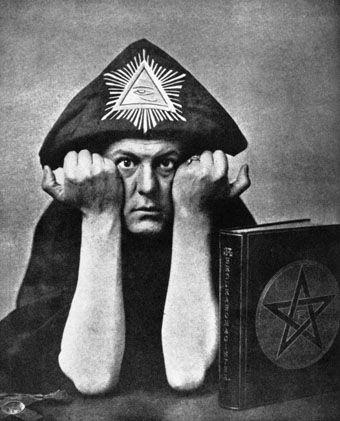
One of the films showing in Providence for the convention is Daniel Haller’s 1970 production of The Dunwich Horror. I have a low tolerance for bad horror films, and this is a bad one despite being closer to its source than other AIP quickies. Dean Stockwell plays Wilbur Whateley whose goatish qualities are here reduced to a gesture which even the filmmakers may not have known as “the Horns of Pan”, a borrowing from the famous photo of Aleister Crowley in his magician’s robes. I noted an earlier borrowing of this gesture some time ago after stumbling upon an obscure silent film serial, The Mysteries of Myra. The use in The Dunwich Horror provides another odd link between Lovecraft and Crowley, and makes me wonder whether any other films have nodded to Crowley in this way.

crowley.jpg

Aleister Crowley in 1912.

Another stray connection worth noting: Dean Stockwell was good friends with Dennis Hopper, and the pair are described in a number of sources as living for a while in a house run by Marjorie Cameron, an artist with a direct connection to Crowley via her husband, Jack Parsons. This may be rumour but Hopper and Cameron did appear together in Curtis Harrington’s beguiling Night Tide in 1961.

dunwich2.jpg

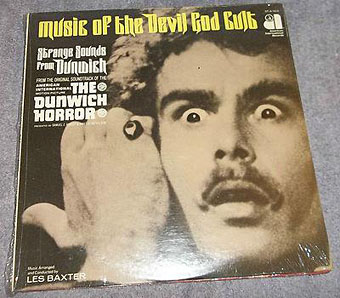
Finally, the gesture appears again on the cover of the soundtrack album which AIP smartly titled Music of the Devil God Cult: Strange Sounds from Dunwich. The title was too much for easy-listening maestro Les Baxter to live up to but he does have the distinction of being the first composer to record a piece of music entitled Necronomicon.

Previously on { feuilleton }
NecronomiCon Providence 2015
The horror
Die Farbe and The Colour Out of Space
The Mysteries of Myra