Relighting the Magick Lantern

anger2.jpg

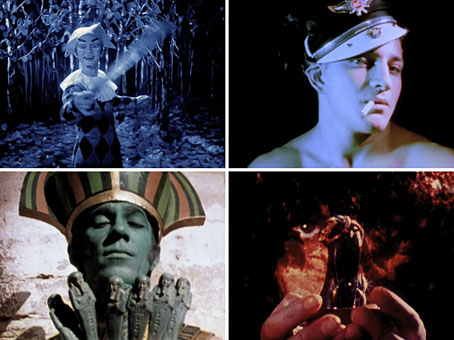
The first part of Kenneth Anger’s Magick Lantern Cycle appeared on DVD in a splendid edition from Fantoma earlier this year. The second and final part is due for release on October 2nd and you can see the mouthwatering trailer here.

This new set includes the Cocteau-esque Harlequinade, Rabbit’s Moon (1950); homoerotica, bikers and rock’n’roll in Scorpio Rising (1964); a hot rod, a blond boy in tight pants and the Paris Sisters crooning Dream Lover in Kustom Kar Kommandos (1965); magick ceremonies and Mick Jagger playing with a Moog synth in Invocation of My Demon Brother (1969); and Donald Cammell, Marianne Faithfull, Egypt, volcanoes, Aleister Crowley, an orange UFO and a great score from Bobby Beausoleil in the miniature epic, Lucifer Rising (1982).

The Magick Lantern Cycle is a great work of cinema that’s suffered from shoddy presentation on previous video releases; Fantoma have given these films the care and attention they deserve. If you haven’t seen them yet, you’re in for a treat.

Previously on { feuilleton }
James Bidgood
Kenneth Anger on DVD…finally
Un Chant d’Amour by Jean Genet

New things for June II

chaoticum.jpg

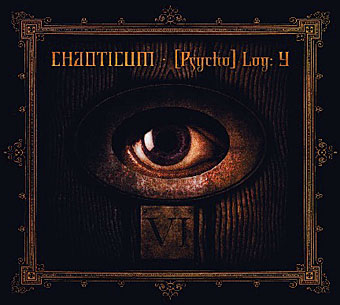
Work on two very different CDs was completed this month, a pair of releases so different they’re almost polar opposites. Chaoticum describe their music as “art for your ears” and the label for this album is HORUS CyclicDaemon, producers of the Aleister Crowley anthology I designed in 2005. The package is a digipak and will include a poster which features one of my Great Old Ones portraits.

eskiboy.jpg

Eskiboy is UK Grime artist Wiley who’s proved himself notable enough to be featured on the cover of last month’s Wire magazine. This compilation was a commission from Baked Goods in Manchester. I was trying to avoid the obvious tunnel image at first but the label was keen to see something along those lines so this is the result of the usual to-ing and fro-ing which design work often entails.

Meanwhile the CD I designed earlier this year for Turisas is now in the shops and the band is interviewed in this month’s Metal Hammer. I’ll be putting the full artwork for all these releases onto the site over the next week or so.

The art of Cameron, 1922–1995

cameron_work01.jpg

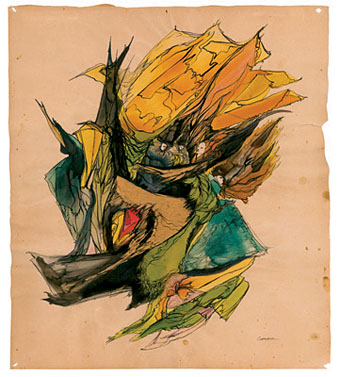
Fairy Queen (1962), ink and dyes on parchment.

A rare exhibition of work by occult artist Cameron, aka Marjorie Cameron Parsons Kimmel, can be seen at the Nicole Klagsbrun Gallery in New York.

Nicole Klagsbrun Gallery is pleased to present an exhibition of work by Cameron (1922–1995), curated by Michael Duncan, George Herms, and Nicole Klagsbrun. The exhibition runs from January 12 until February 10, 2007. An opening reception will be held on Friday, January 12, from 6–8 pm.

This survey is the first solo gallery exhibition of artist, performer, poet, and occult practitioner, Cameron (Marjorie Cameron Parsons Kimmel). A maverick follower of the esoteric mysticism of Aleister Crowley and his philosophical group, the OTO (Ordo Templi Orientis), Cameron was also an accomplished painter and draftsman and mentor to younger artists and poets such as Wallace Berman, George Herms, and David Meltzer. While enlisted in the Navy, she was assigned the tasks of drawing maps and working in a photographic unit, which led to attendance at art classes after being discharged. In Los Angeles, she became the wife and spiritual avatar of scientist and mystical thinker Jack Parsons (1914–1952), one of the founders of the Jet Propulsion Laboratory and an influential leader of the OTO.

marjorie_cameron.jpg

The mundane Cameron during the Second World War.

In the early 1950s, Cameron met the fellow LA artist and jazz enthusiast Wallace Berman who was fascinated by her artwork, poetry, and mystical aura. In 1955 Berman used his photograph of Cameron as the cover of his literary and artistic journal Semina and included in the issue a drawing she had made the previous year. The drawing became renowned when the police cited it as ?lewd? and shut down Berman’s 1957 exhibition at Ferus Gallery. After this experience, Cameron, like Berman, refused to show her art in commercial galleries. She remained, however, a crucial figure in the Berman circle. Cameron’s romantic aesthetic and commanding persona prompted filmmaker Curtis Harrington to commemorate her output as a visual artist in The Wormwood Star (1955), a lyrical short film recording the art and atmosphere of her candlelit studio. Filmmaker Kenneth Anger cast her in a leading role opposite Anäis Nin in his film Inauguration of the Pleasure Dome (1954).
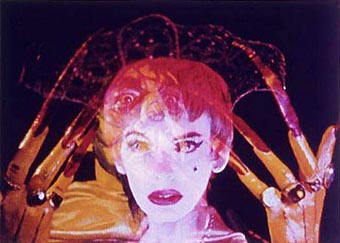
cameron.jpg

The occult Cameron, manifesting as the Scarlet Women for Kenneth Anger.

Despite the grim fatality of much of her writings, Cameron?s artworks portray a fanciful, even wistful lyricism. In the early 1960s she corresponded with Joseph Campbell, citing her interest in his book The Hero with a Thousand Faces, as well as in the fiction of Hermann Hesse and Isak Dinesen. Consumed by myth and the idea of protean growth, Cameron depicted the process of metamorphosis and transformation in hundreds of line drawings where ominous figures and landscapes emerge from uniformly striated, passionately articulated ink marks. Other gouache drawings and paintings depict mythic figures of her own creation engaged in ritualistic, symbolic acts.

For now, her work is barely visible on the web but there’s another small gallery of her pictures here. And just to show how MySpace is seemingly intent on resurrecting everyone who ever lived, Marjorie Cameron, Babalon 156 is in your extended network.

Nicole Klagsbrun Gallery
526 West 26th St, no. 213,
New York.

Via Jay.

Previously on { feuilleton }
Kenneth Anger on DVD…finally
Austin Osman Spare

Robert Anton Wilson, 1932–2007

raw.jpg

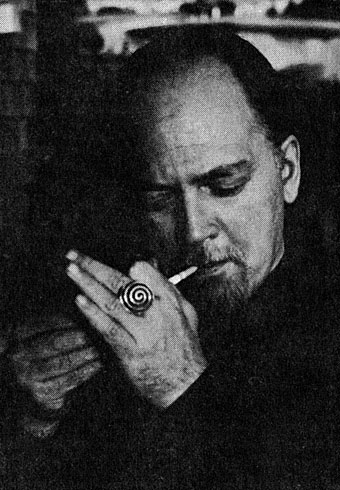
There are few people who really change your life but Robert Anton Wilson—who died earlier today—certainly changed mine. Wilson’s Illuminatus! trilogy (written with Robert Shea) was my cult book when I was at school in the 1970s, a rambling, science fiction-inflected conspiracy thriller that opened the doors in my teenaged brain to (among other things) psychedelic drugs, HP Lovecraft, James Joyce, William Burroughs and Aleister Crowley as well as being a crash-course in enlightened anarchism. I’ve had people criticise the books to me since for their ransacking of popular culture but this was partly the point, they were collage works, and they worked as a perfect introduction for a young audience to worlds outside the usual circumscribed genres.

The philosophical side of Wilson’s work was probably the most important at the time (and remains so now), his “transcendental agnosticism” made me start to question the adults around me who were trying to force my life to go in a direction I wasn’t interested in at all. I’m sure I would have resisted that kind of pressure anyway but the value of RAW’s writings in Illuminatus! and the later Cosmic Trigger came with being given an intelligent rationale for those decisions; I couldn’t necessarily articulate why I was “throwing my life away” by wanting to drop out of the whole education system but Wilson’s work had convinced me it was the right thing to do. I still mark the true beginning of my life as May 1979, the month I left school for good.

He wouldn’t want us to be maudlin, I’m sure. It’s typical for a writer who spent so much of his life writing about drugs and coincidences that he managed to die on Albert Hofmann’s birthday. So I’ll just say thank you Robert, for changing my life. And Hail Eris!

Previously on { feuilleton }
The Absolute Elsewhere

The art of Hubert Stowitts, 1892–1953

stowitts1.jpg

Left: Stowitts photgraphed by Nickolas Muray, 1922.

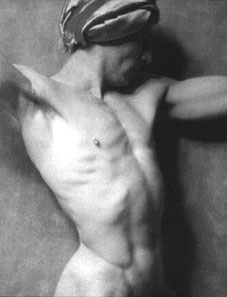
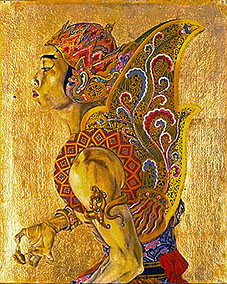
Hubert Julian Stowitts had a number of careers, including dancer, film actor, painter, designer and metaphysician. As a dancer he worked with Anna Pavlova, who discovered him in California in 1915 and took him on tour around the world. His statuesque figure was used by Rex Ingram for the infernal scenes in The Magician (1926), an adaptation of Somerset Maugham’s rather limp roman-à-clef based on the exploits of Aleister Crowley. The scene with Stowitts as a satyr owed nothing to the book, however, being more inspired by the director’s fondness for the tales of Arthur Machen. Most photos that turn up from this film show Stowitts rather than Paul Wegener who played the sinister alchemist of the title.

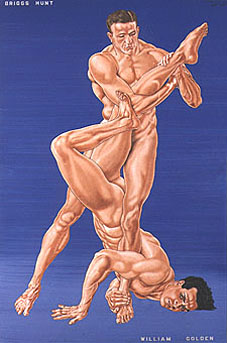
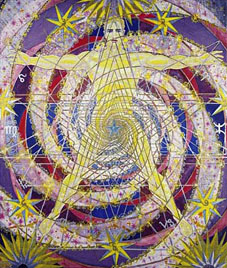
Stowitt’s painting developed in the 1930s and included a series of 55 paintings of nude (male) athletes for the 1936 Olympics (see Ewoud Broeksma’s contemporary equivalents at originalolympics.com). Other paintings depicted dance scenes, costume designs, people encountered during travels in the Far East and, in the 1950s, a series of ten Theosophist pictures entitled The Atomic Age Suite.

stowitts3.jpg

Prince Suwarno in Mahabarata role (1928).

stowitts2.jpg

Briggs Hunt and William Golden (1936).

stowitts4.jpg

The Crucifixion in Space (1950).

The Stowitts Museum and Library
Stowitts at the Queer Arts Resource

Elsewhere on { feuilleton }
The gay artists archive

Previously on { feuilleton }
The art of Nicholas Kalmakoff, 1873–1955