
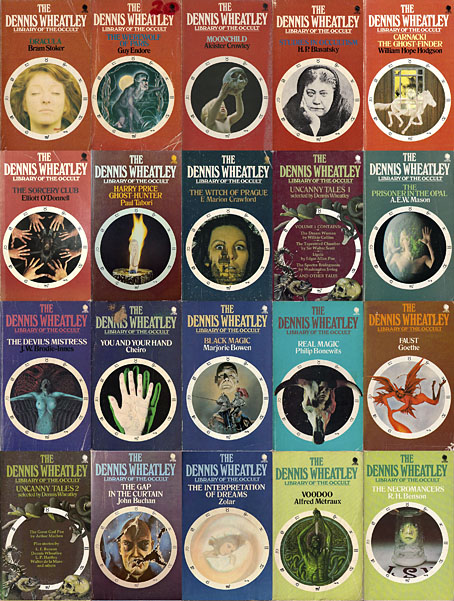
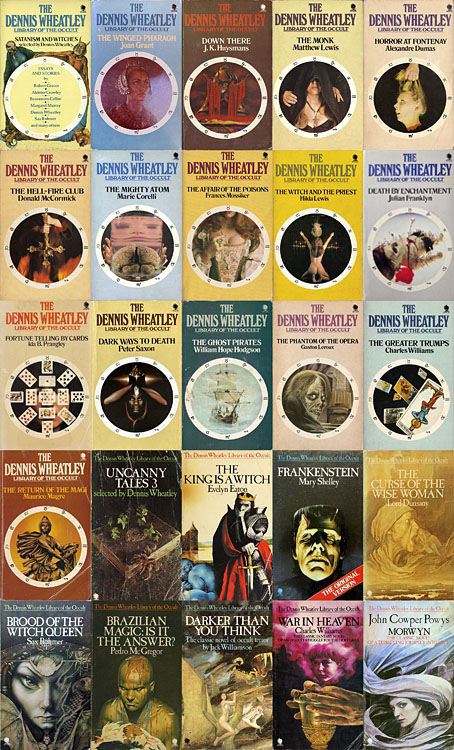
I ought to have been writing this in the run-up to Halloween but as I’ve said before, Halloween here is a state of mind, not a mere twenty-four hours. The Dennis Wheatley Library of the Occult received a mention in the recent post about Charles Williams, two of whose novels were included in the collection. The paperback series was brought to mind again last week when another of the titles, The Prisoner in the Opal by AEW Mason, turned up at Standard Ebooks, the home of high-quality, public-domain texts. This in turn gave me the idea of compiling a list of links to online sources of all the other titles which are now in the public domain. As you’ll see below, that list has sprawled into a guide to the entire series. When I’ve referred to these books in the past I’ve usually pointed to one of the Wheatley fan sites which are generally informative but also lacking in detail, especially when it comes to telling you anything about the individual titles. In this post I’ve satisfied my curiosity about the more mysterious books, listed all the public domain texts and also sought out the information that the Wheatley sites neglect to offer.
The Dennis Wheatley Library of the Occult was launched by Sphere Books in Britain in 1974. Unlike similar series which promote their titles with a well-known name, Wheatley himself was heavily involved, writing a promotional flyer which was sent to booksellers, and helping to choose the books. The flyer’s text suggests that Wheatley was eager to capitalise on the occult revival of the 1970s, a resurgence of popular interest which had been especially prominent in Britain thanks to our pagan past and the legacy of earlier revivalists like Gerald Gardner, the Golden Dawn and others. Each of the books in the Library series contains a brief introduction by Wheatley which is signed with his facsimile signature, while the four collections of short stories and non-fiction pieces include essays or fictional extracts by Wheatley himself. The introductions for all of the books may be read here and here.
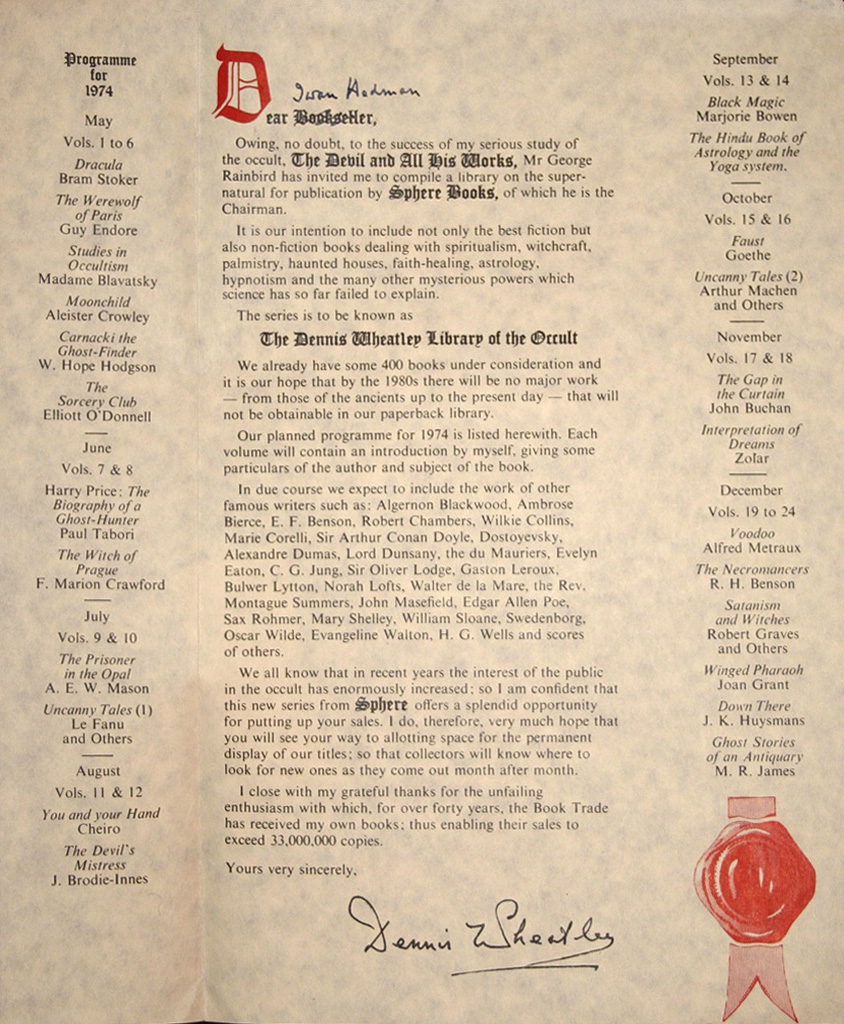
The flyer gives an idea of Wheatley’s ambitions, with a mention of 400 titles being under consideration. One of the books listed as forthcoming—Ghost Stories of an Antiquary by MR James—never appeared, possibly for copyright reasons. The list of prospective authors includes many who appeared in the series and a few more who didn’t, among them Robert Chambers (presumably the author of The King in Yellow), Carl Jung and—surprisingly—HG Wells; the list also manages to misspell Edgar Allan Poe’s middle name. The series as it was published is unusual in its mix of fiction and non-fiction, with magical guides and historical studies scattered among the weird tales; this really is a Library of the Occult, albeit a popular take on the subject, rather than another collection of horror stories. Sphere published 45 of the books in all, an impressive number that might have been greater if Wheatley hadn’t died in 1977. I bought the Library copy of Dracula in the same year, and subsequently managed to accumulate 23 of the titles during visits to secondhand shops. Many of these books were being published for the first time in paperback, and some of them remain obscure today. Even if Wheatley had lived a little longer I doubt the series would have sustained itself much further than 50 titles. The occult revival of the 1970s oscillates between poles of attraction and repulsion; an acknowledgement that this is dark and even dangerous material which is also attractive because of its previously forbidden nature. Wheatley’s fiction had been trading on the same attraction/repulsion since the 1930s, but by the end of the 1970s all the old “forbidden” grimoires were back in print and being joined on the bookshelves by invented ones like the two fake versions of the Necronomicon. The arrival of a new decade demanded a new sensibility. The darkness and witchiness didn’t vanish in the 1980s, when “occult” in its popular manifestations was diluted into “New Age”, it retreated to the shadows to fuel the Goth and metal subcultures while serious occultism began breeding something called Chaos Magic. But that’s another story…
1: Dracula by Bram Stoker
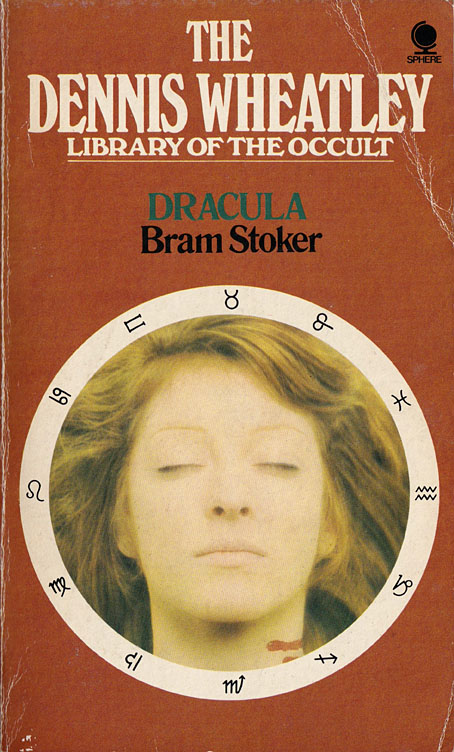
★ ★ ★ Dracula at Standard Ebooks ★ ★ ★
2: The Werewolf of Paris by Guy Endore
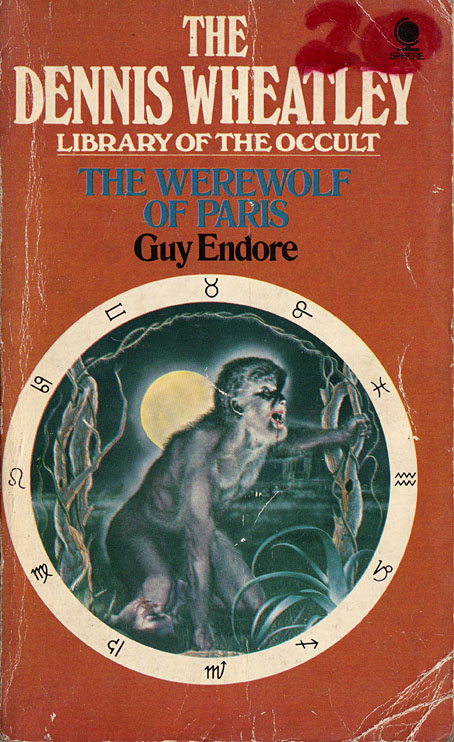
The novel follows Bertrand Caillet, the eponymous werewolf, throughout the tumultuous events of the Franco-Prussian War.
Still in copyright.
3: Moonchild by Aleister Crowley
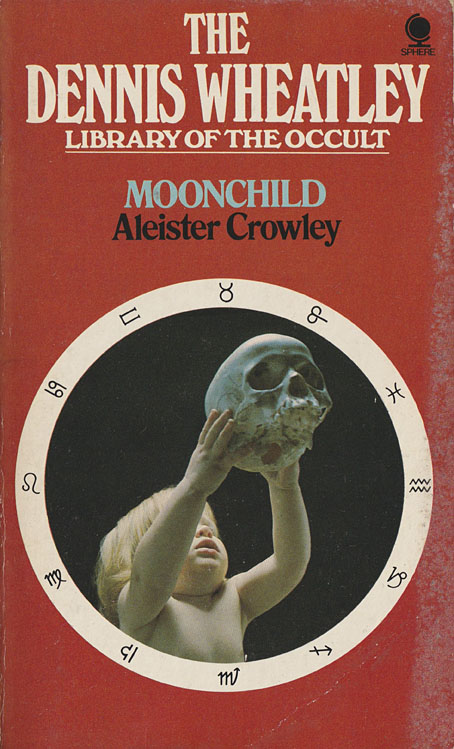
★ ★ ★ Moonchild at the Internet Archive. ★ ★ ★
Its plot involves a magical war between a group of white magicians, led by Simon Iff, and a group of black magicians, over an unborn child.
Crowley was a better poet than a novelist but this novel has been reprinted many times, with Sphere publishing it again a few years later. Wheatley met Crowley at least once, and in his introduction to this edition describes being in attendance one evening in Paris when Crowley performed a summoning which had tragic consequences. It’s a very Wheatleyan anecdote which doesn’t seem to have ever been confirmed by either Crowley himself or any of his biographers.
4: Studies in Occultism by Helena Blavatsky
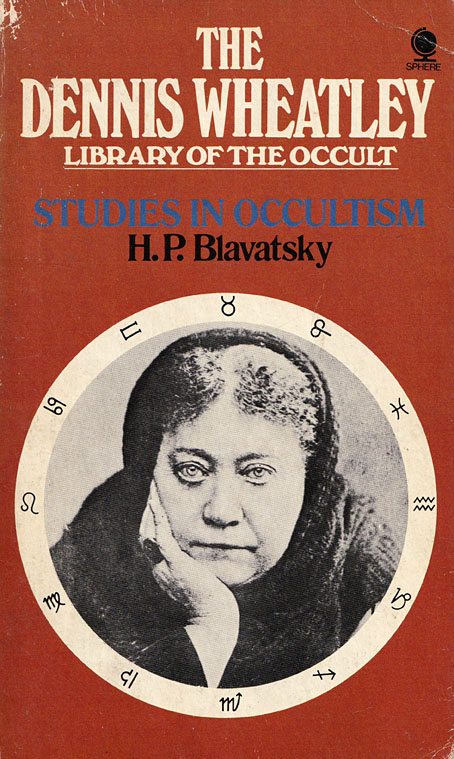
★ ★ ★ Studies in Occultism at Project Gutenberg. ★ ★ ★
…a collection of essays written in the early 20th century. This book delves into the foundational concepts and practices of occultism and theosophy, distinguishing between true spiritual knowledge and superficial magical practices.
The first non-fiction title of the series.
5: Carnacki the Ghost-Finder by William Hope Hodgson
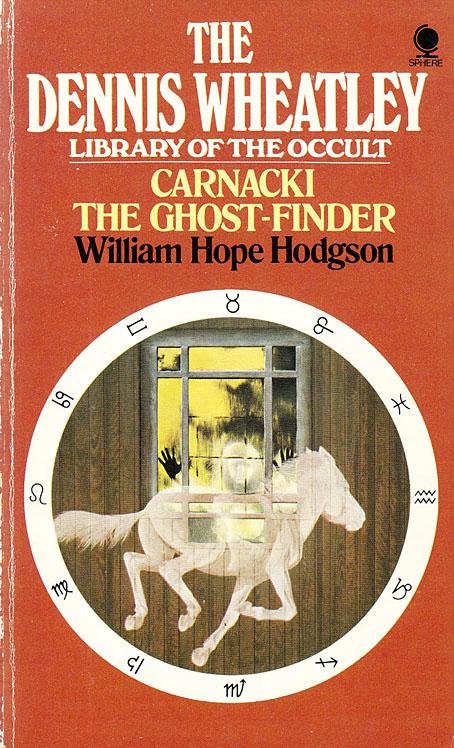
★ ★ ★ Carnacki the Ghost-Finder at Project Gutenberg. ★ ★ ★
…a collection of short stories published between 1910 and 1913. The work features Thomas Carnacki, an occult detective who investigates unusual hauntings using scientific methods, photography, and his fictional invention, the Electric Pentacle.
Wheatley was an early champion of William Hope Hodgson’s fiction, and in his introduction to this edition announces an intention to reprint all of Hodgson’s novels plus a collection of his sea stories. In the end only The Ghost Pirates was added to the series. One thing Wheatley doesn’t mention here is his borrowing of details from the Carnacki stories for his own occult novels. He swiped a lot more from Hodgson’s Sargasso Sea tales for a non-occult novel, Uncharted Seas.
Continue reading “The Dennis Wheatley Library of the Occult”