Weekend links 814

dameron.jpg

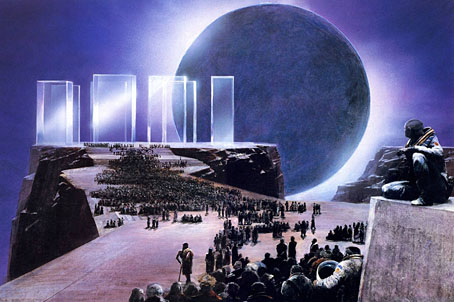
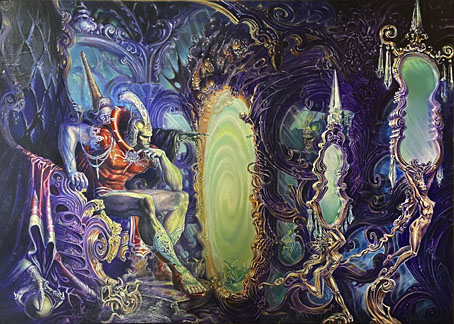
Kull of Atlantis—The Mirrors of Tuzun Thune by Ned Dameron for Kull (1985) by Robert E. Howard. Via.

Jeremy Allen reviews the latest reissue of The New Worlds Fair by Michael Moorcock and The Deep Fix, describing the album as “a fascinating and quixotic document from the time it was made, deserving to be taken seriously in its own right”.

• Among the new titles at Standard Ebooks, the home of free, high-quality, public-domain texts: Short Fiction, a small collection of early stories by Clark Ashton Smith.

• New music: Geometry of Murder: Extra Capsular Extraction Inversions by Earth x Black Noi$e; Live At Nonseq by WNDFRM.

The book is not just loaded with words or tongues. Its also loaded with genres, or more accurately, different modes of literature. And one of the modes I particularly enjoyed this time around is, appropriately, the Weird. In ways long noted on forlorn and unspeakable subreddits, there is a decidedly Lovecraftian dimension to Melville’s Whale, which the Master of Providence did read and enjoy months before writing his game-changing “Call of Cthulhu.” We begin the novel with a sick soul, who may or may not be named after an Old Testament outcast, wandering through a macabre and fetid New England whale-town, following grim portents that lead him on towards a cursed ship doomed to confront a monster who sleeps or at least feeds, and presumably dreams, at the bottom of the sea. And that’s just the first couple of chapters.

Erik Davis on the pleasures of re-reading Moby-Dick, in a piece which makes me want to read the novel again

• At the BFI: Phil Hoad on David Lynch’s efforts to keep making films in an industry resistant to his kind of art.

• Exploration Log 12: Adam Rowe on the best retro science fiction art collections.

• At Public Domain Review: The Nine Birds of Jacques de Fornazeris (1594).

Winners and finalists for the 2025 Ocean Art Contest.

• Mix of the week: A mix for The Wire by Hilary Woods.

The Whale (1977) by Electric Light Orchestra | Don’t Kill The Whale (1978) by Yes | School For Whales (1980) by Marc Barreca

Weekend links 767

east-totem-west.jpg

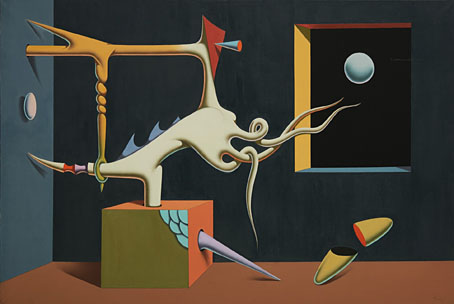
East Totem West head shop poster, from DJ Food‘s latest delve into the psychedelic poster auctions.

• The week in science-fiction illustration: Joachim Boaz on Rodger B. MacGowan’s “approachable New Wave art”; and Andrew Liptak talks to Adam Rowe about Rowe’s Worlds Beyond Time: Sci-Fi Art of the 1970s.

• At The Wire: Philip Brophy sets out his intentions for the return of his long running column on film music.

• At Public Domain Review: Gustatory Wisdom: Bruegel the Elder’s Twelve Proverbs (1558).

Though the project’s genesis predated Roeg’s involvement, Cammell said that his codirector “needled” him: “He provoked me, made me focus more and more clearly on what I was trying to say.” It was Roeg’s visual sensibility, Cammell graciously admitted, that “mobilized” and “improved” his own concepts. It’s appropriate that the movie concerns two men who become fully realized only in meeting and merging with each other. Turner, said Cammell, “believes himself to be at the end of his creative life. He’s a man in despair. And then destiny brings him his mirror image, Chas, the man in whom he sees what he was and what he could be again.”

Roeg and Cammell were hardly in despair in 1968; both were novices in the foothills of their own artistry. It is not fanciful, though, to see in their collaboration something like the same lightning connection that forms between Turner and Chas. Cammell said that he set out “to make a transcendental movie.” In achieving that goal, he stretched and challenged not just himself but cinema too. Even as Performance closed the lid definitively on the sixties, it opened the door to a radical new way of making films.

Ryan Gilbey on Donald Cammell and Nicolas Roeg’s Performance

• At A Year In The Country: Broadcast and Pathways Through Otherworldly Villages.

• “Pilot is an elegant and expressive display serif,” says Kim Tidwell.

Winners of the 2025 World Nature Photography Awards.

• New music: Forgotten Worlds by Rodrigo Passannanti.

• Janus Rose presents her Digital Packrat Manifesto.

• RIP Jamie Muir and Gene Hackman.

Pilots Of Purple Twilight (1981) by Tangerine Dream | Pilots (2000) by Goldfrapp | I’m With The Pilots (2001) by Ladytron

Weekend links 710

Menace (1974) by Ivan Tovar.

• “I find myself going back to Early Water more and more in recent years. It should be better known.” B. Sirota reviewing the one-off musical collaboration between Michael Hoenig and Manuel Göttsching. (Previously.) It should indeed be better known.

• At Unquiet Things: “Come for the cosmic awe, stay for the skeletons in spacesuits”; S. Elizabeth talks to Adam Rowe about the science-fiction art of the 1970s.

• “The architectural style wars have started all over again.” Owen Hatherley on the unending debate between traditionalists and modernists.

• At Public Domain Review: Clear Shadows (1867), a book of Japanese silhouette portraits by Ochiai Yoshiiku.

• New music: Flux Gourmet Original Motion Picture Soundtrack by Various Artists, and Volta by Loula Yorke.

• Meta machine mantras: Steve Barker on the birth of the Buddha Machine.

Cosmohedron, a short animated film by Duncan Hatch.

• Mix of the week: isolatedmix 125 by Sa Pa.

Chelsea Wolfe’s favourite music.

• At Dennis Cooper’s: Mirrorers.

A Silhouette Of A Man And A Wasp (1995) by Add N To (X) | A Silhouette Approaches (2005) by Robin Guthrie & Harold Budd | Silhouette (2015) by Julia Holter

The sublimities of John Harris

harris01.jpg

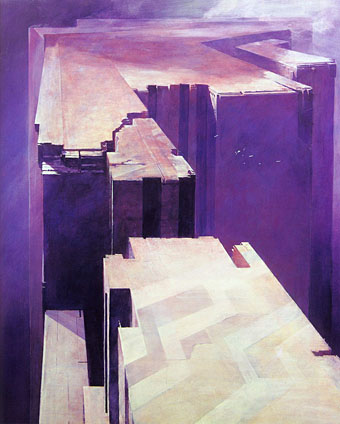
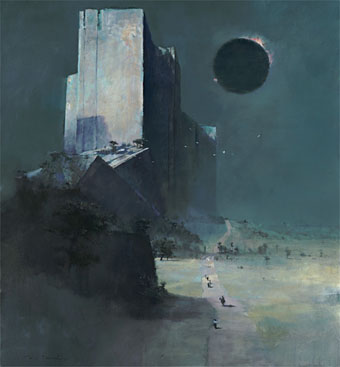
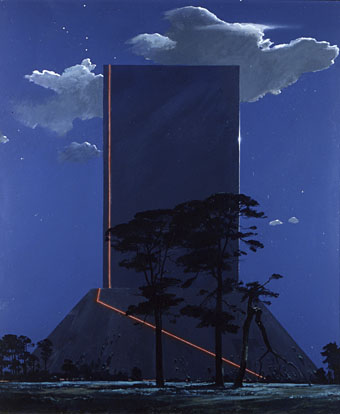
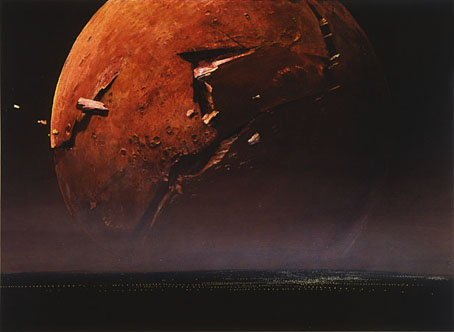
I might never have paid much attention to John Harris’s paintings if they hadn’t appeared so often at Adam Rowe’s 70s Sci-fi Art. Harris is also featured in Rowe’s new book, Worlds Beyond Time, with a few examples that sent me looking for more. I like science-fiction art when it’s dealing with megastructures, especially if those structures aren’t readily interpretable as buildings, spaceships or alien artefacts. This is SF art in the service of the philosophical Sublime, a quality which, since the 1940s, you don’t find very much in painting outside the work of illustrators or artists of the fantastic. Some of these structures, like the one that Harris calls “The Wall” (below), might be relatives of the abandoned concrete edifices in Jean-Pierre Ugarte’s paintings. Another point in Harris’s favour is the way he uses SF-like imagery as outlets for his own visionary experiences: there’s a series entitled Mass which depicts images that came to him following a period of transcendental meditation. The Mass series later gave a title to the first book of Harris’s art which was published by Paper Tiger in 2000.

More John Harris

harris02.jpg

harris13.jpg

harris14.jpg

harris15.jpg

Continue reading “The sublimities of John Harris”

Worlds Beyond Time

worlds1.jpg

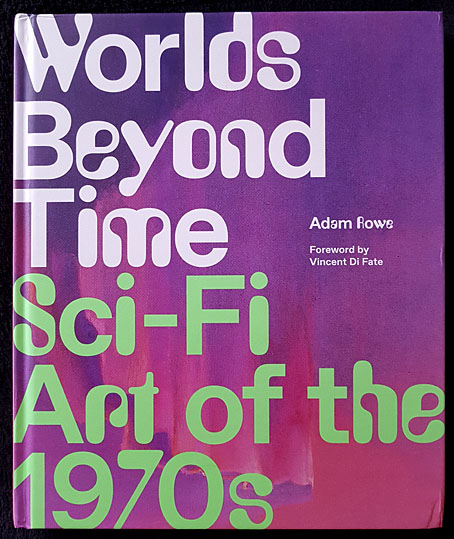
Or yesterday’s tomorrow today. Adam Rowe’s book arrived in the post this weekend, a little bumped at the corners (art books often suffer at the hands of the postal services) but very welcome all the same.

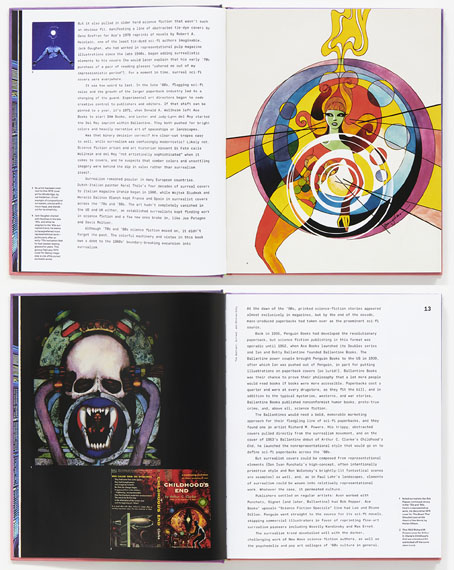
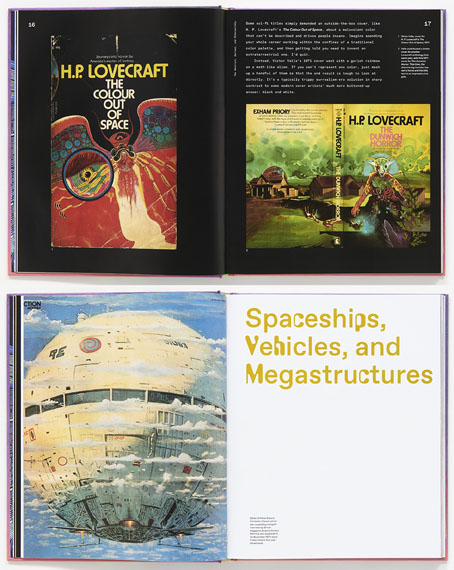
In the 1970s, mass-produced, cheaply printed science-fiction novels were thriving. The paper was rough, the titles outrageous, and the cover art astounding. Over the course of the decade, a stable of talented painters, comic-book artists, and designers produced thousands of the most eye-catching book covers to ever grace bookstore shelves (or spinner racks). Curiously, the pieces commissioned for these covers often had very little to do with the contents of the books they were selling, but by leaning heavily on psychedelic imagery, far-out landscapes, and trippy surrealism, the art was able to satisfy the same space race–fuelled appetite for the big ideas and brave new worlds that sci-fi writers were boldly pushing forward.

worlds2.jpg

In Worlds Beyond Time: Sci-Fi Art of the 1970s, Adam Rowe—who has been curating, championing, and resurrecting the best and most obscure art that 1970s sci-fi has to offer on his blog 70s Sci-Fi Art—introduces readers to the biggest names in the genre, including Chris Foss, Peter Elson, Tim White, Jack Gaughan, and Virgil Finlay, as well as their influences.

worlds3.jpg

One of my own formative influences was Visions of the Future (1976), a large-format book edited by Janet Sacks that recycled material from NEL’s Science Fiction Monthly magazine to present a guide to British SF art in the 1970s. In many ways the book was a rather poor collection—the reproductions aren’t good, not all the artists are first-rate, and a few have nothing to do with SF or “the future” at all—but it was important to me for the many artist interviews which confirmed that you could make some kind of living producing this type of art. Adam Rowe’s book is like a superior sequel to Visions of the Future, with miniature biographies for many of the artists, plus a look at the recurrent themes he’s explored on his 70s Sci-fi Art Tumblr. There’s a lot in here I hadn’t seen before. I’m grateful he’s found space for Paul Kirchner’s Dope Rider, a typically Surrealist Kirchner comic strip, and one I never got to see when it was running in the pages of High Times. Kirchner’s The Bus was a favourite, however, being a regular in the pages of Heavy Metal magazine. Kirchner has never been very science fictional either but Worlds Beyond Time is a more flexible title than Visions of the Future, one that can embrace imaginative possibilities that aren’t limited to spaceships, planets and futuristic cities.

Elsewhere on { feuilleton }
The book covers archive
The illustrators archive

Previously on { feuilleton }
Corgi SF Collector’s Library
Foss, Jodorowsky and low-flying spacecraft
Crank book covers
Do You Have The Force?
The artists of Future Life
Science Fiction Monthly
The fantastic and apocalyptic art of Bruce Pennington
Roger Dean: artist and designer