The art of Fay Pomerance, 1912–2001

pomerance1.jpg

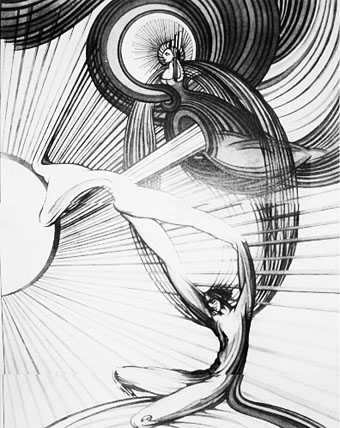
The Sixth Palace of Hell (1945).

Fay Pomerance’s painting of Lilith makes a startling appearance in a book I have about the history of magic symbols, and it’s that appearance which prompts this post since I’ve never seen her work given any attention elsewhere. This seems surprising when women artists, and artists whose concerns encompass mysticism or the occult, are receiving greater attention than ever before.

pomerance2.jpg

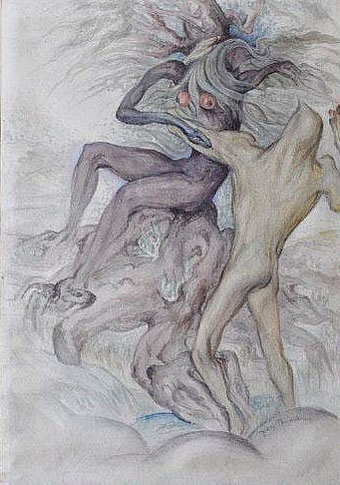
The Union of Isis and Osiris (1959).

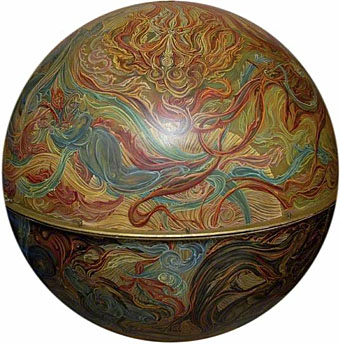
Pomerance was British, and had the misfortune to be working during a lengthy period when expressions of the imagination or unorthodox spirituality in visual art were regarded as suspect or even disreputable. Her work also stands apart from any of the prevailing movements which provide such convenient labels for those art critics and writers who dislike anything that won’t fit into one of their boxes. The Lilith picture shows an obvious debt to another British artist who stands apart from the crowd: William Blake. The BBC’s Your Paintings site has a few of Pomerance’s larger works from the collection at Durham University, including the Sphere of Redemption below which is painted on a fibreglass globe, but for the moment there isn’t a dedicated site representing her art.

pomerance3.jpg

The Temptation (date unknown).

pomerance4.jpg

The Sphere of Redemption (date unknown).

May

may04.jpg

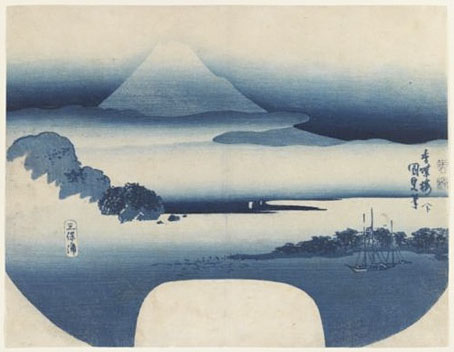
View of Fuji from Miho Bay, May (1830) by Utagawa Kunisada.

No weekend links this week, unfortunately. The past few days have been spent re-establishing some equilibrium following the technical upheavals of the previous weeks, including updating things on the old computer so it can be the main work machine until the new one is fixed. Consequently I’ve spent no time at all looking at blogs or reading RSS feeds.

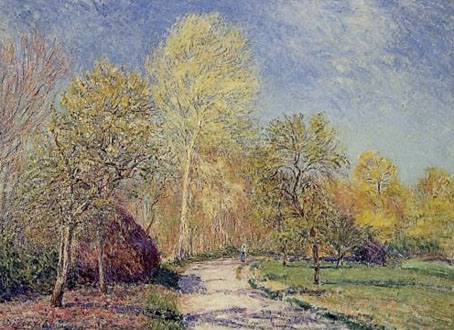
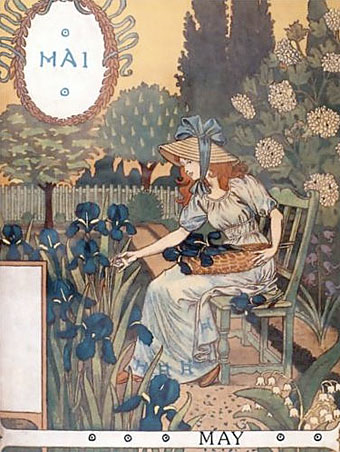
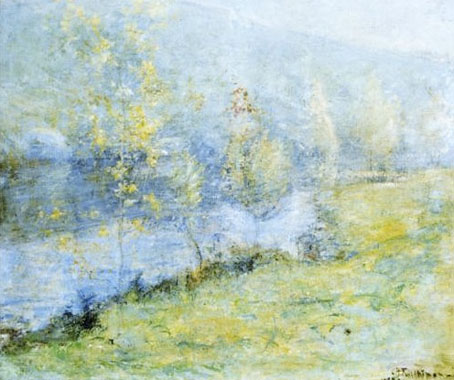
Continuing the monthly post of month-related paintings, and May is a difficult month to search for when its name is also a woman’s name and a word that turns up in other contexts: the BBC’s Your Paintings website is rendered almost completely useless by the profusion of portraits of the nation’s mayors through the ages. As months go there’s an understandable emphasis on the blossoming of the natural world. Some examples are represented here, together with a few less obvious depictions.

may02.jpg

A May Morning in Moret (1886) by Alfred Sisley.

may01.jpg

La Belle Jardiniere: May (1896) by Eugène Grasset.

may10.jpg

May Morn (1899) by John Henry Twachtman.

Continue reading “May”

The Man Who Paints Monsters In The Night

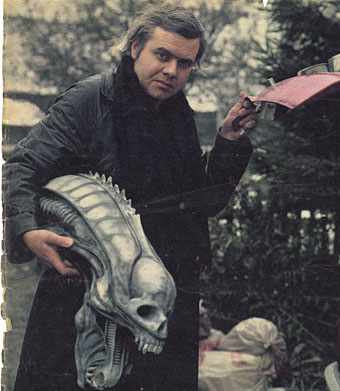
giger.jpg

HR Giger. Photo by Eve Arnold, 1979.

The news of HR Giger’s death was prominently featured in UK papers, something that wouldn’t have happened without his connection to the Alien films. Artists like Giger seldom make the front-page news even though he was well-established before the call from Ridley Scott. He’d already worked on Jodorowsky’s aborted Dune project alongside Moebius (who also did some work on Alien; people forget that), and his work had even appeared in a major feature film before Alien with a blink-and-you-miss-it appearance from his portrait of Li Tobler in Alain Resnais’s Providence (1977). Alien may have made him world-famous but I’ve always felt that Ridley Scott needed Giger far more than Giger needed either Scott or Hollywood. Paul Scanlon and Michael Gross’s The Book of Alien (1979) shows the production designs for the alien components before Giger’s involvement, none of which had the requisite strangeness that made the film such a success. That success would have made many artists decamp to Los Angeles in the hope of repeating the trick but Giger kept his distance. You can’t blame him when his work was diluted by James Cameron in Aliens while a unique project like Clair Noto’s The Tourist—which had heavy Giger involvement—never got made. (See here and here.)

The following is the first interview I read with Giger, a feature in the Sunday Telegraph magazine from August 1979, shortly before Alien was released in the UK. I wasn’t sure whether I still had this since I’d chopped up some of the other pages in the 1980s when I was making collages. The Sunday Telegraph then was even more of a stuffily conservative title than it is now so it’s a surprise to see Giger given such treatment; he was also the cover star although the cover on my copy is lost. I was given this by a friend whose parents read the paper; the only time I’ve ever bought the Sunday Telegraph was when I appeared in it in the early 1990s for a piece about Savoy Books. The interviewer on that occasion was Byron Rogers who I’m surprised to find wrote one of the other pieces in this magazine. (Thanks to Joe for sending me a picture of the missing cover!)

* * *

THE MAN WHO PAINTS MONSTERS IN THE NIGHT by Robin Stringer
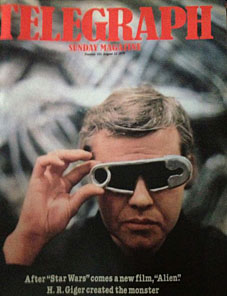
giger4.jpgThe man in black is talking about his monster. “It is elegant, fast and terrible. It exists to destroy—and destroys to exist. Once seen it will never be forgotten. It will remain with people who have seen it, perhaps in their dreams or nightmares, for a long, long time. Perhaps for all time.”

The speaker is H. R. Giger, a Swiss-German surrealist painter, who designed the monster for Alien, the latest screen shocker, made in British studios under British direction to meet the apparently insatiable twin public cravings for space and horror films. Alien has already persuaded Americans to queue in record-breaking numbers outside their cinemas. It is said to have recouped its £15 million cost within 26 days of opening, and it comes to Britain on September 6.

The crew of a space tug on a fuelfinding mission answer a distress signal from an unknown planet. They land and discover an alien spacecraft in which, unknown to them, an awful creature has been spawned and waits seething, but with infinite patience, for a chance of life. Taken on board the space tug, clinging to one of the crew, the creature parasitically reproduces itself in him and bursts out into life in a welter of blood. It proceeds to make itself at home on board by hiding in dark places and jumping out at passers-by. It gobbles up the space crew one by one and grows prodigiously. Being unfamiliar with the monster’s lifestyle, the crew understandably panic.

That in brief the story of Alien, which, of course, has actually been spawned by the movie makers to scare us just a little bit and, in the process. to make them a lot of money.

The man who designed the monster will make some money, too—though not a lot, he says. He is not on a percentage. H. R. Giger, who calls himself H.R., because “the other things are too long and complicated”, is a chunky 39-year-old who lives with his girlfriend/secretary Mia, two cats, 12 skeletons and some books on magic in the middle of a rickety row of terraced houses in the industrial outskirts of Zurich. He always wears black.

Continue reading “The Man Who Paints Monsters In The Night”
April

april08.jpg

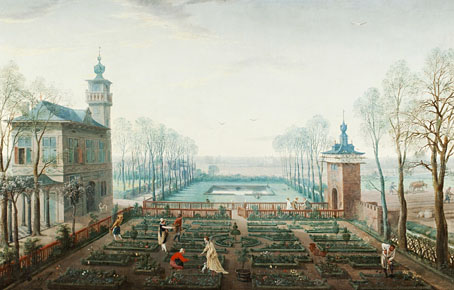
April, Works in a Garden (1614) by Jan Wildens.

The cruellest month in paintings. Snowy scenes abound for this time of year but I’ve avoided those.

april07.jpg

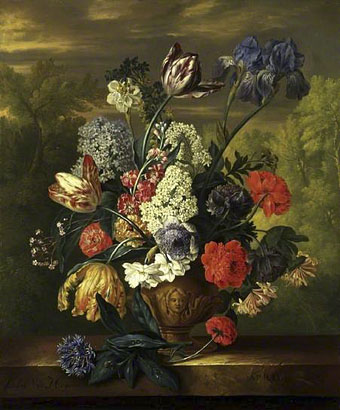
Twelve Months of Flowers: April (no date) by Jacob van Huysum.

april09.jpg

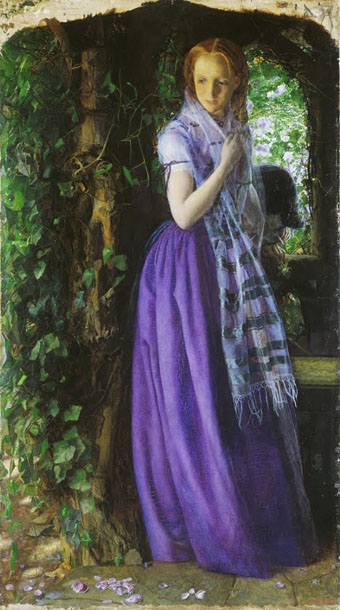
April Love (c. 1855) by Arthur Hughes.

Continue reading “April”

Weekend links 208

sungwon.jpg

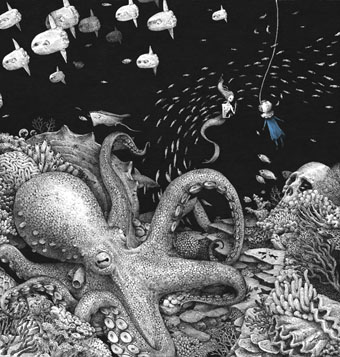
The Blue Girl (2013) by Sungwon.

• “Meanwhile, in her parents’ room [Max] Ernst painted aardvarks eating ants and big human hands around the windows. ‘Sexual connotations, I think,’ she says shyly.” Agnès Poirier talks to Cécile Eluard about her childhood among the Surrealists.

• “Thrilling and prophetic”: why film-maker Chris Marker‘s radical images influenced so many artists. Sukhdev Sandhu, William Gibson, Mark Romanek and Joanna Hogg on the elusive director.

• At Dangerous Minds: Throbbing Gristle live in Manchester in 1980, and Brian Butler talks about the rediscovered early print of Kenneth Anger’s Lucifer Rising. There’s a trailer!

• From 1981: The Art of Fiction No. 69 at The Paris Review, an interview with Gabriel García Márquez. Related: Thomas Pynchon reviewed Love in the Time of Cholera in 1988.

• “Seven years ago, a stolen first edition of Borges’s early poems was returned to Argentina’s National Library. But was it the right copy?” Graciela Mochkofsky investigates.

• “What was Walter Benjamin doing with his shirt off in Ibiza?” Peter E. Gordon reviews Walter Benjamin: A Critical Life by Howard Eiland & Michael W. Jennings.

• A video by Marcel Weber for Måtinden, a track from Eric Holm’s Andøya album. Another album on the Subtext label that I helped design.

• More Ian Miller: Boing Boing has pages from his new book, The Art of Ian Miller, and there’s an interview at Sci-Fi-O-Rama.

Outrun Europa, a free compilation of 80s-style electronic music. There’s a lot more along those lines here.

• Praise Be! Favourite religious and spiritual records chose by writers at The Quietus.

Ralph Steadman illustrated Alice’s Adventures in Wonderland in 1973.

British Pathé is uploading 85,000 of its newsreel films to YouTube.

• Drawings by Lebbeus Woods at The Drawing Center, New York.

• At Pinterest: Ian Miller and Kenneth Anger.

Lucifer Sam (1967) by Pink Floyd | The Surrealist Waltz (1967) by Pearls Before Swine | Which Dreamed It (1968) by Boeing Duveen And The Beautiful Soup