The Divine Sarah

bernhardt11.jpg

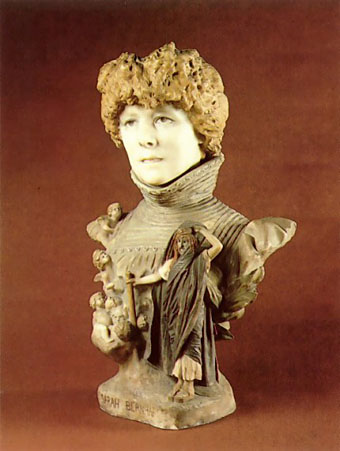
Sarah Bernhardt by Jean-Léon Gérôme (1895).

You can’t be a fin de siècle fetishist and not develop a fascination with actress Sarah Bernhardt, a woman who was muse to many of the era’s finest artists, most notably Alphonse Mucha, who she employed as her official designer. Mucha’s marvellous posters are endlessly popular, of course; less well-known is the sculpture by academic painter and Orientalist Jean-Léon Gérôme, a rare three-dimensional work inspired by the actress.
bernhardt2.jpg

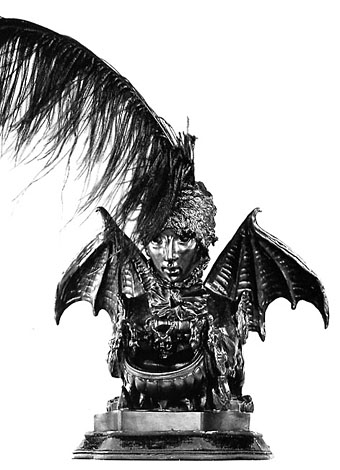
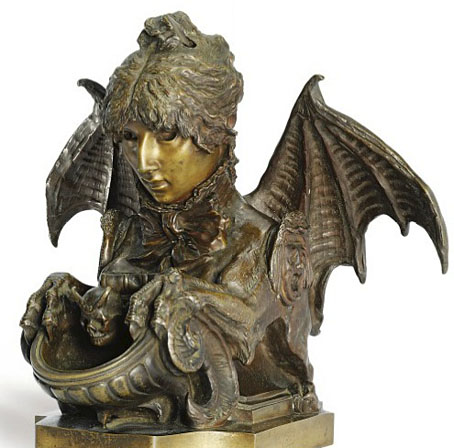
Inkwell by Sarah Bernhardt (1880).

Even less well-known is Ms Bernhardt’s own design for a curious bat-winged inkwell. I’ve read of her having created other sculptural works but so far this is the only one I’ve seen a picture of. With something as decadent as this you’d really have to use peacock quills for pens, wouldn’t you?
bernhardt4.jpg

bernhardt3.jpg

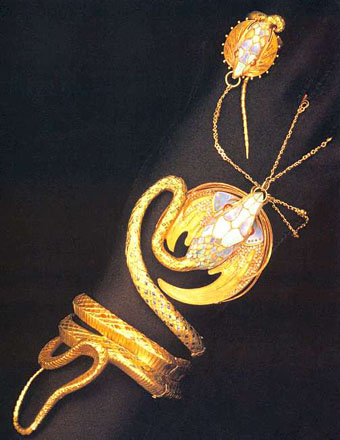
Bracelet by Alphonse Mucha & Georges Fouquet (1899).

And in a similar sinister vein to the inkwell there’s this serpentine bracelet and ring, a superb one-off, designed by Mucha and crafted by the jeweller Fouquet. After seeing works such as this and the Lalique dragonfly (which Ms Bernhardt once wore), most other jewellery seems timid and unadventurous in comparison.

Update: Added another photo of the inkwell.

Previously on { feuilleton }
The art of Philippe Wolfers, 1858–1929
Lalique’s dragonflies
Lucien Gaillard
Smoke
The Masks of Medusa

Carlos Schwabe’s Fleurs du Mal

schwabe11.jpg

La Déstruction.

More Symbolist femmes fatale, this time courtesy of Carlos Schwabe (1866–1926) and his illustrations for Baudelaire’s Fleurs du Mal from 1900. I’d had the site these pictures are from bookmarked for some time but hadn’t noticed that the version of Schwabe’s Spleen et Ideal illustration (below) was different to the one more commonly seen in books of Symbolist art. In fact the more common picture is about the only one of these illustrations that turns up at all in books. (It also appeared on a UK edition of Baudelaire’s poems, as I recall.) Schwabe is more usually represented by his mystically-inspired paintings and drawings, especially those he produced for the Salon de la Rose+Croix; on the strength of some of his Baudelairean pieces I’d say he’s a worthy companion to Félicien Rops.

Continue reading “Carlos Schwabe’s Fleurs du Mal”

Empusa

empusa1.jpg

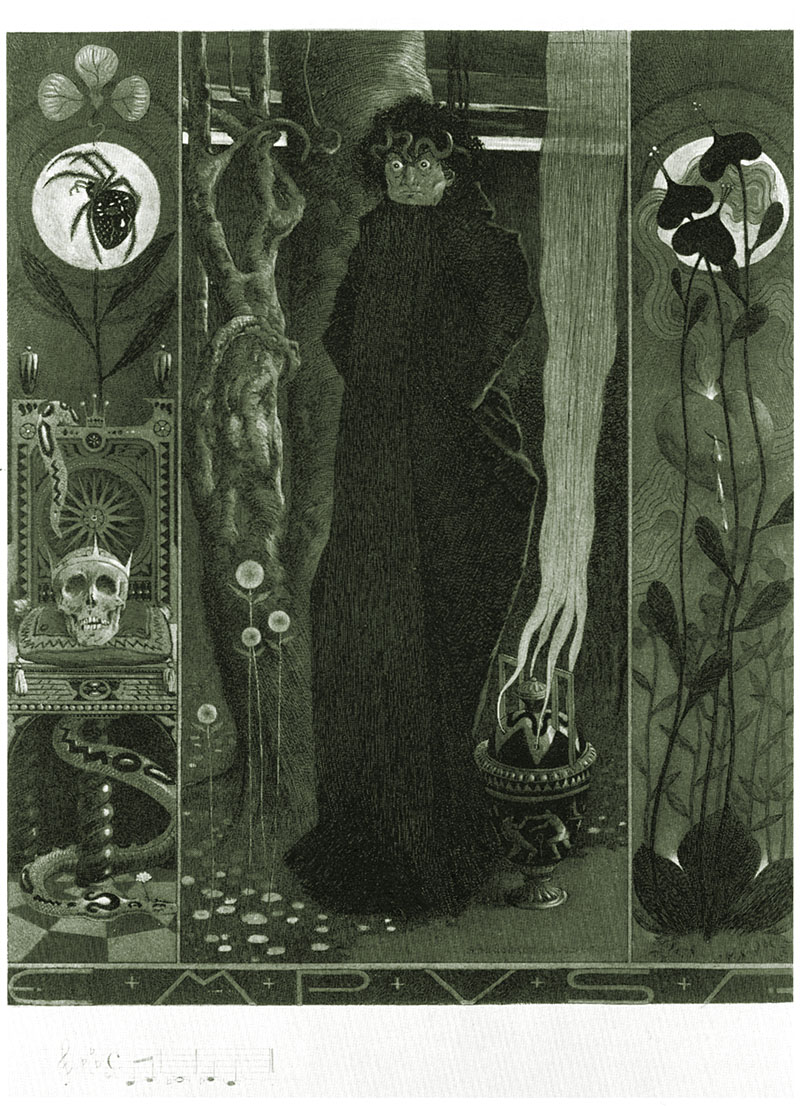
The Empusae, we’re told, were daughters of Hecate in Greek mythology, sent to harass the unwary traveller on lonely roads, as if travellers on lonely roads didn’t have enough to worry about from human malefactors. The sinister femme fatale of mythology was a popular subject among fin de siècle artists which perhaps explains why Carl Schmidt-Helmbrechts (1871–1936) went to such trouble with this etching of one of the baleful demonesses.

There’s very little information about Schmidt-Helmbrechts on the web and little of his other work to be seen; this picture was scanned from High Art and Low Life: ‘The Studio’ and the fin de siècle (1993) and even there they don’t give a date for it although I’d guess it was a product of the 1890s. The description does say it was printed in olive, however, so I’ve taken the liberty of tinting their black and white version accordingly. I’ve no idea what the musical notes at the bottom left are for but I like the lettering design, there’s almost enough of it to develop into a font.

Update: I’ve since discovered that the print was made in 1894.

Elsewhere on { feuilleton }
The etching and engraving archive

Previously on { feuilleton }
The art of Philippe Wolfers, 1858–1929
The Masks of Medusa