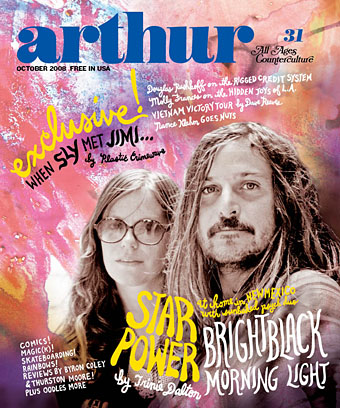
Arthur #31

arthur31.jpg

Cover photography by Lisa Law, design by Alia Penner.

It was only a few months ago that Arthur Magazine was struggling to stay afloat in a nation swimming in inflated wealth. How quickly things change… Arthur #31 is available right now as a free PDF download while those in the US can pick up the paper edition (free!) at the best kind of record stores, coffee houses and Wall Street soup kitchens. Or be the envy of your friends by taking out a subscription. Douglas Rushkoff’s take on the credit crisis can also be read here.

Author Trinie Dalton traveled into the wilds of New Mexico to live with psychedelic earthers BRIGHTBLACK MORNING LIGHT for two days. Sublimity ensued. Here’s what happened. With photography by Lisa Law.

Douglas Rushkoff: The mortgage and credit crisis wasn’t merely predictable; it was predicted. And not by a market bear or conspiracy theorist, but by the people and institutions responsible. Illustration by Arik Moonhawk Roper.

Dave Reeves: Having doubts about Iraq? America’s victory is Infinite. Just have a look at Vietnam…

Molly Frances on all sorts of delights in, from, or about Los Angeles—from Wallace Berman, Velaslavasay Panorama and Lily Tomlin in The Late Show to Show Cave, Nite Jewel and the new Flying Lotus album. Plus other, non-geographically specific stuff.

On May 10, 1968 SLY & THE FAMILY STONE opened two shows for THE JIMI HENDRIX EXPERIENCE at the Fillmore East in New York City. Artist/scholar Plastic Crimewave reports on this extraordinary, little-known moment in American countercultural history.

Greg Shewchuk: What is it about skateboarding that makes kids willing to break laws in order to do it? Illustration by Joseph Remnant.

Nance Klehm: What to do with the nuts, seeds and berries you can find while foraging in the urban jungle. Illustration by Makeswell.

The Center for Tactical Magic: Do the ends ever justify the magic(k)? Illustration by Cassandra Chae.

Erik Davis: Is the “planetary consciousness” of neotribal psytrance gatherings like Portugal’s Boom festival just window dressing for the same old hedonism and escapism—or could it actually be what it says it is?

A centerfold of new ARTHUR COMICS by Jeffrey Brown, Charles Burns, Al Columbia,

P.W.E., Simon Evans, Matt Furie, Tom Gauld, Lisa Hanawalt, Joseph Hanks, Tim Hensley, Ted May, Anders Nilsen, Laura Park, Helge Reumann, Souther Salazar, Julia Wertz and Dan Zettwoch. Edited by Buenaventura Press.

STYLE: Annakim Violette, glampire vamp, tells an arachnid tale from a rainbow’s underbelly. Styled by Miss KK, with photography and design by Alia Penner.

BYRON COLEY & THURSTON MOORE review choice finds from the deep underground.

C and D let it rip about the Fela! musical, Hacienda, Megapuss, Little Joy, Kasai All-Stars, Grouper, Natacha Atlas, Matt Baldwin, Mercury Rev, Desolation Wilderness, Gang Gang Dance, Raglani, Jonas Reinhardt, Apse, and Eagles of Death Metal.
Dark horses

equus1.jpg

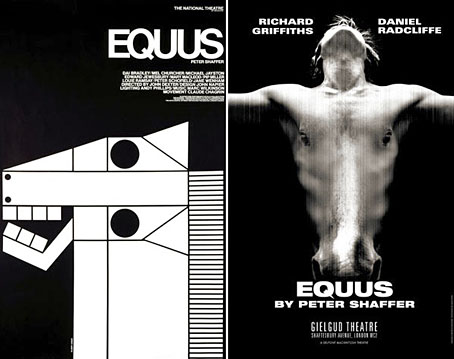
A juxtaposition of old and new theatre posters in the New York Times caught my eye this week, part of a feature about the current Broadway run of Peter Shaffer’s play. The news there, of course, has been Daniel Radcliffe’s on-stage nudity; understandable, perhaps, but celebrity trivia has overshadowed appraisal of Shaffer’s work as a piece of art.

What struck me seeing these was the two very different approaches to the same design problem. Given the subject matter, using an image of a horse is somewhat unavoidable as well as being immediately attractive since horses nearly always look good. The freight of historical and cultural association they carry is also one of the themes of the play. I really like the spare treatment of Gilbert Lesser’s 1976 poster for the National Theatre (left) and much prefer it to the new version used for the London and New York shows. The Lesser poster has the quality of a puzzle, matching the psychological piecing together of the story and Alan Strang’s accusation that Dysart the psychiatrist is always “playing games”. It also has a sinister quality lacking in the contemporary version; Shaffer’s Equus is an unforgiving god and the black eyes could refer to the blinded horses. The Photoshop horse looks altogether too mundane and is it my imagination or is the horse head misshapen slightly in order to fit the torso?

Continue reading “Dark horses”

The art of Angelo Filomeno

filomeno1.jpg

Venom (2003).

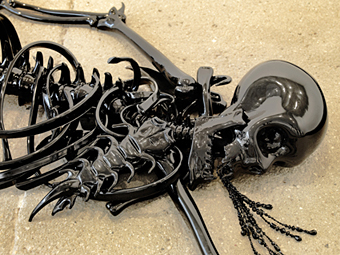
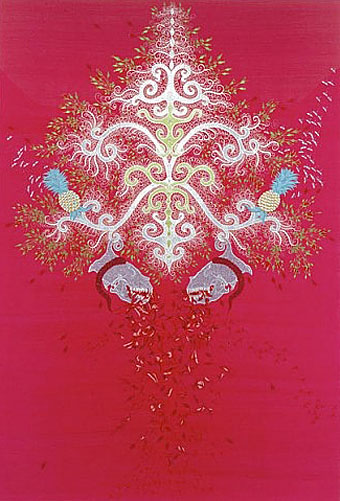
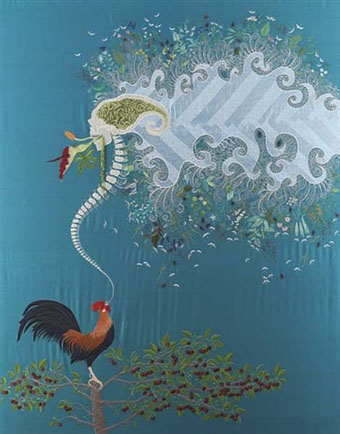
The work of Angelo Filomeno, an Italian artist based in New York, is just the kind of thing I like to see: insects, skulls and bones in a luscious presentation. The sculpture below is made of glass while the flat works are silk embroidery with crystals as part of the decoration. There’s a selection of the latter works here.

filomeno2.jpg

Cold (detail) (2007).

filomeno3.jpg

Incendiary Lovers (2005).

Previously on { feuilleton }
The skull beneath the skin
Vanitas paintings
Giant Skeleton and the Chocolate Jesus
Very Hungry God
History of the skull as symbol

Paul Newman, 1925–2008

hombre.jpg

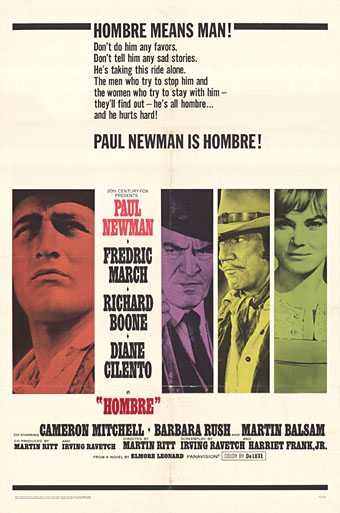
Paul Newman often said that his best films began with the letter H, among them The Hustler (1961) and Hud (1963). Two of the H films were directed by Martin Ritt, including my favourite, Hombre (1967), a tough and unsentimental western based on a novel by the tough and unsentimental Elmore Leonard. Hombre is one of the few decent American westerns of the Sixties, with a great script and a first class cast. Newman plays John Russell, a white man raised by Apaches who has to save a group of stagecoach passengers from Richard Boone’s murderous bandits. His performance is a study in emotionless determination, the polar opposite of his far more popular roles as Butch Cassidy and Cool Hand Luke. One of many memorable lines of dialogue comes when Diane Cilento’s character asks Russell why they should trust him to lead them to safety. “’Cause I can cut it, lady,” he says. Paul Newman could always cut it.