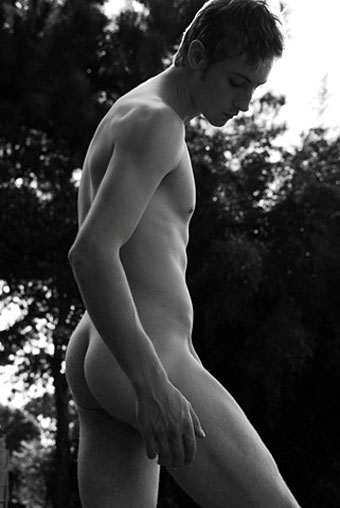
A stunning photo set of model Luciano Gossmann by Brazilian photographer Didio.
Via VGL.
A journal by artist and designer John Coulthart.
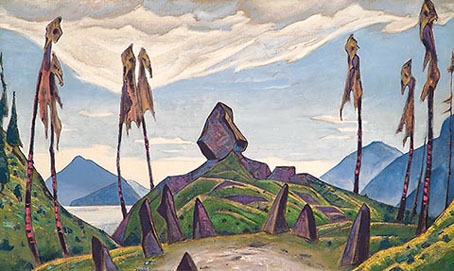
Backdrop for the League of Composers’ production, Philadelphia, 1930.
Something for the vernal equinox. The painting is a stage design by artist, writer and theatre designer Nicholas Roerich (1874–1947) for an American production of Stravinsky’s Rite of Spring. Roerich designed the costumes and decor for the riotous Paris performance of 1913 and the Roerich Museum has a selection of designs for this and subsequent performances. Stravinsky’s fiercely primitive ballet has long been a favourite musical work of mine so it’s especially satisfying when one enthusiasm bleeds into another. I’ve noted before HP Lovecraft’s praise for Roerich’s paintings of whom he wrote in 1937:
There is something in his handling of perspective and atmosphere which to me suggests other dimensions and alien orders of being—or at least, the gateways leading to such. Those fantastic carven stones in lonely upland deserts—those ominous, almost sentient, lines of jagged pinnacles—and above all, those curious cubical edifices clinging to precipitous slopes and edging upward to forbidden needle-like peaks!
Roerich is also mentioned in At the Mountains of Madness and some of his designs for the Rite—which are, after all, backdrops for a ritual sacrifice—might easily serve as a scene of Cthulhoid invocation. Writer Mike Jay has a fascinating piece about the artist which proposes that he should perhaps be given more credit for the origin of the Rite of Spring. He’s not the first to note that it was the stage designer who nurtured a lifelong passion for mysticism and esoteric ritual, not the composer.
Finally, some slightly more contemporary music: Can performing Vernal Equinox for the BBC in 1975.
Previously on { feuilleton }
• HP Lovecraft’s favourite artists
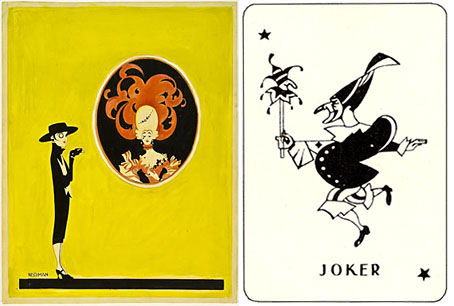
left: No title or date; right: Joker from a playing card set (1924).
A recent post by Silent-Porn-Star draws my attention to Swedish illustrator and cartoonist Einar Nerman (1888–1983) whose work I don’t recall having come across before. There isn’t much available to see online unfortunately, a shame as SPS’s posting of a 1926 cigarette ad shows a distinct Beardsley influence. Nerman seems known chiefly today for his caricatures of Greta Garbo, one of which was used on a commemorative postage stamp in 2005.
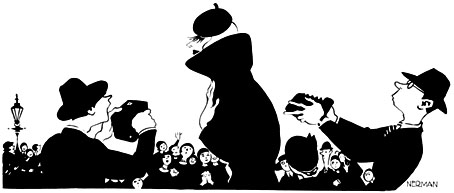
Greta Garbo.
Elsewhere on { feuilleton }
• The illustrators archive
Previously on { feuilleton }
• Oscar Wilde playing cards
• Surrealist cartomancy
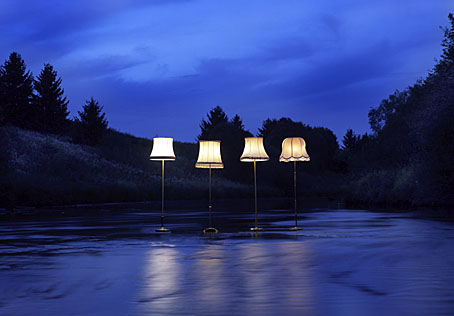
Evolution 4.
Tableaux by a Norwegian artist whose photographs capture mundane objects in remote settings. I especially like these lines of migrating household lamps.
Previously on { feuilleton }
• Lightmark
• Maximum Silence by Giancarlo Neri
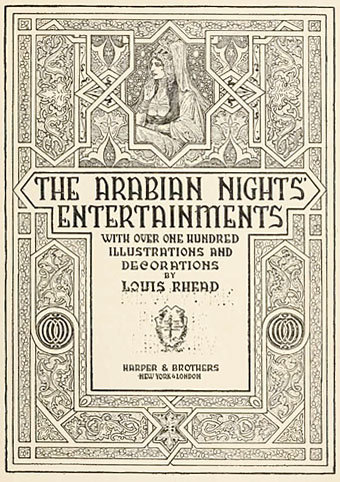
Louis Rhead (1916).
Continuing from the weekend’s book discovery, a browse at the Internet Archive reveals many scanned editions of the Arabian Nights. No surprise given the enduring popularity of the stories, and no surprise either that the texts are of variable quality, most of them diluted from the earthy and inventive originals to the status of the mildest fairy tales. The exotic settings make for some fine illustrations, however, a selection of which follow. Edmund Dulac’s edition of Sindbad the Sailor is a typically masterful adaptation by one of the great illustrators.
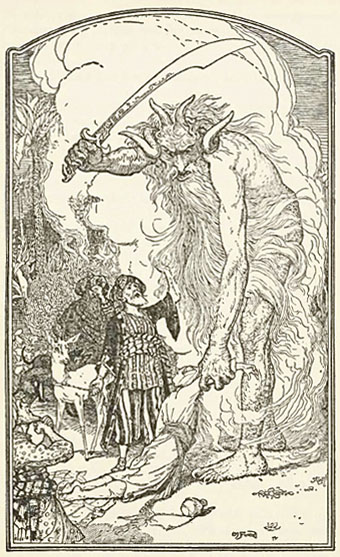
HJ Ford (1898).
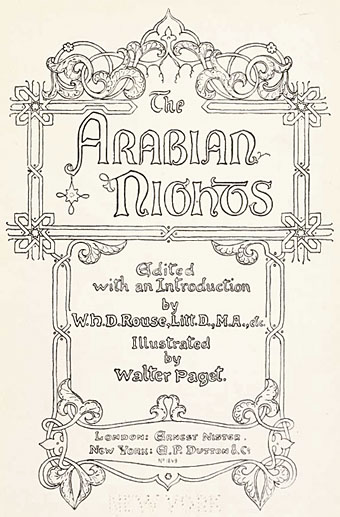
Walter Paget (1907?).
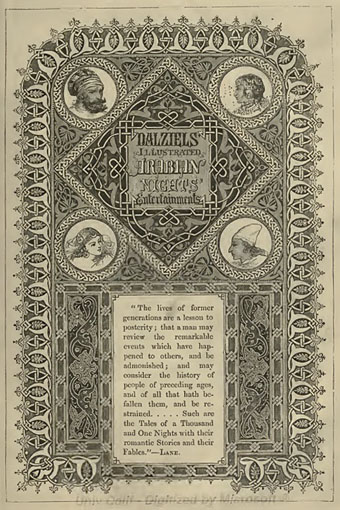
The Brothers Dalziel (1865).
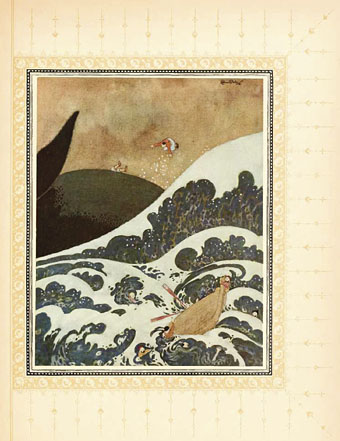
Edmund Dulac (1914).
Elsewhere on { feuilleton }
• The illustrators archive
• The etching and engraving archive
Previously on { feuilleton }
• Edward William Lane’s Arabian Nights Entertainments