Brion Gysin record covers

gysin01.jpg

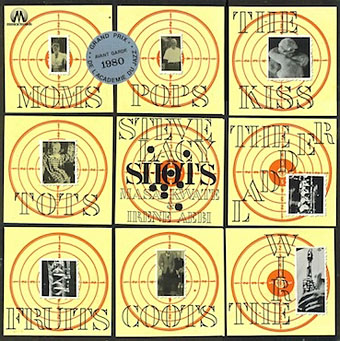
Shots (1977) by Steve Lacy.

Continuing an occasional series about artists or designers whose work has been used on record sleeves. The life and work of Brion Gysin (1916–1986) is the subject of a new exhibition, Unseen Collaborator, that opened last week at October Gallery, London. The gallery page mentions Gysin’s connections to the music world: among other things, it was Gysin’s enthusiasm for the Master Musicians of Jajouka that gave those people and their music global prominence, with a little help from Brian Jones. But there are other connections, whether as a collaborator with Steve Lacy, or as a decorator of album covers. Some of these uses are posthumous but this small collection includes a few releases I’d not come across before.
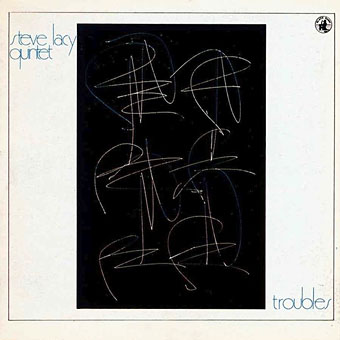
gysin02.jpg

Troubles (1979) by The Steve Lacy Quintet.
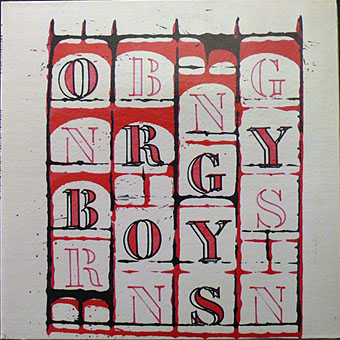
gysin03.jpg

Orgy Boys (1982) by Brion Gysin.

A 12-inch single with Gysin reading from William Burroughs and his own writings. “Songs dedicated to his orgy pals: William S. Burroughs, Mick Jagger, Keith Richards, Iggy Pop, David Bowie, Fafa de Palaminy, Patti Smith, Allen Ginsberg and John Giorno…”
Continue reading “Brion Gysin record covers”

The art of Aleksandr Kosteckij

ak06.jpg

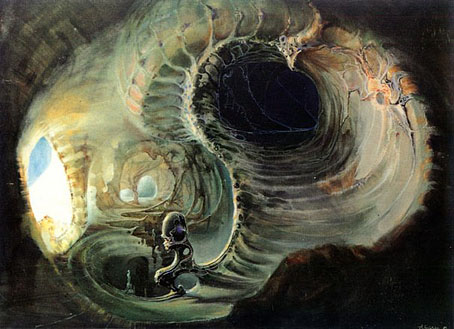
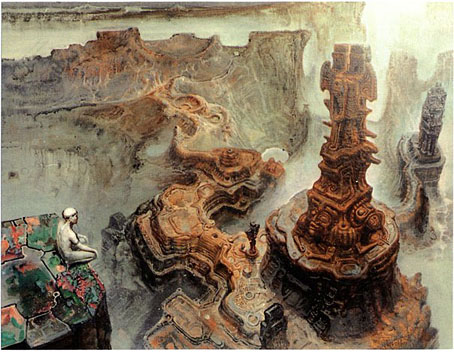
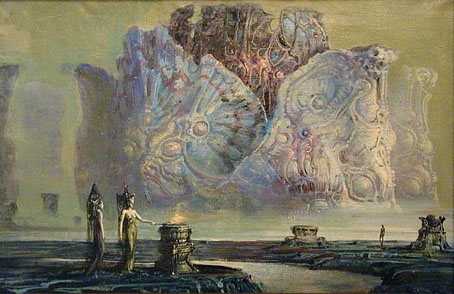
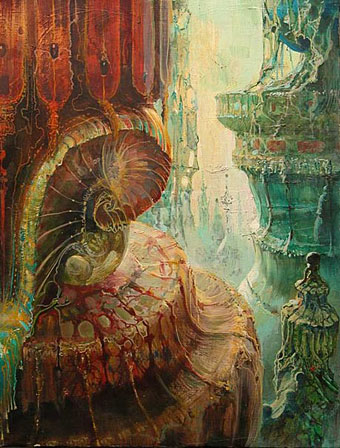
This is the kind of fantastic art I like a great deal: nebulous landscapes whose vast forms may be some kind of hybrid architecture; implications of the alien and mystical that retain some ambiguity; dreamlike without slipping into post-Surrealist cliché. Monsieur Thombeau at Full Fathom Five (whose excellent eye I have to thank once again) describes the paintings of Aleksandr Kosteckij/Kostetsky (1954–2010) as being “like Gustave Moreau, Salvador Dalí, and Max Ernst put in a blender and left out in the rain.” I’d place them somewhere between Ernst Fuchs and Bruce Pennington but Moreau’s chimeras are certainly present. You’d think an artist of this calibre with a large body of work would be better known, most of the attention at the moment seems to be on Russian websites. Let’s hope that changes soon.

Update: Thanks to Joe for pointing the way to this dedicated website, something I missed in my haste.

Examples chosen from these sites:
http://vk.com/album-32941665_175452413 (139 images)
http://www.2photo.ru/en/post/18614

ak07.jpg

ak02.jpg

ak03.jpg

Continue reading “The art of Aleksandr Kosteckij”

Invisible Cities: Miscellanea

cities01.jpg

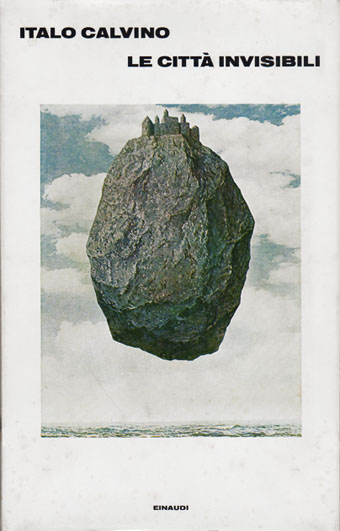
Cover art: The Castle in the Pyrenees (1961) by René Magritte.

A final post for this week devoted to Italo Calvino’s Invisible Cities, and it occurs to me that “Miscellanea” could easily be the name of one of Marco Polo’s cities.

One thing that’s become apparent over the past few days is that this subject is a very popular one with artists, especially in Italy. This is understandable but it also means you could probably fill another week of posts pursuing further illustrations and homages. Rather than belabour things I’m ending with a few of the more notable derivations including some cover designs. The Einaudi volume above was the first printing in Italy in 1972.

cities03.jpg

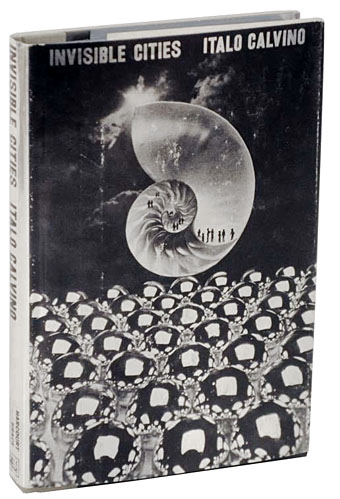
Cover design by Arnold Skolnick.

And this was the first American edition from Harcourt, Brace and Jovanovich in 1974. The cover is printed in silver foil which makes the book a particularly desirable item. This might explain why it’s also rather expensive today.

cities04.jpg

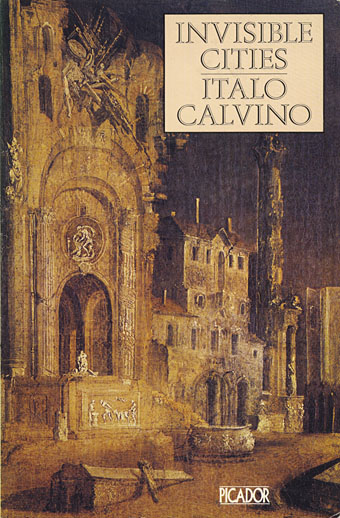
Cover art: Martyrdom of a Saint by Monsù Desiderio.

The 1979 Picador edition is one of two paperback editions I own. The enigmatic “Monsù Desiderio” has a confused identity (see this post), and specialised in curious architectural paintings so this is an apt choice.

Continue reading “Invisible Cities: Miscellanea”

Colleen Corradi Brannigan’s Invisible Cities

ccb1.jpg

Cities and Memory 5: Maurilia.

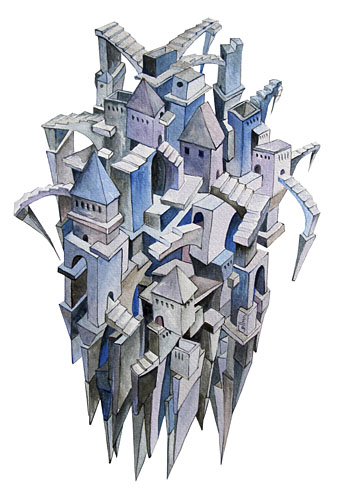
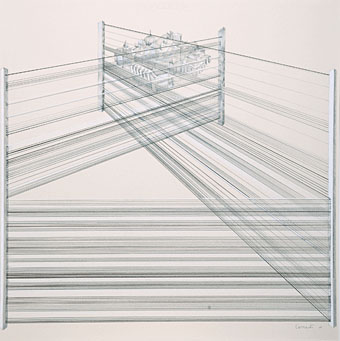
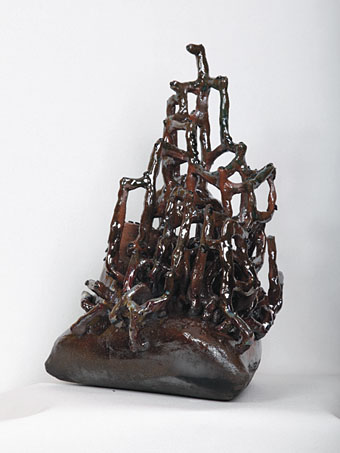
Colleen Corradi Brannigan’s multimedia project was linked here back in 2011 when news of her endeavours reached a number of high-profile websites. These artworks are another attempt to depict all of Italo Calvino’s cities, this time using a range of media that includes sculpture. I like the variety of this series; some of the depictions approach the more rigorous perspectives of MC Escher while others are as loose as Expressionist paintings. The website also includes extracts from Calvino’s descriptions.

ccb2.jpg

Trading Cities 4: Ersilia.

ccb3.jpg

Thin Cities 3: Armilla.

Continue reading “Colleen Corradi Brannigan’s Invisible Cities”

The recurrent pose 56

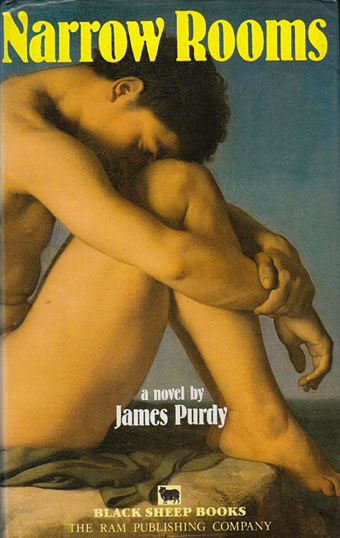
purdy.jpg

A pair of literary poses for this increasingly sluggish series. Both these titles are gay-themed to a greater or lesser degree. James Purdy (1914–2009) received much praise from contemporaries while he was alive but, like Angus Wilson, he’s one of those writers’ writers you don’t hear about today. Outsiders were a favourite Purdy theme, and he wrote several novels about gay characters, of which Narrow Rooms is considered something of a classic. I’ve not read it but going by descriptions the use of Flandrin’s painting on this cover from 1980 would seem a little lazy. This later use on the cover of Teleny (another gay classic) at least suits the French theme. (Thanks to Sander for the tip!)

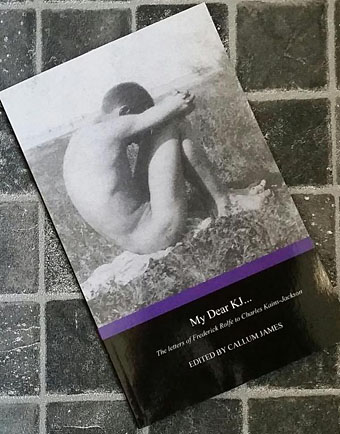
rolfe.jpg

The second volume hasn’t been published yet but Callum James posted the cover proof on Twitter a few days ago so I hope he doesn’t mind my showing it here. The book is a collection of letters by Frederick Rolfe aka Baron Corvo. I don’t know whether this is one of Rolfe’s own photos but he enjoyed photographing naked youths so even if it isn’t his work it suits the book. Further news about the publication should be announced at Front Free Endpaper.

Elsewhere on { feuilleton }
The recurrent pose archive