TS Eliot: Guru-in-chief | The poet as editor and businessman.
Paul Schütze online
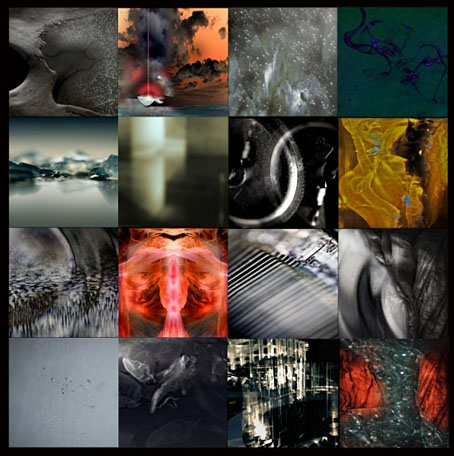
One of the drawbacks with recommending Paul Schütze‘s music lately has been a lack of availability, with most of his CDs being out of print. That changes this month with his back catalogue returning via iTunes sporting a range of impressive new artwork (above) created by Mr Schütze himself.
Schütze’s electronic music stood out for me in the mid-Nineties for a number of reasons: firstly, and most obviously, it wasn’t always tied to the rigid metronomic pulse which governed the rest of the dance world. There were 4/4 beats at times—and he even had an album on Belgian dance label Apollo under the anagrammatical pseudonym Uzect Plausch—but his music was equally subject to unusual time-signatures with chiming timbres borrowed from gamelan orchestras.
Those timbres and their attendant tropical atmospheres were a second point of distinction. Like Jon Hassell, to whom he pays homage on Stateless (1997), there’s an acknowledgement of non-Western music without any falling into pastiche. This realises one aspect of Hassell’s Fourth World concept, whereby a meeting of the First World and the Third World creates an exclusive temporary zone that nonetheless can’t exist without the contribution of either party.
A third distinction would require a detailing of Schütze’s notable collaborators—Bill Laswell and Raoul Björkenheim among them—and his inventive track titles, many of which sound like Surrealist paintings. But describing music is always a poor thing compared to experiencing it. If you want a place to start, I’d recommend New Maps of Hell II: The Rapture of Metals (1993; reissued 1996) or Abysmal Evenings (1996), two constant favourites.
Previously on { feuilleton }
• The art of Josiah McElheny
• The Garden of Instruments
Melancholy Lucifers
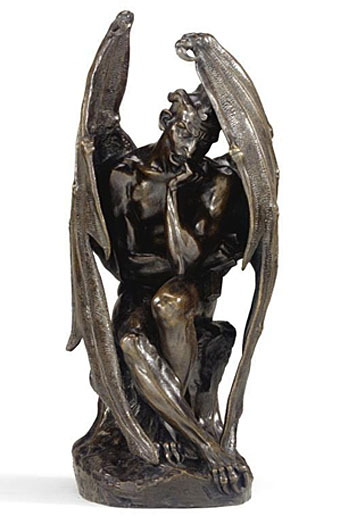
Satan (1833).
I always enjoy it when a search for a piece of information about an artist leads to works you hadn’t come across before. Today it was a quest for the identity of the Satan statue above, created, as it turns out, by French sculptor Jean-Jacques Feuchère (1807–1852). The Louvre site has another view of what seems to have been a popular work, produced in a range of bronzes.

I did actually know the artist’s name a few years ago since I’d used the statue as a starting point for the Satan figure on the cover of Cradle of Filth’s Lovecraft & Witch Hearts in 2002. One function of postings such as this is that it allows me to make a note of details which otherwise might flee the memory. Here Feuchère’s statue was combined with some squid tentacles and seated on an elaborate Gothic throne which is mostly obscured by the band’s name. (See a larger version sans lettering here.)
More sex please, you’re artists
More sex please, you’re artists | Or less North, more South as Jon Hassell would say.
Henry Keen’s Dorian Gray
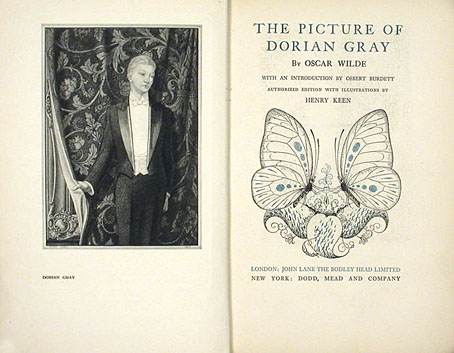
Returning to the golden boy again this week with an illustrated edition of Wilde’s novel from 1925. The publisher was Aubrey Beardsley’s old employer, John Lane, and the illustrator was Henry Keen, an artist of singular and dismaying obscurity. Perhaps some of my knowledgeable commenters can provide more information. Keen’s 12 plates look like lithographs but the book also featured ink embellishments and a splendid sunflower/butterfly design on the boards and slipcase.