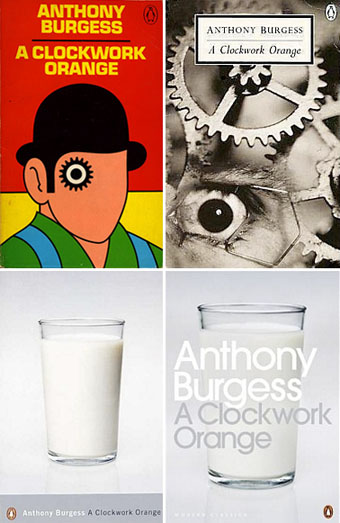
March of the Penguins

aco_penguin.jpg

top left: David Pelham’s classic design (1972); top right: photography
by Lionel F Williams (Eye) and SOA / Photonica (Cogs) (1996).
bottom left and right: photography by Véronique Rolland (2000 & 2008).

In April this year I wrote about James Pardey’s excellent site devoted to book covers from the Penguin science fiction range. I’m often pointing to various book cover galleries on Flickr and elsewhere but James’s site goes far beyond these, with credits and annotations for every cover on display. He emailed this week to let me know that his site has been considerably expanded, from 160 covers to 250 (!), bringing the timeline closer to the present. In addition the site has improved page layouts which enable you to study the evolution of each title. All design sites should be this good.

And coincidentally, Anne S mentioned in the comments yesterday that she’s been adding some Penguin Classics covers to her Eye Candy for Bibliophiles site. Lots of other worthwhile viewing there, including some of the old Puffin covers for Alan Garner.

Elsewhere on { feuilleton }
The book covers archive

Previously on { feuilleton }
Penguin science fiction
A Clockwork Orange: The Complete Original Score
Penguin Labyrinths and the Thief’s Journal
Penguin Surrealism
Juice from A Clockwork Orange
Penguin book covers
Clockwork Orange bubblegum cards
Alex in the Chelsea Drug Store

Steinlen’s cats

steinlen1.jpg

Chat Noir poster (1896).

We had Louis Wain yesterday so it only seems right to follow with the other notable cat artist of the period, and also the one whose work I prefer, Théophile Alexandre Steinlen (1859–1923).

Steinlen’s designs for the Montmartre cabaret, Le Chat Noir, of which there are many variations, are dismayingly ubiquitous in contemporary Paris, so much so that you quickly tire of his haloed feline when wandering the streets. Parisians regard Steinlen’s posters the way Londoners regard pictures of Beefeaters; they’re part of the background noise of the capital city, intended solely for tourists. A shame because it really is a splendid cat.

steinlen2.jpg

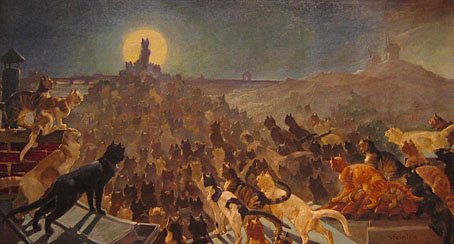
The Apotheosis of the Cats (c. 1890).

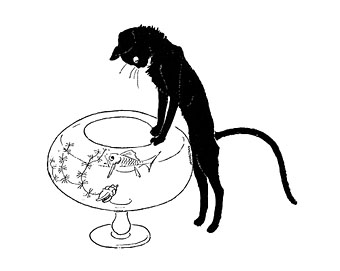
Steinlen’s cat pieces run the gamut of styles and variations, from delicate life studies and bronze sculptures to works such as the three-metres wide mural above depicting the advent of some ultimate feline deity. Among his many drawings he produced a number of marvellous cartoon sequences like the one below featuring cats fighting, playing and generally getting into trouble. Some of these can be found on Flickr here and here.

For more Steinlen, including his non-feline works, there’s Steinlen.net.

steinlen3.jpg

The End of a Goldfish.

Elsewhere on { feuilleton }
The illustrators archive

Previously on { feuilleton }
Louis Wain at Nunnington Hall
The Boy Who Drew Cats
8 out of 10 cats prefer absinthe
Monsieur Chat

Louis Wain at Nunnington Hall

wain.jpg

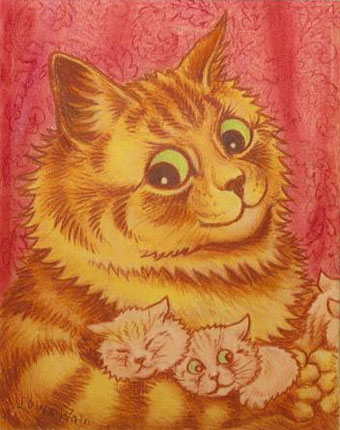
The Mother of Triplets.

Anyone in the vicinity of Nunnington Hall in North Yorkshire over the next month has the opportunity to view and—if you’re wealthy enough—buy some pictures by Victorian cat artist Louis Wain (1860–1939). Wain is famously “The Cat Artist Who Went Mad” (as Chris Beetles’ gallery site puts it) and that piece of knowledge always comes to the fore when looking at his anthropomorphised felines with their huge eyes and often scowling expressions. The excellent Beetles gallery has an overview of the works on display at Nunnington. For the really eccentric stuff, however, you’ll have to go here.

Louis Wain at Nunnington Hall runs until September 13, 2009.

Catland: The art of Louis Wain

Previously on { feuilleton }
Marbled papers
A Madmen’s Museum
The art of Franz Xaver Messerschmidt, 1736–1783

Automates Ki

automates_ki

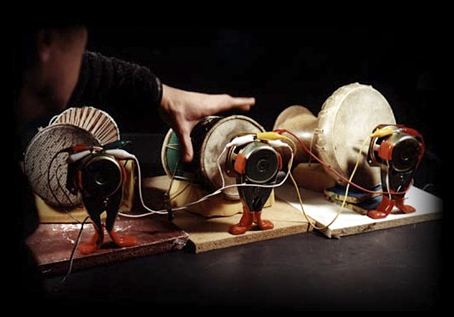
Following the post last week about the Gamelatron, Masha left a comment referring me to the similar, if less harmonious, Automates Ki systems of Canadian composer Maxime De La Rochefoucauld who describes his constructions as “musical robots activated by inaudible frequencies”. He also says:

Ki is a japanese concept : roughly, it is the invisible vital energy that makes things move. I use this word as an allegory for the energy that animates my automatons. The listener and spectator only hears and sees the consequences of this vibration. In this context, my Automates Ki are “spokespersons” for the vibration instead of invented musical instruments, since to build them I use previously created instruments gathered from various countries.

For several years I have worked on a system of my own invention that animates the automatons, producing a music centered on percussion. The Systeme Ki™ transforms inaudible low-frequency modulations into an acoustic phenomenon.

The Automates Ki comprises a speaker joined to a musical instrument. A pliable firing pin is set on the speaker. The firing pin, when animated by the vibration of the speaker, hits the acoustic instruments (drums, cymbals, strings instruments) in an oscillating manner.

There’s a website devoted to these works, and a MySpace page, but the best appraisal can be had by viewing some of the composer’s YouTube clips.

Previously on { feuilleton }
The Gamelatron
Metronomes
Cristalophonics: searching for the Cocteau sound
Max Eastley’s musical sculptures
The Reactable
The Ondes Martenot

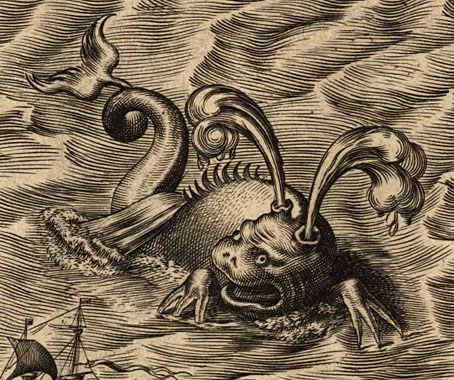
Of the Monstrous Pictures of Whales

whale1.jpg

When Herman Melville complains in chapter 55 of Moby Dick about erroneous representations of whales, this is the kind of thing he had in mind. Among those he takes to task, however, I don’t recall any of them having two blow-holes like the creature above.

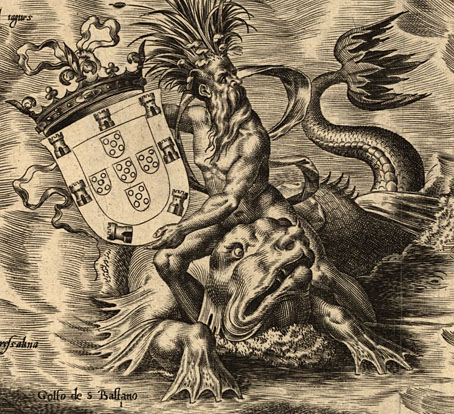
whale2.jpg

The coat of arms of Portugal.

These fanciful beasts are the work of (no sniggering, please) Hieronymus Cock (1510–1570), an Antwerp engraver, and they populate the seas as part of his marvellous map of America created with the assistance of Spanish cartographer Diego Gutiérrez.

Gutiérrez’s magnificent 1562 map of America was not intended to be a scientifically or navigationally exacting document, although it was of large scale and remained the largest map of America for a century. It was, rather, a ceremonial map, a diplomatic map, as identified by the coats of arms proclaiming possession. Through the map, Spain proclaimed to the nations of Western Europe its American territory, clearly outlining its sphere of control, not by degrees, but with the appearance of a very broad line for the Tropic of Cancer clearly drawn on the map.

The map is described in detail here while another part of the Library of Congress Map Collections site has an incredible high-resolution copy which is a delight to pore over. This is a really big image (10492 x 11908 pixels) but the huge size is just what I love to see. You can not only zoom into the myriad details—cannibals cooking a human feast in Brazil—but also admire the precision of the cross-hatching. Less than forty years separate these generic creatures from Jan Saenredam’s far more accurate rendering of a beached sperm whale.

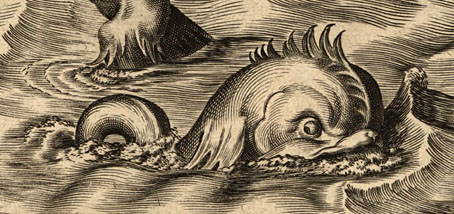
whale3.jpg

A dolphin (Melville classed dolphins and porpoises as small whales).

Elsewhere on { feuilleton }
The etching and engraving archive

Previously on { feuilleton }
Jan Saenredam’s whale
The Whale again
Rockwell Kent’s Moby Dick