
Delville, Scriabin and Prometheus

delville1.jpg

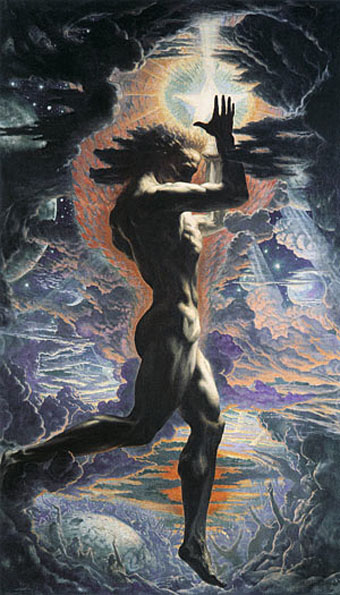
Another striking design found by chance. Symbolist artist Jean Delville (1867–1953) created this sheet music title page for Promethée by Scriabin in 1912, and the pair are well-matched given their shared predilection for mysticism (Theosophy in Delville’s case). Delville had also dealt with Prometheus in a typically dramatic, if sexless, picture a few years earlier (below). Once again it’s unfortunate that one of the really great artists of the Symbolist period is so poorly-served by the web that one has to discover his work by accident. There’s a dedicated site here but the gallery pages are only harvesting what’s already scattered around. Delville had a long and consistently high-quality career; he deserves better.

delville2.jpg

delville3.jpg

Prometheus (1907).

Update: Dave C reminds us of another Delville site with a better selection of pictures including a photo of the artist at work.

Previously on { feuilleton }
The faces of Parsifal
Masonic fonts and the designer’s dark materials
Angels 4: Fallen angels

Caldwell & Co

caldwell.jpg

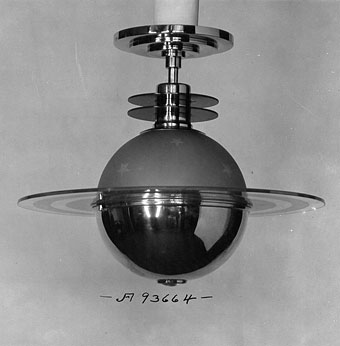
A cosmic pendant lamp by New York lighting manufacturer, Caldwell & Co, created for the Rockefeller Center in 1932. The company’s Art Deco-styled designs for that building feature a number of other flying saucer pendants although none as striking as this one. The photo is one of many made available by the Smithsonian Institute on a site which catalogues the company’s history.

Edward F. Caldwell & Co., of New York City, was the premier designer and manufacturer of electric light fixtures and decorative metalwork from the late 19th to the mid-20th centuries. Founded in 1895 by Edward F. Caldwell (1851–1914) and Victor F. von Lossberg (1853–1942), the firm’s legacy of highly crafted creations includes custom made metal gates, lanterns, chandeliers, ceiling and wall fixtures, floor and table lamps, and other decorative objects that can be found today in many metropolitan area churches, public buildings, offices, clubs, and residences.

Previously on { feuilleton }
Hugh Ferriss and the Metropolis of Tomorrow

Rashied Ali, 1935–2009

ali.jpg

The death this week of guitar pioneer Les Paul is already receiving considerable attention; less will be given to the passing of drummer Rashied Ali. The latter means more for me as a musician since I’m listening to his work all the time. Ali famously (and to some, controversially) replaced drummer Elvin Jones as John Coltrane’s drummer of choice from 1966 onwards, and Ali’s revolutionary free style enabled Coltrane to voyage even further out with his stream-of-consciousness sax playing. Ali’s playing supports all of Coltrane’s later recordings, including their extraordinary duet album Interstellar Space (recorded in the ’60s but not released until 1974). Following Coltrane’s death in 1967, Ali played on a number of albums by the fantastic Alice Coltrane, and while this period inevitably overshadows any appraisal of his work, his career continued to develop to the present day.

If you’re unused to the “formlessness” of free jazz, Interstellar Space can be a forbidding region until you attune yourself to its rarefied atmospheres. Alice Coltrane’s A Monastic Trio, recorded shortly after her husband’s death, is less challenging and a beautiful tribute to John Coltrane from his wife, friends and collaborators. With Jimmy Garrison on bass, Pharoah Sanders on sax, Alice playing harp and piano, and Ali drumming on five of its six tracks, its a perfect introduction to Ali’s work, and, by extension, to some of the finest music of the last century.

Previously on { feuilleton }
John Coltrane’s Giant Steps
Alice Coltrane, 1937–2007

March of the Penguins

aco_penguin.jpg

top left: David Pelham’s classic design (1972); top right: photography
by Lionel F Williams (Eye) and SOA / Photonica (Cogs) (1996).
bottom left and right: photography by Véronique Rolland (2000 & 2008).

In April this year I wrote about James Pardey’s excellent site devoted to book covers from the Penguin science fiction range. I’m often pointing to various book cover galleries on Flickr and elsewhere but James’s site goes far beyond these, with credits and annotations for every cover on display. He emailed this week to let me know that his site has been considerably expanded, from 160 covers to 250 (!), bringing the timeline closer to the present. In addition the site has improved page layouts which enable you to study the evolution of each title. All design sites should be this good.

And coincidentally, Anne S mentioned in the comments yesterday that she’s been adding some Penguin Classics covers to her Eye Candy for Bibliophiles site. Lots of other worthwhile viewing there, including some of the old Puffin covers for Alan Garner.

Elsewhere on { feuilleton }
The book covers archive

Previously on { feuilleton }
Penguin science fiction
A Clockwork Orange: The Complete Original Score
Penguin Labyrinths and the Thief’s Journal
Penguin Surrealism
Juice from A Clockwork Orange
Penguin book covers
Clockwork Orange bubblegum cards
Alex in the Chelsea Drug Store