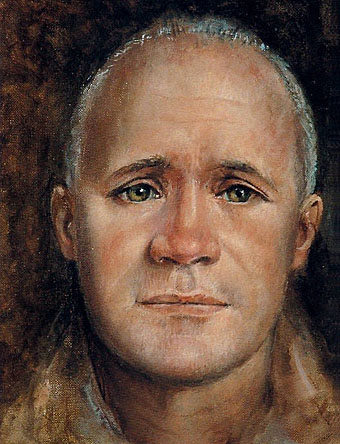
Ira Cohen, 1935–2011

cohen.jpg

Ira Cohen (1979) by Gerard Malanga.

Another of the psychedelic magi departed our mundane sphere this week, and for the moment his passing seems to have been unacknowledged by those cultural wardens who you’d think would know better. Ira Cohen was a poet with a gift for phrases which demand to be appended to Mati Klarwein paintings (one such phrase, The Surgeon Of The Nightsky Restores Dead Things By The Power Of Sound, was used by Jon Hassell for an album title); he was also a photographer whose use of a chamber covered in sheets of reflective Mylar turned photo-portraiture into a psychotropic art:

I never wanted to be a photographer like the commercial photographers. For me, it was more about the involvement of the mirror, and scrying, reflection, crystal-ball-gazing, trying to get to some other place. It was all about reflection, in the deepest sense of the word. (More.)

Cohen’s 1968 film, The Invasion of Thunderbolt Pagoda, used his Mylar Chamber as a locus to create one of the key works of psychedelic cinema. More of that work can be seen here while his 1994 album of readings and music, The Majoon Traveler, is available via iTunes.

The Invasion of Thunderbolt Pagoda, six postcards from Aspen no. 9 (1971).

Previously on { feuilleton }
Dreamweapon: The Art and Life of Angus MacLise, 1938–1979
William Burroughs by Ira Cohen, 1967
The Invasion of Thunderbolt Pagoda

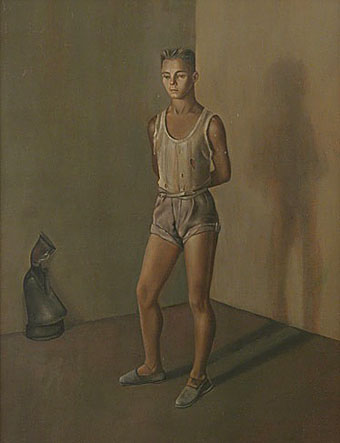
Loving Boys by Christian Schad

schad.jpg

Loving Boys (1929).

German artist Christian Schad (1894–1982) wasn’t gay but his New Objectivity paintings were often overtly sexual, as with his most well-known work, Self-Portrait with Model (1927). This drawing was posted in a piece about Schad at Weimar Art, and, given the place and period from which it originates, wouldn’t be out of place on the cover of Christopher and His Kind, Christopher Isherwood’s memoir about gay life in pre-war Berlin which was recently dramatised by the BBC.

For more about Schad’s work and erotic concerns there’s Lewd Awakening: Rediscovering a German Connoisseur of Sex at Village Voice. Ten Dreams has a gallery with more of his paintings.

Elsewhere on { feuilleton }
The gay artists archive

Weekend links 56

kallela.jpg

Ad Astra (1907) by Akseli Gallen-Kallela.

• Andres Serrano’s works are photo prints so you can’t damage an exhibition item the way you can with a painting. That didn’t stop Catholic protestors in France attacking a copy of Piss Christ on Monday. By coincidence, Dave Maier had posted an essay about Serrano’s work a few hours earlier, and with a reminder that the notorious photograph was part of a series, a detail which is often forgotten or conveniently ignored.

• The Avant Garde Project which made available deleted experimental audio works (see this earlier post) ceased activity a while ago so it’s good to see that its archives will now be hosted at Ubuweb.

…African Head Charge again was a studio name I had to start with, and it evolved into a band about eight years later. That started out again I read an interview in a newspaper where Brian Eno talked about he’d made an album called My Life in the Bush of Ghosts with another musician—that Talking Heads fellow [David Byrne]—and he said “I had a vision of a psychedelic Africa”. And I thought, “Oh, that’s pretentious”. But then I thought about it, and thought “No, what a good idea! Make really trippy African dub”.

Adrian Sherwood on thirty years of On-U Sound.

• Related: Brian Eno has a new album out in July, Drums Between The Bells, a collaboration with Rick Holland.

“Do you think Lord Leighton could by any chance have been a homosexual?” enquired Richard. “It says here,” I replied, consulting a laminated information card, “that there is no evidence one way or the other.”

“Rent boys leave no evidence,” said Richard.

A private view of Lord Leighton’s home in Holland Park, London, which opened to the public again last year.

Passengers, an exhibition of urban transit photos by Chris Marker at Peter Blum, NYC. For a different kind of rail transport there’s this exploration of London’s disused underground Post Office Railway.

• Reappraising the recent past: Jon Savage on Taxi zum Klo, Christiane F, David Bowie and the seedy attraction of Berlin in the 70s and 80s; Iain Sinclair on the Festival of Britain sixty years on.

Stella Steyn’s illustrations for Finnegans Wake as seen in transition magazine, 1929. And speaking of literary magazines, the return of New Worlds has been announced.

Clive Hicks-Jenkins is an art monograph published next month by Lund Humphries. Clive enthused about the book’s arrival.

• 50 Watts announces the Polish Book Cover Contest.

• 4th June, 2011 is Radiophonic Creation Day.

• Americans: has your state banned sodomy?

Stardust (1931) by Louis Armstrong | Stardust (1940) by Artie Shaw | Stardust (1957) by Nat King Cole.

Arcimboldo’s Four Elements

arcimboldo1.jpg

Water (1566).

After yesterday’s post it’s necessary—mandatory, even—to follow it with a similar series of paintings by Giuseppe Arcimboldo (1527–1593). For my own attempt at the Arcimboldo style, see this post.

arcimboldo2.jpg

Fire (1566).

arcimboldo3.jpg

Earth (c. 1570).

arcimboldo4.jpg

Air (undated).

Previously on { feuilleton }
My pastiches
Fantastic art from Pan Books