Franz Stassen’s illustrated Hoffmann

stassen01.jpg

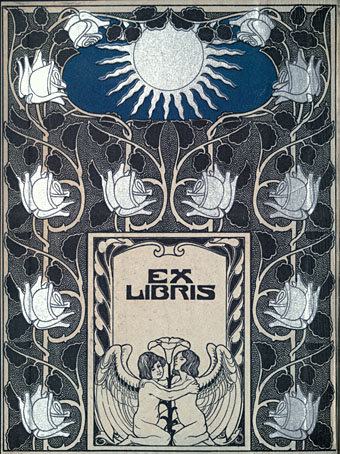
Endpaper design with an ex libris plate by the artist.

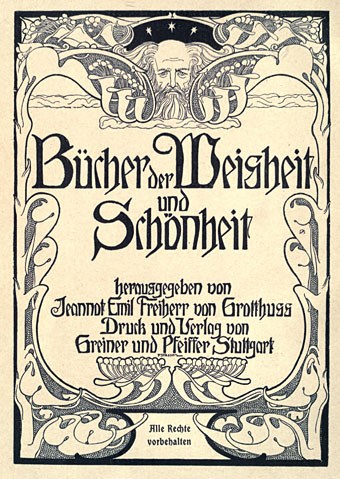
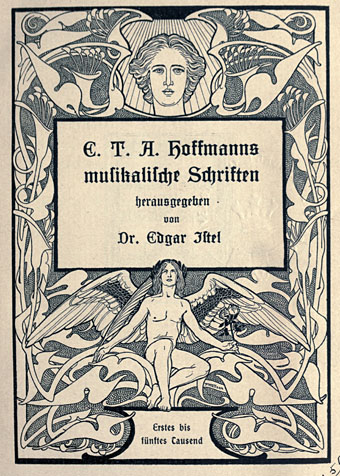
Another prolific illustrator with a clear-line style, Franz Stassen (1869–1949) here decorates the pages of Musikalische Schriften, a book devoted to the musical works of writer ETA Hoffmann. I haven’t checked but I’m fairly sure that Stassen was featured in Jugend magazine a few times, his florid style in this undated volume would certainly complement the work of the other artists there. Like some of those artists, Stassen was enthused by Teutonic nationalism during the First World War, a path that led eventually to work for, and plaudits, from the Nazis. We’re also told (via an unsourced Wikipedia detail) that he ended his days in a gay relationship, something the Third Reich would have either overlooked or conveniently ignored.

stassen02.jpg

stassen03.jpg

Continue reading “Franz Stassen’s illustrated Hoffmann”

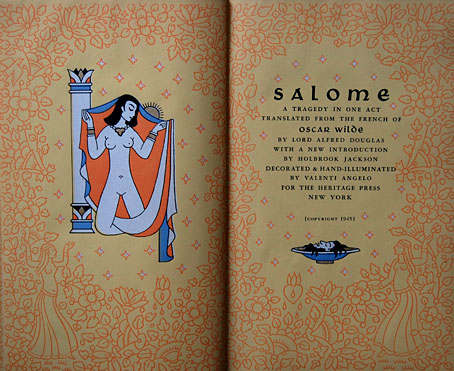
Valenti Angelo’s Salomé

angelo.jpg

And still they come… Valenti Angelo (1897–1982) was an American printmaker, author of several books for children and the illustrator of an estimated 250 classic works of fiction including this 1945 edition of Wilde’s Salomé for Heritage Press. Angelo has an engagingly simple style in this and other works, reminding me of David Sheridan’s Tarot designs. The Internet Archive has a copy of his illustrated The Imitation of Christ with drawings reminscent of Eric Gill’s woodcuts.

Elsewhere on { feuilleton }
The illustrators archive
The Oscar Wilde archive
The Salomé archive

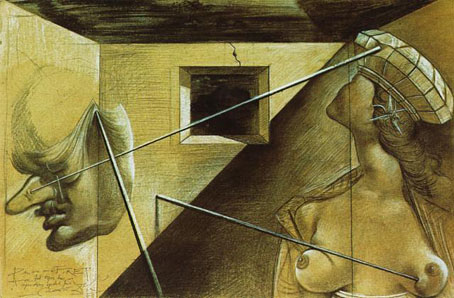
Dalí’s Salomé

dalisalome.jpg

Queen Salomé (1937) by Salvador Dalí.

Of all the Surrealists, Salvador Dalí had his fingers in the most cultural pies—designing for film and theatre, writing books (including a novel, Hidden Faces), even performing occasionally, or at least making a public spectacle of himself—so it’s no surprise to find him adding to the stock of 20th-century Salomé interpretations, first in a drawing then for the stage. The stage work was something I hadn’t run across before (not since this current obsession began, anyway), a 1949 production of the Strauss opera at Covent Garden directed by Peter Brook. The now celebrated theatre director was at the outset of his career when he chose Dalí as his designer but the resultant furore shows that Brook’s ability to challenge an audience (or at least, a gaggle of theatre critics) had an early start. The critics savaged the production and the show closed after only six performances. Brook, who was sacked, had this to say:

The critics all decided that Dali and I were only out to annoy them. There, at least, I might claim that they underestimated us; if that have been our intention I think that between us we might have done much worse… (More)

Getty Images has some tantalising photos here, here and here, but I’ve not seen anything in the way of production sketches. The objections seem to have been the usual tiresomely English revulsion against anything too original, too strange or too imaginative (it’s no wonder Leonora Carrington abandoned Britain for Mexico). An article about the production from the BBC’s Music Magazine includes this detail:

In the last scene for Dali and Brooke, [Salomé] was slowly covered over by a sort of green ooze of bile that came from the head of John the Baptist, an effect of luxuriant disgust which we can imagine without too much difficulty, bearing in mind others of Dali’s images.

That piece also mentions a proposed restaging of the opera with Dalí’s designs but I’ve been unable to discover whether this took place. If anyone knows better, please leave a comment.

Elsewhere on { feuilleton }
The Salomé archive

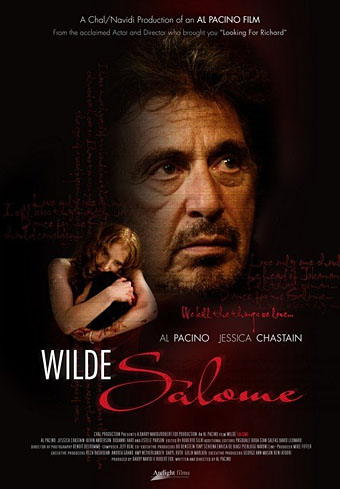
Wild Salomés

wildesalome.jpg

So there’s a poster for Al Pacino’s forthcoming drama-documentary about the Oscar Wilde play but I’ve yet to see any release details. The tagline connects Salomé with The Ballad of Reading Gaol: “We kill the thing we love.”

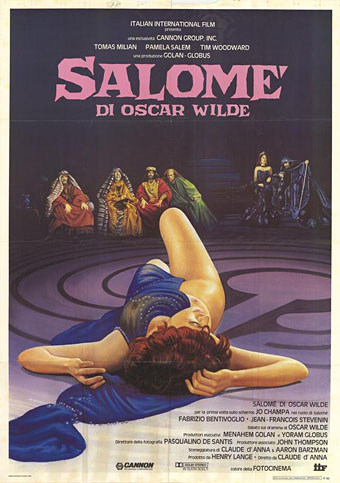
salome1986.jpg

Searching around for posters turned up this item for an Italian-French co-production of the Wilde play directed by Claude d’Anna. I’ve not seen this but it can’t be any worse than Ken Russell’s version so it may be worth seeking out.

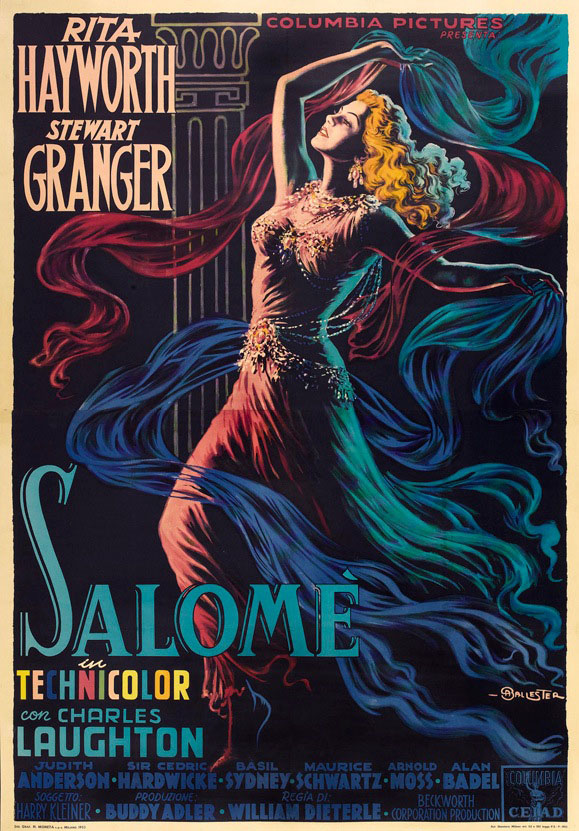
salome1953.jpg

Far better poster-wise is this splendid creation by Anselmo Ballester for the Italian release of the 1953 Hollywood film (which isn’t based on the play). Rita Hayworth was too old for the role, and the film is simultaneously lavish and dull in the way that so many sword-and-sandal epics manage to be, but the poster is a gem. This site has many more examples of Ballester’s poster art.

Elsewhere on { feuilleton }
The Oscar Wilde archive
The Salomé archive

The Rock Drill

epstein.jpg

The Rock Drill (original version, 1913–1914).

Jacob Epstein’s Rock Drill (1913-15) was reconstructed in polyester resin by Ken Cook and Ann Christopher in 1973–74. It is the exemplary Vorticist art work. It shows a man on a tripod who is one with his machine. His drill is also his rigid proboscis, his hard, angled phallus. The tripod has weights (embossed Colman Bros Ltd Camborne England) on each leg, just above midpoint—which look like enlarged joints, or a bee’s pollen knee-pads (only available in black).

The rib cage of the figure is exactly like the twin cylinders on a motorbike. He is recognisably human, true, but the human body, with its curves and trim little bum, has been made-over to the angular machine: it is an armoured exoskeleton. The arms are like greaves. I thought of Seamus Heaney’s description of a motorbike lying in flowers and grass like an unseated knight. And I thought too of “Not My Best Side”, UA Fanthorpe’s marvellous poem about Uccello’s St George and the Dragon in the National Gallery. In it, Fanthorpe imagines the young girl being rather taken by the dragon’s equipment, when suddenly, irritatingly, “this boy [St George] turned up, wearing machinery”.

Thus Craig Raine on Jacob Epstein’s unforgettable sculpture. It’s astonishing to think that this piece in its various forms (lost, reworked, reconstructed) is now nearly a century old. Raine was writing about the forthcoming The Vorticists: Manifesto for the Modern World, an exhibition which will be opening at Tate Britain next month. Epstein’s truncated Torso in Metal from The Rock Drill (the full-figure version was destroyed) was one of the handful of sculptures which stood out for me when I first visited the Tate Gallery (as Tate Britain used to be) and it’s since become a piece I always enjoy seeing again. Epstein’s art was frequently controversial, his Oscar Wilde Memorial of 1911 was famously declared indecent, and The Rock Drill would have seem shockingly angular and aggressive to a British art world where aged academicians were still painting medieval fantasies or trying to sculpt like Praxiteles. To us today it looks unavoidably cybernetic even though the word “robot” didn’t arrive until 1920. Flickr has some views here of the reconstructed version which I’d hope is going to be on show at the Tate. In the meantime, there’s Anthony Gormley discussing the work on BBC Radio 3 (via iPlayer) which he regards as the first Modernist British sculpture, and a favourite work of art.

Previously on { feuilleton }
Wildeana #2
Against Nature: The hybrid forms of modern sculpture
Angels 2: The angels of Paris