The art of Ferenc Helbing, 1870–1958

helbing1.jpg

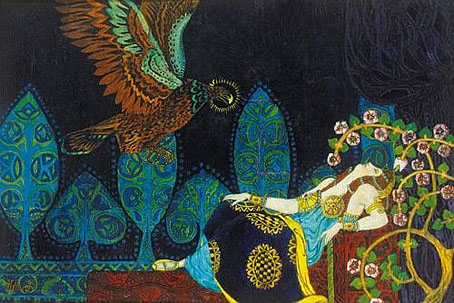
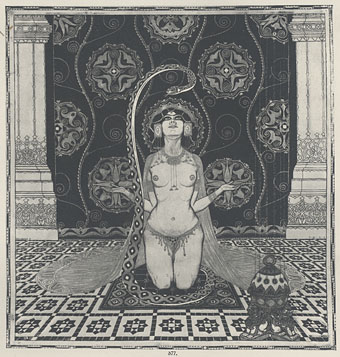
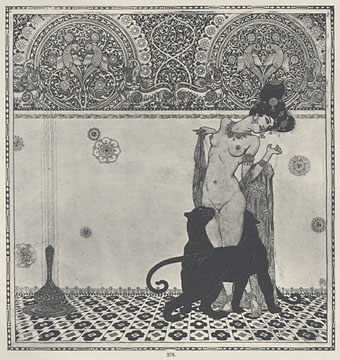
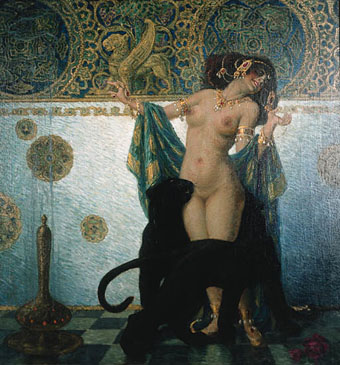
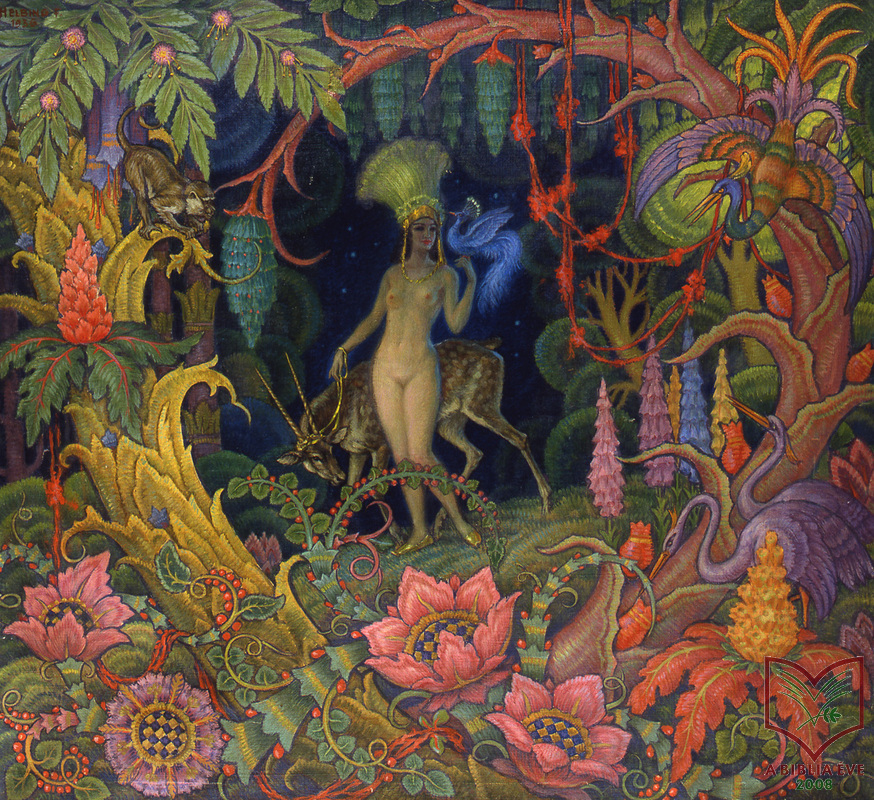
Beautiful Century drew my attention to this Hungarian artist and designer, one of many Eastern Europeans passed over in fin de siècle art books by virtue of working too far from Paris, Munich or Vienna. Helbing’s work would have been most visible to Hungarians in the designs he produced for the nation’s banknotes but on the evidence of these lavish and exotic examples he’s a match for his contemporaries elsewhere in Europe. Of the Seherezade (sic) depictions I prefer the black-and-white version over the painting. There’s more at Flickr.

helbing3.jpg

helbing2.jpg

helbing4.jpg

Seherezade (1918).

helbing5.jpg

Édenkert (1936).

Wavelength

wavelength1.jpg

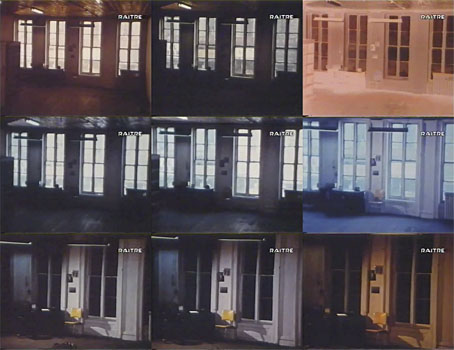
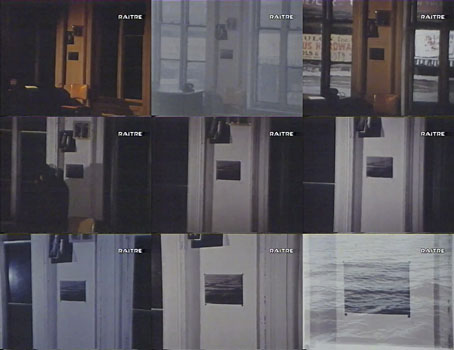
Thanks be to YouTube for once more resurrecting moments of underground cinema which would otherwise be very difficult to see. Wavelength (1967) is Michael Snow’s experimental masterwork, a 45-minute zoom across a New York loft that ends on a photograph of waves that fills the screen. This recipe for ennui is not without incident: we see a bookcase being installed, someone plays a Beatles record—Strawberry Fields Forever—a man breaks into the apartment and collapses. (He may be dead but we never find out.) Throughout this, the film is subject to flashes of colour filtering, moments of negative inversion and sudden flares of light. For at least half the running time the sound is replaced by a droning oscillator tone which rises inexorably the closer the camera brings us to its destination.

wavelength2.jpg

Between these events there’s plenty of time to meditate upon the meaning of the title: the various wavelengths of sound and light, the distance across the room to the view of the waves, the waves themselves. It’s a fascinating film which is linked for me (and may have influenced) two other takes on the long take: JG Ballard’s short story The 60 Minute Zoom (1976), in which a man monitors his wife’s infidelity from a hotel balcony, and the celebrated shot at the end of Antonioni’s The Passenger (1975) when Jack Nicholson’s character is assassinated off-screen in another hotel room while the camera floats miraculously through the iron bars of the window. You can see Wavelength in full here. I’d recommend watching it full-screen, it requires immersion.

Previously on { feuilleton }
() by Morgan Fisher
La Région Centrale
Downside Up

Weekend links 150

feanne.jpg

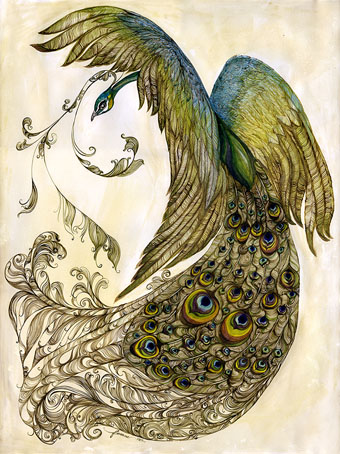
One of A Pair of Peacocks (2012) by Feanne.

Jonathan Barnbrook reveals his package design for the new David Bowie CD. The Barnbrook studio has also designed the catalogue for the forthcoming V&A Bowie exhibition. And there’s more (don’t worry, it’ll be over soon): Jon Savage on When Bowie met Burroughs.

• “Witches have a fashion moment,” says the NYT. Nice clothes but the writing trots out too many of the usual lazy clichés. Related: A Tale of Witches, Woodland and Half-remembered Melodies…, a new mix by Melmoth the Wanderer.

Calidostópia! is a free album (FLAC & mp3) from Marcus Popp aka Oval: “an enticing 16-track collaboration…with seven wonderful singers/musicians from all over South America”.

Before meeting Moorcock in person, [Hari] Kunzru went on to say, ‘I didn’t realise the role he’d played in connecting so many different scenes and undergrounds together – the psychedelic music scene, the science fiction scene, the hip experimental literature scene around people like William Burroughs, pop art’.

Brave New Worlds: A Michael Moorcock Retrospective by Carol Huston. Moorcock’s Elric novels will be published by Glénat in new bande dessinée adaptations later this year.

• More art by Michael W. Kaluta at The Golden Age. And more fantastic comics/illustration by Philippe Caza at 50 Watts. There’s more Caza here.

• Mine and David Britton’s new book, Lord Horror: Reverbstorm, was reviewed at The Spectator.

Google Street Scene: “Moments of cinema captured by Google Street View cameras”.

Cosmic Sentinels and Spiral Jetties: JG Ballard, Robert Smithson & Tacita Dean

• Strange Flowers showcases the heads of Pavel Tchelitchew, 1949–1952.

Setting in the East: Diamanda Galás on Women and Real Horror

Little Joe: “A magazine about queers and cinema, mostly.”

Nanoparticles loaded with bee venom kill HIV.

Treatises on Dust: Antic Found Texts

The Wizard Blew His Horn (1975) by Hawkwind (with Michael Moorcock) | Brothel In Rosenstrasse (1982) by Michael Moorcock’s Deep Fix | Running Through The Back Brain (1983) by Hawkwind (with Michael Moorcock)

() by Morgan Fisher

mfisher1.jpg

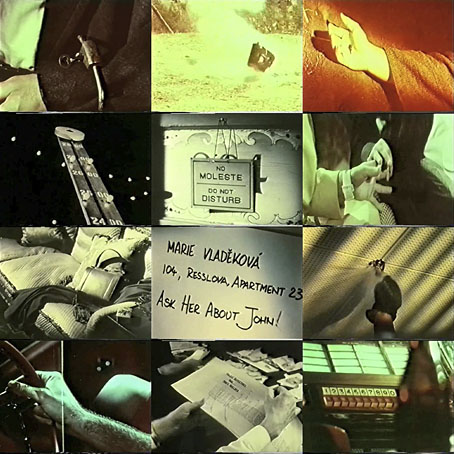
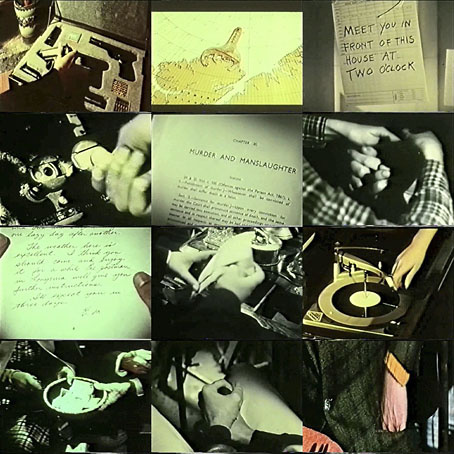
Here’s a good one for enthusiasts of cinematic formalism. () (2003) is a 20-minute soundless assembly by Morgan Fisher of isolated moments from many feature films:

() is made up entirely of “inserts” from feature films organized according to Oulipian principles. Inserts were usually shot by assistants when star actors, large crews, or expensive sets were not needed. These include details of weapons, wounds, letters, signs, tombstones, machinery, games of chance, timepieces, money, and even intimate caresses. Fisher culled the inserts from a number of films he collected for that purpose and edited them together under constraints he does not fully reveal; he places the inserts from a given film in the order in which they appeared in that film, but two inserts from the same film never follow each other directly in his assemblage. Alternating among them we catch glimpses of violence, intrigue, high-stakes gambling, and sexual adventure.

Morgan Fisher is an expert musical collagist as well as a notable anthologist. His Miniatures (1980) anthology is a particular favourite, being a collection of one-minute recordings by a host of different artists. () is the first of his films that I’ve seen, however. The idea is superficially similar to Christian Marclay’s recent The Clock (2010), although Marclay’s concept is rendered more audience-friendly by sticking to a single theme which requires little explanation.

Both works remind me that some years ago I spent two weeks labouring with a pair of video recorders and a huge stack of tapes to collage together three hundred separate clips from famous films. The resulting 15-minute piece was intended as a visual complement to Holger Czukay’s Hollywood Symphony, the last track on his Movies (1979) album. That collage seemed impressive at the time, mostly because the effort required to produce anything decent via such crude methods was considerable. In the age of non-linear editing and YouTube supercuts few people would be impressed at all. I did send a copy of the video to Holger Czukay, however, and received a pleasant phone call by way of thanks. I still relish that.

Morgan Fisher’s () can be seen at Ubuweb. Fisher writes about the Miniatures tracks in great detail on his blog.
mfisher2.jpg

Previously on { feuilleton }
La Région Centrale
Downside Up

Raising the roof

ramases1.jpg

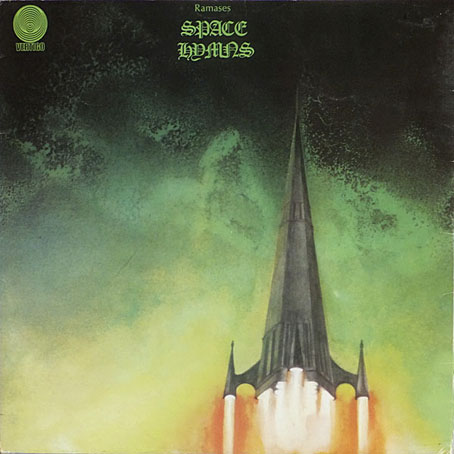
Roger Dean’s album cover art extends further than his sleeve illustrations for Yes. His earlier designs for the Vertigo label showed his visual invention to good effect, and a couple of those designs have had their imitators. The cover art for Dedicated To You, But You Weren’t Listening by the Keith Tippett Group is one that I’ve seen copied although I forget where for the moment so you’ll have to take this on trust. (Ahem.)

ramases2.jpg

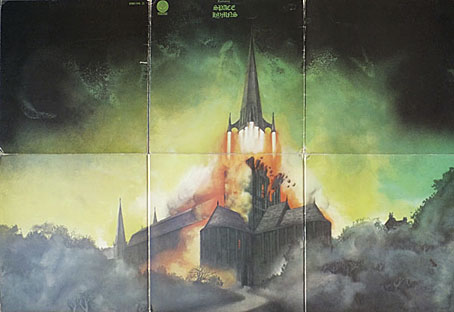
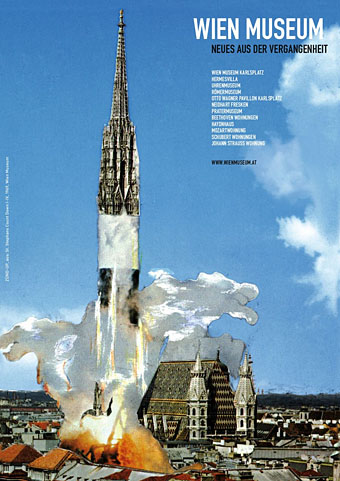
The church steeple blasting off from Space Hymns (1971) by Ramases is borrowed somewhat crudely in a 2011 ad for the Wien Museum which shows Vienna’s St Stephen’s cathedral undergoing a similar transformation. The Ramases idea is so eye-catching I’m surprised I’ve not seen it imitated before, although it wasn’t Dean’s invention; in his Views book he says that it was the group’s idea, and they gave him a thorough brief. I presume by this he means that they also wanted the spire as a cover detail, and looking sufficiently rocket-like to give a surprise when the sleeve is opened.

wien.jpg

“Ramases” was Martin Raphael Barrington Frost, an Egypt-obsessed British musician who recorded two albums and a single with wife, “Selket”. The single B-side, Mind’s Eye (1968), is a decent piece of psychedelia that turns up on compilations. The same can’t be said for Space Hymns, unfortunately; the presence of 10cc as backing band isn’t enough to rescue songs whose cosmic titles offer more than they deliver. But that’s still a great sleeve. Thanks to @weird_prophet for the Wien tip!

Elsewhere on { feuilleton }
The album covers archive

Previously on { feuilleton }
Roger Dean: artist and designer