School Daze by Patrick Cowley

cowley.jpg

School Daze sleeve designed by Eloise Leigh.

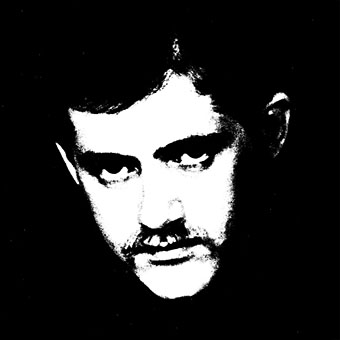
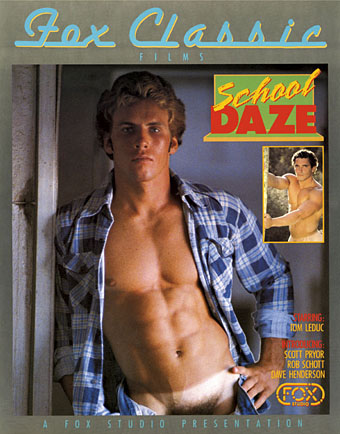
Music made for porn films is nothing if not derivative and unmemorable, assuming it’s been specially made at all and isn’t merely a cheap library track, the aural equivalent of stock footage. This wasn’t necessarily the case when porn cinema was getting established in the America of the 1970s but a huge turnover of anonymous product combined with simple expediency—hours of footage that needed to be soundtracked by something—made falling standards inevitable. The cliché of the cheesy porn soundtrack is such a given that it’s a surprise to encounter anything which is even halfway listenable away from the screen. In the case of this album by Patrick Cowley it’s even more of a surprise to find that such exceptional music has been hiding for years on a couple of gay porn films, School Daze and Muscle Up, from 1980.
foxclassic.jpg

Gay porn would seem the perfect thing to be soundtracked by the creator of an unashamed anthem like Menergy (1981) but the music on School Daze bears little resemblance to Cowley’s Hi-NRG disco hits, not least because some of the tracks were composed as far back as 1973 when Cowley was still in college. The tapes were unreleased until John Coletti, the owner of Fox Studios, asked Cowley for some music which is how these early experiments ended up as porn scores. Experiments they may be, in differing moods and styles, but they’re also very successful ones. Jorge Socarras’s album notes describe Cowley’s wide-ranging musical (and sexual) tastes which would explain why one of the longer tracks, Journey Home, features a didgeridoo of all things. The didgeridoo sound became a considerable dance music cliché in the early 90s but prior to this you’d only find it outside Indigenous Australian music on pastiche numbers such as Flying Doctor by Hawklords or The Dreaming by Kate Bush; Cowley uses the instrument as simply another sound source. Socarras also mentions Cowley listening to Tomita and Wendy Carlos while in college but none of the music here sounds anything like the earlier generation of Moog composers. It also doesn’t sound much like Tangerine Dream or anything that was happening in Europe during the 1970s. If anything, the subdued and often dark atmosphere is a better fit with the post-punk music being produced in Britain around the time the films were released, sombre albums like The Bridge by Thomas Leer & Robert Rental, or instrumental tracks by The Human League. Didgeridoo or not, some of the tracks are pretty gloomy for porn music.

In the autumn of 1982 I was in the process of moving from Blackpool to Manchester, and spent a lot of time shuttling back and forth on coaches listening to tapes on a cheap Walkman clone. A couple of those journeys were soundtracked by Patrick Cowley’s extended remix of I Feel Love by Donna Summer and Industrial Muzac by Throbbing Gristle, a piece of subdued electronica which has been out of circulation for far too long. The music on School Daze fills an unlikely space between the two, there’s even a synth solo like the one that erupts into the Donna Summer remix. Patrick Cowley died in November of that year, one of the earliest casualties of a disease which at that time wasn’t even called AIDS. Listening to School Daze, and to the last album released while he was alive, Mind Warp, you can’t help but wonder what he might have done with the sampling technology that became widespread a couple of years later.

School Daze is available on double-vinyl and CD from Dark Entries who say all proceeds from the album will be donated to Project Open Hand and the AIDS Housing Alliance.

Nightcrawler from School Daze
Mockingbird Dream from School Daze
Dark Entries interviews John Coletti of Fox Studio
Five Things You Need to Know about Gay Electronic Wizard Patrick Cowley

Previously on { feuilleton }
William E. Jones on Fred Halsted
Summer of Love
A Clockwork Orange: The Complete Original Score
Weekend links 198

boty.jpg

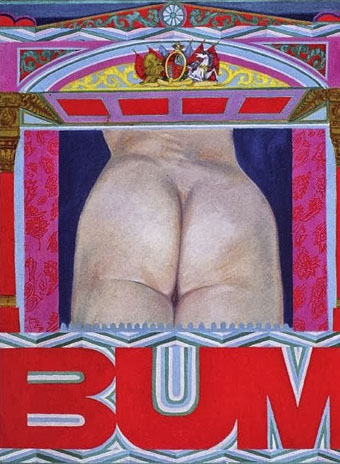
Bum (1966) by Pauline Boty.

Eleanor Birne on Pauline Boty, “the only prominent female Pop artist among a generation of famous men”. Ken Russell’s Pop Art documentary, Pop Goes the Easel (1962), which features Boty, may be seen here. Two years later Boty was back with Ken Russell playing the part of the prostitute from The Miraculous Mandarin in a film about Béla Bartók. That’s something I’d love to see. There’s more about her painting, and the work of other female Pop artists, here.

• Why Are We Sleeping? Mark Pilkington on the music world’s recurrent interest in the philosophy of GI Gurdjieff. Pilkington’s most recent Raagnagrok release with Zali Krishna, Man Woman Birth Death Infinity, was reviewed by Peter Bebergal.

• Cinematic details: Frames-within-frames in The Ipcress File (1966), and the typography of 2001: A Space Odyssey (1968).

highrise.jpg

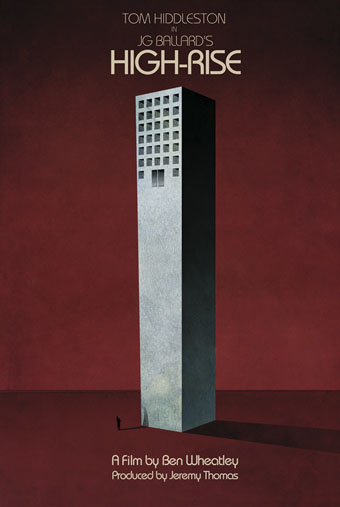
A Jay Shaw poster for Ben Wheatley’s forthcoming film of High-Rise.

• “…a large cavity must be dug in the bird’s shoulder and filled with ball bearings.” Christine Baumgarthuber on the dubious delights of The Futurist Cookbook.

• Why Tatlin Can Never Go Home Again: Rick Poynor on the difficulties of finding a definitive representation of an artwork online.

Jay Parini reviews Inside a Pearl: My Years in Paris by Edmund White. At AnOther Donatien Grau talks to White about fashion.

• At Bajo el Signo de Libra (in Spanish): the homoerotic and occasionally Surrealist art of Pavel Tchelitchew.

• At 50 Watts: Kling Klang Gloria: Vintage Children’s Books from Austria.

• The motorbike girl gangs of Morocco photographed by Hassan Hajjaj.

Geoff Manaugh on how LED streetlights will change cinema.

Stylus “is an experiment in sound, music and listening”.

• Mix of the week: Secret Thirteen mix 106 by Senking.

• At Pinterest: JG Ballard

This Is Pop? (1978) by XTC | Pop Muzik (1979) by M | Pop Quiz (1995) by Stereolab

Thot-Fal’N, a film by Stan Brakhage

brakhage1.jpg

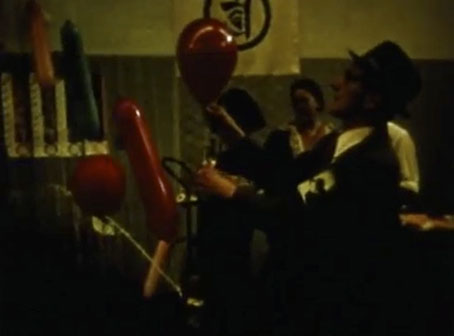
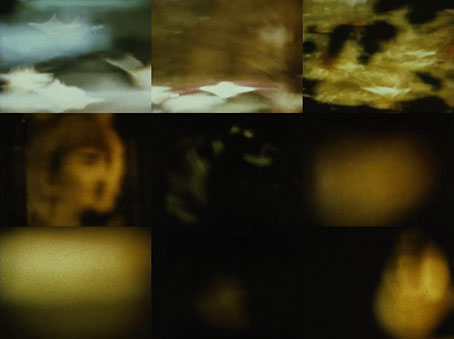
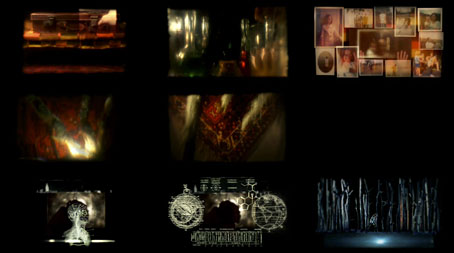
A final film for this week of Burroughs-related posts. Thot-Fal’N (1978) is a typical piece of Stan Brakhage montage: 9 minutes of completely silent close-ups, shots blurred to incoherence, plus occasional clips of American streets or people. Among the identifiable humans there’s a brief sequence with William Burroughs and a balloon, also shots of Allen Ginsberg and Peter Orlovsky. Brakhage enjoyed creating cinema that was deliberately abstract and without narrative so there’s no need to go looking for a meaning.

brakhage2.jpg

Elsewhere on { feuilleton }
The William Burroughs archive

Mr Bradly Mr Martin Hear Us Through The Hole In Thin Air

bradly1.jpg

Vimeo swarms with Burroughs-related films, many of which might not have been made had it not been for the profusion of recordings of the author reading his work. This short from 2010 is one of the better examples, a combination of live-action film and animation by Greig Johnson that crams a considerable amount of invention into five minutes. The text is from the mulch of cut-ups that formed Nova Express, the recording being one of the tracks on Burroughs’s first album of readings, Call Me Burroughs (1965). Given the film’s style and short running time it makes a good double-bill with Philip Hunt’s Ah Pook Is Here (1994).

bradly2.jpg

Elsewhere on { feuilleton }
The William Burroughs archive

The Last Words of Dutch Schultz, a film by Gerrit van Dijk

lastwords.jpg

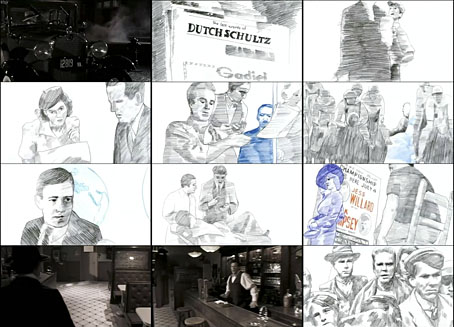
Gerrit van Dijk’s combination of live-action sequences and rotoscoped animation is tangentially related to William Burroughs, it being Burroughs who popularised the deathbed ramblings of New York gangster Arthur “Dutch Schulz” Flegenheimer with a “fiction in the form of a film script” also entitled The Last Words of Dutch Schultz (1970).

Flegenheimer was gunned down in the toilet of the Palace Chop House in Newark, New Jersey, in October 1935. Three of his associates had also been shot but he survived, and he spent two days muttering in his hospital bed while a police stenographer took notes. Burroughs was fascinated by the dissociated stream-of-conscious nature of the transcript which revealed little about his assailants but drifted feverishly through memories and hallucinations. The shooting and the deathbed ramblings were further popularised in 1975 by the publication of the Illuminatus! trilogy by Robert Shea and Robert Anton Wilson in which some of Flegenheimer’s more surreal pronouncements—”A boy has never wept nor dashed a thousand kim”—acquire occult significance. Flegenheimer and his last words also turn up in Exterminator! (1973), and Burroughs further fragmented the transcript in at least one of his own recordings where he reads out the equally strange phrases from transcripts of so-called electronic voice phenomena over an earlier reading of Flegenheimer’s words; the voices of the (supposed) dead wiping out the voice of the dying.

Burroughs’ Last Words of Dutch Schultz is nicely presented in its original form, the pages being laid out like a screenplay interposed with crime-scene photos from the period, Flegenheimer’s mug-shots and Art Deco graphics. The scene descriptions range through Flegenheimer’s life and mob history; whether they would make a good film or not would no doubt depend on the director. A film based on the script would be feature-length, and the narrative is a very fragmented one. Gerrit van Dijk’s film runs for 23 minutes and takes a similar approach, dramatising the shooting from different angles while juxtaposing the live action with animated sequences that are often anachronistic. Rutger Hauer supplies Flegenheimer’s dying voice. The anachronistic moments don’t contribute much unless we’re meant to regard Flegenheimer’s fever as being some kind of precognitive vision. Given the nature of the material—Depression-era gangsters, hallucinations, the Burroughs connection—I’m sure this won’t be the last film we see on the subject.

Elsewhere on { feuilleton }
The William Burroughs archive