The Nose, a film by Alexandre Alexeieff & Claire Parker

nose.jpg

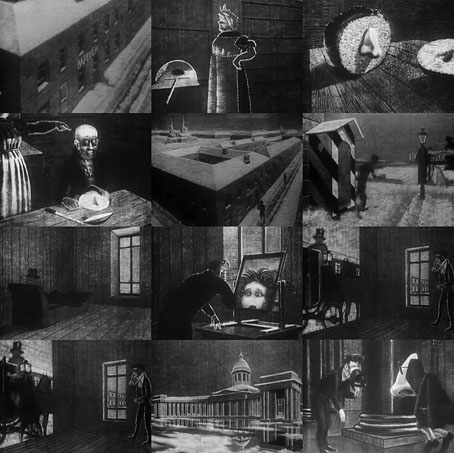
The last time I wrote about the animated films of Alexandre Alexeieff & Claire Parker the only copies available were low-grade things on YouTube which have long-since vanished (one of many reasons I don’t embed YT players in these posts). Happily a new copy of The Nose (1963) has appeared that’s not only better quality but isn’t split into two as was the case earlier.

The Nose is based on the Gogol story of the same name, a tale of a St Petersburg official who wakes to find his nose has left his face and is masquerading as a civil servant. I’ve not read Gogol’s story but I do have Nabokov’s book about Gogol which dwells not only on the prominent nose of the author, but also his traumatic death which was hastened in part by a quack physician who treated Gogol by applying leeches to his nose. Neither story or film contain anything as horrific. The film version is a wordless animation made using the pinscreen technique which Alexeieff & Parker developed in order to create greyscale animated films without recourse to smudgy materials like pencil, pastel, charcoal, etc. As I’ve mentioned before, the most notable application of this technique is the prologue the pair created for Orson Welles’ film of The Trial (1962). What’s striking about the Alexeieff & Parker use of the pinscreen is how skilfully they use it to manipulate light and shade. Where other animators like Jacques Drouin used the technique more impressionistically, Alexeieff & Parker’s films at times give the impression of watching an animated engraving. The Nose is one of their finest pieces. (Thanks to Gabe for the tip!)

Previously on { feuilleton }
Alexandre Alexeieff and Claire Parker
William Morris and His Work

morris01.jpg

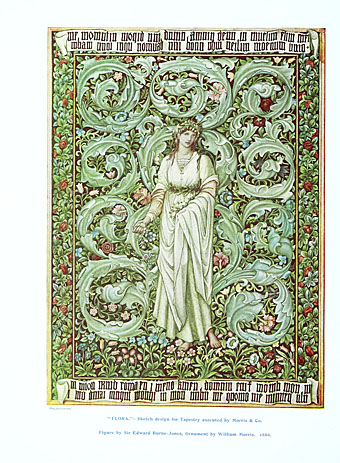
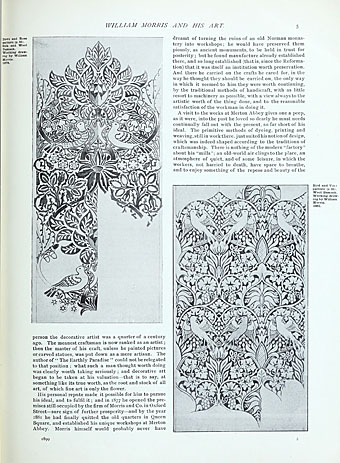
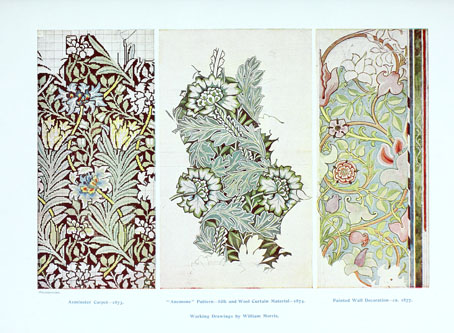
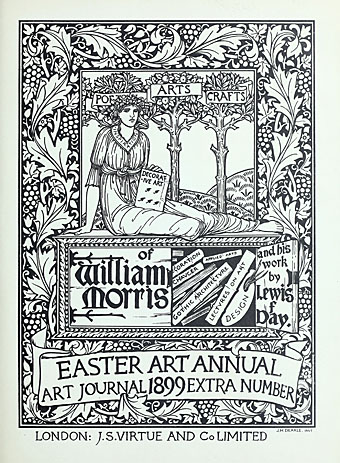
The world isn’t exactly starved of books about William Morris but William Morris and His Work (1899) is the first I’ve seen that gives an opportunity to study the creation of some of the Morris company’s florid textile designs. Those that follow obvious repeating patterns (like the bird designs below) don’t appear technically challenging but I’ve wondered a few times about the difficulties of creating some of the very elaborate interlacings of foliage that became the Morris hallmark. Lewis Foreman Day wrote a number of books on the history of ornament and design so he’s an ideal guide. Browse his book here or download it here.

morris02.jpg

morris03.jpg

morris04.jpg

Continue reading “William Morris and His Work”

The Voyage of the Pequod

henry1.jpg

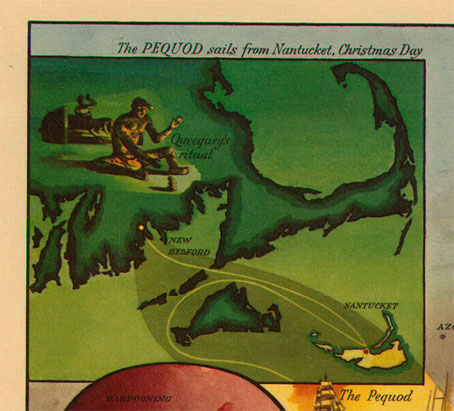
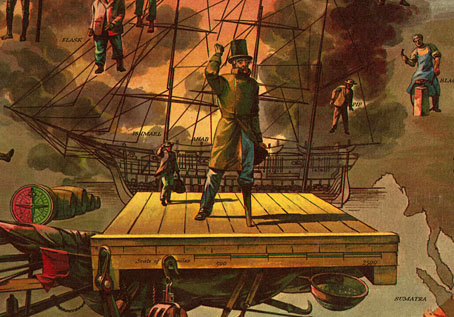
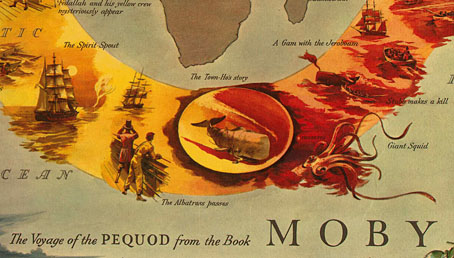
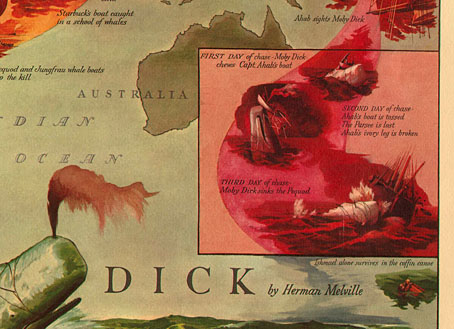
American illustrator Everett Henry (1893–1961) created several maps based on classic American novels but The Virginian and The Adventures of Huckleberry Finn lack the epic, globe-trotting qualities of Moby-Dick, one of the few novels where almost every scene takes place in a different part of the world. The linear nature of the voyage also aids Henry’s design with its graded colours and suitably bloody culmination. The use of vignettes in literary maps reminds me most of the charts drawn by Pauline Baynes for Tolkien’s books but there are plenty of other examples, some of which may be seen at VTS.

henry2.jpg

henry3.jpg

henry4.jpg

henry5.jpg

Elsewhere on { feuilleton }
The illustrators archive

Previously on { feuilleton }
Of the Monstrous Pictures of Whales
Jan Saenredam’s whale
The Whale again
Rockwell Kent’s Moby Dick
Pauline Baynes, 1922–2008

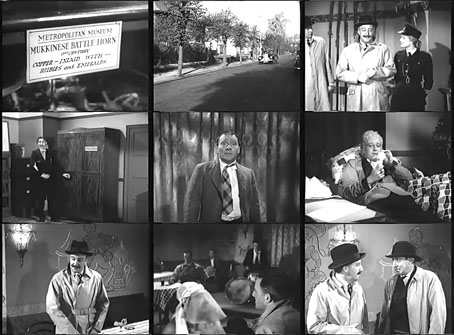
The Case of the Mukkinese Battle-Horn

mukkinese1.jpg

I probably should have posted this when the Monty Python reunion shows were in progress since the first time I saw it was as the support film for a screening of Monty Python and the Holy Grail in 1974.

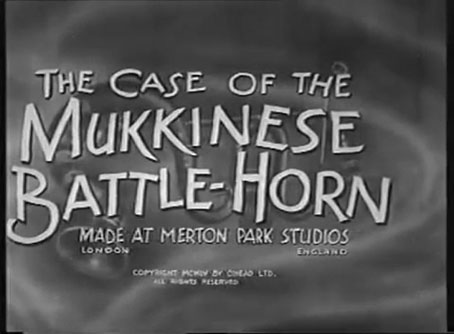
The Case of the Mukkinese Battle-Horn (1956) is one of the few film outings for The Goons, the radio-comedy troupe who famously influenced the Pythons and The Beatles. Joseph Sterling was the director. The 27-minute film features a diminished Goons cast: regulars Peter Sellers and Spike Milligan, with Dick Emery replacing Harry Secombe; all three have multiple roles, as they did in the Goons, and Emery did later in his TV shows. It’s a cheap production but packed with silly sight gags, some of which draw attention to the film medium: no wonder the Pythons liked it. Most surprising of all is seeing Michael Deeley listed as producer; Deeley started out producing lowly fare such as this but went on to produce some very notable British films including The Man Who Fell to Earth and Blade Runner.

mukkinese2.jpg

Previously on { feuilleton }
The Running Jumping & Standing Still Film

Weekend links 222

wicker.jpg

A self-portrait by Nadia Wicker from her Projectie series.

• “And boy, did that Rain Parade sleeve look cool with its picture of the insouciant band sitting in front of large hot-house (or glass palace), the sky behind them tinted a sickly shade of apocalypse pink…” Joe Banks on the Rain Parade’s finest moment, Explosions In The Glass Palace.

• “…there are pleasures to be had from books beyond being lightly entertained. There is the pleasure of being challenged; the pleasure of feeling one’s range and capacities expanding…” Rebecca Mead on the pleasure of reading to impress yourself.

• “If Gengoroh Tagame performed the acts he drew in his comics he’d probably be dead or in jail,” says Zac Bayly, interviewing Tagame for BUTT.

Crime does not fascinate James Joyce as it fascinates the rest of us—the suggestion of crime dismays him. He tells me that one of his handicaps in writing Work in Progress is that he has no interest in crime of any kind, and he feels that this book which deals with the night-life of humanity should have reference to that which is associated with the night-life of cities—crime. But he cannot get criminal action into the work. With his dislike of violence goes another dislike—the dislike of any sentimental relation. Violence in the physical life, sentimentality in the emotional life, are to him equally distressing. The sentimental part of Swift’s life repels him as much as the violence of some of his writing.

Padraic Colum attended Joyce’s 47th birthday party.

• I’m currently reading The Wanderer, “a weird document” by Timothy J. Jarvis, which is officially published this week.

The Changes, another remarkable children’s TV series from the 1970s, is out on DVD next week.

Sir Richard Bishop has made all 14 of his solo albums available as free downloads.

• “How long do CDs last? It depends, but definitely not forever,” says Laura Sydell.

• “Readers absorb less on e-readers than on paper, study finds

• Book designer Craig Mod wants to talk about margins.

• Mix of the week: a mix for The Quietus by Helm.

Ozu’s passageways

• The Rain Parade: No Easy Way Down (BBC TV, 1984) | No Easy Way Down (studio, 1984) | No Easy Way Down (Tokyo, 1984)