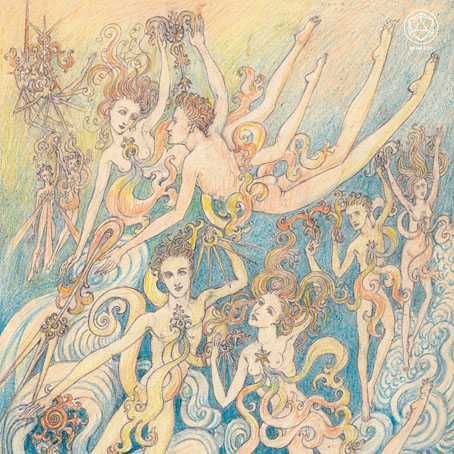
Viewing View

view1.jpg

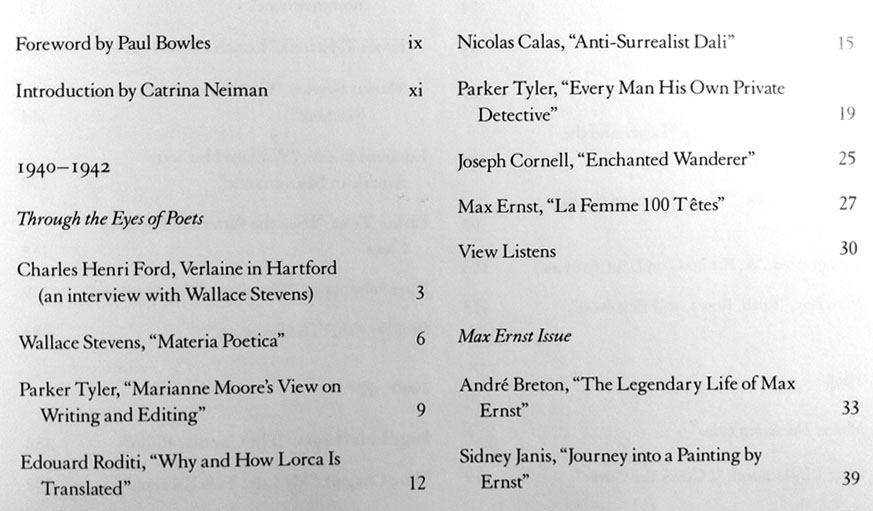
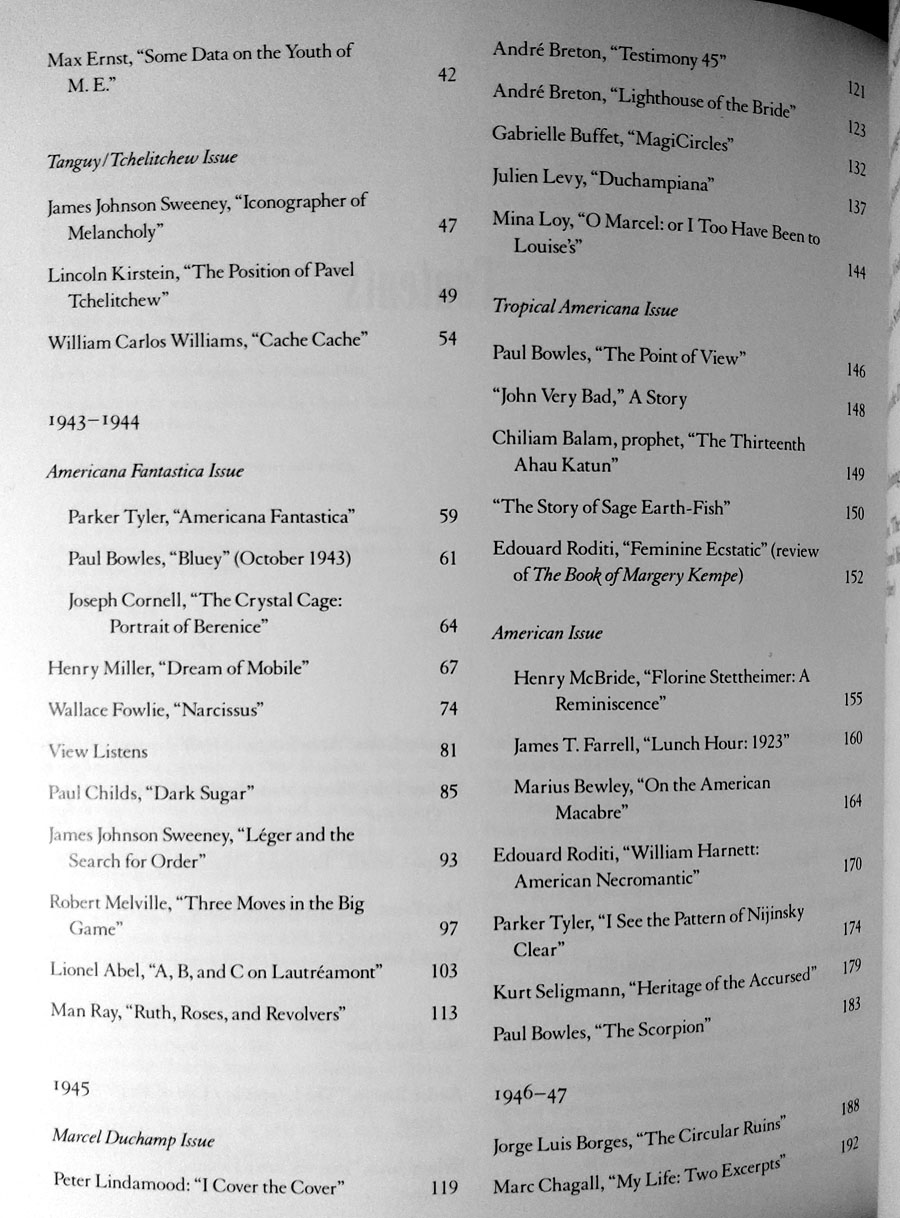
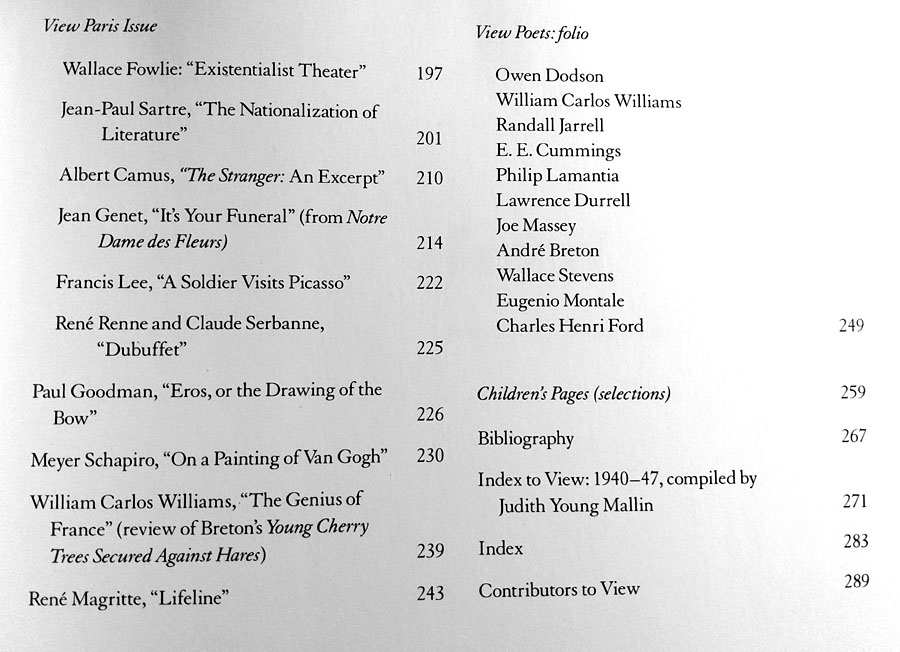
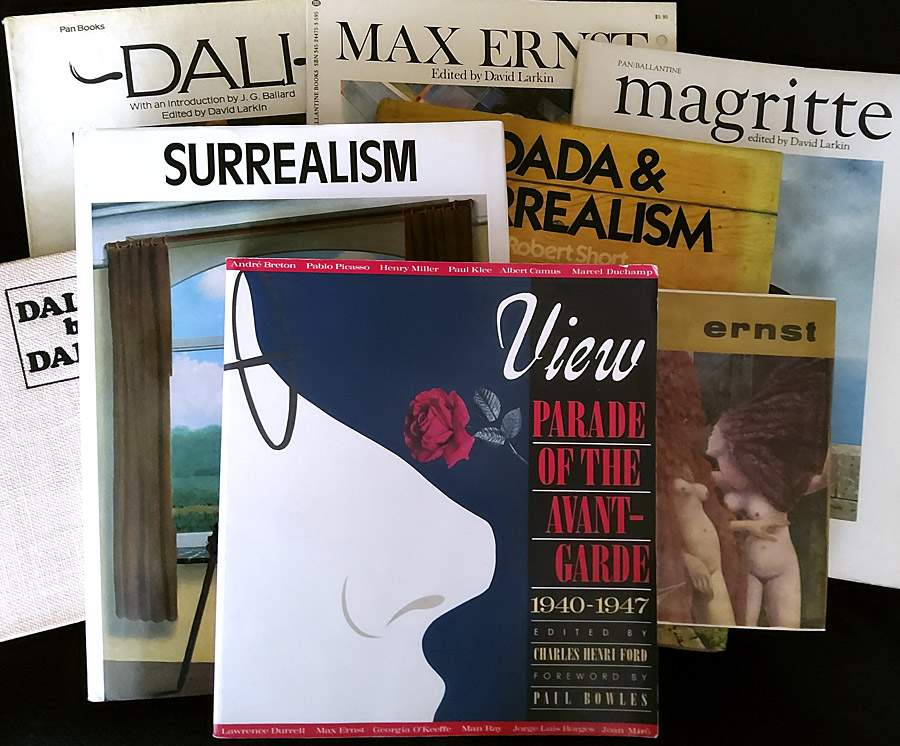
“Convulsive beauty” continues to be the order of the day around here. Reading Deborah Solomon’s Joseph Cornell biography back in April I was wishing again that there might be a way of seeing back issues of Charles Henri Ford’s View magazine, a heavily Surrealist art journal published in New York in the 1940s with an incredible list of contributors. (See this post.) Cornell was good friends with Ford and his artist-partner, Pavel Tchelitchew, and provided material for several issues of the magazine, including a substantial contribution to the Americana Fantastica special of January 1943. So I was delighted—convulsed, even—when the generous Mr TjZ of Connecticut offered to send me a copy of View: Parade of the Avant-Garde, a 290-page reader compiled by Ford for Thunder’s Mouth Press in 1992. Ideal reading just now. Thanks, Joe!

view2.jpg

view3.jpg

view4.jpg

Previously on { feuilleton }
View: The Modern Magazine

Weekend links 520

teleplasmiste.jpg

Cover art by Ethel le Rossignol for To Kiss Earth Goodbye by Teleplasmiste.

• I’ve been listening to London Zoo by The Bug this week so two new releases by The Bug’s beatmaster, Kevin Martin, seem well-timed. Martin’s music isn’t all pummelling rhythms and abrasive noise, he also favours doomy ambience, as demonstrated on his landmark compilation album, Isolationism (1994). The new releases, Frequencies For Leaving Earth, Vols 1 & 2, are isolationist in multiple senses of the word, being further products of lockdown life, with the second volume described as reflecting Martin’s “ongoing obsession with scarce sci-fi scores”.

• “It was designed to run counter to formalist & Hollywood Structuralist definitions & expectations.” M. John Harrison in a discussion about his cycle of Viriconium novels and stories. Harrison’s new novel, The Sunken Land Begins To Rise Again, will be published at the end of this month.

• Mix of the week: 31st May 2020 (Lovecraft 2) by French Rock Sampler, a recording of Warren Hatter’s radio show devoted to French underground, synth and progressive music of the 1970s. The current season may be heard each Sunday at 3pm (London time) on Resonance FM.

This is a very important book. It may even be a historic book, one with which gay history can arm itself with more sufficient factual veracity as to start vanquishing at last the devil known as queer studies. Queer studies is that stuff that is taught in place of gay history and which elevates theory over facts because its practitioners, having been unsuccessful in uncovering enough of the hard stuff, are haughtily trying to make do. […] It is not only breathtaking to read this all in a work the likes of which so many Americans long to have written about our own gay history, but when one finishes reading it, one utters an audible huge sigh of relief. Of course this is how it was! Why did we all not know and accept this instinctively without having to create and/or buy into the Foucaultian and Butlerian (to name but two) nightmares with the obtuse vocabularies they invented and demanded be utilized to pierce their dark inchoate spectacles of a world of their own imaginings. Homosexuality did not exist because there was no word for it, say they. What bushwa.

The late Larry Kramer in 2009 reviewing Before Wilde: Sex between Men in Britain’s Age of Reform by Charles Upchurch

• I mentioned in April that I’d designed the CD and vinyl packaging for Roly Porter’s latest album, Kistvaen. It’s another monumental release, and it’s out now. Hear it for yourself at The Quietus.

To Kiss Earth Goodbye, the new album from Teleplasmiste, features cover artwork by Ethel le Rossignol, and a previously unheard trance recording of occultist Alex Sanders.

• “It’s impossible to completely quantify the effect of I Feel Love on dance music.” John Doran on Donna Summer and Giorgio Moroder’s finest moment.

• More film lists: 10 great Japanese film noirs selected by Matthew Thrift, and the 15 best Czech horror films selected by Jason Pirodsky.

Mark Blacklock selects a top ten of four-dimensional novels (one of which isn’t a novel at all but a short story by Ian McEwan).

• At Dennis Cooper’s: BDSM.

Angry (2008) by The Bug feat. Tippa Irie | Insane (2008) by The Bug feat. Warrior Queen | Fuckaz (2008) by The Bug feat. Spaceape
All change

linotype.jpg

Since I’ve decided to start writing here more frequently I’m also taking advantage of a rare lull between commissions to upgrade the blog. I’ve avoided doing this for far too long with the result that the current three-column appearance is no longer suitable for mobile hardware. I don’t look at websites on my phone but I use a tablet every day and these pages aren’t very readable on small screens so I’m looking for a more flexible blog theme. Before doing this I’ve also been upgrading some of the background software, and will probably be installing things and messing around behind the scenes for the next couple of days. Consequently, the TS Eliot testcard may be visible more than usual while I take WordPress offline.

The Marvellous

melly.jpg

The marvellous is always beautiful. Anything marvellous is beautiful. In fact only the marvellous is beautiful.

George Melly (above) quoting André Breton’s declaration from the first Surrealist Manifesto, 1924

Two posts in one week—quelle surprise. This is partly because I’m trying to get WordPress to post updates to Twitter, something that hasn’t been possible for many years without going through the long-winded process of signing up as a Twitter developer. Anything that limits my involvement with Twitter’s burning café feels like a positive thing at the moment, so thoughts that I previously cast into the flames may find their expression here instead.

svankmajer.jpg

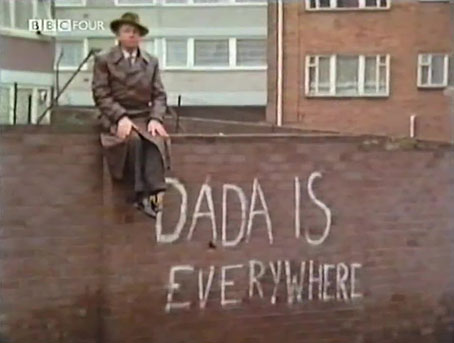
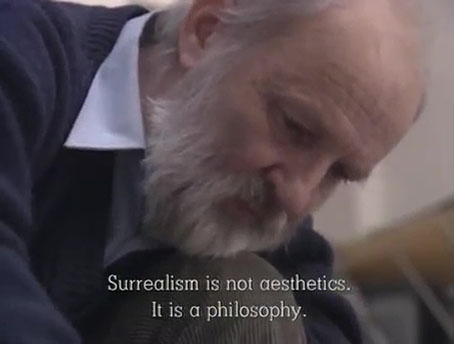
The two screengrabs are from recent re-viewings. George Melly’s short guide to Surrealism for the BBC’s Arena, and Jan Švankmajer’s equally short BBC profile have both been featured here in the past, but my recent purchase of a box of blu-rays from Švankmajer’s shop has prompted a journey back into the Surrealist praxis via whatever books and videos I have to hand. It’s been interesting looking again at René Passeron’s Encyclopedia of Surrealism (1975), a book which for many years was more interesting for the 24-page section devoted to the precursors of Surrealism, all the artist-eccentrics, architects, illustrators, Mannerists, and (especially) the Symbolists whose works I spent most of the 1980s pursuing. Today there are more threads to be followed in the Surrealist section of Passeron’s study so I’m looking forward to seeing where they lead. As for The Marvellous, the Švankmajer discs are this with and without the capital “M”. I recommend them.

Update: And the post didn’t announce itself at Twitter which isn’t so surprising; I’ll keep working at this behind the scenes. Social media is the anti-Marvellous.

Moirage, a film by Stan VanDerBeek

vanderbeek1.jpg

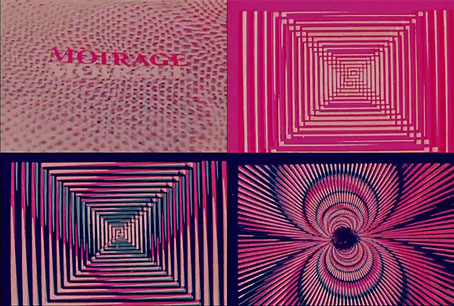
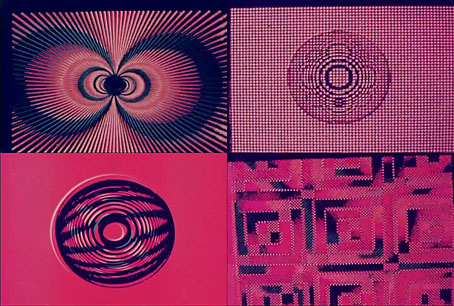
Further proof that if you wait long enough (almost) everything turns up eventually. In 2011 I mentioned a fruitless search for Moirage (1970), a short film by Stan VanDerBeek, and here it is, in a rather scratched print at the Internet Archive. The film proves to be as I expected, an abstract work that animates the kinds of patterns that would have been deemed Op Art in the few years before LSD use became widespread, but which were unavoidably psychedelic by the time VanDerBeek came to make his film.

vanderbeek2.jpg

The patterns were provided by Gerald Oster, a biophysicist who used his discoveries in photochemical research to create works of art. My Studio Vista guide to Op Art lists two Oster studies in its bibliography: a book, The Science of Moiré Patterns (1959), which included sheets of overlays for the reader to play with; and an article co-written with Yasunori Nishijima, Moiré Patterns, for Scientific American (May, 1963). (The magazine also had a moiré pattern as its cover illustration.) I was playing with moiré interference myself a few weeks ago so this discovery is a timely one. My experiments involved vector graphics, a much more versatile medium for creating these effects than the printed sheets that Oster and his colleagues had to create. I’d been thinking of using the patterns as part of a book design but haven’t decided yet whether they’re suitable.

Elsewhere on { feuilleton }
The abstract cinema archive