Suspicion: The Voice in the Night

voice1.jpg

This isn’t the best quality at all but it’s worth noting for those of us intrigued by the very small number of film and television adaptations of William Hope Hodgson’s stories. The Voice in the Night (1907) is Hodgson’s most popular story with anthologists, a tale of fungal horror that features a number of the author’s familiar motifs: the derelict ship, the uncharted island, and the sea as a home of insidious menace. The story was filmed by Godzilla director Ishiro Honda in 1963 as Matango (aka Fungus of Terror, Curse of the Mushroom People and Attack of the Mushroom People) but I’ve never seen this so I can’t comment on it.

voice2.jpg

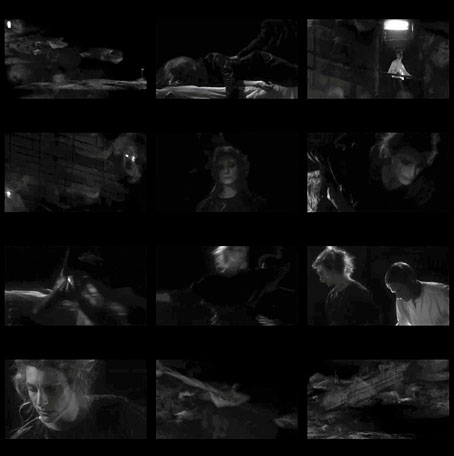
Hodgson aficionados evidently prefer the 1958 television film directed by Arthur Hiller and shown as part of NBC’s Suspicion series. The title on this copy is Alfred Hitchcock’s Voice in the Night although Hitchcock seems to have had nothing to do with the production. Stirling Silliphant adapted the story, and he does a good job of fleshing out the narrative without spoiling things. James Donald and Barbara Rush are the doomed shipwreck survivors who find a fungus-covered derelict, and beyond this, an uncharted and similarly fungus-covered island. Patrick Macnee and James Coburn play the two sailors to whom Thomason (Donald) narrates his tale, although their scenes in this copy are so murky and indistinct it might as well be a radio play. Quality aside, this is a very effective adaptation even if it does evade some of the more terrible details in the closing pages of the story. It’s closer to the spirit of Hodgson than The Horse of the Invisible or Dennis Wheatley’s Hodgsonian The Lost Continent. The Suspicion series doesn’t seem to have been released on DVD so for now YouTube is the only place you can see this film. (Big thanks to Ross for the tip!)

Previously on { feuilleton }
Hodgsonian vibrations
The Horse of the Invisible
Tentacles #2: The Lost Continent
Tentacles #1: The Boats of the ‘Glen Carrig’
Hodgson versus Houdini
Weekend links: Hodgson edition
Druillet meets Hodgson

Weekend links 248

baylay.jpg

The Dreamers (2013) by Kate Baylay, from Seven Gothic Tales by Isak Dinesen.

• RIP composer and musique-concrète pioneer Tod Dockstader. “I didn’t have the money for electronic sounds…I had to have things like bottles, or anything that would make a noise. It didn’t matter what it was; if it sounded interesting, or I could make it interesting, I’d go for it.” Geeta Dayal talked to Dockstader for Wired in 2012. Dockstader’s film credits included Fellini’s Satyricon and Tom and Jerry cartoons. He also wrote the story for one of the latter, Mouse into Space, in 1962. Ubuweb has some early Dockstader recordings.

• “…anyone who has ever sat in a cafe, or in the bath, with a paperback owes a debt to Aldus and the small, cleanly designed editions of the secular classics he called libelli portatiles, or portable little books.” Jennifer Schuessler on Aldus Manutius, and the roots of the paperback.

• “At Chernobyl, we made ‘the world’s first radioactive nature preserve.’ We made black rain. We made the Red Forest, which was green when the day began, and is dead.” Mary Margaret Alvarado reviews The Long Shadow Of Chernobyl by Gerd Ludwig.

Prison was often the fate of those caught circulating samizdat in the Soviet Union—not only the “high” samizdat such as Solzhenitsyn, but the crude and lowly joke books as well. The official rationale for the prohibition was in context no less reasonable than the rationale given more recently for condemning Charlie Hebdo or R. Crumb. There is always a perception that the very serious project of perfecting society is being undermined. But society will not be perfected, and it is a last resort of desperate perfecters to go after the subtle-minded satirists who understand this.

Justin EH Smith on why satire matters

• “You have to do your research, and you’ll find treasures that you couldn’t even have begun to sit down and draw until you saw them in front of your eyes,” says Annie Atkins, graphic designer behind The Grand Budapest Hotel.

The Tales of Hoffmann: exclusive materials from the making of Powell and Pressburger’s masterpiece. The film will be released on Blu-ray by the BFI later this month.

• The illustrated score for Irma, the opera offshoot of Tom Phillips’ A Humument, is now available from Lulu.

Mellifluous Ichor From Sunless Regions, a free album of Hauntological electronica by The Wyrding Module.

Kraftwerk at the controls: what the group’s live instrument setup looks like today.

• Booze, Blood and Noise: The Violent Roots of Manchester Punk by Frank Owen.

• Mix of the week: 14th February 2015 by The Séance.

Vintage logo designs

Transmission (1979) by Joy Division | Radioactivity (William Orbit mix, 1991) by Kraftwerk | Bellstomp/Pond Dance (Mordant Music remix, 2012) by Tod Dockstader

Weekend links 247

buratti.jpg

Encounter with the Priestess by Robert Buratti.

• “We were gothy, we loved the New York thing and people like Suicide, Dave loved Throbbing Gristle, we both loved the Sheffield bands…we loved the darkness to that kind of electro.” Marc Almond talking to Simon Price. Also at The Quietus, Cat’s Eyes choose their favourite soundtracks.

• “When he reveals that all he wants is to deliver a breakfast sandwich, the enigma of his desire is not so much dispelled as redoubled—why on earth would anyone want to do that?” Adam Kotsko on the unheimlich nature of old Burger King ads.

• “…commercial design is full of politics, to be a commercial designer is a political decision.” Jonathan Barnbrook talking to Katrina Schollenberger.

You need to know who Billy Wilder was. You need to know the names of people who are no longer alive. Because it’s very important—it’s what our history is made of. You need to see the movies the way they were—with the racism, the violence, and the censorship. All the things that let you see what the movie past had been so you understand where we are! But really nobody’s interested in that right now. Their interests are so bifurcated.

Joe Dante discussing film production past and present with Michael Sragow.

• From 1983: The Encyclopedia of Ecstasy, Vol. 1, a publication which creator Alistair Livingston describes as a “psychedelic goth punk fanzine”.

• Mixes of the week: No One’s There, a collection of post-punk electronica by Abigail Ward, and Secret Thirteen Mix 146 by Te/DIS.

• Frans Masereel’s My Book of Hours is “a crucial example of the power of stories without words,” says Stefany Anne Golberg.

Miles Davis and band in concert, 18th August, 1970. Pro-shot, 45 minutes.

• Lots of good reading and cultural connections at Celluloid Wicker Man.

A world map of micro-nations

Tokyo in dense fog

Tainted Love/Where Did Our Love Go? (1981) by Soft Cell | Tainted Love (1985) by Coil | Titan Arch (1991) by Coil with Marc Almond

Crystal balls

crystal04.jpg

The Crystal Ball (c. 1900) by Robert Anning Bell.

Crystal balls in art, film and the pulp magazines.

crystal05.jpg

The Crystal Ball (1902) by John William Waterhouse.

crystal02.jpg

Alexander, Crystal Seer (1910).

Continue reading “Crystal balls”

A Darkness Made of Beating Wings, a film by Dave Colohan

darkness.jpg

When Dave Colohan was in touch late last year he mentioned work on a new film which is now available for viewing at Vimeo. A Darkness Made of Beating Wings is another meditation on the sombre beauties of the Irish landscape (with additional shots of the Inner Hebrides) only this time there’s more textual substance in the figure portrayed by Ciarán MacAoidh, a traveller caught between the Celtic past and present, shadowed all the while by a spectral figure. Deliciously atmospheric work once again, with monochrome photography by Mick Carey.

Given all the Celtic business, I thought the hills seen at the beginning might be the Paps of Anu in Kilarney but searching revealed that they’re a different set of breast-shaped hills, the Paps of Jura in the Hebrides, which I’d not heard of before. The isle of Jura produces one of my favourite brands of malt whisky so this adds an additional note of approval.

Previously on { feuilleton }
Newlyborn, a film by Dave Colohan