Weekend links 686

bickus.jpg

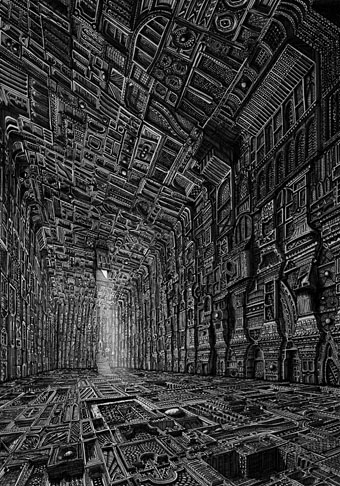
The Great Lab (2020); speculative architecture by Gytis Bickus. “This room is where the majority of the hallucinogenic substances are archived, within the walls & floors. It seems as though the architecture itself is being affected by the hallucinogenic substances stored within its fabric.”

• “They ran the recording through a vocoder, so it sounded staticky, like a voice infused with white noise, and put it at the end of the song. Then they went home.” Mark Dent on Change The Beat by Beside (aka Bee-side or Beeside), a song produced by Bill Laswell & Michael Beinhorn that includes one of the most sampled vocal lines in hip-hop. A great piece of audio-archaeology: I knew the sample but had no idea this song was its source. I only got to hear the Change The Beat very recently when I found a copy of Materialism, a collection of early Laswell productions, in a charity shop.

• At Unquiet Things: Artist, Chemist, Goofball: Catching Up With Tyler Thrasher.

• DJ Food looks at psychedelic posters created for London’s Middle Earth club.

His last commissioned work for Radio Berlin was a fantastical play he had composed himself. The transcript, titled “Lichtenberg: A Cross-Section,” ranks among the strangest things that he ever wrote. Beings who live on the moon are charged with the task of investigating the career of Georg Christoph Lichtenberg, a prominent physicist of the German Enlightenment. The moon beings have uncanny names—Labu, Quikko, Sofanti, and Peka—and they convene as the Moon Committee for Earth Research, which deploys odd contraptions for its work, each of them “easier to use than a coffee grinder.” There is a “Spectrophone,” which permits them to hear and see everything that happens on Earth; a “Parlamonium” that translates human speech into music; and an “Oneiroscope” that allows the researchers to observe human dreams. With the aid of these devices, the moon beings seek to understand why humans are so afflicted with misery. Their investigations finally reach the tentative conclusion that even if humans are unhappy, “perhaps it is their unhappiness that allows them to advance.” To honour the scientific achievements of Herr Lichtenberg, they conclude by naming a crater in his honour, a crater from which shines a “magical light that illumines the millennium.”

Peter E. Gordon on Walter Benjamin’s radio years

• At Dennis Cooper’s: Spotlight on…Brigid Brophy In Transit (1968).

15 lighthouses from the Smithsonian Magazine Photo Contest.

Sathnam Sanghera’s favourite songs.

• RIP William Friedkin and Jamie Reid.

• New music: The Long Song by Drøne.

Lighthouse (1978) by Tim Blake | Walk To The Lighthouse (1980) by John Carpenter | The Lighthouse (1994) by Hector Zazou ft. Siouxsie
Weekend links 683

inshaw.jpg

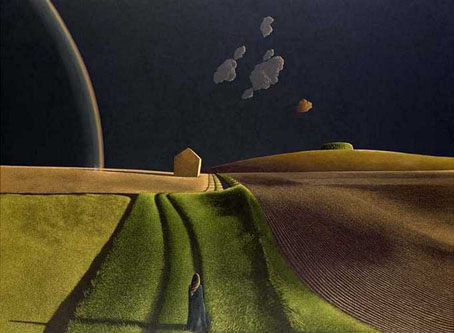
She Did Not Turn (1974) by David Inshaw.

• “Pauline Kael compared Bruce Lee to Fred Astaire; I think the comparison works better with Rudolf Nureyev. Astaire had a besuited, playful grace, while Nureyev was shirtless, dramatic, and muscular. Astaire moved with athletic modesty, while Lee’s bravura dominated the screen.” Micah Nathan on 50 years of Enter the Dragon.

• New music: This Stolen Country Of Mine by Alva Noto, and Denshi Ongaku No Bigaku (The Aesthetics of Japanese Electronic Music) Vol.1 by Cosmocities Records.

• At Cartoon Brew: A profile of Sally Cruikshank. The spooky psychedelia of Face Like a Frog has long been a favourite round here.

• “My Life in a Hop, Skip and a Jump!” Clive Hicks-Jenkins answers a few questions about his art.

• At Public Domain Review: Hokusai’s Illustrated Warrior Vanguard of Japan and China (1836).

• More martial arts: Tom Wilmot on Bruce Lee’s greatest fight scenes at Golden Harvest.

• Submissions to the Astronomy Photographer of the Year Awards.

• At Dennis Cooper’s: Lucrecia Martel Day.

• RIP Jane Birkin.

Enter The Dragon (1974) by The Upsetters | Dragon Power (A Tribute To Bruce Lee) (1978) by JKD Band | Edit The Dragon (1985) by Colourbox

Weekend links 681

hunter.jpg

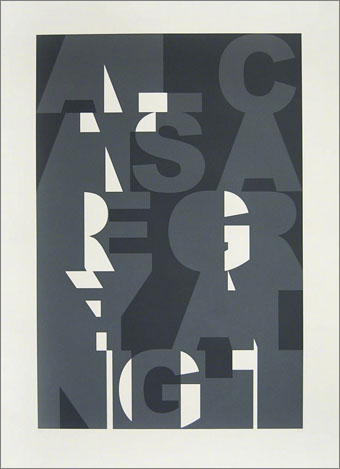
All Cats are Grey At Night (2009) by Kenny Hunter.

“They found ways to do the impossible”: Hipgnosis, the designers who changed the record sleeve for ever. Lee Campbell talks to Anton Corbijn about Squaring the Circle, Corbijn’s documentary about the Hipgnosis design team. Peter Christopherson is shown in the accompanying photo but Campbell doesn’t mention him at all, despite his having been an equal partner with Storm Thorgerson and Aubrey Powell from the mid-70s on. Many of those famous covers were photographed by Christopherson’s camera.

• A new book by Stephen Prince at A Year In The Country: “Lost Transmissions weaves amongst brambled pathways to take in the haunted soundscapes of electronica, the rise of the occult in the 1970s, cinema and television’s dystopian dreamscapes and hauntological work which creates and gives a glimpse into parallel worlds…”

• New music: Ambient Bass Guitar by John von Seggern, and Sturgeon Moon/Beaver Moon by Missing Scenes.

• How Samuel R. Delany Reimagined Sci-Fi, Sex, and the City.

• Mix of the week: Tranquility by A Strangely Isolated Place.

Galerie Dennis Cooper presents…Snow Globalists.

• The Strange World of…African Head Charge.

• Steven Heller’s font of the month is Baudot.

Nights on Earth.

Transmission (1979) by Joy Division | Clandestine Transmission (1994) by Richard H. Kirk | Transmission (1996) by Low

Back and forth


Another advantage of the recent WordPress upgrade means I can now do things like this. The photo is a Prague street scene that I found in a newspaper years ago which I decided to depopulate in Photoshop. In the past you could only do this with a special plugin but WordPress changed the user interface a while back from a basic write-text-and-add-media arrangement to a more complex editing system known as Gutenberg. The new editor uses CSS-style blocks which you fill with different types of “content” then shuffle around until you have a layout that you’re happy with. You can do a lot with these blocks but most of the tools that control them are hidden from view behind multiple menus and sub-menus; using the system means you first have to learn and memorise the location and function of all these hidden tools. Users of standalone installations of WordPress are a loyal bunch but there was a very negative reaction to the new editor, so much so that a plugin appeared almost immediately which reverts the interface to the former system. WordPress continues to evolve Gutenberg, however, and now provides a variety of media blocks like this picture-comparison thing. The utility is limited but it looks nice.

I’m in the anti-Gutenberg camp for the most part, especially when looking at the code that makes something like this possible. Most of the posts here are written outside WP as plain text with handwritten HTML tags; Gutenberg adds loads of new tags and instructions that clutter up the back end. I may work as a book designer but a print-style layout isn’t what I want to emulate for these pages. (And the Adobe applications I use don’t hide all their controls unless you really want them to.) Gutenberg is no doubt useful for people with big media websites using WordPress as a CMS to create layouts filled with articles, video and the like. But I’ll be sticking with the old system for now.

Weekend links 676

binnie.jpg

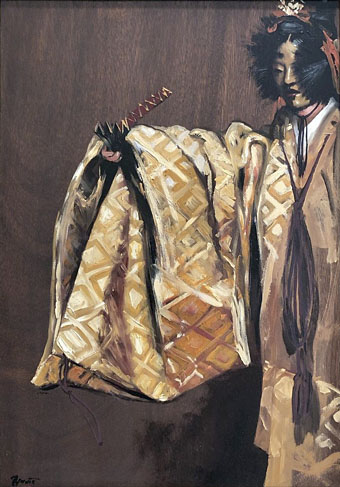
Sleeve Study, from Kakitsubata (1998) by Paul Binnie.

• “London was not a project for me. It was the curse that never stops giving.” Iain Sinclair talking to Matthew Stocker about his new book for Swan River Press, Agents of Oblivion.

The Ultimate DMT Breakthrough Replication Compilation, a video guide to the DMT experience by Josie Sims. Related: Kristen French on what hallucinogens will make you see.

• At Spoon & Tamago: A return to Tokyo Genso’s depictions of an urban Japan transformed by vegetation and neglect.

• New music: The Shell That Speaks The Sea by David Toop & Lawrence English.

• At Bajo el Signo de Libra: San Sebastián de Mártir a Icono Homosexual.

• Cosmic views from the Milky Way Photographer of the Year, 2023.

Nakamura Mitsue makes a Noh mask from a single block of wood.

• Mix of the week: A mix for The Wire by Eleni Poulou.

• At Dennis Cooper’s: Delphine Seyrig Day.

Of Ancient Memory (The Oblivion Seekers) (1994) by Jarboe | Oblivion (2001) by Lustmord | Oblivion (2004) by Redshift