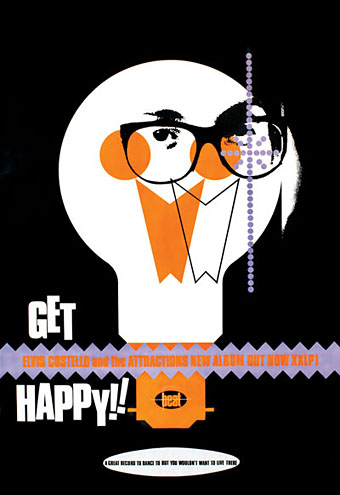
Poster by Barney Bubbles for Elvis Costello’s Get Happy!! (1980).
Adelita, the publishers of Reasons To Be Cheerful: the life and work of Barney Bubbles, announced this week that Paul Gorman’s essential collection of BB graphics has been named Book of the Year in Mojo magazine:
Reasons To Be Cheerful – the acclaimed study of the life and work of the late graphic genius Barney Bubbles – has been declared Book Of The Year by the UK’s leading rock monthly Mojo magazine.
Described as “fascinating and definitive” by the Sunday Times and “moving and lovingly researched,” by GQ editor Dylan Jones in The Independent, Reasons To Be Cheerful was written by Paul Gorman (author of style bible The Look and Straight with Boy George) and published by British independent popular culture imprint Adelita (sales and distribution through Turnaround Publisher Services).
Mojo will name Reasons To Be Cheerful Book Of The Year in its January 2010 issue (published November 27) with an exclusive interview with Factory Records designer Peter Saville praising its publication.
A quarter of a century after he took his own life at the age of 41, Reasons To Be Cheerful has transformed Barney Bubbles’ cult status by elevating him into the pantheon of graphic design greats. Among fans of the book are such prominent musicians as Paul Weller, Jah Wobble, Mick Jones, Nick Lowe and Billy Bragg.
Reasons To Be Cheerful is the first and definitive exploration of this important visual artist’s body of work, with more than 600 images including student sketchbooks, private paintings, product, brand, underground and music press and examples of the hundreds of record sleeves, posters, adverts, promotional items and music videos he created for the likes of the Rolling Stones, Hawkwind, Ian Dury, Elvis Costello, Nick Lowe, Squeeze, Depeche Mode, The Specials and Billy Bragg.
Reasons To Be Cheerful has also spawned a spectacular online presence featuring fresh interviews, information and rare and previously unseen images (see http://barneybubbles.com/blog) and has been well received in the UK and US (where it is distributed by D.A.P). Author Paul Gorman will also curate a Barney Bubbles exhibition to be inaugurated at London’s Chelsea Space gallery during Design Week in September 2010.
By coincidence, two days after Mojo appears the All-Day Barney Bubbles Benefit Memorial Concert will be staged at the 229 Club, Great Portland Street, London. Bands featured include various members of the Hawkwind/Hawklords family led by Nik Turner. There’ll also be the return of Turner’s post-Hawks outfit Inner City Unit, for whom Barney created some of his last designs, and the resurrection of the Imperial Pompadours, a one-off rock’n’roll collaboration between Nik and Barney. That’s happening on 29th November and Turner’s website has all the necessary details.
The Elvis Costello poster above comes from a feature about the Get Happy!! album at Paul Gorman’s BB site. I was never a great fan of Costello’s records but the designs Barney created for those early releases were outstanding and represent the peak of his career. (See the Armed Forces sleeve design for a real eye blast.) Paul’s post shows how much work went into creating a range of integrated graphics for the album, singles and promotional material, and he also has some exclusive material which didn’t make it into Reasons To Be Cheerful. The BB book has been a continual treat to look through this year, and the book design I happen to be finishing has not only been inspired by Barney’s example but also manages to make passing reference to him inside. More about that later.
Previously on { feuilleton }
• Hawk things
• Who is Heeps Willard?
• The Sonic Assassins
• Reasons To Be Cheerful, part 3: A Barney Bubbles exclusive
• More Barney Bubbles
• Reasons To Be Cheerful, part 2
• Reasons To Be Cheerful: the Barney Bubbles revival
• Barney Bubbles: artist and designer