November shirts

skullprint-shirts.jpg

Skull Print shirts.

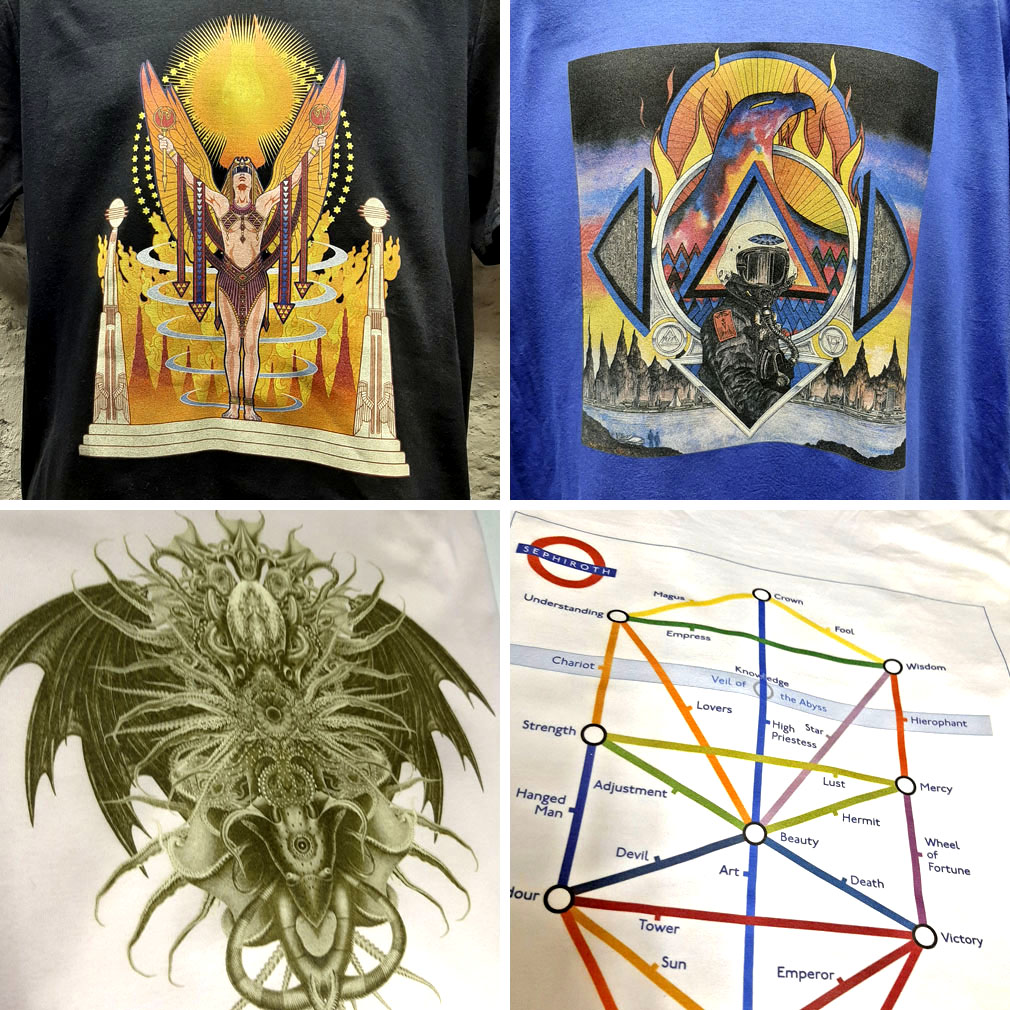
November weather isn’t exactly suitable for T-shirt wearing when you live this far north (although it’s unseasonably mild just now) but I’ve recently added four more shirt designs to my Skull Print page. As I was saying last month, now that I’ve quit CafePress all shirts featuring my art and design will be done through Skull Print, a small business who specialise in shirt-printing, and do so with very reasonable prices: £22 (inc. postage) for the UK, £32 (inc. postage) for the rest of the world. Long sleeves, sizes 3XL and over, and tie-dye colours add a little more to the cost.

skullprint-magus.jpg

It’s always the case when creating spin-off products that I’m guessing what people may want. Three of the four new designs have been extracted from popular works of the past (the Tarot designs have been given a boost now that they’re featured in the Bumper Book of Magic). I’m always open to suggestions for new designs so long as they don’t infringe on any trademarks or copyright agreements.

skullprint-priestess.jpg

skullprint-chaos.jpg

The Chaos symbol is a new creation based on a shirt I designed for Hawkwind’s Chronicle Of The Black Sword tour in 1985 (see this post). The symbol isn’t exclusive to Hawkwind, of course. Michael Moorcock invented it for the original Elric stories in the 1960s after which it was picked up by the practitioners of Chaos magic in the 1980s.

skullprint-alice.jpg

And this is one of my popular Alice in Wonderland designs which I amended for The Graphic Canon in 2012, extending the square composition into a rectangle. I may add one or two more from this series in future although this was one was easier to adapt than some of the others.

Weekend links 750

long.jpg

Cover art by Edward Gorey, 1964.

• Plenty of Halloween fallout as usual this week, but then Halloween here is a state of mind rather than a single day’s celebration. Leading off with an article by Smoky Man for Italian readers (and for auto-translators) at (Quasi), the first in what will be a series of reviews of each section of the Moon and Serpent Bumper Book of Magic. I’ve been helping with this, answering questions about the book’s production. I may post my answers here at a later date but for the moment I’m happy to keep them exclusive. In other Moon and Serpent news, the Bumper Book was reviewed by Sam Thielman in the New York Times last weekend, and also subjected to a deeper exploration by Joe McCullough for The Comics Journal.

Michael Atkinson explores the psychosocial dread at the heart of Japanese horror. One of the films I watched for Halloween was Kiyoshi Kurosawa’s brilliantly unnerving Pulse, a film which turns up again in Anne Billson’s evolution of horror in ten revolutionary films.

• Among the new titles at Standard Ebooks, the home of free, high-quality, public-domain texts: Short Fiction by Frank Belknap Long, a collection of science fiction and horror stories which opens with Long’s contribution to the Cthulhu Mythos, The Hounds of Tindalos.

Paracelsus’ quasi-scientific, quasi-magical worldview would profoundly influence scientists for centuries to follow. As historian Violet Moller puts it in her new book Inside the Stargazer’s Palace, “To our rational, orderly, 21st-century minds the 16th-century map of knowledge appears messy, a paradoxical and confusing place where magic was studied alongside geometry, people searched obsessively for the philosopher’s stone and astrology was fundamental to many areas of life.” But in this mixed-up cauldron of magic and nature, real science was forged.

Dale Markowitz on how the occult gave birth to science

• New music: Of Nature & Electricity by Teleplasmiste, and Tristitiam Et Metus Tradam Portare Ventis by Philippe Blache (Day Before Us).

Adam Scovell dares to look inside Dario Argento’s dungeon-like museum of horror memorabilia, Profondo Rosso.

• At Little White Lies: Tyler Thier on Stan Brakhage’s autopsy film, The Act of Seeing With One’s Own Eyes.

• At Spoon & Tamago: Keisuke Oka’s Arimaston Building in Tokyo, made entirely by hand.

• At Bandcamp: George Grella on the pioneers of musique concrète.

• At Unquiet Things: Marci Washington’s midnight revelations.

Typo 8: The International Journal of Prototypes.

• RIP Teri Garr.

Pulse (1972) by Agitation Free | Pulse State (1991) by The Future Sound Of London | Pulse Detected (2021) by The Grid/Fripp

In the footsteps of The Soul

soul1.jpg

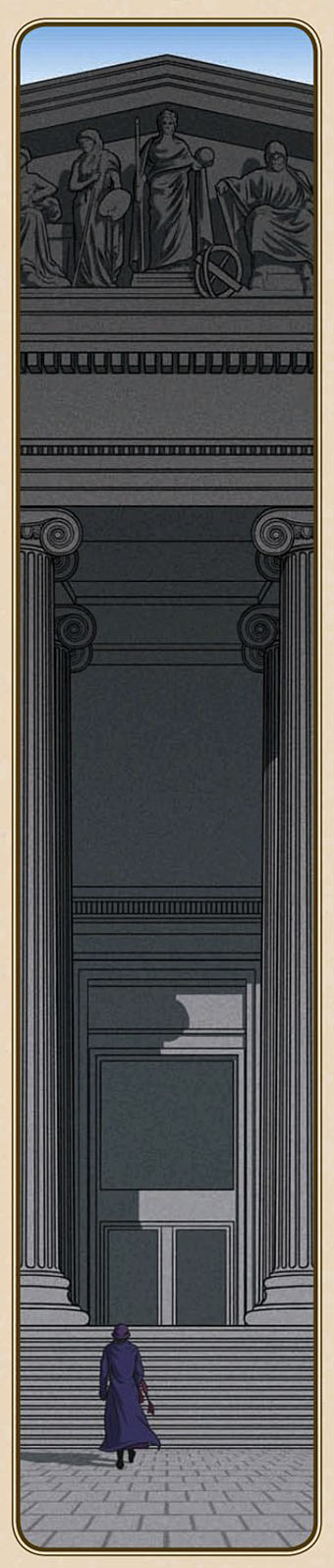
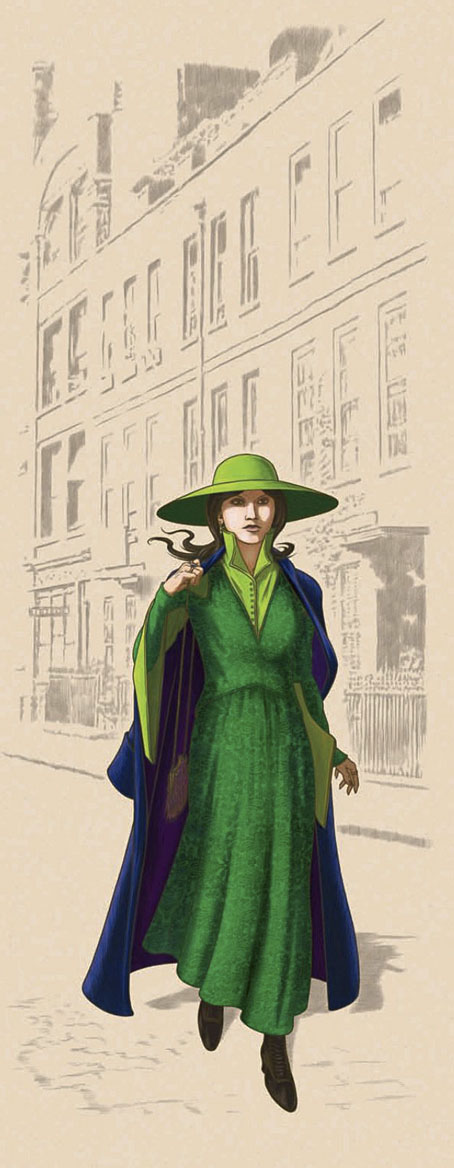
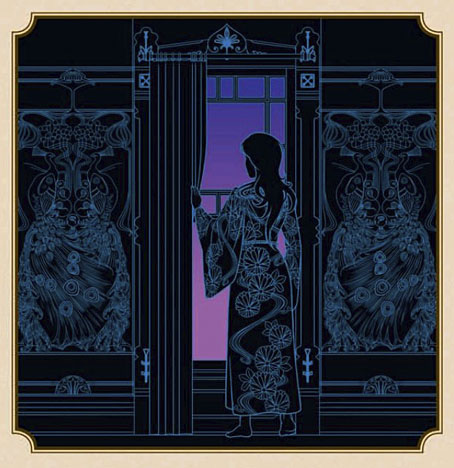
Adeline Carr, aka “The Soul”, wandering through the streets of Holborn while worrying about her future. Her dress is an Erté creation with curiously complicated sleeves.

After checking out of my Bloomsbury hotel on Saturday morning I decided to walk over to the nearby Atlantis Bookshop, London’s oldest occult bookseller, which is located in Museum Street close to the British Museum. I know the shop well but this visit was different since the route would take me past a number of locations mentioned in the fiction serial which runs throughout the Moon and Serpent Bumper Book of Magic.

The Dweller in the Abyss is a story about “The Soul”, a young woman in the 1920s who was originally going to be a kind of occult investigator for a comic series Alan Moore and I were planning for ABC in the late 1990s. This didn’t work out for a variety of reasons but The Soul has been reborn in the new book, with her character reinvented in order to demonstrate the personal evolution of a neophyte entering the world of magic. Adeline Carr, “The Soul”, is an artist’s model who lives in the first-floor flat above the Atlantis shop. I won’t go into detail about the story, the whole thing needs to be read with the complementary material surrounding it, but Adeline’s wanderings around this quarter of the city take her to a number of well-known locations which you can visit today, and which I illustrated to a greater or lesser degree.


1: Russell Square
russelsq.jpg

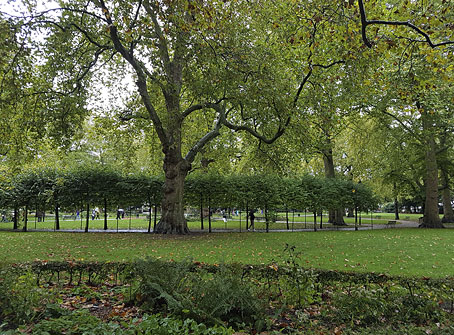
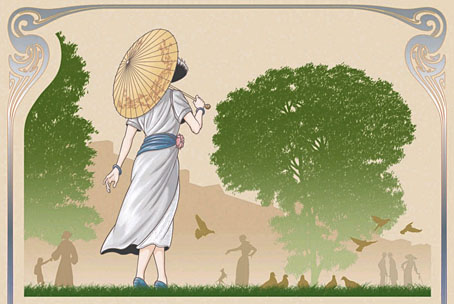
The first location I encountered—although my drawing of it appears near the end of the story—is the park in Russell Square, one of two such parks in the Bloomsbury area. It was raining on the morning I was there but Adeline’s walk through the park takes place on a sunny spring afternoon. The real place is rather more wooded than I showed it (there are more trees on the page which faces this one) but artistic licence is in operation here, and the park has been reorganised once or twice since the 1920s.
soul4.jpg


2: The British Museum

soul5.jpg

The next location is one I didn’t photograph, the British Museum. If it hadn’t been raining I might have walked through the gates to get a corresponding shot of the portico but the rain was heavier at this point and a large mass of umbrella-wielding tourists were crowding the entrance.


3: Museum Street
atlantis1.jpg

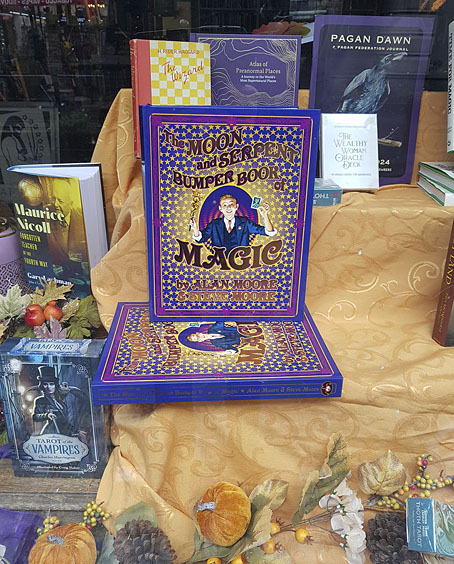
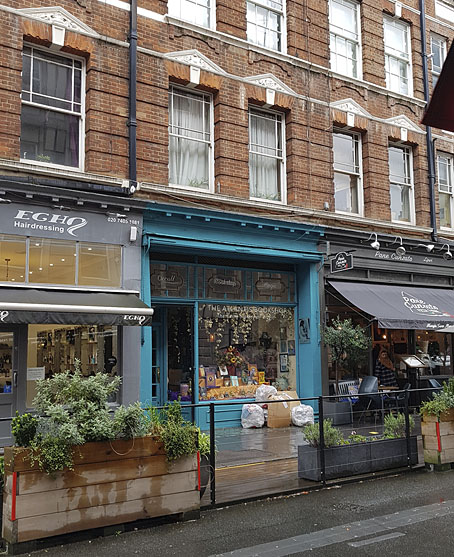
Into Museum Street and the Atlantis shop where the Bumper Book of Magic is visible in the window! This view shows the windows above the shop where Adeline lives. (Adeline’s windows aren’t a precise match but artistic licence again… Also, windows get replaced, especially after the wartime bombing that London endured.) The shop hadn’t opened yet so I walked round the corner into Bloomsbury Way to face the imposing bulk of Nicholas Hawksmoor’s church.
soul2.jpg


4: St George’s, Bloomsbury

stgeorges.jpg

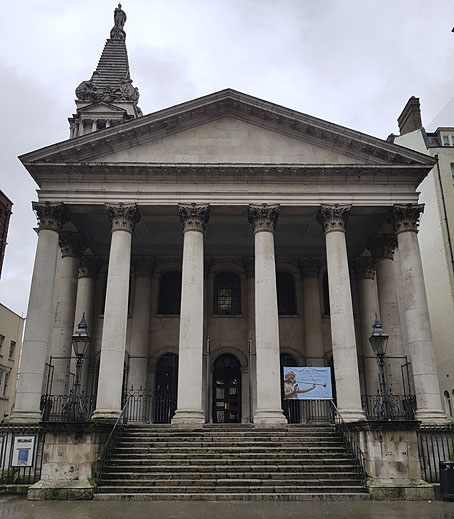
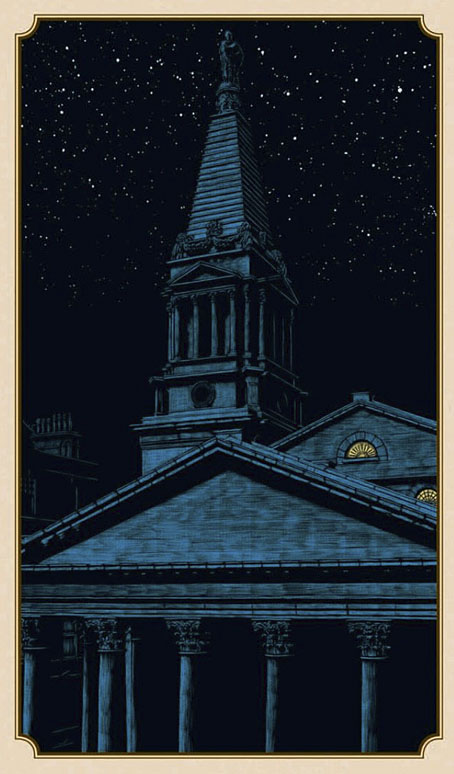
To date, this building and Christ Church, Spitalfields, are the only Hawksmoor churches I’ve visited in person. The church is an important location in Adeline Carr’s journey into magic, being the place where her spiritual revelations begin and reach their eventual climax. The pyramid-capped tower looks slightly different to the one I was drawing. The steeple, which is based on Pliny’s description of the Mausoleum of Halicarnassus, was originally decorated at its base with statues of lions and unicorns but these were removed during a restoration of the building in the 1870s. Like many London buildings, the church suffered from the ravages of neglect, wartime bombing and air pollution during the 20th century (Hawksmoor’s St John, Horsleydown, was destroyed entirely during the Blitz). Restoration of St George’s began in the late 1990s, a process which included the return to the steeple of the missing lions and unicorns. (See this website.) Visiting the place this time I was hoping to get a view of the tower from the passage that runs along the side but the gate to this was locked. You can, however, see the church from the rear via a narrow road where the steeple rises over the dingy back rooms which fill out the plot.
soul3.jpg


5: The Atlantis Bookshop

atlantis2.jpg

And so to the Atlantis shop again. It was a genuinely magical moment seeing the book in the window after spending so much time thinking about this very location and the events that take place in the flat above. By coincidence (or is it? etc), the book sitting next to it is by Gary Lachman who I’d been with the previous evening for the book launch. After the shop had opened I talked for a while with the proprietors, showing them the place on page 39 of the Bumper Book where their establishment is mentioned. The Atlantis isn’t the only occult bookshop in London (or even the only one in Bloomsbury…Treadwell’s is nearby) but if you’re in London it should be your first port of call if you’re looking for a copy of the Bumper Book.

The Atlantis Bookshop

Previously on { feuilleton }
Moon and Serpent Rising
Serious houses: The Lud Heat Tapes, 1979
London churches of the XVIIth and XVIIIth centuries
The Cardinal and the Corpse
Terror and Magnificence

Minotaur Ballet – Swansea Surreal

minotaur.jpg

October is still Spook Month as usual but this year it’s also the 100th anniversary of the publication of André Breton’s first Surrealist Manifesto, something I wrote about back in January. Many events have been acknowledging the anniversary including Minotaur Ballet – Swansea Surreal, an exhibition curated by David Greenslade and Incunabula Media which will be running at Volcano Theatre, Swansea from now to the end of the month. I’m one of the contributors with prints of my Alice in Wonderland posters. Lewis Carroll’s books were rare examples of British culture that Breton was enthusiastic about—he made Alice the “Siren of Dreams” in the Surrealist card deck—while Salvador Dalí and Max Ernst both created illustrations for the stories. I would have preferred to have made something new for the event but other work intervened.

The exhibition…will feature mainly Welsh artists, most of them from Swansea, alongside guests from Australia, Ukraine, Romania, Czech Republic, Egypt, Ireland and other parts of the UK.

ARTISTS INCLUDE
George Ostafi, Mark Sanders, Alexandria Bryan, Neil Coombs, John Goodby, Ricardo Acevedo, Carla-Francesca Schoppel, Dagmar Stepankova, David Rees Davies, Matt Leyshon, Jennifer Allan, Ben Faircloth, Wynford Vaughan Thomas, James Green, David K Mitchell, John Coulthart, Ian Walker, Premysl Martinec, Roger Moss, Julia Lockheart, David Greenslade, Simon Evans, Syd Howells, Keith Bayliss, Anatoly Shmatok, Maria Dolorosa de la Cruz

FILMS OLD AND NEW BY
Kenji Siratori, Zac Ferguson, Jane Arden (Norah Morris), Ricardo Acevedo

And a special screening of Blue Scar (1949)

alice.jpg

Elsewhere on { feuilleton }
The Surrealism archive

Previously on { feuilleton }
Scenes from a carriage
Dalí in Wonderland
Surrealist cartomancy

In the Mad Mountains

madcover.jpg

Cover design by Elizabeth Story. Cover art by Mike Mignola.

The subtitle tells you everything you need to know about this new collection of Joe R. Lansdale stories from Tachyon. I designed the interior of the book, less floridly than some of my previous designs for Tachyon, and a little more abstractly than I’d usually do for a title such as this. All of the stories have been published before, and since I’d illustrated one of them (for Lovecraft’s Monsters) I had vague hopes of incorporating my earlier illustration while providing new ones for the rest of the stories. This proved impossible, however; I was working on the layout while still finishing the design for The Bumper Book of Magic so didn’t have the time to do seven more drawings. I’ll post the illustration here anyway.

bleeding.jpg

The Bleeding Shadow is a great story, a low-rent detective tale set in the 1920s in which the predicament from The Music of Erich Zann—violinist has to keep playing his instrument in order to keep something terrible at bay—is recast with shellac 78s and a blues guitarist. Among the other pieces there’s a story that manages to successfully contrive a meeting between Huckleberry Finn, Brer Rabbit and the Cthulhu Mythos; and the final story which gives the collection its name, wherein the setting of Lovecraft’s Antarctic epic becomes a Sargasso-like landscape of shipwrecks, lost planes and horrors great and small. I especially enjoyed The Crawling Sky, a story of the Old Weird West featuring a Solomon Kane-like itinerant preacher, the Reverend Jebidiah Mercer. Lansdale’s grotesque humour is to the fore in this one. I’d like to see the Reverend given a collection of his own someday.

mad1.jpg

mad2.jpg

mad3.jpg

Elsewhere on { feuilleton }
The Lovecraft archive

Previously on { feuilleton }
Things Get Ugly
Lovecraft’s Monsters