
Weekend links 766

steam.jpg

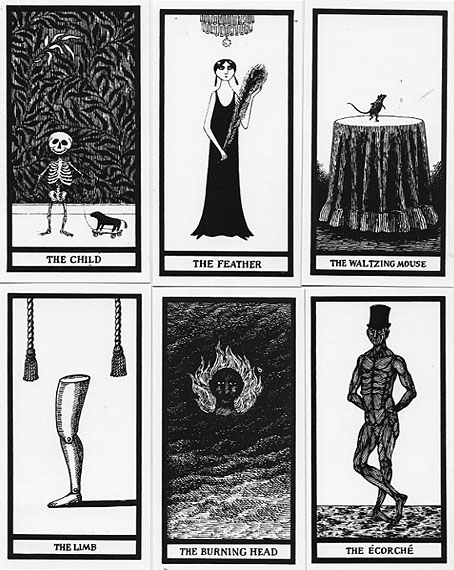
The Fantod Pack (1995): a Gorey take on the Tarot deck.

• A happy 100th birthday to Edward Gorey. I was hoping to link once again to Gorey’s appearance on the Dick Cavett Show from 1977 (a rare TV interview) but it’s one of those things that’s no longer available at YouTube. You can always browse Goreyana instead. Meanwhile, there’s this in Scotland: In Gorey Detail: Celebrating An American Friend At Custom House, Leith. A tribute exhibition which is running in Edinburgh for this week only.

• “A blisteringly frank and triple X-rated chat with Peter Berlin”. A blisteringly hyperbolic headline for a discussion between Ted Stansfield and Peter Berlin, the self-invented sex object of the 1970s.

• This week in the Bumper Book of Magic: Smoky Man posts my replies to his questions about the creation of the book’s Rainy Day and Kabbalah sections.

• Tricky’s Maxinquaye was released 30 years ago this month. David Bennun revisited the album five years ago.

• At Colossal: Felines evoke ‘A Floating World’ in Tùng Nâm’s whimsical illustrations.

• New music: Gloam by Emptyset, and The Mount Hibiki Tapes by Mount Shrine.

• Mix of the week: A mix for The Wire by Polonius.

• Steven Heller’s font of the month is Steam.

Last Of The Steam Powered Trains (1968) by The Kinks | Steam Megawatt (1979) by Tod Dockstader | Building Steam With A Grain Of Salt (1996) by DJ Shadow

Gwenaël Rattke record covers

rattke04.jpg

Muscle Up (2015) by Patrick Cowley.

This post is partly a reminder to myself that I’m still missing the last two Patrick Cowley album releases on the Dark Entries label. Dark Entries have distinguished themselves over the past few years by compiling selections from Cowley’s previously unreleased tape archive. Many of the recordings were made in the years before Cowley established himself as a producer of Hi-NRG disco hits, long pieces of instrumental electronic music which are closer to the typical electronica of the 1970s than the club music he became known for. This didn’t prevent his early recordings from being used as soundtracks for gay porn films, however, a connection that Dark Entries acknowledge in the packaging for their first three Cowley releases: School Daze (2013), Muscle Up (2015) and Afternooners (2017). The fourth album in the series, Mechanical Fantasy Box (2019), was released in tandem with a book of the same name, a journal of Cowley’s sexual encounters during the late 70s. The book and the albums from Muscle Up on have all featured art and graphics by Gwenaël Rattke, a German artist who uses traditional collage methods to repurpose imagery and graphics copied from gay magazines and porn publications of the 1970s and 1980s. The last time I looked at Rattke’s work I wasn’t aware that he’d created more album art so this post gathers a few additional examples along with his designs for Dark Entries.

rattke01.jpg

Lesbians On Ecstasy (2004) by Lesbians On Ecstasy.

I always like to see an accurate pastiche, and Rattke’s pastiches are close enough to their targets to be mistaken for products of the period they resemble, especially when assisted by fonts like Quicksilver, Stop, Sinaloa, and Motter Textura, all of which are redolent of the disco decade. Creating collages with scissors, paper and what looks in places like Risograph reproduction also helps with the period authenticity. You could create work like this with wholly digital means but if you did you’d have to do spend time disguising the absolute precision of those techniques.

rattke02.jpg

We Know You Know (2007) by Lesbians On Ecstasy.

rattke03.jpg

Liquidation (2015) by Liquid G.

rattke05.jpg

Patrick Cowley – Afternooners (2017) by Patrick Cowley.

Continue reading “Gwenaël Rattke record covers”

Weekend links 763

parent.jpg

I Live in Shock (1955) by Mimi Parent.

• At Public Domain Review: “Ben Hecht’s Fantazius Mallare (1922) is at turns obtuse, grotesque, and moralizing—and sought to provoke the obscenity trial of the century. Only it didn’t, quietly vanishing instead. Colin Dickey rereads this failed satire, finding a transcendent rhythm pulsing beneath the novel’s indulgent prose.”

• “There are no surprises when a pallet of CDs arrives at my office, but when a pressing plant alerts me to a shipment of records headed my way I start to worry.” John Brien, head of Important Records, on the problems involved in the manufacture of vinyl albums.

• The sixth installment of Smoky Man’s exploration of The Bumper Book of Magic has been posted (in Italian) at (quasi).

They were building a vast alternative religion with a lack of dictates but no shortage of rituals and icons. They’d pass through the end of the world to get there first; the next album was based on a vision of the Four Horsemen of the Apocalypse slaughtering their animals and constructing a earth-gouging machine from their jawbones, demonstrating they weren’t quite intending to settle down yet. It would take them far from mainstream culture, and indeed mainstream gay culture given their repeated disdain for sanitised queerness, and into enigmatic territory. Having scared away most fans of synth pop and industrial with provocation, and the weak and tyrannical with ambiguity, they were unencumbered and “allowed to mature in the dark”, sustained by a cult following (you rarely encounter a tepid fan of Coil, most are acolytes).

Darran Anderson looking back at Coil’s debut album, Scatology

• At Smithsonian Magazine: See 15 winning images from the Close-Up Photographer of the Year Competition.

• At The Daily Heller: How did pink become a colour? Meanwhile, Steven Heller’s font of the month is Vibro.

• New music: Even The Horizon Knows Its Bounds by Lawrence English.

SciURLs: A science news aggregator.

Shackleton’s favourite albums.

• RIP Marianne Faithfull.

The Pink Panther Theme (1963) by Henry Mancini | The Pink Room (1988) by Seigen Ono | Pink (2005) by Boris

Weekend links 762

max.jpg

Aquarius from the 1971 Astrologicalendar by Peter Max. Via.

AOS of London: Psychogeographia Zosiana is a map guide to the London of Austin Osman Spare with accompanying illustrations by Ben Thompson. The book also contains an interview transcript in which Alan Moore talks about the importance of Spare’s work, and a contextual history by Gavin W. Semple.

Emigre was “…a (mostly) quarterly magazine published from 1984 until 2005 in Berkeley, California, dedicated to visual communication, graphic design, typography, and design criticism.” The magazine ran for 69 issues which can be downloaded here.

• “The ultimate reason for initiating something ambitious is not to fulfill certain notions but to find out what surprises might emerge.” Stewart Brand, quoted in a long read by Alec Nevala-Lee about the Clock of the Long Now.

• At the Criterion Current: David Hudson on David Lynch’s life and work, an overview of the reaction to last week’s news. I was surprised to find my comments about Alan Splet included in the collection.

• At Wormwoodiana: Mark Valentine on the connections between Charles Williams’ The Place of the Lion and an obscure piece of fiction (or is it?) by Ruaraidh Erskine.

• At Public Domain Review: Illustrations by Jay van Everen from The Laughing Prince: A Book of Jugoslav Fairy Tales and Folk Tales (1921).

• At Colossal: Beguiling botanicals fluoresce in Tom Leighton’s otherworldly photographs.

• New music: Glory Fades by Yair Elazar Glotman & Mats Erlandsson.

• Old music: Cités Analogues by Lightwave.

• At Dennis Cooper’s: Georges Perec Day.

The Clock Strikes Twelve (1959) by Bo Diddley | Clock Factory (1993) by The Sabres Of Paradise | Clock (1995) by Node

Three alphabets

mitelli.jpg

E is for Elefante.

Last week I was trying without success to find the origin of a calligraphic alphabet I have in a book about ornamental typography. A failed quest but the search did turn up a couple of those illustrated alphabets that were popular in the 17th and 18th centuries, including this first one which I have as poor reproductions in another book. Alfabeto in Sogno (“Dream Alphabet”), a book of etchings by Giuseppe Maria Mitelli, dates from 1683, and shows the letters of the alphabet constructed by posing human figures, some of which require props to create their letters. A common feature of the abecedary is an attempt to match one or more details in the picture to the letter in question, something which Mitelli does with a small illustration of an animal. Each of his plates also includes a few lines of verse and the less common addition of details intended to help students of drawing.

betti.jpg

E is for Endymion.

A’ dilettanti delle bell’ arti (“To the Amateurs of the Fine Arts”, 1785) by Giovanni Battista Betti opts for an easier method of depicting human-sized letterforms with a series of tableau-style caprices in which the shapes of the letters are formed by baroque curlicues or lengths of fabric arcing around the figures. Not all of these figures are human. Where Mitelli matches animals with each letter, Betti chooses characters from mythology—Bacchus, Endymion, Faunus, Ganymede and so on—or fills the space with the putti that are ubiquitous fixtures of the art of this period. You can take this as a quiz without an immediate solution: I couldn’t decipher the identities of all the non-putti characters but then my knowledge of Classical mythology isn’t very thorough.

basoli1.jpg

B is for Babylon.

The third alphabet is one that’s appeared here before, the Alfabeto Pittorico (1839) of Antonio Basoli, but the copies I linked to ten years ago were hosted on a dubious Russian site which is now defunct. No matter, all the plates may now be seen at Gallica where they should have a more permanent home. Basoli’s abecedary is my favourite of the three, being a collection of very plausible architectural designs that pastiche the building styles of different countries or eras. Once again the viewer is challenged to try and match the letter with the view in which the letter-building is situated. Some of these are very easy (the identity of H with “harem” is revealed by a sign above the door) while others are complicated by Basoli’s loose interpretation of ancient architecture. As for assignation of the ampersand below, that’s anybody’s guess.

basoli2.jpg

Elsewhere on { feuilleton }
The etching and engraving archive

Previously on { feuilleton }
Liber Artificiosus Alphabeti Maioris
Abeceda
The Royal Picture Alphabet
Giovanni Battista Pian’s Pictorial Alphabet
Antonio Basoli’s Pictorial Alphabet
Grand capitals
Paulini’s mythological alphabet