Early woodcut initials

initial1.jpg

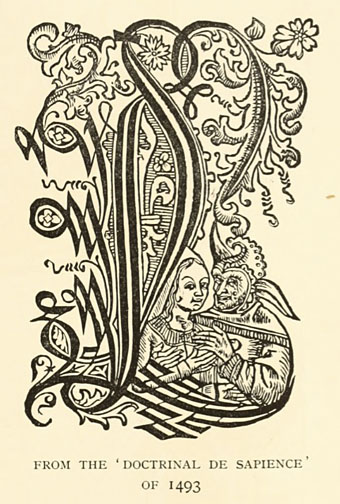
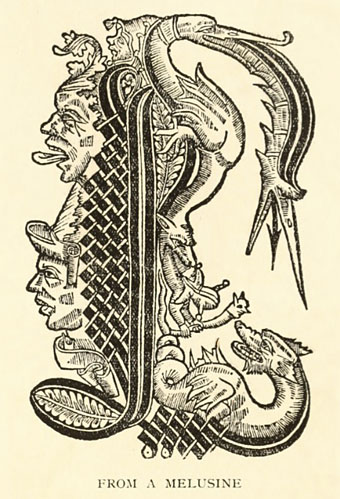
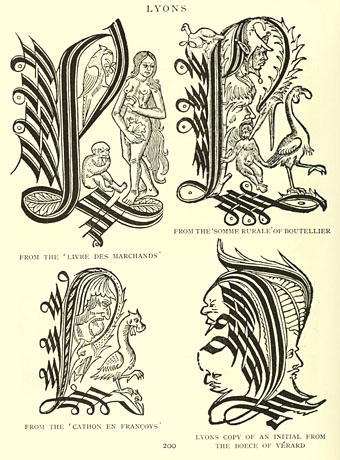
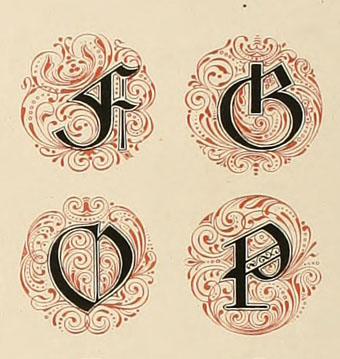
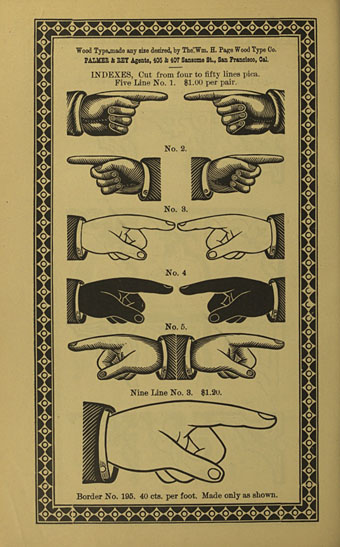
More decorated initials, these being from Early Woodcut Initials (1908), a collection by Oscar Jennings of ornamental letters from books of the fifteenth and sixteenth centuries. By way of contrast with yesterday’s examples, not all of these feature the religious or mythological figures one would expect, some show early mathematical and astronomical devices.

initial2.jpg

initial3.jpg

Continue reading “Early woodcut initials”

Paulini’s mythological alphabet

paulini1.jpg

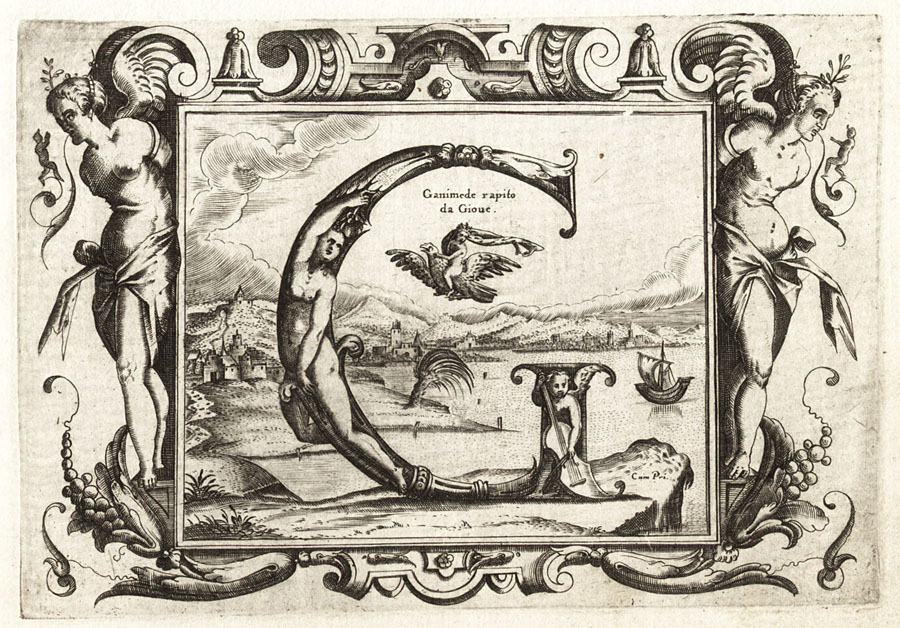
Whoever I. Paulini was, no one seems to know his (or, indeed, her) first name. Even the Metropolitan Museum of Art, NYC, which owns a copy of these plates, doesn’t elaborate. The copies here are scans from a Getty edition of Alphabeto, part of the collection of Getty Institute volumes at the Internet Archive. The book is usually dated 1570 but a note states that “The watermarks … suggest a printing date closer to the end of the 16th century than to 1570, the conjectural date of first publication.”

paulini2.jpg

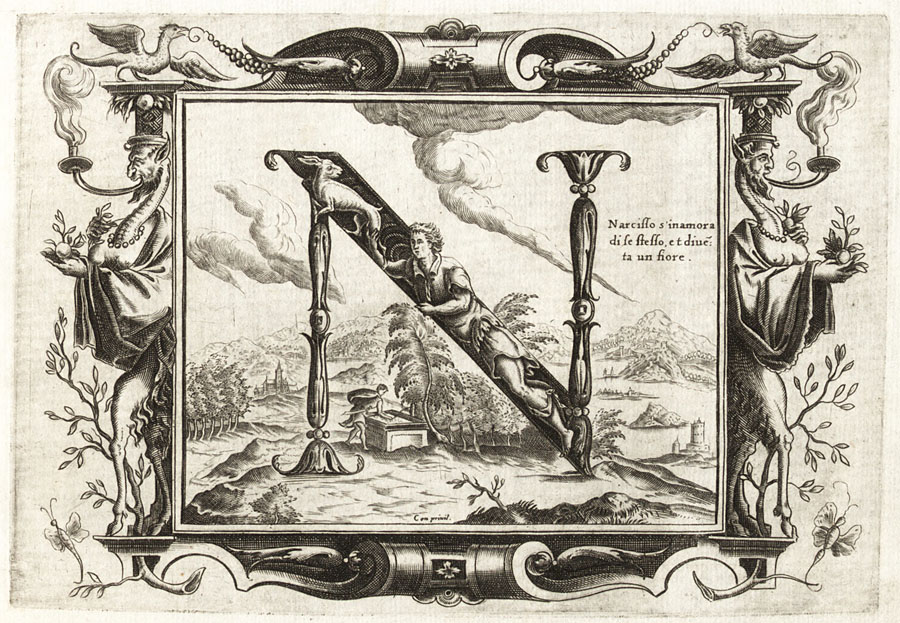
Paulini gives use twenty engraved plates each showing an ornamented letter of the Roman alphabet with a background depicting a scene from Greek and Roman mythology; each letter is tied to a different character or scene, so here we have G for Ganymede, and N for Narcissus. Mister Aitch at the late, lamented Giornale Nuovo was a great enthusiast for these kinds of alphabets, and for engravings in general. He pursued his own researches into the Paulini mystery back in 2006 when copies of the complete set of letters were difficult to find.

Elsewhere on { feuilleton }
The etching and engraving archive

Previously on { feuilleton }
Joseph Balthazar Silvestre’s Alphabet-album
Johann Theodor de Bry’s Neiw Kunstliches Alphabet
The Book of Ornamental Alphabets
Paul Franck’s calligraphy
Gramato-graphices
John Bickham’s Fables and other short poems
Letters and Lettering
Studies in Pen Art
Flourishes

Seminal art and design

fountain.jpg

Fountain (2011) by John Coulthart.

seminal, a. and n.

A. adj. Of or pertaining to seed; of the nature of seed.

1. a. Of or pertaining to the seed or semen of men and animals (applied Phys. and Anat. to structures adapted to contain or convey semen); of the nature of semen.

Oxford English Dictionary

The Dirty Comics exhibition curated by Jon Macy opens today in San Francisco so here at last is my non-comics contribution to Jon’s erotic art show. This is something I’d had in mind for a while so it was good to have the opportunity to actually tackle the thing, and also have an outlet for it outside this website. Below I explore some of the intent and inspiration which led to the piece.

Creating some sort of gay erotica was an idea I’d had in mind for a while but it suffered from the usual syndrome whereby work with no immediate outlet gets shunted aside by the pressure of paid commissions and ongoing personal projects. It’s also the case that pieces of work I create for myself I tend to want to sell or see reproduced via a service such as CafePress. The trouble is that most of those services are based in the US which means they’re subject to that tiresome puritan attitude towards sexual content: anything other than “artistic” nudity is forbidden at CafePress, and the same applies to many other self-publishing services. There are outlets for gay erotica but I’ve not had chance to explore the best options. If anyone has any tips then please leave a comment.

closeup.jpg

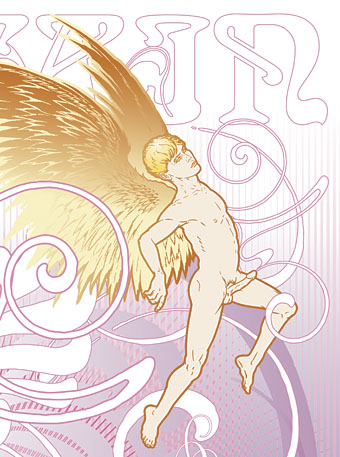
This angel figure was something I’d drawn back to 2008 when I’d made a start on a similar work which fell by the wayside. One of the great things about computer graphics is being able to work on part of something which can then be picked up later and dropped into a new composition.

figures.jpg

So the intention was to produce a follow-up to the Dodgem Logic cover I created last year which presented a same-sex take on various Art Nouveau stylisations. The figures above are from one of the early drafts which takes a border design from Alphonse Mucha’s Documents Decoratifs (below), a series of sample borders and frames Mucha produced for the use of artists and designers.

Continue reading “Seminal art and design”

Index, fist or manicule?

index5.jpg

Third revised specimen book and price list of printing material (1887), Palmer & Rey, San Francisco.

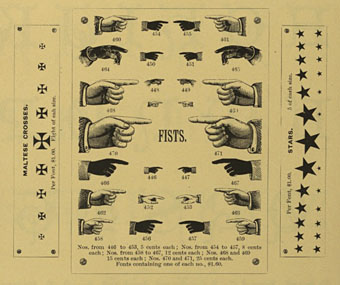
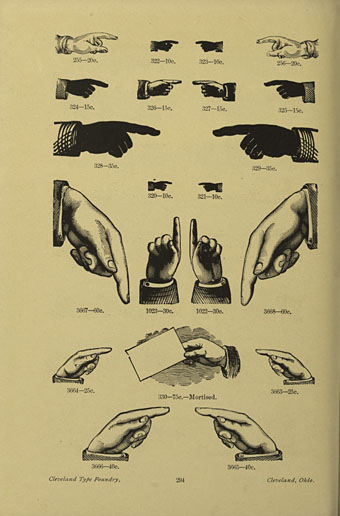
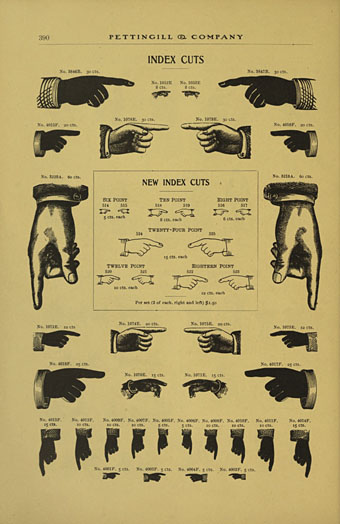
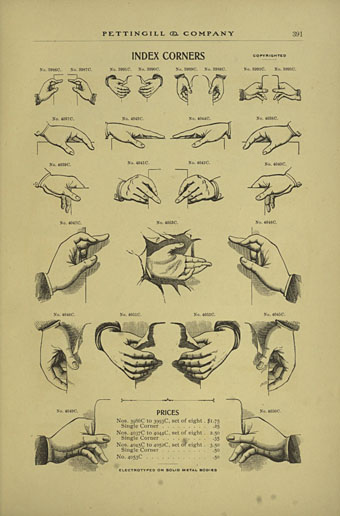
Browsing through old type foundry catalogues recently reminded me of a question posed by Callum James a few years ago over at Front Free Endpaper, namely: what is the official description of those pointing hands favoured by pre-20th century typesetters? Writer Mark Valentine in a follow-up post mentions a term invented by William H Sherman—”manicules”—since Sherman also believed that the pointing hands were nameless. That’s not quite the case, however, as these pages show, with two descriptors being used: “indexes” and “fists”. Just to confuse matters both terms are used on different pages of the same catalogue which implies that the names may have been a convenience term to avoid having to repeatedly discuss “those pointing hand things” with customers. “Manicule” seems a better choice since “index” already has a standard meaning in printing, while “fist” doesn’t suit at all.

These catalogues contain many pages of similar type decorations and embellishments. All can be downloaded at the Internet Archive, just follow the links.
index2.jpg

Third revised specimen book and price list of printing material (1887), Palmer & Rey, San Francisco.
index4.jpg

Catalogue and book of specimens of type faces and printing material and machinery (1895), Cleveland Type Foundry.
index1.jpg

Copper alloy type book (1901), Pettingill & Co., Boston.
index3.jpg

Copper alloy type book (1901), Pettingill & Co., Boston.

Update: Thanks to Alan in the comments for pointing the way (so to speak) to William Sherman’s Toward a History of the Manicule.

Update 2: See this manicule Flickr group for many contemporary examples.

Previously on { feuilleton }
Victorian typography

Joseph Balthazar Silvestre’s Alphabet-album

silvestre01.jpg

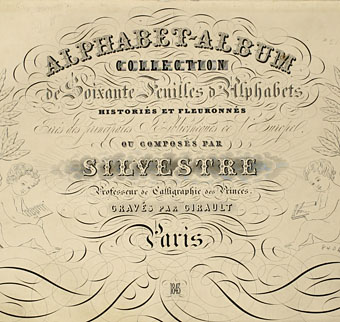
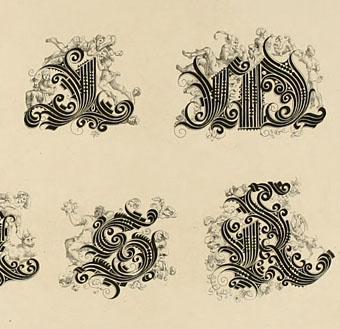
Monsieur Silvestre’s Alphabet-album, a collection of decorative alphabets, has a lengthy subtitle—Collection de Soixante Feuilles d’Alphabets Historiés et Fleuronnés, tirés des Principales Bibliothèques de l’Europe—and is a good example of how the 19th century, always characterised as a period of over-elaborate decoration, contains the seeds of 20th-century design. Silvestre’s book dates from 1843 yet contains several examples of sans serif or rectilinear lettering which wouldn’t have looked out of place a hundred years later. There’s also some fine examples of over-elaborate lettering, of course, with the usual embellishments and calligraphic flourishes, and also a page of letterforms based on tree shapes, a common sight in Victorian graphics.

silvestre02.jpg

silvestre03.jpg

Continue reading “Joseph Balthazar Silvestre’s Alphabet-album”