Magicians

magic01.jpg

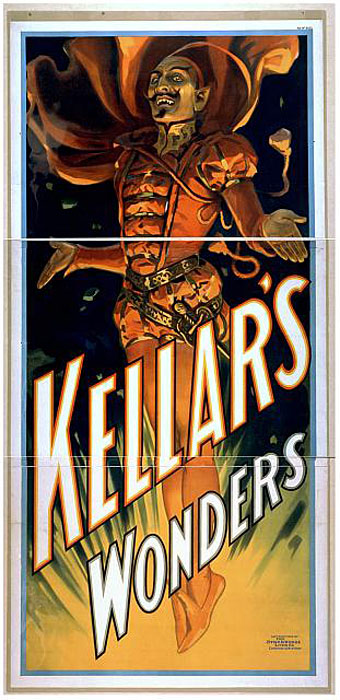
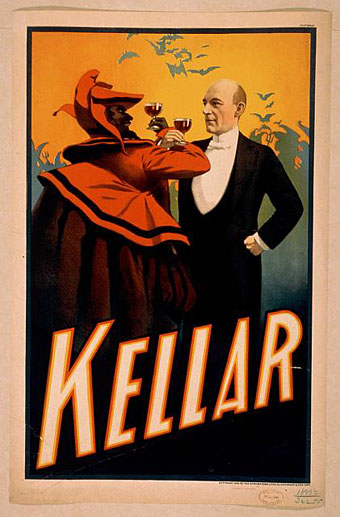
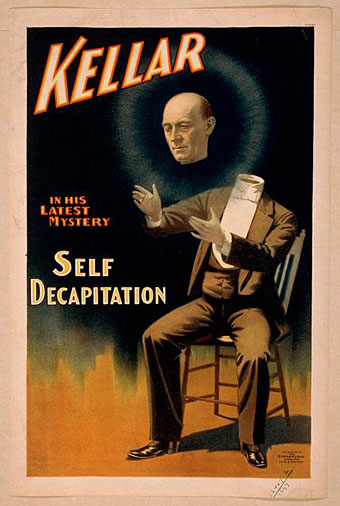
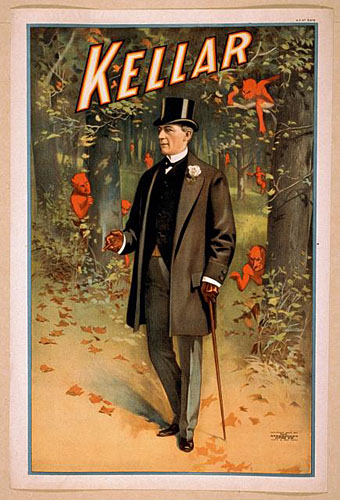
The stage variety rather than occult practitioners. The levitating Mephistopheles above is the one I borrowed earlier this year for the Alas Vegas Tarot designs. “Kellar” was Harry Kellar (1849–1922), a popular American magician blessed with some talented poster designers who stripped away the superfluous text to concentrate on his name and the recurrent motif of a red devil. Considering their age (they date from around 1900) these posters are surprisingly elusive, with no indication on some of them that Kellar is a stage performer at all. He retired in 1908 so by this time his name alone was evidently enough of an audience draw.

Howard Thurston was Kellar’s appointed successor, hence the continuity of the red devils and type design. Devils and imps weren’t the sole property of the pair as the other examples here demonstrate. “Miss Baldwin” is a rare example of a woman achieving parity with her male colleagues, at least in the poster department. All these posters are from the collection at the Library of Congress where many more examples may be seen. A detail from the horizontal Kellar poster below appears on the cover of the recent lavish Taschen volume Magic: 1400s–1950s by Mike Caveney, Jim Steinmeyer, Ricky Jay and Noel Daniel.

magic02.jpg

magic03.jpg

magic04.jpg

Continue reading “Magicians”

Weekend links 176

dlouhy.jpg

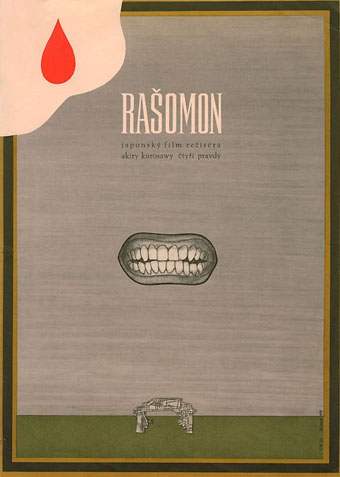
This week PingMag was looking at Czech film posters. This one by Bedrich Dlouhy is for the belated 1970 release of Kurosawa’s Rashomon.

• In October Alison Goldfrapp curates an exhibition for The Lowry, Salford, featuring her favourite art. Examples will include work by Leonora Carrington, Lotte Reiniger and Henry Darger so I’ll definitely be seeing this one. The new Goldfrapp album, Tales of Us, is released this week. Alison Goldfrapp & Lisa Gunning’s film for Annabel is here.

Michael Glover profiles artist Tom Phillips who has a new show of his paintings at the Flowers Gallery, London. The indefatigable Phillips also talked to Tracy McVeigh about his design for the new 50 pence coin which celebrates the centenary of Benjamin Britten.

Get Carter director Mike Hodges remembers re-teaming with Michael Caine for the island-set crime thriller Pulp, and shares a letter that JG Ballard wrote to him in admiration of the film.

Dismantling the surveillance state won’t be easy. Has any country that engaged in mass surveillance of its own citizens voluntarily given up that capability? Has any mass surveillance country avoided becoming totalitarian? Whatever happens, we’re going to be breaking new ground.

Bruce Schneier on how to deal with the total surveillance state.

• Babel/Salvage presents The Midnight Channel, the newest montage of poetry by Evan J. Peterson, inspired by cinema of the horrific, fantastic and bizarre.

• Mixes of the week are from composer Amanda Feery at The Outer Church, and Pinkcourtesyphone (Richard Chartier) at Secret Thirteen.

• At Dangerous Minds: Kimberly J. Bright on the psychedelic poster art of Hapshash and the Coloured Coat. Related: LSD may not be bad for you, says study.

Queer Zines: a 400-page study edited by AA Bronson & Philip Aarons.

• Justin Abraham Linds on The Walt Whitman of gay porn.

• Designs for theatre and print by Oskar Schlemmer.

Beautiful Mars: a Tumblr.

Catleidoscope!

• Goldfrapp: Lovely Head (2000) | Strict Machine (2003) | Caravan Girl (2008)

Wildeana 10

wilde.jpg

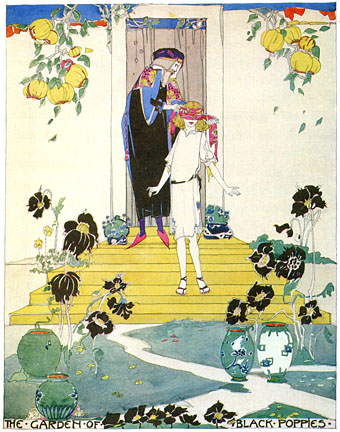
Illustration from The House of Pomegranates (1914) by Jessie M. King.

Continuing an occasional series. Recent Wildean links.

• It’s a measure of a writer’s success if the characters or stories they create resonate sufficiently with future generations to be subject to new interpretations. Among Oscar Wilde’s contemporaries this has happened to Arthur Conan Doyle and Bram Stoker, both of whom Wilde knew. Increasingly it’s been happening to Wilde’s own fiction, especially in the case of Dorian Gray whose tragedy assumes the status of a modern myth. At Cannes this year, Clio Barnard premiered a contemporary retelling of Wilde’s The Selfish Giant. Bleeding Cool has some clips. The social realism is a long way from Wilde’s tale but that shows how flexible these fables can be.

• Jessie M. King’s illustrations for Wilde’s The House of Pomegranates have appeared here before but the copies posted at The Golden Age are the usual quality scans.

Rick Gekoski: “Visiting the US, I am reminded of Oscar Wilde’s tour there in 1881, which allowed him to become an orator and a celebrity.”

Paper Dolls by David Claudon based on the characters from The Importance of Being Earnest. (Thanks to Gabe for the tip.)

Elsewhere on { feuilleton }
The Oscar Wilde archive

Weekend links 174

ikuma.jpg

Dress (2012) by Nao Ikuma.

• Two of my Cthulhu artworks can currently be seen in the Ars Necronomica exhibition at the Cohen Gallery, Brown University, Providence, RI. The exhibition is part of NecronomiCon, and runs to September 13th. In related news, my steampunk illustration has been nominated in the Visual category of this year’s Airship Awards. Winners will be announced at Steamcon V in October.

• “…the story of how a small cabal of British jazz obsessives conducting a besotted affair with the style arcana of Europe and America somehow became an army of scooter-borne rock fans…” Ian Penman looks back at the culture of Mod for the LRB.

• “What is it about the writer in the First World that wants the Third World writer to be nakedly political, a blunt instrument bludgeoning his world’s ills?” Gina Apostol on Borges, Politics, and the Postcolonial.

If someone had designed a work regime perfectly suited to maintaining the power of finance capital, it’s hard to see how they could have done a better job. Real, productive workers are relentlessly squeezed and exploited. The remainder are divided between a terrorised stratum of the, universally reviled, unemployed and a larger stratum who are basically paid to do nothing, in positions designed to make them identify with the perspectives and sensibilities of the ruling class (managers, administrators, etc) – and particularly its financial avatars – but, at the same time, foster a simmering resentment against anyone whose work has clear and undeniable social value. Clearly, the system was never consciously designed. It emerged from almost a century of trial and error. But it is the only explanation for why, despite our technological capacities, we are not all working 3–4 hour days.

On the Phenomenon of Bullshit Jobs by David Graeber

Ron Rosenbaum talks to Al Pacino about all the usual stuff, and reveals some detail about the actor’s obsessive interest in Oscar Wilde’s Salomé.

• More queer history: The Brixton Fairies and the South London Gay Community Centre, Brixton 1974–6.

• At Dangerous Minds: Anthony Burgess and the Top Secret Code in A Clockwork Orange

• Every day for 100 days, Jessica Svendsen redesigned a Josef Müller-Brockmann poster.

LondonTypographica: Mapping the typographic landscape of London.

• Mix of the week: Secret Thirteen Mix 083 by Demdike Stare.

• At Strange Flowers: Alfred Kubin the writer.

Derek Jarman’s sketchbooks.

Rick Poynor on Collage Now.

• Thomas Leer: Private Plane (1978) | Tight As A Drum (1981) | Heartbeat (1985)

Lindsay Kemp’s Salomé again

salome00.jpg

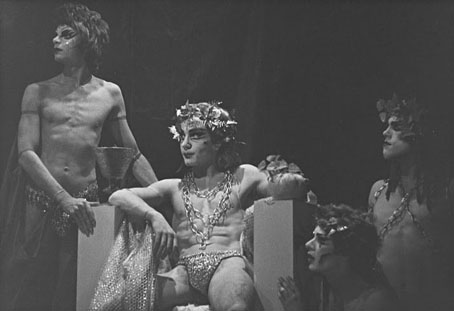
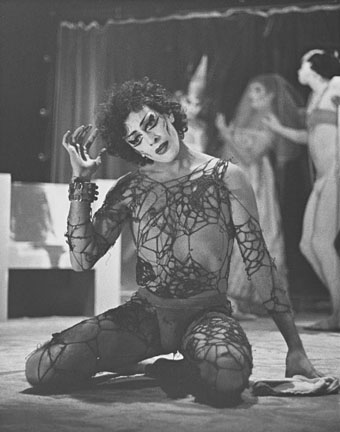
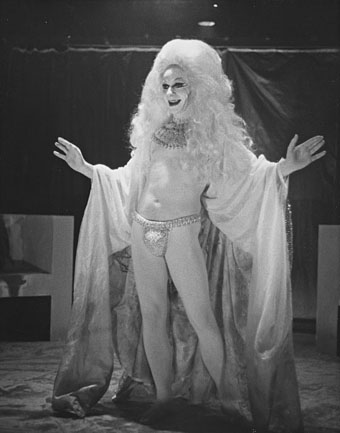
The NYPL digital library has recently upgraded its website (thanks to BibliOdyssey for the news), adding some features that make searching (and random browsing) an easier business. At first glance the contents seem pretty much the same but I definitely hadn’t seen this set of photos by Kenn Duncan before. The all-male production of Oscar Wilde’s Salomé staged by Lindsay Kemp in 1975 was the queerest of them all but pictures and a few films clips are all the record we have. The production was also vividly coloured, a quality that’s lost in these shots. There’s a lot more at NYPL by Kenn Duncan, many of them photos of film, television and theatre performers taken for After Dark magazine in the 1970s.

salome01.jpg

salome02.jpg

Continue reading “Lindsay Kemp’s Salomé again”