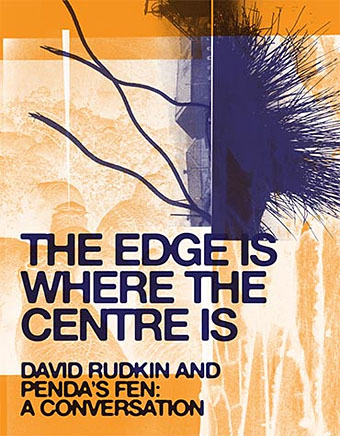
The Edge Is Where The Centre Is

pf1.jpg

Design by Rob Carmichael.

“I am afflicted by images, by things that are seen, pictures of things. They are extraordinary, momentary, but they stay with me.” (David Rudkin, 1964)

“The pattern under the plough, the occult history of Albion – the British Dreamtime – lies waiting to be discovered by anyone with the right mental equipment.” (Rob Young, Electric Eden)

Penda’s Fen, written by David Rudkin and directed by Alan Clarke, is one of the key films in the pantheon of what has been called The Old Weird Albion. A radical archaeology of Deep England, a work of dark pastoral, a praise-song to anarchistic transformation, as militant a rejection of imperial identity as Lindsay Anderson’s If…, it culminates with perhaps the most euphoric revelation in British cinema: “My race is mixed. My sex is mixed. I am woman and man, light with darkness, nothing pure!”

The Edge Is Where The Centre Is, the first book devoted to this visionary and never-commercially-released film, has at its heart a rare and far-ranging interview with Rudkin (b. 1936), a writer who for more than fifty years has, in the words of Gareth Evans, “charted a vast topology of viscerally-realised primary narratives for our troubled times”. It also features new essays by its editors — Gareth Evans, William Fowler and Sukhdev Sandhu – that explore the film’s status as a radical horror film, an experimental topography, a work that anticipates subsequent political debates about Englishness. (more)
pf2.jpg

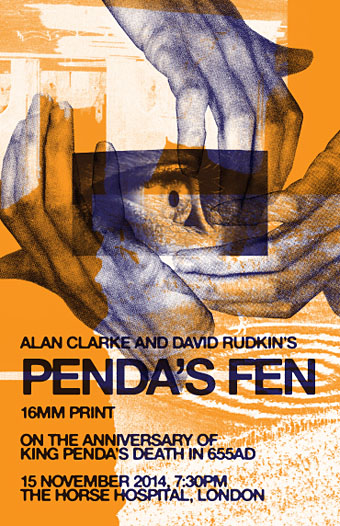
What could be more essential than a book (and poster) devoted to my No. 1 Cult Thing Of All Time? My copies are already on order. Even better, this is a publication from the same team—editor and designer—that produced The Twilight Language of Nigel Kneale last year, a celebration of another British television dramatist that sent me on a full-scale re-viewing of Kneale’s major works.

There’s no need to enthuse about Penda’s Fen when I did all that four years ago but there’s a couple of points worth making in the light of this publication. The first is that it’s surprising that a wider reappraisal of Rudkin and Clarke’s film has lagged behind the resurrection of so many other British TV dramas, especially those that deal with rural horror, those that share a mythic resonance or impart an atmosphere of dread. Surprising because almost all the recent resurrections—the BBC ghost films (one of which was written by Rudkin), Robin Redbreast, The Children of the Stones, etc.—are primarily entertainments with little subtextual meat on their bones. That’s not to say that a subtext can’t be found if you apply the usual academic tools but Alan Garner’s adaptation of Red Shift is one of the few films of this school that has much going on under the surface.

Penda’s Fen doesn’t need a subtext when so much of its polemic is out in the open. It’s one of the most interesting of these films in being so directly political on several levels at once, even when it’s also being directly metaphysical: a call for disobedience and nonconformity on a sexual as well as a social level that (unlike Ken Loach et al) manages to generate a succession of indelible images.

This leads to the second point, the comparison made above to Lindsay’s Anderson’s If…. The similarity between the two films has always been unavoidable for me when If…. is another film that sits at the top of the cult list (see this post). Both films share a rejection of school and society, and also share an approach to sexuality that was very unusual for the late 60s/early 70s. The difference between the two films lies in their conclusions: If…. ends with riot and massacre, and while this may be a cathartic moment Lindsay Anderson wrote in the published script: “It doesn’t look to me as though Mick can win. The world rallies as it always will, and brings its overwhelming firepower to bear on the man who says ‘No.'” By contrast, Stephen in Penda’s Fen defeats his mental demons. If the final shot is of him walking down the hill into darkness we can at least feel he’s on his way to a better life. “Cherish the flame.”

The Edge Is Where The Centre Is is limited to only 200 copies so if you’d like a copy I’d suggest you place your order now.

Previously on { feuilleton }
Afore Night Come by David Rudkin
White Lady by David Rudkin
The Horror Fields
Robin Redbreast by John Bowen
Red Shift by Alan Garner
Children of the Stones
Penda’s Fen by David Rudkin
If….
David Rudkin on Carl Dreyer’s Vampyr
Weekend links 231

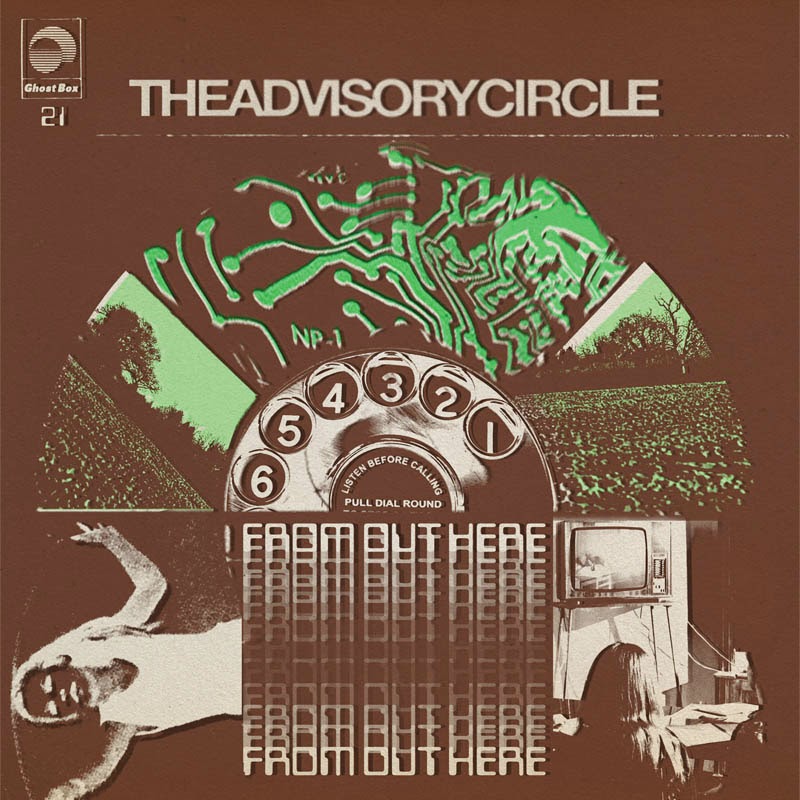
advisory.jpg

Design by Julian House.

Always good to hear of a new release on the Ghost Box label, and a new album by The Advisory Circle (due on 5th December) is especially welcome. From Out Here is described thus: “Exploring darker territory than 2012’s more pastoral As The Crow Flies, The Advisory Circle hint at a Wyndham-esque science fiction story, where bucolic English scenery is being manipulated and maybe even artificially generated by bizarre multi-dimensional computer technology.” The Belbury Parish Magazine has extracts.

• Jon Hassell’s Fourth World Music Vol. I: Possible Musics receives a long-overdue reissue next month. Possible Musics was a collaboration with Brian Eno, and Eno has some of his own albums reissued again in expanded editions. Most notable is the first official release of My Squelchy Life, an album that was withdrawn in 1991 to be replaced by Nerve Net.

• Some Halloween theatre on Friday (the 31st) at the Museum of Bath at Work with a dramatisation of Ringing the Changes by Robert Aickman. There’s a repeat performance the following week (8th November) with added spectral atmospherics from the Electric Pentangle. Free admission.

The value of these books wasn’t anything wholesome they contained, or any moral instruction they offered. Rather, it was the process of finding them, the thrill of reading them, the way the books themselves, like the men they depicted, detached you from the familiar moral landscape. They gave a name to the palpable, physical loneliness of sexual solitude, but they also greatly increased your intellectual and emotional solitude. Until very recently, the canon of literature for a gay kid was discovered entirely alone, by threads of connection that linked authors from intertwined demimondes. It was smuggling, but also scavenging. There was no internet, no “customers who bought this item also bought,” no helpful librarians steeped in the discourse of tolerance and diversity, and certainly no one in the adult world who could be trusted to give advice and advance the project of limning this still mostly forbidden body of work.

Smuggler: A Memoir of Gay Male Literature by Philip Kennicott

• Getting in before the Mixcloud Halloween rush, mix of the week is Samhain Seance 3: Better Dead Than Never by The Ephemeral Man. My Halloween mix for this year is almost finished; watch the skies.

• For those who can’t wait until December for From Out Here, there’s a new Howlround album, Torridon Gate, out this week from A Year In The Country.

• Last week, Yello’s Boris Blank was choosing favourite electronic albums, this week he runs through a list of thirteen favourite albums.

Altered Balance: A Tribute to Coil by Jeremy Reed & Karolina Urbaniak. Richard Fontenoy reviewed the book for The Quietus.

Cut-Ups: William S. Burroughs 1914–2014, an exhibition of Burroughs’ typescripts at Boo-Hooray, NYC, from 7th November.

Brando, a film by Gisèle Vienne for the song by Scott Walker & Sunn O))).

NASA has a Soundcloud page

The art of leaves

Cobra Moon (1979) by Jon Hassell | Moon On Ice (1987) by Yello feat. Billy MacKenzie | Moon’s Milk Or Under An Unquiet Skull Pt. I (1998) by Coil

Wildeana 13

wilde.jpg

Oscar Wilde, no. 26 (1882). One of a series of photo portraits taken by Napoleon Sarony when Wilde was in New York.

Every day is an anniversary for something. Among other things, October 16th 2014 is the 160th anniversary of the day that Oscar Wilde was brought to Earth in a spaceship—see Velvet Goldmine for details—so in honour of that moment here’s a few more Wildean links.

• One item of news I missed last month was Al Pacino’s announcement that he’ll be bringing his production of Wilde’s Salomé to the London stage in 2016. Good to hear that his enthusiasm was sparked by the excellent Steven Berkoff production, and this detail is especially noteworthy: “There will be make-up, sets, costumes… and decadence. It will be a whole different thing to what we did in America.”

• Turkish censors still have problems with Anglophone novels that publishers attempt to present in Turkish translations—the work of William Burroughs caused a fuss a couple of years ago—but last month an uncensored edition of The Picture of Dorian Gray was published there for the first time.

Oscar Wilde’s grandson Merlin Holland: “We’ve got as close as we can to hearing him speak” Holland has co-written The Trials of Oscar Wilde, a dramatisation of Wilde’s court appearances which opens at Trafalgar Studios, London, this week.

The extraordinary story of Oscar Wilde’s holiday in Worthing in 1894. James Connaughton interviews Antony Edmonds about his new book, Oscar Wilde’s Scandalous Summer: The 1894 Worthing Holiday and the Aftermath.

The beau of Reading jail: was prisoner 1122 Oscar Wilde’s lover? (The answer to any newspaper headline ending with a question mark is invariably “No”.)

Elsewhere on { feuilleton }
The Oscar Wilde archive

Saragossa Manuscript posters

saragossa1.jpg

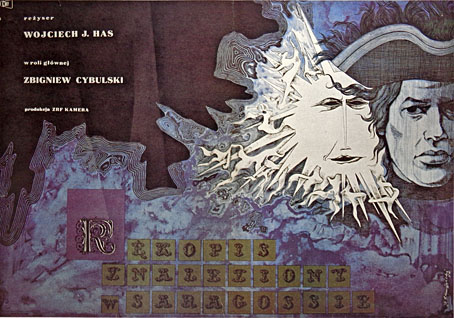
Polish poster (1965) by Jerzy Skarzynski who was also the film’s production designer.

I love The Saragossa Manuscript, both the novel by Potocki and the movie by Has. I saw the film three times which, in my case, is absolutely exceptional.

Luis Buñuel in My Last Sigh (1983)

No surprise that a lifelong Surrealist was enamoured with Jan Potocki’s rambling collection of stories-within-stories. The 1965 Polish film by Wojciech Has had another famous enthusiast in Jerry Garcia whose efforts to restore and reissue The Saragossa Manuscript helped bring the film to a new generation of viewers in 1999. I was a beneficiary of this, having been intrigued for years by descriptions whilst hoping in vain that it might turn up on television. I prefer the film to the novel although to be fair to Potocki it’s a long time since I read his book.

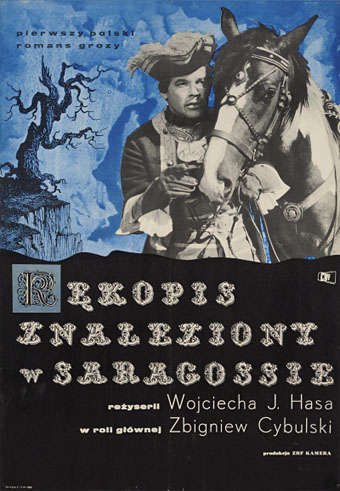
saragossa2.jpg

Another Polish design showing Zbigniew Cybulski as Alphonse.

Watching The Saragossa Manuscript again this weekend sent me looking for posters, some of which can be seen below. There are odd omissions: plenty of examples from the Eastern Bloc countries but few at all from Western Europe. The film suffered by having its 3-hour running time hacked about by distributors which didn’t help its reception outside Poland. The manuscript of the title is a book discovered during a skirmish in the Napoleonic wars, an account of the strange adventures of Alphonse Van Worden in the Sierra Morena region of Spain; one of the soldiers reading the manuscript is Van Worden’s grandson, the first of many coincidental connections. Van Worden’s adventures seem macabre at first—there are more bones in the opening scenes than in many horror films—but they soon turn farcical. As a burgeoning cast of characters appears, many of whom have their own tales to tell, the mood veers into outright sex comedy, albeit with mild philosophical overtones. Some scenes aren’t very far removed from Monty Python, especially those that feature an inept band of Spanish Inquisitors.

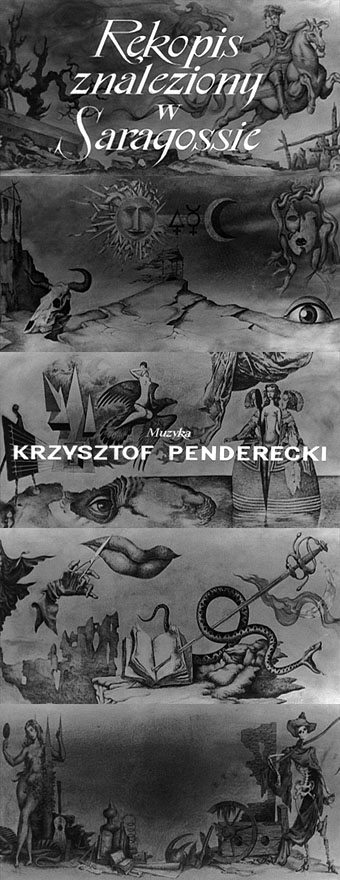
saragossa10.jpg

Background drawings from the title sequence. Yes, the score is by Penderecki, his first.

All of which means this is another film that presents a challenge for a poster designer. Most of the early examples take their cues from the opening titles whose backgrounds feature drawings with a vaguely Surrealist and occult flavour that I’m guessing are also the work of Jerzy Skarzynski.

Continue reading “Saragossa Manuscript posters”

Salomé and Wilde Salomé

salome1.jpg

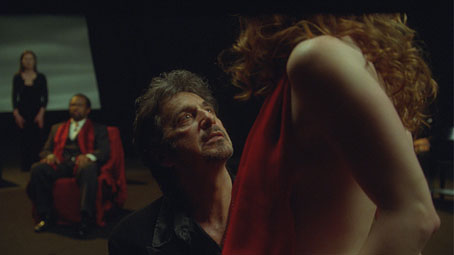
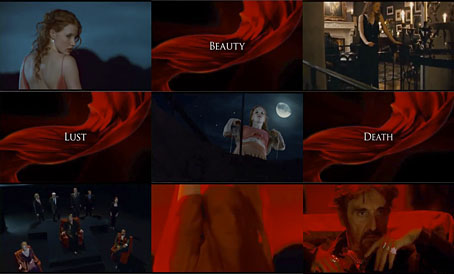
Three years on and Al Pacino’s recent pet projects—Salomé and Wilde Salomé—have yet to be given a general release. Salomé is the one I’m most eager to see, a filmed performance of the Oscar Wilde play with Jessica Chastain in the title role. There is at least a trailer now, which gives an intriguing taste of the production. Like Steven Berkoff, Pacino has opted for modern dress while making some of the details—the moon, Jokanaan’s well—more material. If Wilde’s Symbolist melodrama seems rather effete for a man known for playing gangsters it should be noted that the play features a suicide and two executions, as well as a strong theme of paternal incest and even necrophilia. Herod, of course, is notorious for being a child-murdering king.

salome2.jpg

Pacino and Jessica Chastain are in London on Sunday at BFI Southbank talking with Stephen Fry about Salomé and the feature-length production documentary, Wilde Salomé. Both films will also receive screenings. Here’s hoping the rest of us won’t have much longer to wait before we can see them.

Elsewhere on { feuilleton }
The Oscar Wilde archive
The Salomé archive