The Magic Toyshop

toyshop1.jpg

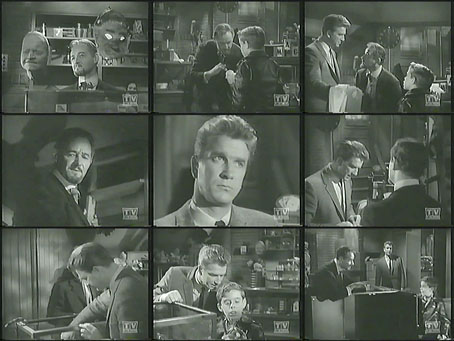
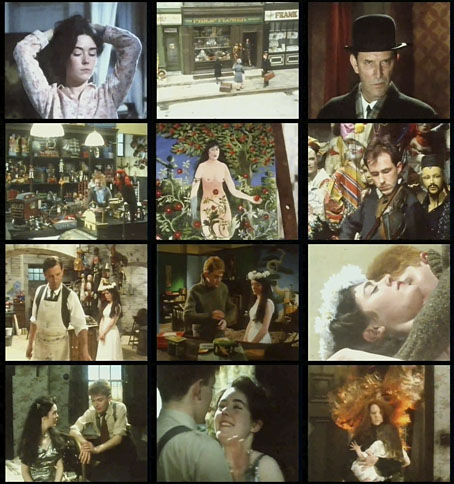
Yet more revenant TV drama. Seems like everything turns up if eventually so long as you’re prepared to wait. I’d looked for this film a couple of times after writing about TV director David Wheatley. The Magic Toyshop (1987) was a feature-length Granada Television adaptation of Angela Carter’s 1967 novel, with Wheatley directing and Carter herself supplying the screenplay. Caroline Milmoe plays Melanie, a teenage girl left in the care of her Uncle Philip after she and her younger brother and sister are orphaned. Tom Bell plays the sinister uncle who owns the toyshop of the title, a place where the toys, puppets and automata are as lively as JF Sebastian’s menagerie in Blade Runner. Melanie’s younger uncles, Finn and Francie, live in fear of the tyrannical Philip who forces them to assist with his life-size puppet shows, while Melanie’s aunt Margaret is not only cowed by her husband but also mute. The arrival of Melanie and her growing sexual awareness upsets the household’s balance of power.
toyshop2.jpg

It was good to see this film again having recently watched David Wheatley’s René Magritte film and his marvellous Borges documentary. In light of those earlier works an adaptation of Angela Carter would seem a natural progression. Aside from an overly-emphatic score, The Magic Toyshop was better than I remembered, the initial viewing no doubt suffering from an expectation that it might be a match for The Company of Wolves (1984). The Granada film had a much lower budget than Neil Jordan’s feature so it’s an unfair comparison. Wheatley and co. saved money with some careful use of the Baker Street set from Granada’s Sherlock Holmes adaptations.

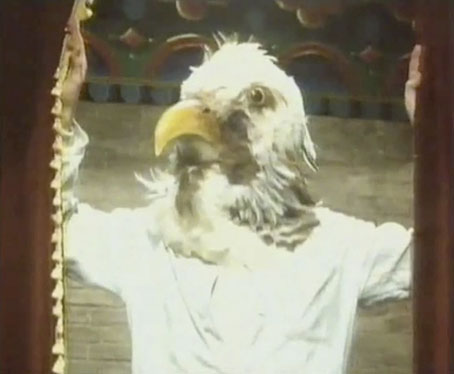
Watching The Magic Toyshop now it’s surprising it was made at all, it’s an odd piece of work stippled throughout with surreal moments, and even Surrealist references, as with Finn’s Loplop-like appearance above. What drama there is refuses the familiar shapes that a TV audience would expect, and there’s also a surprising amount of incestuous desire boiling among the major characters that goes unquestioned. I’ve not read Carter’s novel so I can’t say how it compares but the film feels like a very pure delivery of the author’s landscape of entwined sexuality, fantasy and myth. The Magic Toyshop hasn’t been reissued on DVD so the YouTube version is from a tape copy. It’s also chopped into chunks (why, oh, why, etc) but it’s highly recommended to Angela Carter readers.

The Magic Toyshop: part 1 | part 2 | part 3 | part 4 | part 5 | part 6 | part 7

Previously on { feuilleton }
Borges and I
René Magritte by David Wheatley
The Magic Shop by HG Wells

magic.jpg

The Magic Shop (1964).

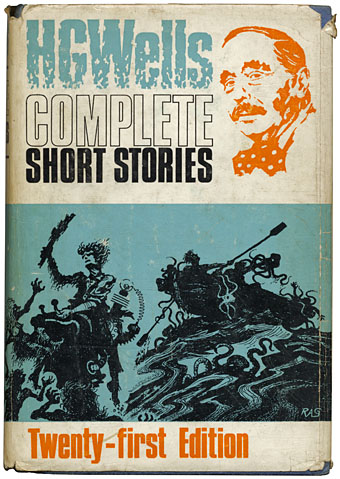
I discovered this TV adaptation by accident while looking for something else (more about the something else tomorrow). The Magic Shop is a 45-minute drama directed by Robert Stevens in 1964 for The Alfred Hitchcock Hour. Writer John Collier adapted a script by James Parish that’s loosely based on the short story by HG Wells. The story is one I know very well, having read it many times, but I hadn’t come across this TV version before. It’s a surprise finding it so close to Christmas since I first read the story in the only Christmas present that’s survived from childhood, a hefty collection of HG Wells’ short stories that I pestered my parents into buying me in 1973. I mostly wanted to read The Time Machine but the other stories seemed promising, especially the ones illustrated by Richard Gilbert on the (miraculously intact) dustjacket: The Sea Raiders (sailors attacked by octopuses), The Flowering of the Strange Orchid (man attacked by tentacular plant), The Valley of Spiders (attacking spiders falling from the sky), and so on. The book as a whole runs to over 1000 pages, and proved to be a revelation with Wells ranging through fantasy, science fiction, horror, and oddities which don’t fit any category other than Robert Aickman’s indispensable label, “strange stories”. The book made me a lifelong Wellsian, and also spoiled me a little when I moved on to more recent science fiction and found many of the alleged greats to be appalling writers. Wells’ prose can’t compete with Robert Louis Stevenson but it’s still well-crafted in that no-nonsense late Victorian manner familiar to readers of Arthur Conan Doyle.

wells.jpg

Design and illustration by Richard Gilbert (1970).

The Magic Shop is one of the strange stories, the shop in question being a mysterious establishment somewhere in Regent Street, London, one of those premises one discovers by accident then can’t find again. The narrator is informed by the proprietor that this is a Genuine Magic Shop, as distinct from the kind selling mere conjuring tricks. The meaning of this isn’t clear at first but while the narrator’s young son is being beguiled by the marvels on display we follow his father’s growing alarm when he realises there’s more to the shop than he anticipated, not all of it pleasant or fun. The story was published in Twelve Stories and A Dream in 1903, and can be read here.

The TV version takes the bare bones of the tale—curious shop, indeterminate location, friendly yet sinister proprietor—and blends it with the nasty-child-with-magic-powers theme that was dramatised so memorably by The Twilight Zone in It’s A Good Life. The Hitchcock show was made three years after the Twilight Zone episode so it’s easy to see It’s A Good Life as an influence. Leslie Nielsen is the father who takes his son, Tony (John Megna), to the fateful shop on his birthday. The proprietor informs the pair that Tony is “the right boy” since he found the shop in the first place, the subtext being that he’s also possesses the right character to be the recipient of some heavy voodoo abilities. The boy’s bad seed status has been telegraphed from the outset by a birthday gift from an uncle of a black leather jacket; throughout the scene in the shop he looks like a miniature hoodlum. More American anxiety about its troublesome youth? Maybe, although the episode ends so poorly that the whole thing comes across as a lazy piece of filler. This is, of course, a long, long way from the Wells story which is all the more effective for being elusive, understated and, yes, magical.

Previously on { feuilleton }
HG Wells in Classics Illustrated
The night that panicked America
The Door in the Wall
War of the Worlds book covers

Joseph Cornell: Worlds in a Box

cornell1.jpg

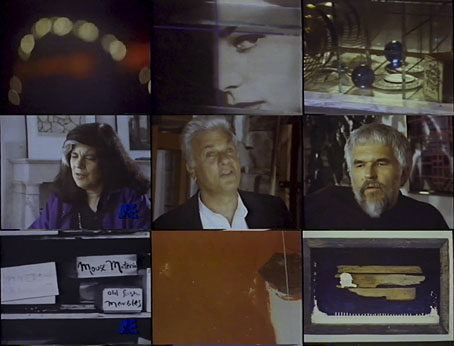
Susan Sontag, Tony Curtis and Stan Brakhage all shared an appreciation for the work of American artist Joseph Cornell (1903–1972), and all appear in a 51-minute documentary Joseph Cornell: Worlds in a Box directed by Mark Stokes for the BBC in 1991. Susan Sontag was also the subject of one of Cornell’s collages, something she discusses here. Tony Curtis collected many of Cornell’s boxes and used to visit the artist when he was in New York; in Stokes’s film he discusses their relationship and reads from Cornell’s writings.

cornell2.jpg

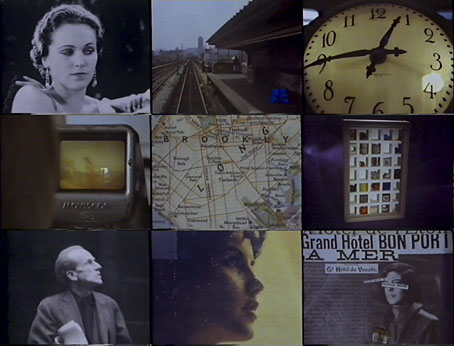
I’ve had a tape of this for years courtesy of Kerri Sharp who worked on the film (hi Kerri!) but it’s taken a while to turn up on YouTube. The value of films such as this isn’t so much the view they give of the works themselves—all of which are better judged in books or museums—but the way they function as mini-biographies which give a sense of the environment from which the art emerged. You can read in detail about Cornell’s life in Deborah Solomon’s Utopia Parkway: The Life and Work of Joseph Cornell (1997) but a text description of his home lacks the immediacy of the views Stokes gives us of the Cornell house, and the room where he created so much of his work. The film also follows Cornell’s train journeys into New York City, and visits the locations of his short films. Extracts of the latter appear throughout the documentary but you can see them in full at Ubuweb.

If you’re looking for an arty (and costly) Christmas present this year, Thames & Hudson have just published Joseph Cornell’s Manual of Marvels: How Joseph Cornell reinvented a French Agricultural Manual to create an American Masterpiece; two books in a box with a CD, edited by Analisa Leppanen-Guerra and Dickran Tashjian. The NYT reviews it here.

Previously on { feuilleton }
Joseph Cornell, 1967
Rose Hobart by Joseph Cornell
View: The Modern Magazine

Burroughs: The Movie revisited

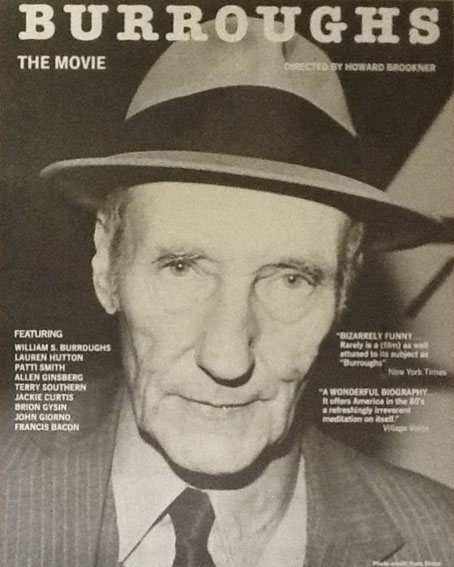
burroughs.jpg

Photo by Kate Simon.

Howard Brookner’s 86-minute documentary Burroughs: The Movie (1983) has been mentioned here on several occasions, and with good reason since it’s the best film anyone has made or will make about William Burroughs and the Beat circle he emerged from in the 1950s. Brookner’s documentary is a model film biography, opening with the writer’s appearance on Saturday Night Live in 1981 then backtracking to his childhood in St. Louis, his family life, the Beat period, the Bunker years, and so on, ending with his move to Lawrence, Kansas in the early 1980s. It’s intimate, frequently very funny, and reveals a human side to Burroughs too often buried by the weight of a sinister reputation. Brookner spent several years working on the film which features appearances from, and interviews with, a priceless range of friends, relatives and collaborators: Allen Ginsberg, Herbert Hunke, John Giorno, James Grauerholz, Brion Gysin, Patti Smith, Terry Southern, Mortimer Burroughs (William’s brother), William S. Burroughs Jr (William’s son who died while the film was in production), Francis Bacon, Jackie Curtis and many others. Tom DiCillo and Jim Jarmusch helped with the camera and sound duties.

The BBC screened the film as part of their Arena arts strand during the miraculous run of that series in the 1980s, since when it’s become difficult to see unless you have a copy on tape. So it’s been good to hear that Aaron Brookner is intending on restoring and reissuing his uncle’s debut film, having found the original print along with many outtakes. Howard Brookner died of AIDS in 1989 so Aaron is launching a Kickstarter fund to restore the film today, December 1st, which is World AIDS Day:

Burroughs: The Movie is a very special film: with in-depth interviews from Allen Ginsberg, Brion Gysin, and many more; intimate scenes such as Burroughs and James Grauerholz with Burroughs’ son Billy Jr.; and it is the only time on camera Burroughs speaks candidly about the tragic shooting accident that left his wife Joan dead.  As Janet Maslin wrote in The New York Times Review: “Rarely is a documentary as well attuned to its subject as Howard Brookner’s Burroughs, which captures as much about the life, work and sensibility of its subject as its 86 minute format allows. Part of the film’s comprehensiveness is attributable to William S. Burroughs’ cooperation, since the author was willing to visit old haunts, read from his works and even playfully act out a passage from Naked Lunch for the benefit of the camera. But the quality of discovery about Burroughs is very much the director’s doing, and Mr. Brookner demonstrates an unusual degree of liveliness and curiosity in exploring his subject”. (more)

Given that so many of the film’s participants are now dead this project has historical as well as aesthetic significance. If you have some spare cash and a more than passing interest in William Burroughs than I’d urge you to lend your support.

Elsewhere on { feuilleton }
The William Burroughs archive

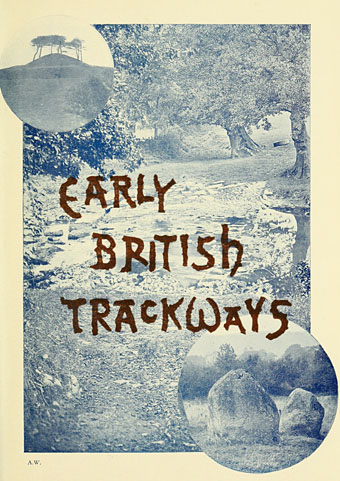
Early British Trackways

watkins01.jpg

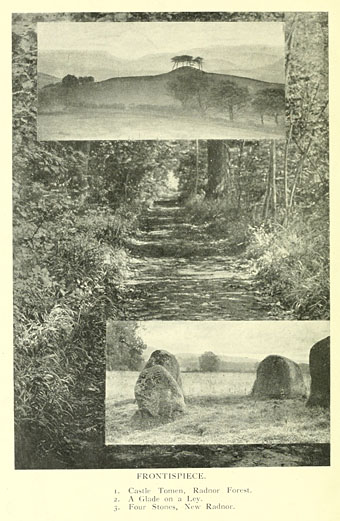
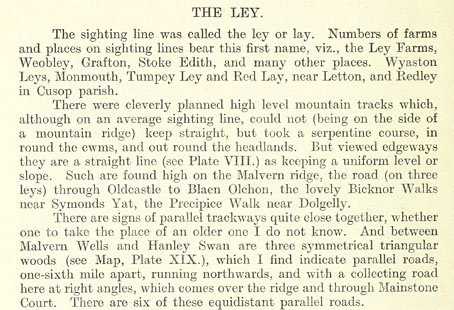
Continuing the Earth mysteries/megaliths theme, Early British Trackways: Moats, Mounds, Camps, and Sites (1922) by Alfred Watkins (1855–1935) was the first book in which the ley lines theory was proposed. Watkins was an amateur archaeologist (more a kind of early psychogeographer), photographer and writer who theorised that ancient Britons had marked the land with pathways connected by a variety of natural and man-made features: hills, mounds, trees, ponds, hillside notches and (of course) standing stones. Watkins coined the term “ley” after noticing that many of the lines connecting these features ran through villages or areas of land whose names ended in “-ley”, “-lay” or similar. The thesis was developed more fully in The Old Straight Track (1925), a book which became the ur-text for subsequent ley hunters. I’ve never seen any of Watkins’ books so it was interesting finding this short volume at the Internet Archive, not least because several of the photos appear in Mysterious Britain (1972) by Janet & Colin Bord, a classic guide to Britain’s sacred sites and folk rituals.

watkins02.jpg

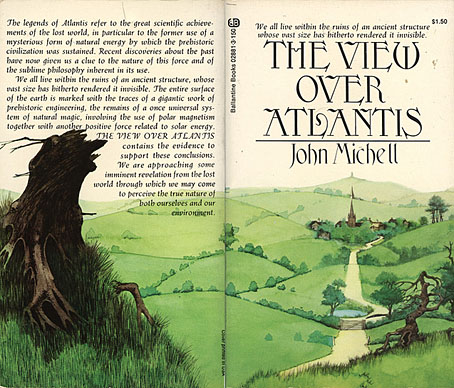
Watkins never regarded ley lines as having any mystic significance, he thought they were probably old trade routes. Archaeologists have never agreed with his suppositions, however, and Watkins himself might have disapproved of the conjectures added to his theories by John Michell in The View Over Atlantis (1969) which wedded ley line theory to feng shui to create the whole “lines of energy” idea. Whatever one thinks of Michell’s theories, that book and subsequent volumes put ley lines firmly into popular culture, and without them we wouldn’t have the references in Children of the Stones, Steve Hillage’s Green (1978) (pretty much a Michell-inspired concept album), Nigel Kneale’s Quatermass (1979) and so on. But this slim book is where it all begins.

tvoa.jpg

Illustration by Roger Dean (1972).

watkins03.jpg

Continue reading “Early British Trackways”