Haeckel fractals

haeckel.jpg

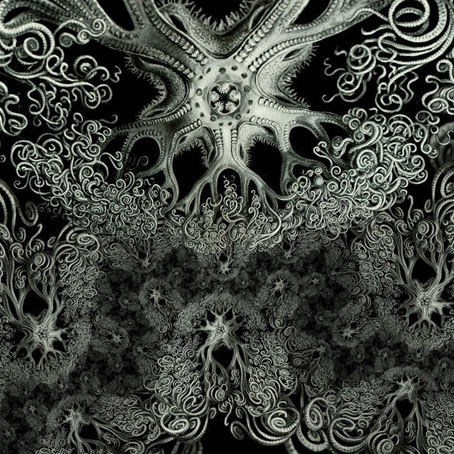
In which Ernst Haeckel’s Art Forms in Nature are given the Mandelbrot treatment. The example above is one of a number of variations created using the splendid Gorgon-headed Starfish, a creature I’ve messed with myself a couple of times.

These fractal images have been created by the Subblue people using their Fractal Explorer plug-in for Adobe’s Pixel Bender Toolkit, both of which are free downloads. I’ve not had chance to play around properly with Pixel Bender but the results here make it seem worth spending time getting to grips with its rather primitive interface.

Previously on { feuilleton }
Ernst Haeckel, Christmas card artist

Luke Jerram’s Glass Microbiology

jerram1.jpg

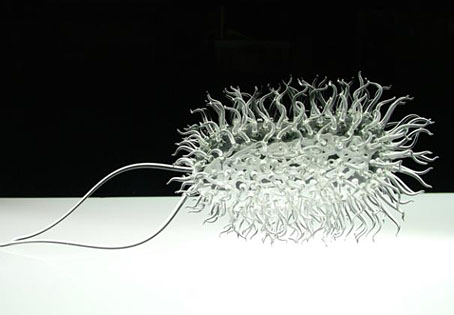
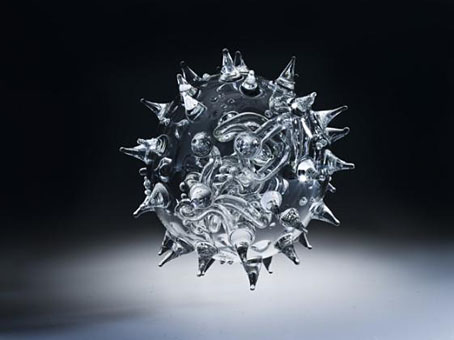
Large E-Coli.

Or art as virus…. Just because micro-organisms can make us seriously ill doesn’t mean they can’t be beautiful. Luke Jerram‘s glass renderings of some of the most deadly examples are on display at the Smithfield Gallery, London, until October 3rd.

The sculptures were designed in consultation with virologists from the University of Bristol using a combination of different scientific photographs and models. They were made in collaboration with glassblowers Kim George, Brian Jones and Norman Veitch. (More.)

jerram2.jpg

Avian flu.

Previously on { feuilleton }
Andy Paiko’s glass art
The art of Josiah McElheny
The art of Angelo Filomeno
IKO stained glass
Cristalophonics: searching for the Cocteau sound
Glass engines and marble machines
Wesley Fleming’s glass insects
The art of Lucio Bubacco
The glass menagerie

An apology for Alan Turing

turing.jpg

Sometimes petitions work. A few weeks ago one such was launched by computer scientist John Graham-Cumming on the UK government website requesting a public apology for the terrible treatment accorded mathematician and wartime codebreaker Alan Turing in 1952. Turing was prosecuted after admitting a gay affair to police investigating another matter and given the choice of imprisonment or parole with chemical castration; in order to carry on working he took the latter choice but subsequent depression led to his suicide. The law used was the same which sent Oscar Wilde to prison in 1895, and Turing’s case was probably the worst treatment of a notable figure on the basis of sexuality since Wilde. During the Second World War Turing had saved countless lives by helping crack the Enigma code, and his early computer research led to the development of machines like the one on which you’re reading these words. In 1999 TIME Magazine put him in a list of the 100 Most Important People of the 20th Century.

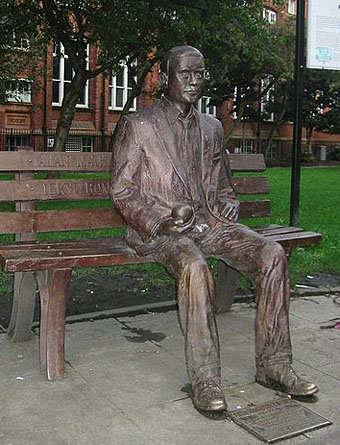
Turing has always felt like a local hero to me even though he only lived in Manchester for a few years. The house where he died isn’t far from where I live, and he has a memorial statue (above) in Sackville Park in the city centre, midway between the gay village and the Institute of Science and Technology where he worked. The petition gained a lot of support—30,805 signatures—including endorsement from high-profile figures such as Richard Dawkins and Stephen Fry. I signed it although I was sceptical it would lead to anything; this government doesn’t have much of a record for paying attention to the wishes of its citizens. So colour me surprised now that PM Gordon Brown has issued an apology:

Thousands of people have come together to demand justice for Alan Turing and recognition of the appalling way he was treated. While Turing was dealt with under the law of the time and we can’t put the clock back, his treatment was of course utterly unfair and I am pleased to have the chance to say how deeply sorry I and we all are for what happened to him. Alan and the many thousands of other gay men who were convicted as he was convicted under homophobic laws were treated terribly. Over the years millions more lived in fear of conviction.

I am proud that those days are gone and that in the last 12 years this government has done so much to make life fairer and more equal for our LGBT community. This recognition of Alan’s status as one of Britain’s most famous victims of homophobia is another step towards equality and long overdue. (More.)

I take a consistently dim view of the present administration when it comes to its diminishing of our civil liberties and its involvement in other people’s wars. But when it comes to gay issues, Blair and Brown have been the best Prime Ministers since 1967, when another Labour government overturned the law which killed Wilde and Turing. The best, bar none. This announcement is another plus in that direction.

Previously on { feuilleton }
Stonewall forty years on
Over the rainbow
Forty years of freedom after centuries of injustice

Le Phallus phénoménal

denon.jpg

Le Phallus phénoménal (1793–1794).

This blurred and discoloured picture arrives following a discussion with Paul Rumsey in the comments for an earlier post about engravings of monstrous whales. The pictures there were by engraver Hieronymus Cock whose surname gives us an additional resonance when discussing Moby Dick and sperm whales. The picture I posted of Jan Saenredam’s stranded whale showed the dead creature’s considerable penis (another engraving does the same) which led Paul to alert me to Dominique Vivant’s mischievous play on these pictures, where the artist exchanges the whale for a Brobdingnagian phallus. Or perhaps it’s merely a Gulliverian phallus and those people are Lilliputians… Whatever the case, I then mentioned to Paul JG Ballard’s story ‘The Drowned Giant’ from Ballard’s Terminal Beach collection which concerns the body of an enormous human found washed on a beach and subject to similar scrutiny by townspeople as in the stranded whale pictures. The body is eventually dissected and sold off. Paul reminded me of the end of the piece where Ballard writes:

As for the immense pizzle, this ends its days in the freak museum of a circus which travels up and down the north-west. This monumental apparatus, stunning in its proportions and sometime potency, occupies a complete booth to itself. The irony is that it is wrongly identified as that of a whale…

…which brings us full circle. Perhaps fittingly, Ballard’s story was published in Playboy magazine in 1965 under the title ‘Souvenir’.

As for Dominique Vivant (1747–1825), aka the Baron de Denon, his prestigious career besides engraving included, among other things, the directorship of the Louvre. We’re told he also wrote an erotic novel, Point de lendemain, and produced a selection of pornographic etchings, of which Le Phallus phénoménal would seem to be a part. Let no one accuse the French of being prudes; the picture above is from a site where you can order framed prints should you have a sudden urge to hang a phenomenal phallus on your wall.

Elsewhere on { feuilleton }
The etching and engraving archive

Previously on { feuilleton }
Of the Monstrous Pictures of Whales
Jan Saenredam’s whale
The Whale again
Rockwell Kent’s Moby Dick
Phallic bibelots
Phallic worship
The art of ejaculation

Of the Monstrous Pictures of Whales

whale1.jpg

When Herman Melville complains in chapter 55 of Moby Dick about erroneous representations of whales, this is the kind of thing he had in mind. Among those he takes to task, however, I don’t recall any of them having two blow-holes like the creature above.

whale2.jpg

The coat of arms of Portugal.

These fanciful beasts are the work of (no sniggering, please) Hieronymus Cock (1510–1570), an Antwerp engraver, and they populate the seas as part of his marvellous map of America created with the assistance of Spanish cartographer Diego Gutiérrez.

Gutiérrez’s magnificent 1562 map of America was not intended to be a scientifically or navigationally exacting document, although it was of large scale and remained the largest map of America for a century. It was, rather, a ceremonial map, a diplomatic map, as identified by the coats of arms proclaiming possession. Through the map, Spain proclaimed to the nations of Western Europe its American territory, clearly outlining its sphere of control, not by degrees, but with the appearance of a very broad line for the Tropic of Cancer clearly drawn on the map.

The map is described in detail here while another part of the Library of Congress Map Collections site has an incredible high-resolution copy which is a delight to pore over. This is a really big image (10492 x 11908 pixels) but the huge size is just what I love to see. You can not only zoom into the myriad details—cannibals cooking a human feast in Brazil—but also admire the precision of the cross-hatching. Less than forty years separate these generic creatures from Jan Saenredam’s far more accurate rendering of a beached sperm whale.

whale3.jpg

A dolphin (Melville classed dolphins and porpoises as small whales).

Elsewhere on { feuilleton }
The etching and engraving archive

Previously on { feuilleton }
Jan Saenredam’s whale
The Whale again
Rockwell Kent’s Moby Dick