Monsieur Fantômas by Ernst Moerman

fantomas.jpg

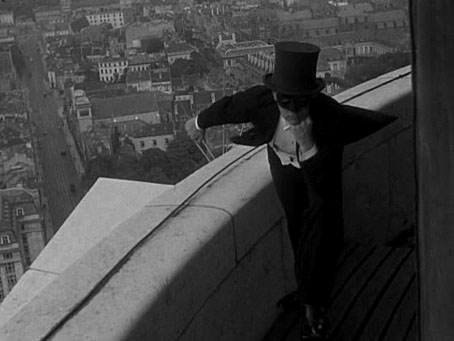
Jean Michel as Fantômas.

Ernst Moerman’s Belgian short from 1937 is available for viewing at Ubuweb and is described on its title card as “Un film Surrealiste”. One might equally describe it as “un film amateur” since it’s very much in the home movie mould as was much of the independent cinema of this time. The direction may be perfunctory but the photography is surprisingly good in places. The action, such as it is, concerns an avatar of the Surrealists’ favourite anti-hero, Fantômas, in a series of farcical scenes many of which are filmed on a beach with a few spare props. The most notable moment for me is one which none of the online documentation mentions, a brief appearance by a youthful René Magritte who pretends to be painting Le Viol. Magritte was a great Fantômas enthusiast so his presence here isn’t too surprising.

Previously on { feuilleton }
The Dark Ledger
Judex, from Feuillade to Franju
Fantômas

Weekend links 5

kamekura.jpg

A poster design by Yusaku Kamekura. More here, via A Journey Round My Skull.

First of all this week, there’s a new interview posted which I gave last year to Crows ’n’ Bones magazine. The replies skate around the usual subjects (Cthulhu et al) and you also find out why I don’t think design and illustration for music is going to vanish as soon as some people think.

• A Journey Round My Skull has announced The Raymond Roussel Illustration Contest which is open to all.

• Cover designs: David Pearson on redesigning Cormac McCarthy’s UK covers, a huge improvement on the previous Picador series. Also, The Robert Lesser Pulp Art Collection.

• Last year I discussed Teleny, Or the Reverse of the Medal, the novel of gay erotica attributed to Oscar Wilde, giving a mention in passing to Jon Macy’s comic strip adaptation of the book. That adaptation has now been published and is available via his website.

bradley_kiss.jpg

The Kiss (1896) by Will Bradley.

• More Art Nouveau (because too much is never enough): Will Bradley’s work at Golden Age Comic Book Stories. Can’t understand how I missed this one.

• A discussion: The Magic Mystery and Melancholy of Five Leaves Left by Nick Drake.

• Sandi Vincent’s Flickr pages overflow with Graphis Annual goodness.

• A new edition of the Arthur Radio Voyage is available to download. And Trunk Records’ Jonny Trunk has a mix of obscure vinyl for you.

• Song of the week: We Want War by These New Puritans. Slow motion shots in the video are a plus.

Sherbet and Sodomy

ebbing.jpg

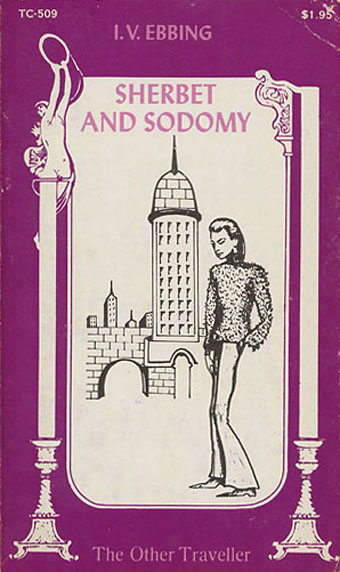
Cover art by Coker.

We had Shock Headed Peters walking through Sodom yesterday so this novel from 1971 seems like a fitting follow-up. The eye-catching title is no doubt an allusion to Byron’s description of Turkish baths as “marble palaces of sherbet and sodomy”, an epithet which one imagines sent generations of sweet-toothed Uranians trekking to Constantinople throughout the 19th century. I’d seen the cover of this book before on sites which collect the gay fiction of the late Sixties and early Seventies—that doubly-phallic tower makes a good match for the cover of Bugger Boy—but I don’t recall reading a description of the contents before. Homobilia has an extract from the opening page:

My name is Jud. I am eighteen and a half. I was born from the felicitous conjunction of an anthropologist and an ethnologist under the sign of Capricorn. I have been called cute, handsome, pretty, and good-looking; actually, I am beautiful… my nose is classically English, along the line of Reynolds, maybe with a little Caravaggio thrown in around the nostrils. My athletic adolescence on the swimming team at Sterling High has given me a slender muscular body… my eyes are South Pacific blue. I have read Hesiod. I masturbate regularly. I have no concept of money or its value. I try to keep my farts silent. I have juvenile down on my ass. I have read the minor Elizabethan poets and I have looked at my anal sphincter in the mirror. Until last week I considered myself heterosexual…

Four art and literatures references in a single paragraph…yes, I’m intrigued. The book is out of print, unfortunately, but searching at Abebooks reveals copies for sale and an additional description:

How does a handsome young cat, newly out and grooving on the gay scene of Greenwich village, suddenly find himself in the silken clutches of El-Dahabi, an Arab sect which celebrates the attainment of perfect love through pain and submission?

So now the Byron reference makes sense. Many of these gay paperbacks were written under nommes de plume and IV Ebbing may well be another of these, there’s certainly no other reference to he (or, indeed, she…) on the web aside from this title. There’s a notable dearth of information about the fiction which emerged in a flood after the first flush of liberation in the late Sixties, when numerous titles for lesbians and gay men were published as cheap paperbacks. Strange Sisters and Gay on the Range document the cover art but I’d like to see a site which told us more about the writers and, where possible, the books themselves. The history of all kinds of pulp fiction has been extensively chronicled; isn’t it time that someone did the same for gay erotica?

Elsewhere on { feuilleton }
The book covers archive

Previously on { feuilleton }
Bugger Boy
Gay book covers

The Mask of Fu Manchu

fumanchu1.jpg

Myrna Loy, Charles Starrett and Boris Karloff.

Los Alamos ranch school where they later made the atom bomb and couldn’t wait to drop it on the yellow peril. The boys are sittin’ on logs and rocks eating some sort of food there’s a stream at the end of a slope. The counsellor was a southerner with a politician’s look about him. He told us stories by the camp fire culled from the racist garbage of the insidious Sax Rohmer. “East is evil, west is good.”

William Burroughs

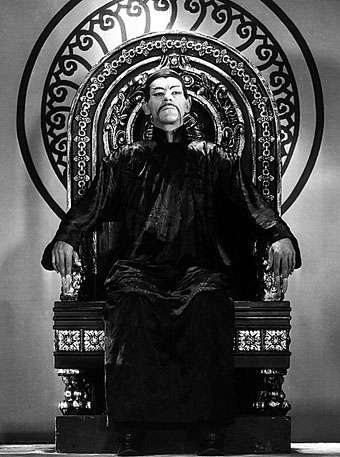
More pulp, and yes, it’s still racist garbage but Charles Brabin’s 1932 film which stars Boris Karloff as Sax Rohmer’s Oriental super-villain has its pleasures if you look past the severely dated attitudes. Together with The Black Cat (1934), where Boris plays a Satan-worshipping Modernist architect (!), this is one of the best non-Frankenstein Karloff films of the 1930s, as I was reminded this weekend when re-watching it along with several Sherlock Holmes episodes.
fumanchu2.jpg

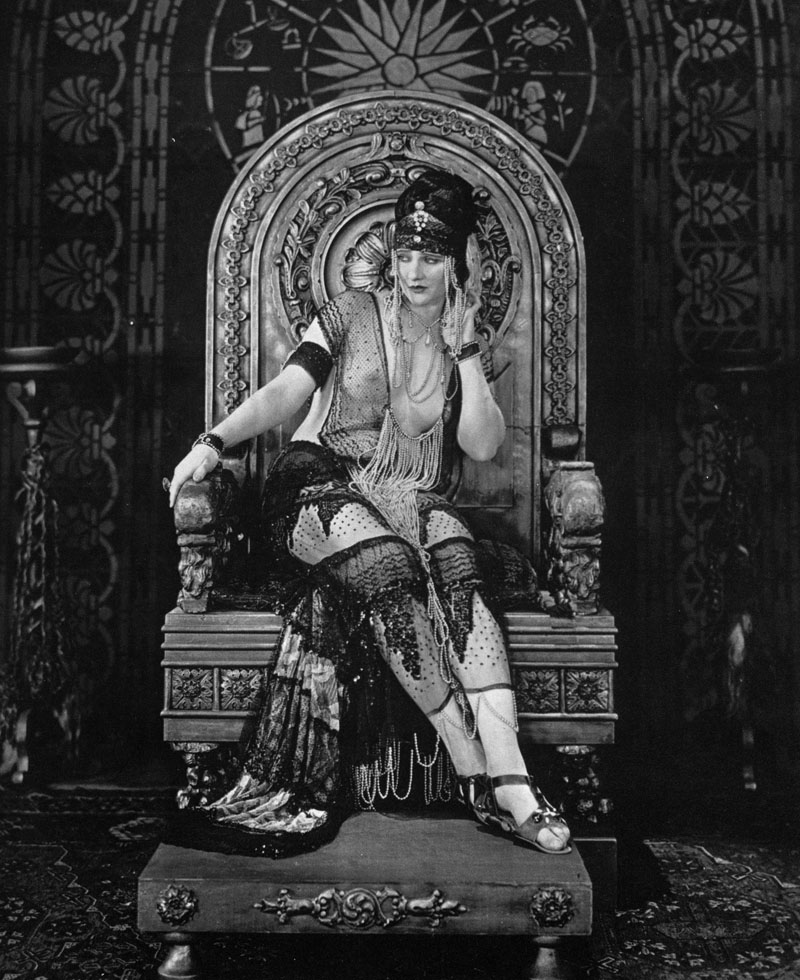
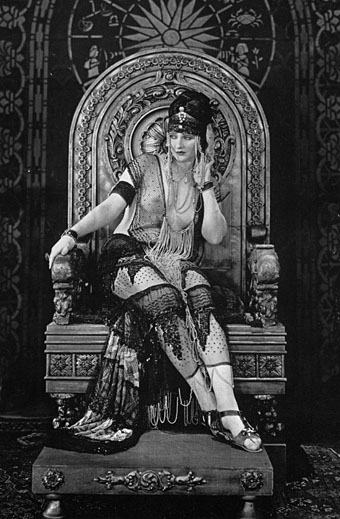
Christopher Lee is elegantly diabolical in the later Fu Manchu films but their cheap budgets force him to skulk around in dismal underground lairs. Karloff’s Doctor has a lavish Art Deco pad whose huge rooms are furnished with a noisy Van de Graaff generator and other scientific apparatus, plus a series of torture rooms where his guests may endure death by encroaching spikes (the “Slim Silver Fingers”), being lowered into an alligator pit, or driven mad by the incessant tolling of a giant bell. I happened to notice that the Doctor’s throne is quite possibly the same one (with a fresh coat of paint) as was used a decade earlier by a notoriously unclad Betty Blythe in The Queen of Sheba (1921), a lavish silent epic which is now unfortunately lost.
sheba.jpg

Betty Blythe as the Queen of Sheba.

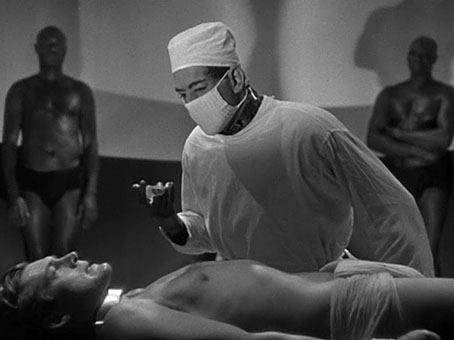
The flaunting of Ms. Blythe’s breasts were one of the many occurrences which led to Hollywood’s adoption of the Hays Code in the 1930s, although the Code’s full effects weren’t felt until later in the decade. The notable scene in The Mask of Fu Manchu where hunk Charles Starrett appears strapped to a table dressed in nothing but a skimpy loin cloth (having previously been thrashed by Fu’s lustful daughter) would have been toned down considerably had the film been made a few years later. All the more reason to watch it today, such scenes only add to the fun.
fumanchu3.jpg

The Doctor prepares to inject his captive with a serum which will turn the man into a compliant slave.

The Mask of Fu Manchu | A page about the original serial, the subsequent novel and its illustrators.

Previously on { feuilleton }
Wladyslaw Benda

The Dark Ledger

ledger1.jpg

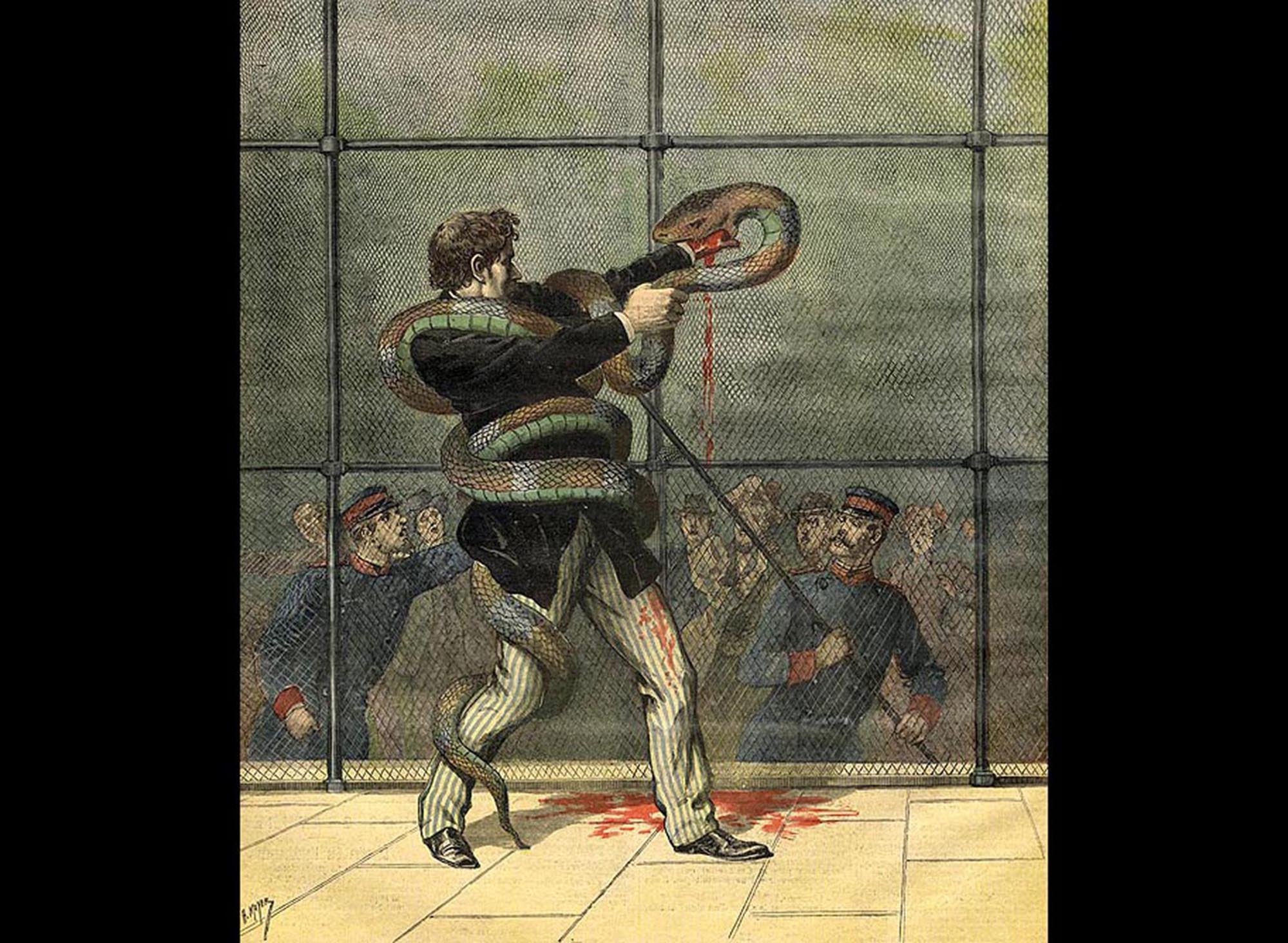
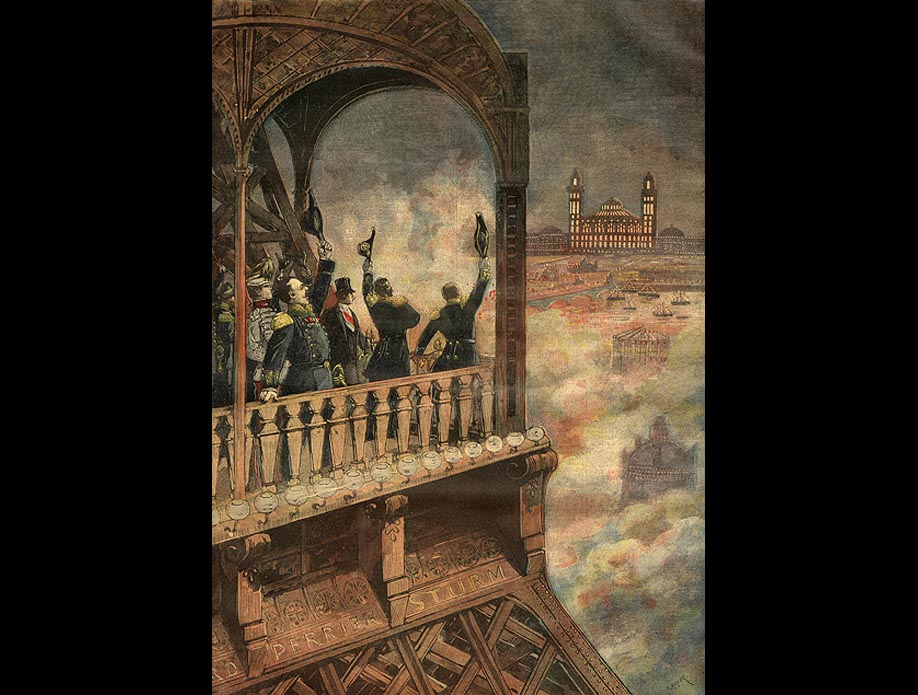
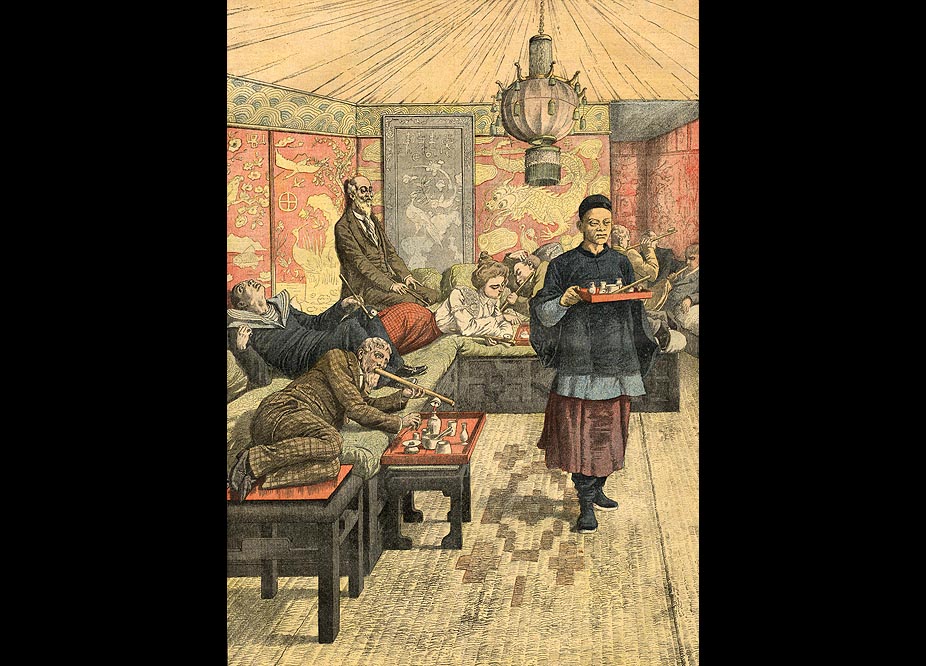
The boundless depths of Chris Mullen’s VTS site continue to yield treasures. The documentation for these pictures is somewhat vague but they seem to be illustrations for Fantômas stories which Mullen has grouped under the title The Dark Ledger, part of a larger selection of pages devoted to the Lord of Evil. The depiction of the Eiffel Tower is of interest here for its showing a view over one of the Paris expositions, possibly the Exposition Universelle of 1900. The opium den, on the other hand, seems remarkably overlit and well-appointed compared to the more customary renderings of such places.

ledger2.jpg

ledger3.jpg

Previously on { feuilleton }
Exposition Universelle publications
Exposition cornucopia
Return to the Exposition Universelle
The Palais Lumineux
Louis Bonnier’s exposition dreams
Exposition Universelle, 1900
The Palais du Trocadéro
The Evanescent City
Judex, from Feuillade to Franju
Fantômas