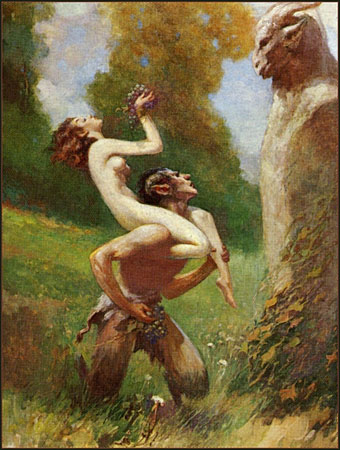
Ave Pan by the amazing J Allen St John. Via.
In the spirit of basic human generosity I try not to be too anti-Christian here, especially when so many churchgoers these days feel themselves rather beleaguered; after centuries persecuting much of the world, the world has finally pushed them back and it hurts the poor things. Much as I’d love to refer to Christianity as a Patriarchal Death Cult that seems unfair to those of its adherents who aren’t hate-mongering bigots, those who put agape before “Thou shalt not…”. But goddamn if those self-appointed leaders don’t make generosity difficult at times. Men (and they’re always men) such as poisonous geriatric Pat Robertson whose recent blather has included this gem:
Any country that openly embraces homosexuality throughout the history of mankind has gone down into ruin. That’s history. That’s the historical record. Whatever nation embraces this so-called lifestyle, it ends up in the garbage heap of history.
Given the onward march of gay rights versus the mortal diminishing of ageing gasbags like the recently deceased Jerry Falwell, the only thing the garbage heap of history awaits is Robertson himself. One might even propose in a spirit of distinct un-generosity that the reason Robertson’s god hasn’t already called him home is because heaven’s inhabitants want to have a few more years of peace before they have to listen to his drivel for the rest of eternity.
And speaking of drivel, the porcine Newt Gingrich dropped this bon mot earlier in the month while speaking to a crowd of evangelicals:
“I think this is one of the most critical moments in American history,” Gingrich said. “We are living in a period where we are surrounded by paganism.”
Setting aside the obvious point that America is actually surrounded by large tracts of water and a nation called Canada, Gingrich (or Lissotriton vulgaris as we’d call him if he really was a newt) was proposing a specious equivalence between what he would perceive as social iniquities and, er…Satanism or something. Whether he actually believes any of this nonsense is moot; he’s telling an audience of believers who may one day be asked to vote for him what they want to hear. Nonetheless, he complains about paganism as though it’s somehow a bad thing. Maybe he’d like to come to our cheerfully pagan isles and argue the point with the increasing number of genuine witches, warlocks and sundry earth-worshippers. A Guardian feature this week entitled Everyone’s a pagan now reported that:
There are said to be a quarter of a million practising pagans in this country, double the number of a decade ago. That would make them more numerous than Buddhists (of which there are 144,500, according to the 2001 census) and almost as numerous as Jews (259,000).
It’s no surprise that this comes at a time when church attendance, which has been declining for years in the UK, continues to plummet:
According to Religious Trends, a comprehensive statistical analysis of religious practice in Britain, published by Christian Research, even Hindus will come close to outnumbering churchgoers within a generation. The forecast to 2050 shows churchgoing in Britain declining to 899,000 while the active Hindu population, now at nearly 400,000, will have more than doubled to 855,000. By 2050 there will be 2,660,000 active Muslims in Britain – nearly three times the number of Sunday churchgoers. (More.)
Before Pat Robertson starts looking for our place on the garbage heap of history it ought to be noted that Christianity’s high-water mark in Britain was the late 19th century which saw a profusion of church building and church attendance. The decline set in after the First World War with many of those churches being abandoned then converted or demolished. (I can point to at least four sites in Manchester which were once Victorian churches). A recent study by the University of Derby found that the church’s antiquated attitudes to women was driving away one half of the population:
The report claims more than 50,000 women a year have deserted their congregations over the past two decades because they feel the church is not relevant to their lives.
It says that instead young women are becoming attracted to the pagan religion Wicca, where females play a central role, which has grown in popularity after being featured positively in films, TV shows and books. (More.)
TV and films only remind people of what’s always been there. Prior to the 19th century we were a Christian nation in name, of course, and I’ve always been grateful for our many cathedrals. But the far older pre-Christian ways are impossible to forget when you have a landscape littered with significant monuments such as Stonehenge, Avebury, Glastonbury Tor, the Callanish Circle, Silbury Hill, the Uffington White Horse, the Long Man of Wilmington, and the Cerne Abbas Giant whose enormous phallus is one of many things which makes me proud to be British. The latter pair can’t be claimed as prehistoric, unfortunately, but they remain fixtures in catalogues of Britain’s venerable un-Christian past.
Early Christianity did its best to co-opt the sites and festivals of our pagan ancestors but it seems as though two thousand years of dominance may now be drawing to a close. People today are far more sympathetic to spiritual attitudes which see the earth as something to be respected not exploited. And women will obviously respond to philosophies which don’t regard them as some unclean extrusion from a masculine creation with no part to play in religious ritual. Ask yourself what’s more attractive: the regressive bile of withered old men or a touch of pagan poetry?
Previously on { feuilleton }
• The Great God Pan
• Gay for god