Outer Alliance Pride Day

outer.jpgToday is Outer Alliance Pride Day so let’s begin with a statement:

As a member of the Outer Alliance, I advocate for queer speculative fiction and those who create, publish and support it, whatever their sexual orientation and gender identity. I make sure this is reflected in my actions and my work.

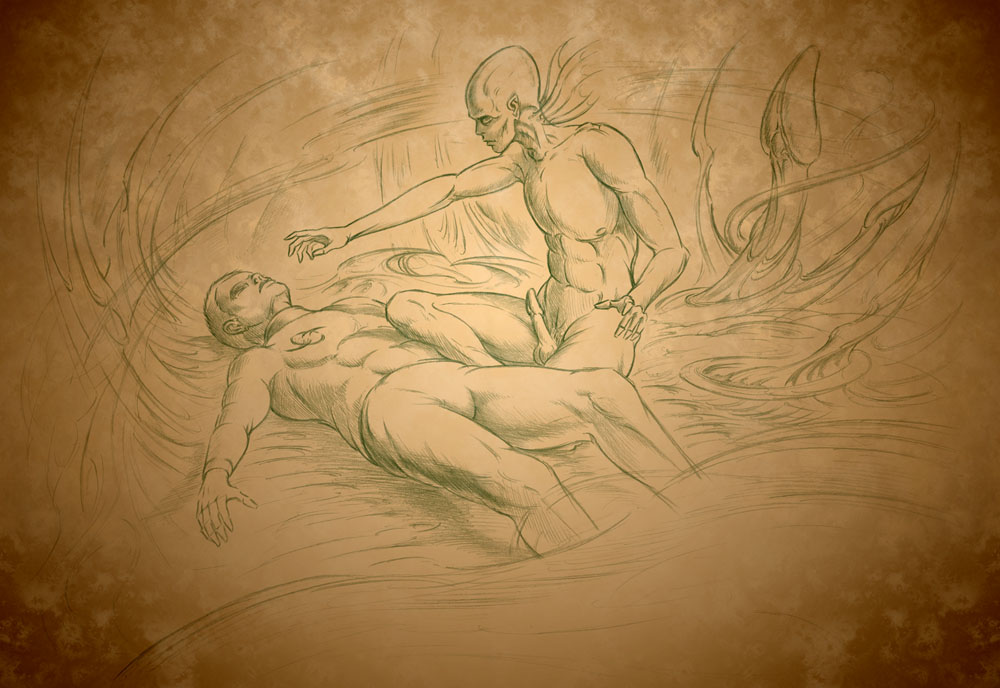
Various members of the Outer Alliance are either posting fiction, or reviewing something or otherwise attempting to fill that declaration of intent. For my part I decided today to do a sketch based on my favourite chapter of The Ticket that Exploded by William Burroughs, the sequence entitled the black fruit which Burroughs wrote with Michael Portman. Ticket was the first Burroughs book I read at the age of 16 or so, having discovered a copy in a local library, and it really felt like something exploding in the head. For a start, the text is some of his least accommodating for an average reader, although I was already familiar enough with literary experiment to cope with that. Far more electrifying was seeing familiar scenarios from science fiction and fantasy infused with a raw and relentless gay sexuality of endless erections and spurting cocks. The black fruit begins with a science fiction scene of lost astronauts encountering alien fishboys intent on having sex; it then progresses through a series of descriptions which read like a pornographic rewriting of similar scenes from HP Lovecraft or Clark Ashton Smith. In the opening pages of Ticket, Burroughs describes his book as “science fiction” but this was like no sf I’d read; I started to wish there was more like it. There are flashes of similar stuff in The Soft Machine (including an idea borrowed from Henry Kuttner) and elsewhere, and Cities of the Red Night is pretty much a full-on fantasy in its second half, but I’d still like to read more about the fishboys…

fishboy

Fishboy and Astronaut (detail).

So here’s an explicitly erotic sketch based on the black fruit (click the picture for the full thing). This should have been a lot better but I’m out of practice drawing at the moment and I didn’t give myself enough time. The scene doesn’t really match the book either, and the astronaut figure is pretty crappy. Feeble excuses aside, Burroughs’ rotting swamp gardens with their marble statues of copulating boys deserve better. And where his fiction leads, I’m still hoping that more writers will follow, not by copying his obsessions but by being as fearless and honest in mining their own.

Previously on { feuilleton }
William S Burroughs: A Man Within
The art of NoBeast

Memories of the Space Age

jc60s.jpg

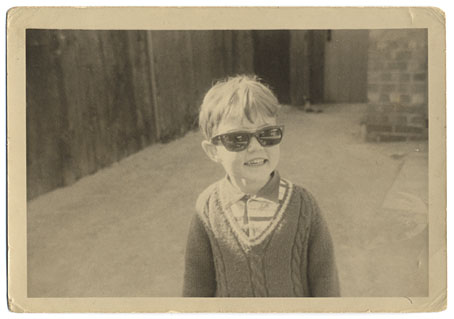
I was a Space Age boy. John Glenn became the first American to orbit the Earth in Project Mercury’s Friendship 7 a month before I was born, and growing up in the 1960s it was impossible to be unaware of the NASA missions. The first encyclopedia I was given in 1967 had a whole chapter about the Mercury and Gemini projects which ran from the late 1950s through to 1966. A subsequent section showed an artist’s impression of how it might look when we were exploring the Moon and the planets. By the time the photo above was taken, in 1968 or ’69, I was obsessed with the Apollo missions and had the names of the astronauts memorised the way others memorised the names of football players. (Everyone knows Neil Armstrong and Buzz Aldrin landed on the Moon; I’ve never forgotten that Michael Collins was the third member of the team, waiting for them in the Command Module.) For a while there was an American boy at school of whom I was deeply jealous; his father was in the USAF and his family had actually been present during the launch of Apollo 8!

Space was everywhere, it became a dominant theme, at least while the Apollo missions lasted. Pop culture of the 1950s had its share of rockets ships and flying saucers but was predominantly filled with Westerns and other Earth-bound adventures. You can see a watershed moment occurring when the hugely popular Gerry Anderson puppet shows went from the cowboy adventure of Four Feather Falls in 1960 to the science fiction of Supercar and, immediately after that, the full-on space adventure of Fireball XL5 in 1961 and ’62. Cowboys couldn’t compete with astronauts; Supercar and subsequent Anderson shows were regularly repeated, Four Feather Falls wasn’t. As well as being enthused by the Anderson shows I enjoyed something called Space Patrol, another science fiction puppet series which few now seem to remember.

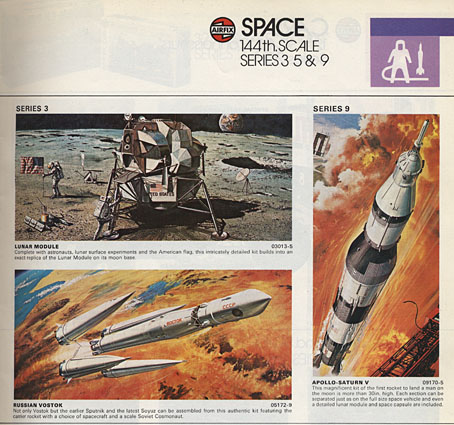
airfix.jpg

A page from a 1977 catalogue for Airfix model kits. I had the lunar module and the Saturn V. I don’t recall ever being interested in the Russian craft.

I wasn’t watching TV when Neil Armstrong first set foot on the Moon—it was 3.39 am here, I was fast asleep—but that didn’t matter, it was the event rather than the moment which counted. And there were five more landings following Apollo 11, each repeating those first moments and all accepted with the same spirit of innocent enthusiasm. What none of us kids realised at the time was that these events weren’t universally seen as a positive thing. Timothy Leary and Robert Anton Wilson later declared that going into space was the next step in human evolution but you wouldn’t know it looking through the underground press of the period. Appraisal of the NASA missions was filtered through the prisms of the Cold War and the cultural wars of the 1960s, with the entire Apollo enterprise being seen as a spin-off of the US military—the astronauts were all airforce pilots, after all—encouraged by a despised President Nixon and used as a means of embarrassing the Soviet Union. (This latter point tends to forget that the Russians were playing tit-for-tat, and had earlier embarrassed the US with Sputnik and Yuri Gagarin.) No one wanted to support men with crew-cuts who prayed in space and enjoyed country & western music. And few were prepared to concede that a President stoking the Vietnam War might have inadvertently done something worthwhile by continuing Kennedy’s space programme.

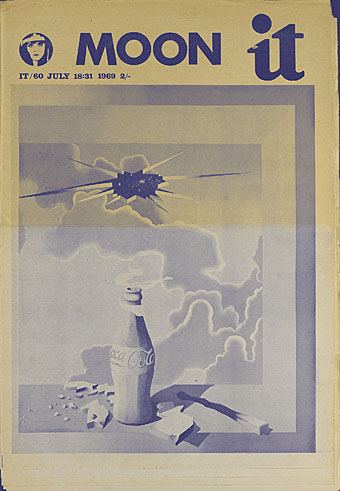
moon_it.jpg

The cover of International Times for July 18, 1969, the Moon mission seen as an exploding Coke bottle which shatters the sky. An editorial within complains about the hoisting of an American flag on the Earth’s satellite.

There was a similar hostility in the attitudes of some of the younger breed of sf writers of the time who saw the Moon missions being praised and supported by the old guard of sf and, like the counterculture freaks, were disappointed by the conservative character of the astronauts. I only know this retrospectively, of course, but the complaints have always seemed rather purposeless; those men were test pilots, what else were people expecting? Equally dismaying was the amount of times throughout the 70s and 80s you’d hear black musicians only referring to the space missions in terms of a waste of money. What happened, I’d want to know, to Sun Ra’s “Space is the place”, to the elegant science fiction of Samuel R Delany, and to Parliament’s Mothership Connection? (For a more positive attitude we now have Afrofuturism.)

My own disappointment came in 1972 when it became evident that the whole show was over. As Tom Wolfe notes, after the Moon landing there was nowhere left to go. I developed a taste for written science fiction which lasted for several years but I’ve wondered sometimes whether that sense of an interplanetary future being brought to a dead stop isn’t the reason why I’ve since regarded all visions of the future as suspect. Everything in the 1960s told us that by 2009 we’d have bases on the moon and probably Mars; some of us might be living in Gerard K O’Neill‘s space colonies. When that future, which for a while seemed not only likely but inevitable, can be so easily short-circuited, why should we believe any others presented to us?

Related links:
NASA’s pages for the Apollo missions
Wired: The Moon Landings: Fact, Not Fiction
Wired: The Science of Apollo 11
Geeta Dayal on Apollo: Atmospheres and Soundtracks
by Brian Eno with Daniel Lanois and Roger Eno

Pink Floyd’s Moon-Landing Jam Session
Armstrong and Aldrin’s “lost Lunar City”
Julius Grimm’s map of the Moon from 1888

Previously on { feuilleton }
Apollo liftoff
Earthrise
East of Paracelsus

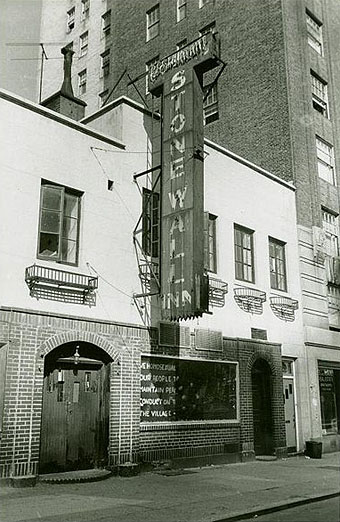
Stonewall forty years on

stonewall.jpg

It was forty years ago, on the night of the 27th and morning of the 28th of June, 1969, that patrons of the Stonewall Inn in Greenwich Village rioted after one police raid too many. You can read about it in detail on an unusually thorough (caveat lector) Wikipedia page. Violence, harassment and suspicion is something gay people still have to endure today but in the 1960s things were considerably worse and the riots which began that night marked the point at which gay people in America showed they weren’t going to be pushed around any more. The exact nature of the events is still being argued over but that doesn’t negate their symbolic value. Here in Britain Parliament had grudgingly (and with ridiculous provisos) decriminalised homosexual acts two years earlier but the Stonewall riots have proved a potent enough symbol to lend their name to Britain’s leading gay rights organisation.

Things have improved immeasurably since 1969 but the struggle for basic civil rights continues, whether for marriage equality in many western countries, or for freedom from persecution and execution elsewhere. Martin Luther King said “Let us realize the arc of the moral universe is long but it bends toward justice.” Likewise, Oscar Wilde, given two years’ hard labour under the law which wasn’t abolished until 1967, said upon his release, “Yes, we shall win in the end; but the road will be long and red with monstrous martyrdoms.” Most of the time it can feel like we’ve reached the end of Oscar’s road but that’s only true in a handful of countries. Until the map on this page can be turned a single colour, the end of the road for many people will remain out of sight. But the arc of the moral universe is long. And it bends towards justice.

• The Times: Church ‘out of touch’ as public supports equal rights for homosexuals

Previously on { feuilleton }
Over the rainbow
Forty years of freedom after centuries of injustice

Born again pagans

stjohn_pan.jpg

Ave Pan by the amazing J Allen St John. Via.

In the spirit of basic human generosity I try not to be too anti-Christian here, especially when so many churchgoers these days feel themselves rather beleaguered; after centuries persecuting much of the world, the world has finally pushed them back and it hurts the poor things. Much as I’d love to refer to Christianity as a Patriarchal Death Cult that seems unfair to those of its adherents who aren’t hate-mongering bigots, those who put agape before “Thou shalt not…”. But goddamn if those self-appointed leaders don’t make generosity difficult at times. Men (and they’re always men) such as poisonous geriatric Pat Robertson whose recent blather has included this gem:

Any country that openly embraces homosexuality throughout the history of mankind has gone down into ruin. That’s history. That’s the historical record. Whatever nation embraces this so-called lifestyle, it ends up in the garbage heap of history.

Given the onward march of gay rights versus the mortal diminishing of ageing gasbags like the recently deceased Jerry Falwell, the only thing the garbage heap of history awaits is Robertson himself. One might even propose in a spirit of distinct un-generosity that the reason Robertson’s god hasn’t already called him home is because heaven’s inhabitants want to have a few more years of peace before they have to listen to his drivel for the rest of eternity.

And speaking of drivel, the porcine Newt Gingrich dropped this bon mot earlier in the month while speaking to a crowd of evangelicals:

“I think this is one of the most critical moments in American history,” Gingrich said. “We are living in a period where we are surrounded by paganism.”

Setting aside the obvious point that America is actually surrounded by large tracts of water and a nation called Canada, Gingrich (or Lissotriton vulgaris as we’d call him if he really was a newt) was proposing a specious equivalence between what he would perceive as social iniquities and, er…Satanism or something. Whether he actually believes any of this nonsense is moot; he’s telling an audience of believers who may one day be asked to vote for him what they want to hear. Nonetheless, he complains about paganism as though it’s somehow a bad thing. Maybe he’d like to come to our cheerfully pagan isles and argue the point with the increasing number of genuine witches, warlocks and sundry earth-worshippers. A Guardian feature this week entitled Everyone’s a pagan now reported that:

There are said to be a quarter of a million practising pagans in this country, double the number of a decade ago. That would make them more numerous than Buddhists (of which there are 144,500, according to the 2001 census) and almost as numerous as Jews (259,000).

It’s no surprise that this comes at a time when church attendance, which has been declining for years in the UK, continues to plummet:

According to Religious Trends, a comprehensive statistical analysis of religious practice in Britain, published by Christian Research, even Hindus will come close to outnumbering churchgoers within a generation. The forecast to 2050 shows churchgoing in Britain declining to 899,000 while the active Hindu population, now at nearly 400,000, will have more than doubled to 855,000. By 2050 there will be 2,660,000 active Muslims in Britain – nearly three times the number of Sunday churchgoers. (More.)

Before Pat Robertson starts looking for our place on the garbage heap of history it ought to be noted that Christianity’s high-water mark in Britain was the late 19th century which saw a profusion of church building and church attendance. The decline set in after the First World War with many of those churches being abandoned then converted or demolished. (I can point to at least four sites in Manchester which were once Victorian churches). A recent study by the University of Derby found that the church’s antiquated attitudes to women was driving away one half of the population:

The report claims more than 50,000 women a year have deserted their congregations over the past two decades because they feel the church is not relevant to their lives.

It says that instead young women are becoming attracted to the pagan religion Wicca, where females play a central role, which has grown in popularity after being featured positively in films, TV shows and books. (More.)

TV and films only remind people of what’s always been there. Prior to the 19th century we were a Christian nation in name, of course, and I’ve always been grateful for our many cathedrals. But the far older pre-Christian ways are impossible to forget when you have a landscape littered with significant monuments such as Stonehenge, Avebury, Glastonbury Tor, the Callanish Circle, Silbury Hill, the Uffington White Horse, the Long Man of Wilmington, and the Cerne Abbas Giant whose enormous phallus is one of many things which makes me proud to be British. The latter pair can’t be claimed as prehistoric, unfortunately, but they remain fixtures in catalogues of Britain’s venerable un-Christian past.

Early Christianity did its best to co-opt the sites and festivals of our pagan ancestors but it seems as though two thousand years of dominance may now be drawing to a close. People today are far more sympathetic to spiritual attitudes which see the earth as something to be respected not exploited. And women will obviously respond to philosophies which don’t regard them as some unclean extrusion from a masculine creation with no part to play in religious ritual. Ask yourself what’s more attractive: the regressive bile of withered old men or a touch of pagan poetry?

Previously on { feuilleton }
The Great God Pan
Gay for god