Muto: The Exterface Manifesto

muto1.jpg

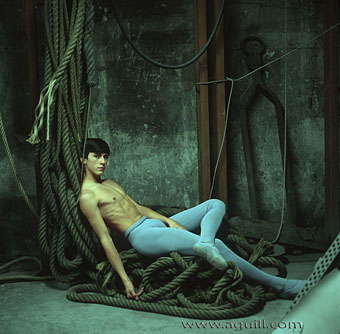
In which French photographers Exterface extend their particular brand of erotic styling into the world of online publications. Muto is a typically high-quality production (requires registration with Issuu), the theme this time being the hothouse of the 1970s when the word “clone” was as much associated with gay bars as with the products of science fiction. What was once a visual cliché now seems fresh (and hot!) amid the clichés (twinks and bears) which took its place. With retromania one of the buzzwords du jour there’s no reason why erotic photography shouldn’t get in on the act, is there?

Via Homotography.

Elsewhere on { feuilleton }
The gay artists archive

Previously on { feuilleton }
Let’s get physical: Bruce of Los Angeles and Tom of Finland
Exterface

Dead roads

west1.jpg

Canon de Chelly — Navaho (1904) by Edward Sheriff Curtis.

A few pictures from the substantial Flickr collection belonging to San Diego’s Museum of Photographic Arts. Many of these are views of the western states of the USA from a time when photographers were documenting the vanishing world of Native American tribes. A couple of pictures in the series by Edward Sheriff Curtis would work as cover illustrations for Cormac McCarthy’s Blood Meridian, while the results of a gunshot injury below is the kind of thing you never see in Westerns.

west2.jpg

Untitled (1910) by Richard Throssel.

And speaking of McCarthy’s baleful masterpiece, William Gibson recently recounted his first experience of reading the book on a journey to Berlin. “I awoke from it as from some terribly potent dream, and found myself, quite unexpectedly, in a strange city,” he says. Read the rest here.

Photo tip via Beautiful Century.

west3.jpg

Distortion of Left Lower Extremity after Gunshot Injury, November 30, 1865.

Previously on { feuilleton }
Repackaging Cormac
Cormac McCarthy book covers

Weekend links 64

magritte.jpg

The Sixteenth of September (1956) by René Magritte.

To Magritte admirers, The Sixteenth of September is a deceptively realistic work painted in 1956, one of a series in which the artist plays tricks with light and time of day. It shows a crescent moon impossibly shining through the dark mass of a tree, against a dawn sky.

To [Marc] Bolan fans, the painting has an entirely different significance: 16 September 1977 was the date the singer was returning home in the small hours from a night out, in a Mini driven by his girlfriend Gloria Jones. […] Fans say the tree in the painting closely resembles the sycamore the car crashed into, and the moon was at the same phase on 16 September 1977. (more)

• New Yorkers finally got a successful vote for gay marriage making New York state the sixth and largest in the US giving full marriage rights to its gay citizens. One of America’s conservative journals, National Review, made the striking point that forty years ago New York was in the vanguard of gay liberation while Spain under Franco was a dictatorship with no gay rights at all. No one then would have bet on Spain beating New York to gay marriage rights as it did in 2005. Allow me to note that we still only have civil unions here in the UK.

• Related: Queer Beacon: LGBT spaces in New York City by Kian Goh, and at Scientific American: The Intelligent Homosexual’s Guide to Natural Selection and Evolution, with a Key to Many Complicating Factors by Jeremy Yoder.

• A pair of intrepid photographers breach the midnight security at St Paul’s Cathedral to bring back photos of the building rooftop. Related (and looking like a good location for a British equivalent of Stalker), photos of the disused Thorpe Marsh Power Station, Yorkshire.

• Mixtape of the month: the ATP I’ll Be Your Mirror collection by Portishead, a great blend of rock, rap and electronic odds-and-ends. Also a dash of Alan Moore & Stephen O’Malley.

Eddie Campbell is blogging again. Welcome back to the madhouse, Eddie. His smart and witty daughter, Hayley Campbell, continues to file regular bulletins from her London bunker.

• Your Tumblrs this week: Fuck Yeah Ken Russell and Fuck Yeah Powell & Pressburger.

Robot Flâneur: Exploring Google Street View.

Paris Visages by Marco Gervasio.

• “Push the button, Max!

Written On The Forehead (2011) by PJ Harvey.

Land art

spiral.jpg

Spiral Jetty.

Reading this story about an ownership dispute over Robert Smithson’s Spiral Jetty in Utah had me searching out his celebrated artwork on Google Maps. It’s easy to find since Google have many of the well-known pieces of 1970s land art marked on their satellite views. Having found Smithson’s construction I went looking for a few more.

city.jpg

City.

Less easy to find, since it’s not marked and the artist forbids visitors, is Michael Heizer’s enormous and enigmatic City, an earthwork complex he’s been constructing in the Nevada desert since the early 70s. From the air it looks like a secret military base, the art area being the diagonal arrangement of structures on this view while the squares to the right are the artist’s home. I’ve been fascinated by this creation ever since a part of it, Complex One, was featured in Robert Hughes’s The Shock of the New, not least for Hughes’s assertion that these remote works impel an act of pilgrimage on any would-be visitors. This page has more about City and some of the few photos which have been released of its structures. See also A Sculptor’s Colossus of the Desert and Art’s Last, Lonely Cowboy.

roden.jpg

Roden Crater.

Equally remote, and for the time being inaccessible to the public, is James Turrell’s Roden Crater in Arizona, an extinct volcano which Turrell has been converting into an enormous viewing space for astronomical events and the transitory effects of natural light. This was begun in 1978 and seems like it may actually get finished, unlike Heizer’s construction site. This NYT article discusses the work’s history while Paul Schütze has recent photos of site details as well as a free download of some of the music he’s composed for the interior.

Continue reading “Land art”

Hello, sailor

bossert.jpg

Homotography goes nautical again this week, sporting shots of model Lukas Bossert in a session by Mustafa Sabbagh. I’m not sure whether these have any purpose beyond showing off Mr Bossert’s physique but we don’t really need any other reason, do we? Homotography has bigger pics should you require them.

Incidentally, fashion photography is now the only place you regularly see photos of anyone smoking, whether posing or otherwise. With the march of prohibition, the cigarette-as-style-fixture seems to have shifted to become a vague signifier of rebellion. The fashion world loves its rebel iconography so I can see this trend continuing for some time, or at least until the habit starts to generate the inevitable complaints.

Previously on { feuilleton }
Querelle again
Sailors
Mikel Marton
Exterface