Bill Travis revisited

travis1.jpg

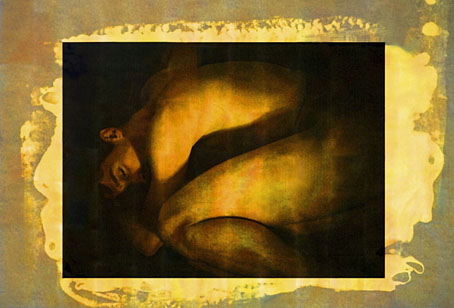
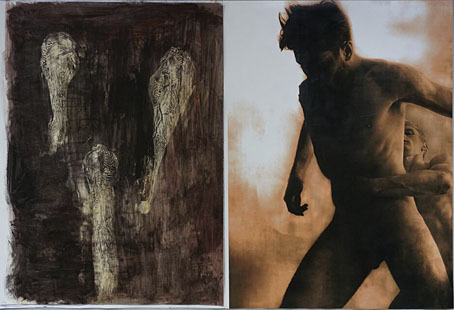
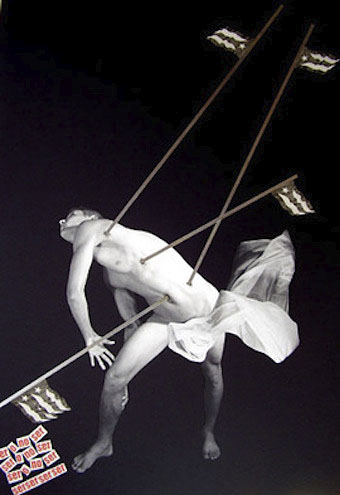
“Todd,” backlit alternative process photo with wax, 28 x 41 in., 2017.

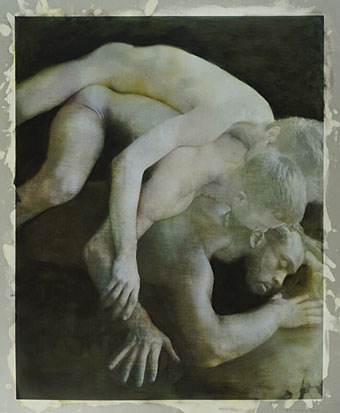
Bill Travis was in touch last week to let me know about his new website which showcases his latest artwork. Travis’s photographs of male bodies. pastoral views and cityscapes are processed in a manner that gives them a painted finish, with the prints being further backlit to create the luminosity commonly associated with stained-glass windows. It’s a beautiful effect that enhances the inherent beauty of the images. Some of the prints are available for purchase.

travis2.jpg

“Dancers 1,” backlit alternative process photo with wax and oil paint, 22 x 18 in., 2019.

travis3.jpg

“Receive Me Darkness” (artist book), pp. 36-37, mixed media, 24 x 36 in., 2021.

Elsewhere on { feuilleton }
The gay artists archive

Previously on { feuilleton }
The art of Bill Travis

The art of Eduardo Hernández Santos

santos1.jpg

From the series Aproposito los flores.

In 1993 I made Homo-Ludens, which was the first homoerotic exhibition to take place in Cuban photography after the Revolution. This show was committed to a direct, frontal discourse, but very aesthetic. It was not intended to reflect great contradictions, but to propose to society that the male body was also an object to analyze, that it was a source of pleasure, and not only to women.

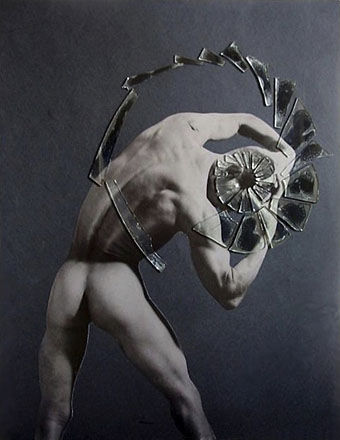
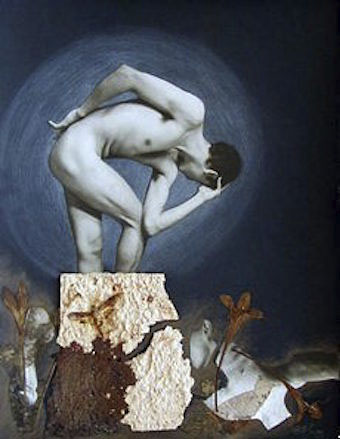
Cuban artist Eduardo Hernández Santos talking in 2016 about his career (here and here). In addition to straightforward photography, Santos favours collage as a technique, combining his own photographs with fragmented slogans and other imagery. The late date of the Homo-Ludens exhibition is a result of the slow evolution of attitudes towards sexuality in Cuban society. Fidel Castro regarded gay men as degenerates, a common sentiment in Communist circles in the 1960s, and one shared by many fascists. A striking thing about homosexuality is the way you can be despised by a wide variety of people who wouldn’t agree with each other about anything else.

santos2.jpg

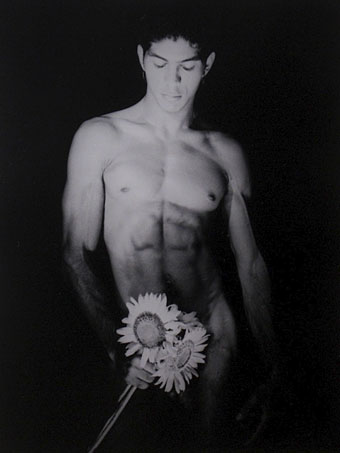
From the series Corpus Fragiles.

It’s tempting to wonder what Jean Genet would have thought about Santos’s photographs of male nudes with flowers. Genet used flowers for their symbolic qualities almost as much as Oscar Wilde, so even though it’s unwise to try and second-guess him I imagine he’d appreciate their use here.

santos3.jpg

Untitled (2000).

santos4.jpg

From the series Palabras.

Elsewhere on { feuilleton }
The gay artists archive

Previously on { feuilleton }
The art of Gregorio Prieto, 1897–1992
Emil Cadoo

London churches of the XVIIth and XVIIIth centuries

birch01.jpg

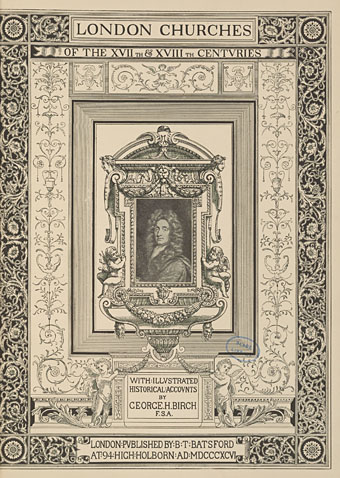
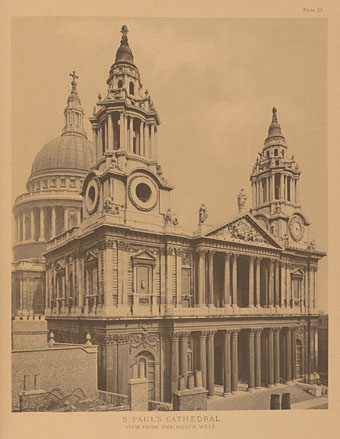
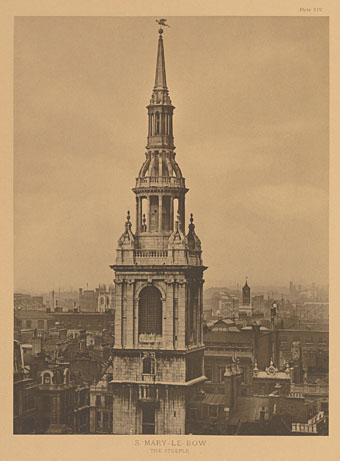
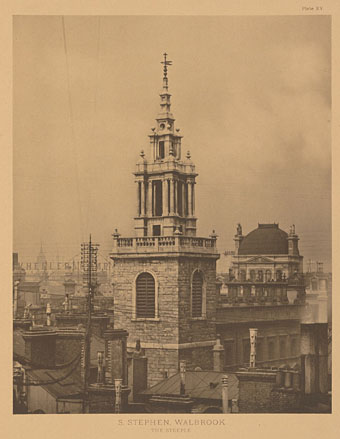
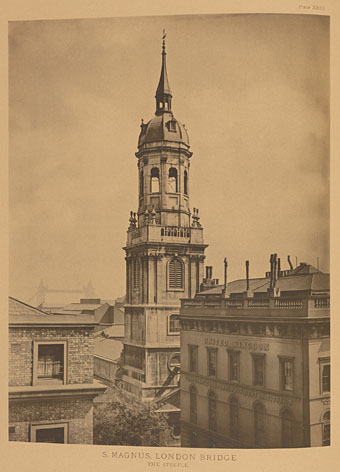
This is another of those books that I’ve been led to by the requirements of the current workload, in this case the need to find pictures of a particular London church. George H. Birch’s book was published in 1896, and while it’s possible to find contemporary photographs of these buildings, I like the exterior views for showing the churches in a different time to our own.

birch02.jpg

The photographs were by Charles Latham who avoids the usual street-level portraits in favour of views of each steeple from the highest floors of surrounding offices and warehouses. The buildings of London in the 1890s didn’t reach very far, St Paul’s Cathedral still dominated the City skyline, but Latham’s pictures have the additional attraction of showing us that skyline as it was over a century ago, before it was radically reconfigured by the bombs of the Luftwaffe and several generations of planners and architects. George H. Birch was the curator at the time of one of my favourite places in London, the Sir John Soane Museum. Browse or download the rest of his book here.

birch03.jpg

birch04.jpg

birch05.jpg

Continue reading “London churches of the XVIIth and XVIIIth centuries”

Eiko Ishioka album covers

ei01.jpg

Eastward (1970) by Gary Peacock Trio. Photography by Hiroshi Asada, Tadayuki Naitoh.

Continuing an occasional series about artists or designers whose work has appeared on record sleeves. Also another jazz-related post which includes Herbie Hancock via the V.S.O.P. album.

Eiko Ishioka is best known outside Japan for the costume designs she created for feature films, especially those in Francis Coppola’s Dracula, but she also had a parallel career as a graphic designer and art director, working with photographers and other designers on a large number of album covers. The examples here are a partial selection, many of which were created for East Wind, a label established by Nippon Phonogram to promote Japanese artists overseas.

ei02.jpg

Circle 2: Gathering (1971) by Circle. Design by Eiko Ishioka, Seiya Sawayama, Yoshio Nakanishi.

ei03.jpg

Weather Report Live In Tokyo (1972) by Weather Report. Design by Eiko Ishioka, Yoshio Nakanishi.

ei04.jpg

Miles Davis Story Vol. 2 (1972) by Miles Davis. Design by Eiko Ishioka, Yoshio Nakanishi. Photography by Columbia Records Photo Studio, Tadayuki Naitoh.

Black ink on silver foil, something that always looks impressive but doesn’t wear very well. This cover may have led to Ishioka’s work on Tutu (see below).

ei05.jpg

Winter Love, April Joy (1975) by David Friedman. Design by Eiko Ishioka, Motoko Naruse.

Continue reading “Eiko Ishioka album covers”

Weekend links 574

vyletal09.jpg

Poster for Beauty and the Beast (1978) by Josef Vyletal.

• Next month, Second Run release Juraj Herz’s 1978 adaptation of Beauty and the Beast on region-free blu-ray. I watched this last year on a Czech DVD so it’s good to hear it’s being given an upgrade. Herz’s film is a distinctly sinister take on the familiar tale, with a bird-headed Beast that’s closer to Max Ernst than anything you’ll find in illustrations for Perrault’s stories.

• “In a coincidence so unlikely it almost seems, well, magical, the girls traced illustrations from a book of folklore that also contained a short story by Sir Arthur Conan Doyle himself, a reflection of a reflection of a reflection.” Audrey Wollen on the Cottingley fairy photographs. Related: The Coming of the Fairies by Arthur Conan Doyle.

• “[Mark E. Smith], with his love of Stockhausen, HP Lovecraft, and (bizarrely) the sitcom Keeping Up Appearances, becomes a reverse coder, an apostle of avant pulp, a ‘paperback shaman’.” Sukhdev Sandhu reviews Excavate! The Wonderful and Frightening World of the Fall, edited by Tessa Norton and Bob Stanley.

• “Found photos of men in love from 1850–1950“. Maybe. As before, I’m always cautious about imposing a narrative on old photographs.

• Mixes of the week: A mix for The Wire by Pamela Z, and a dose of post-punk esoterica by Moin for XLR8R.

DJ Food takes another dive into back issues of International Times in search of ads for London’s Middle Earth club.

• At The Smart Set: Colin Fleming watches John Bowen’s drama of pastoral horror, Robin Redbreast.

• At Dennis Cooper’s: Heavily plotted non-linear structures whose velocity lacks narrative drive.

Ryan Gilbey attempts to rank Robert Altman’s features into a list of 20 best.

• Still Farther South: Poe and Pym’s Suggestive Symmetries by John Tresch.

• New music: At One Point by Scorn.

Visionist‘s favourite albums.

The Beast (1956) by Milt Buckner | Leggo Beast (1978) by Gregory Isaac’s All Stars | This Beast (1983) by Tuxedomoon