Cocteau’s effects

cocteau01.jpg

Chez Cocteau.

“Effects” in the sense of possessions rather than aesthetic or creative effects. I’ve been reading Jean Cocteau’s The Difficulty of Being, an essay collection in which the author muses on a variety of subjects, from his own life, his work, and people he knew, to more general considerations of the human condition. In one of the chapters Cocteau describes his rooms at 36 rue de Montpensier, Paris, where he lived from 1940 to 1947, offering a list of the objects that occupied the shelves or decorated the walls of his apartment. I always enjoy accounts of this sort; the pictures (or objects) that people choose to hang on their walls tell you things about a person’s tastes and character which might not be so obvious otherwise. The same can’t always be said for published lists of favourite books or other artworks when these may be constructed with an eye to the approval of one’s peers. The pictures decorating your living space are more private and generally more honest as aesthetic choices.

I already knew what a couple of these items looked like: the Radiguet bust, for example, may be seen in documentary footage. This post is an attempt to find some of the others. If you know the identity of any of the unidentified pieces then please leave a comment.


cocteau03.jpg

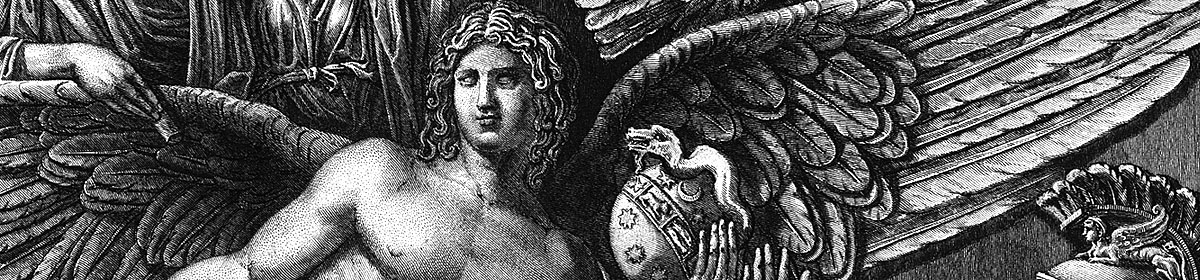
The most engaging bits of such wreckage, thrown up on this little red beach, is without doubt the Gustave Doré group of which the Charles de Noailles gave me a plaster cast from which I had a bronze made. In it Perseus is to be seen mounted on the hippogryph, held in the air by means of a long spear planted in the gullet of the dragon, which dragon is winding its death throes round Andromeda.

“the Charles de Noailles” refers to Charles and his wife, Marie-Laure, a pair of wealthy art patrons who helped finance Buñuel’s L’Age d’Or and Cocteau’s Le Sang d’un Poète. Doré’s illustration (showing Ruggerio from Ariosto’s Orlando Furioso reenacting the heroic rescue) is very familiar to me but I was unable to find any sculptural copies of the work. In addition to decorating Cocteau’s room some of Doré’s illustrations also served as inspiration for the sets in La Belle et la Bête.

cocteau05.jpg

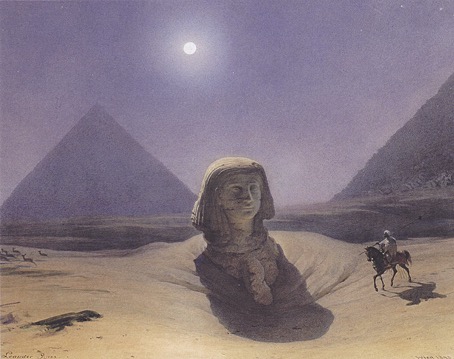
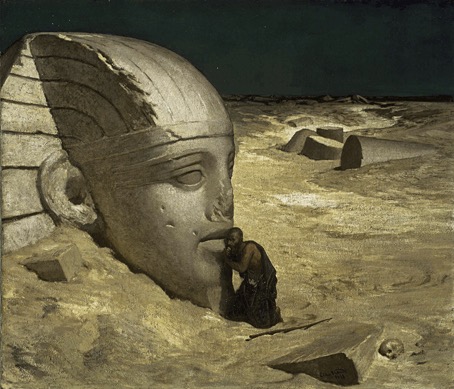
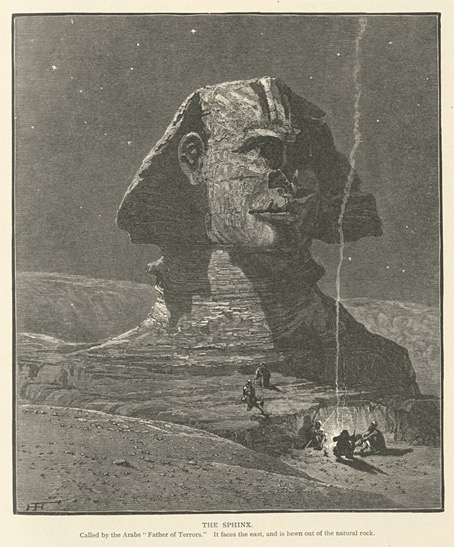
This group is on a column standing between the so-called castor window and a tall piece of slate that can be moved aside and that conceals a small room which is too cold to be used in winter. It was there that I wrote Renaud et Armide, away from everything, set free from telephone and door bells, in the summer of 1941, on an architect’s table above which one sees, saved from my room in the rue Vignon where it adorned the wall-paper, Christian Bérard’s large drawing in charcoal and red chalk representing the meeting of Oedipus and the Sphinx.

Bérard’s drawing is large indeed (see the photo at the top of this post). The artist was a theatrical designer, also the designer of La Belle et la Bête, and one of several of Cocteau’s friends who died young.

cocteau11.jpg

On the right of my bed are two heads, one Roman, in marble, of a faun (this belonged to my Lecomte grandfather), the other of Antinoüs, under a glass dome, a painted terracotta, so fragile that only the steadiness of its enamel eyes can have led it here from the depths of centuries like a blind man’s white stick.

A third head adorns that of my bed: the terracotta of Raymond Radiguet, done by Lipschitz, in the year of his death.

And speaking of premature deaths… Antinous was the celebrated youth beloved of the emperor Hadrian whose death by drowning in the Nile caused Hadrian to establish a cult of Antinous that spread across the Roman Empire. Many busts and full-figure statues survive as a result, but I was unable to find a photo of the one owned by Cocteau. Raymond Radiguet, meanwhile, died of typhoid fever at the age of 20. Radiguet was a precocious talent who managed to write two novels before he died, including Le Diable au corps at the age of 16.

Continue reading “Cocteau’s effects”

Weekend links 781

delville.jpg

Orphée aux Enfers (1896) by Jean Delville

• “Yes, there was a riot, but it was great”: Cabaret Voltaire on violent gigs, nuclear noise – and returning to mark 50 years.

• At Public Domain Review: Matthew Mullane on George Wightwick’s The Palace of Architecture (1840).

• New music: Dissever by Emptyset; Quiet Pieces by Abul Mogard; Analogues by Lawson & Merrill.

• At Spoon & Tamago: Artist Yukiko Suto finds beauty in Japanese residential neighbourhoods.

• At The Quietus: A Condition of the Space: Mary Anne Hobbs interviewed.

• At Baja el Signo de Libra: The homoerotic photography of Yves Paradis.

• Mix of the week: Bleep Mix #303 by Abul Mogard.

• At Dennis Cooper’s: Stan Brakhage Day.

• RIP Edmund White.

Brakhage (1997) by Stereolab | Brakhage (2002) by Robert Poss | Barbican Brakhage (2009) by John Foxx

Weekend links 780

ginsburg.jpg

An early illustration by Burne Hogarth from Federal Illustrator, Winter 1931–1932, credited to the artist’s original name, Bernard Spinoza Ginsburg. (Via)

• RIP Simon House, a musician whose death was announced in the same week as news of a remixed edition of Hall Of The Mountain Grill by Hawkwind, the first of the group’s albums to feature House on violin and keyboards. House’s keyboards made a considerable difference to Hawkwind’s sound, expanding the range of their songwriting; the melodramatic scale of Assault And Battery/The Golden Void wouldn’t have been possible without those massed Mellotrons. Post-Hawkwind it was House’s violin that was sought after during his time as a session musician, on songs like Yassassin by David Bowie, and Talking Drum by Japan. He’s also one of the musicians credited on Thomas Dolby’s biggest hit, She Blinded Me With Science (violin again), although his contribution there is easy to mistake for a synthesizer.

• “We did want the name to be weighty and metal-related because it is a kind of a metal band. So what is heavy and what is metal: that was the answer.” Hildur Guðnadóttir talking about Osmium, an experimental quartet comprising Guðnadóttir with James Ginzburg, Rully Shabara and Sam Slater.

• At Criterion: Stephanie Zacharek on Richard Lester’s The Three Musketeers and The Four Musketeers, films from a time “when delighting audiences meant more than catering to the predetermined whims of a dogged fandom”.

• The week in maps: At Public Domain Review, Bernard Sleigh’s Anciente Mappe of Fairyland (ca. 1920 edition); at Nautilus, the first maps of the Earth’s magnetic field.

• The eleventh installment of Smoky Man’s exploration of The Bumper Book of Magic has been posted (in Italian) at (quasi), and in English at Alan Moore World.

• Not on any map: Mark Valentine describes the time he tried to buy a phantom island from the Hudson’s Bay Company.

• At Colossal: “In surreal portraits, Rafael Silveira tends to the garden of consciousness“.

• New music: Osmium by Osmium, and Along The Wind Spear by Survey Channel.

• Anne Billson chooses Anjelica Huston’s ten best roles.

Owls in Towels

Five Owls (1970) by Canned Heat | Night Owl (1996) by System 7 | Owls And Flowers (2006) by Belbury Poly

Weekend links 779

finlay.jpg

The Crystal World by JG Ballard. An illustration by Virgil Finlay for the Summer–August 1966 issue of Things To Come, the Science Fiction Book Club mailer.

• At Blissblog, Simon Reynolds looks back on 20 years of limited-edition electronic music reissues by the Creel Pone label. (Previously.) A bootleg enterprise but a very worthwhile one since most of the reissues would otherwise remain deleted and largely forgotten. I thought the releases had finished years ago but it seems not, Discogs now lists over 300 of them.

• “Everyone recognized the brilliance of Robinson’s eventual script: they just didn’t want to make it.” David Cairns on the miserable magnificence of Bruce Robinson’s Withnail and I.

• Coming soon from Top Shelf: More Weight: A Salem Story, Ben Wickey’s illustrated account of the Salem Witch Trials.

• The tenth installment of Smoky Man’s exploration of The Bumper Book of Magic has been posted (in Italian) at (quasi).

• At Colossal: “A unique portfolio of Hilma af Klint’s botanical drawings communes with nature’s spiritual side”.

• At Nautilus: The Visual Language of Crystals—Chemistry becomes art in Thomas Blanchard’s timelapse video.

• At Unquiet Things: Supernatural field notes and incomprehensible eldritch frequencies: The art of Ed Binkley.

• See some of the entries from the 2025 Milky Way Photographer of the Year.

• New music: Instruments by Water Damage, and Reverie by Deaf Center.

• The Strange World of…Editions Mego.

Strobe Crystal Green (1971) by Gil Mellé | Crystal Leaves (1983) by Ippu-Do | Crystalline Green (2002) by Goldfrapp

Art on film: Crimes of Passion

cop11.jpg

Continuing an occasional series about artworks in feature films. I’ve been spending the past couple of weeks working my way through the Ken Russell filmography, rewatching familiar documentaries and feature films while acquainting myself with the portions of the Russell oeuvre that I’d missed in the past. Crimes of Passion (1984) was a film that I did see when it turned up on video in the late 1980s but I didn’t remember much about it apart from its overheated erotic atmosphere and a red/blue lighting scheme. It’s not one of Russell’s best—the script lurches uncomfortably between mundane domestic drama and lurid, sex-crazed delirium; Rick Wakeman’s synthesizer score is persistently annoying—but it does feature spirited performances by the lead actors, Kathleen Turner and Anthony Perkins.

cop03.jpg

Turner is Joanna Crane, a swimwear designer who deals with the vacuity of her life by moonlighting as an in-demand prostitute named China Blue. (The polite term “sex worker” didn’t exist in the 1980s.) Russell delivers the art references early on, with unexpected cuts to erotic figures from Aubrey Beardsley’s Lysistrata (above), various Japanese shunga prints, and a flash of The Rape by René Magritte. Since the real woman behind the China Blue persona isn’t revealed until later in the film we don’t know at first that Joanna Crane’s apartment contains reproductions of some of the same pictures. She eventually admits to thinking of them during stressful moments.

cop01.jpg

cop02.jpg

Despite this admission, there’s nothing in the script of Crimes of Passion that warrants the references, Crane’s apartment could easily have been furnished in a blandly expensive manner suited to a successful designer. The only other character who seems remotely interested in art is Anthony Perkins’ Reverend Shayne, a splenetic, sex-obsessed preacher who has a hotel room next door to China Blue. In one of several references to Psycho, Shayne watches his neighbour’s erotic encounters through a spyhole. The walls of his own room are covered in a collage of religious and pornographic imagery but little is made of this.

cop04.jpg

The Lovers by René Magritte.

cop05.jpg

Joanna Crane and Bobby Grady (John Laughlin) in Joanna’s apartment. Among the pictures on the walls are Romeo and Juliet by Marc Chagall, The Embrace by Gustav Klimt, and The Kiss by Gustav Klimt.

Continue reading “Art on film: Crimes of Passion”