Weekend links 590

santesson.jpg

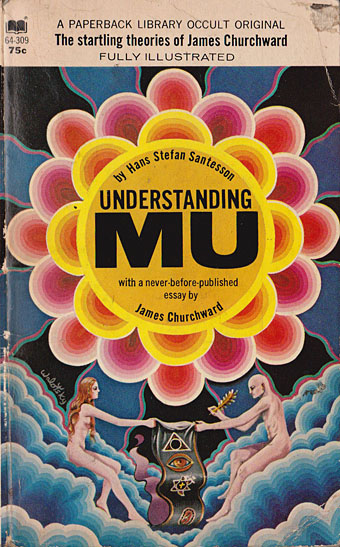
Understanding Mu (1970) by Hans Stefan Santesson. Cover art by Ron Walotsky. Via.

• “I have never believed Chariots of the Gods?—it takes faith, so what I mean is that I’ve never believed in it—but it has still held my affection for decades.” Patrick Allington on ancient aliens, unidentified aerial phenomena, and the unhinged pleasures of speculative nonfiction. I still have a stash of paperbacks in what I call “The Crank Box”, a collection of the more far-out titles that proliferated in the 1970s in the wake of the bestselling (and very egregious) Erich von Däniken. There aren’t many books about ancient astronauts or flying saucers in the box because they were so plentiful, I was always on the lookout for more outlandish volumes: lost continents, yes, but not the all-too-common Atlantis; Lemuria or Mu were more like it. So too with Hollow Earths and mysterious realms as detailed in Shambhala: Oasis of Light by Andrew Tomas, or The Lost World of Agharti: The Mystery of Vril Power by Alec MacLellan. The attraction wasn’t that any of this speculation might be true, more that these books operate as bargain-basement equivalents of the Borges conceit in which metaphysics is regarded as a branch of fantastic literature. Weird fiction by other means.

Collecting these books was a fun thing to do in the 1980s when the crank publications of the previous decade had washed up on the shelves of secondhand bookshops. The shine began to wear off in the 1990s when the emergence of the internet empowered a new breed of hucksters (and worse) pushing all of this stuff as though it was “hidden knowledge”. It’s hard to get excited about a battered paperback brimming with pseudo-science and pseudo-archaeology when similar ideas proliferate on YouTube channels catering to credulous hordes.

• Absolutely elsewhere (and linked here on a regular basis): An archive of the endlessly fascinating Absolute Elsewhere, a website created by the late RT Gault in order to present “a bibliography of visionary, occult, new age, fringe science, strange and even crackpot works published between 1945 and 1988”. The listings are accompanied by an informed, sceptical and often enlightening commentary, and also include a fair amount of weird fiction. Mr Gault had the right attitude.

• New music: Raum by Tangerine Dream, a preview of the new album, Probe 6–8, which will be released next year; new/old music: a reissue of Marine Flowers (Science Fantasy) by Akira Ito.

• “He had been honest about himself, and shockingly honest about his parents, but about his work he had spun me a tale.” Carole Angier on the elusive WG Sebald.

• At The New Criterion: Two stray notes on Moby-Dick by William Logan; on contemporary reviews of Moby-Dick and Melville’s journey on the Acushnet.

• “Perhaps what’s most extraordinary about Kollaps is that it was made at all.” Jeremy Allen on Einstürzende Neubauten’s thrilling debut album.

• At Culture.pl: a podcast about Czech film director Vera Chytilová and her masterpiece of Surrealist anarchy, Daisies.

• At Perfect Sound Forever: Part 2 of a Jon Hassell tribute which talks to friends and musical collaborators.

• At Dennis Cooper’s: Spotlight on…William S. Burroughs The Ticket That Exploded (1962).

• At Wormwoodiana: Mark Valentine unearths a medieval recipe for gingerbread.

• Mix of the week: Death’s Other Dominion by The Ephemeral Man.

MU-UR (2000) by Coil | Mu (2005) by Jah Wobble | Mu 1 (2015) by Acronym
More shirts

skullprint-sephiroth.jpg

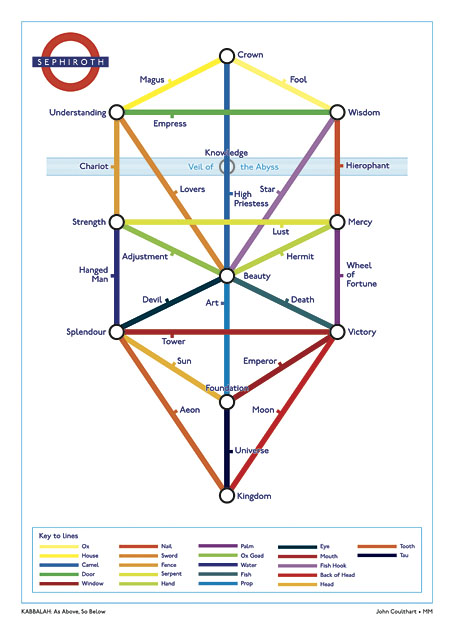
I’ve added a couple more shirt designs to the Skull Print page and I’ve also tweaked the ordering process a little. This was necessary when it became apparent that the PayPal purchase system no longer allows buyers to leave a note to the seller even though this option is still available when you create the code for a PayPal button. (I was surprised to discover that the button-creating area of PayPal still looks the way the site did about 20 years ago.) Thankfully WordPress allows you to add contact forms to posts so I’ve added these to each shirt design. It’s an awkward solution but the form does at least allow a buyer to send along details of their required shirt size and shirt colour. A better solution would be a shopping cart arrangement but this will have to wait for now. I’ve been so busy with work for the past few months it’s taken me all summer to even get this far.

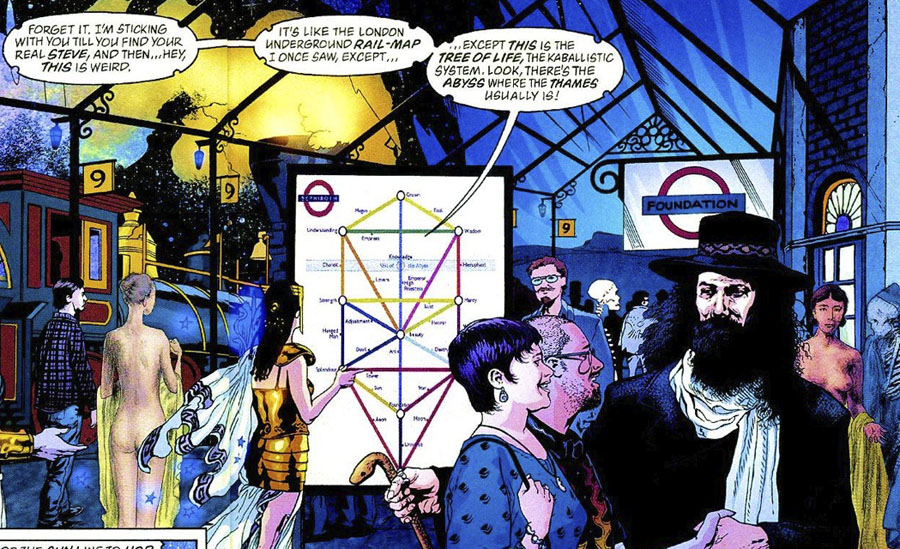
promethea.jpg

Promethea 14, 2001. Art by JH Williams III.

The new designs are two versions of the perennially popular James Joyce design, plus the Kabbalah map which I created in 2000, and which subsequently made a cameo appearance in issue 14 of Alan Moore’s Promethea. This has always been popular as a print at CafePress but people also like to have it on a shirt. I’d suggest white shirts only for this design but the decision is for the purchaser.

Previously on { feuilleton }
T-shirts by Skull Print

Serious houses: The Lud Heat Tapes, 1979

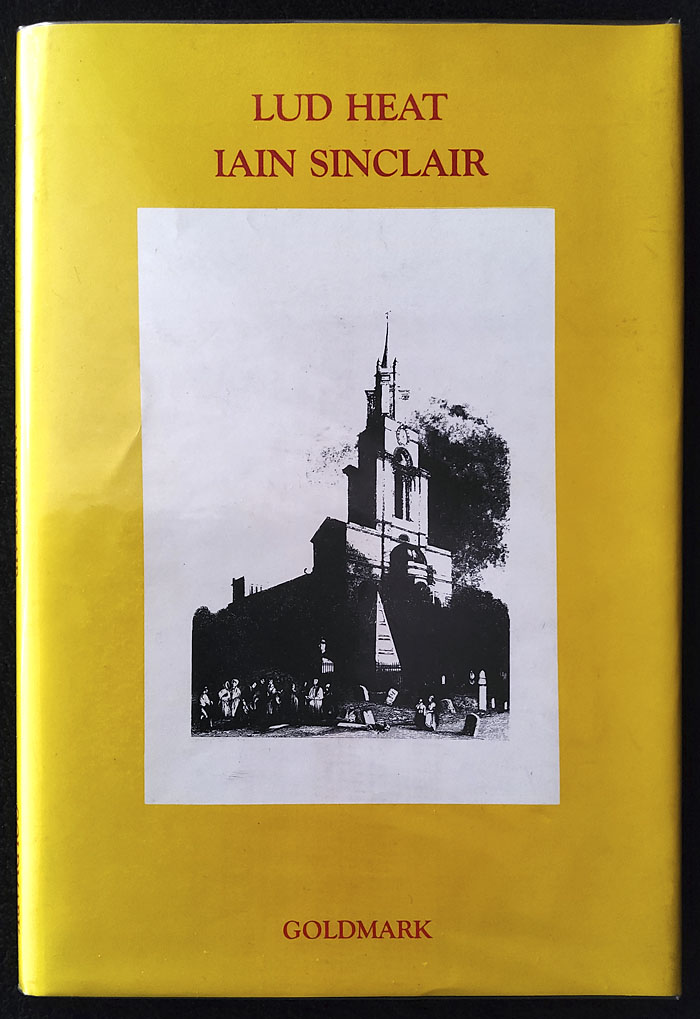
ludheat.jpg
Goldmark hardcover, 1987.

The old maps present a sky-line dominated by church towers; those horizons were differently punctured, so that the subservience of the grounded eye, & the division of the city by nome-wound, was not disguised. Moving now on an eastern arc the churches of Nicholas Hawksmoor soon invade the consciousness, the charting instinct. Eight churches give us the enclosure, the shape of the fear; – built for early century optimism, erected over a fen of undisclosed horrors, white stones laid upon the mud & dust. In this air certain hungers were activated that have yet to be pacified; no turning back, as Yeats claims: “the stones once set up traffic with the enemy.”
—Iain Sinclair, Lud Heat

A serious house on serious earth it is
—Philip Larkin, Church Going

“Serious” is a word with many meanings. The Oxford English Dictionary gives one of these as “attended with danger; giving cause for anxiety”, a definition that wouldn’t suit Philip Larkin’s poem describing a visit to a moribund country church, but which is easily applied to a longer cycle of poems by Iain Sinclair. Lud Heat: A Book of the Dead Hamlets is the collection of writings that lifted Sinclair’s authorial profile out of the poetry ghetto in which he’d been situated throughout the 1970s. He published the first edition through his own Albion Village Press in 1975 but it wasn’t until the arrival of Peter Ackroyd’s Hawksmoor a decade later that wider public attention began to turn in Sinclair’s direction. Lud Heat set out for the first time a series of observations concerning the peculiar and sinister qualities of the churches built by Nicholas Hawksmoor in 18th-century London: Christ Church, Spitalfields; St George’s, Bloomsbury; St Mary Woolnoth; St George in the East; St Anne’s, Limehouse; St Alfege Church, Greenwich; plus those built in collaboration with John James: St Luke Old Street, and St John Horsleydown. The book separates the poetry with prose pieces—diary extracts, accounts of a film viewing and an art exhibition—that anticipate the author’s subsequent explorations of London’s margins and esoterica. Like many of Sinclair’s later writings, the texts in the early editions are accompanied by a variety of illustrations: engravings, contemporary photographs, and a map of London drawn by Brian Catling that posits a network of “lines of influence…invisible rods of force” connecting the churches with each other and with significant locations such as William Blake’s house, Cleopatra’s Needle and so on. Paperback reprints omitted the illustrations* but retained the map which was redrawn by Dave McKean. The new version gave greater emphasis to the Egyptian symbols that Sinclair and Catling had scattered across the city: jackal-headed Anubis as the presiding deity of the Isle of Dogs.

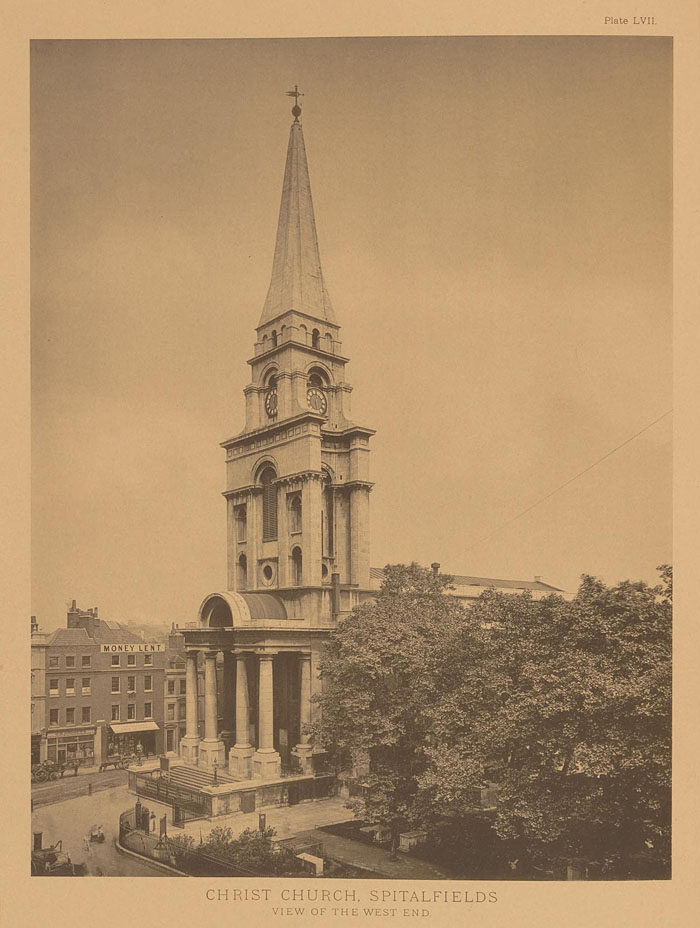
christchurch.jpg

Photo by Charles Latham from London Churches of the XVIIth and XVIIIth Centuries (1896) by George H. Birch.

Lud Heat is a beguiling and potent book; it’s also a book that’s of its time in its suggestion of malefic “rods of force” scored across the capital. Sinclair’s map may be the earliest artistic development of a process begun in 1969 when John Michell published The View Over Atlantis, an elaboration of ideas set forth in another of his books, The Flying Saucer Vision. Michell’s free-wheeling speculations gave new life to the innocuous studies of Alfred Watkins, inflating amateur archaeological ruminations into full-blown Aquarian metaphysics. Where Watkins considered that “ley lines” (a term of his own invention) might have been ancient trading routes, Michell’s enthusiasm for the full range of Fortean phenomena transmuted the alleged paths into channels of unspecified “Earth energy”, flying-saucer guides and the axes of a sacred geometry. Other crank scholars were eager to follow Michell’s lead, leaving an opening for Sinclair to adopt the conceit for its poetic resonances. New Age trappings were inverted to reveal a darker pattern more suited to London’s history of plague, murder and mass destruction. (The Hawksmoor churches had been built to compensate for the devastations of the Great Fire of 1666; two of them were hit by bombs during the Blitz, with one being damaged beyond repair.)

This isn’t to suggest that Sinclair was borrowing directly from Watkins and Michell; in an interview he mentions an earlier precursor of both his map and Watkins’ ley lines in Prehistoric London: Its Mounds and Circles (1914) by Elizabeth O. Gordon. But something was in the air in the 1970s. Lud Heat appeared shortly before the release of a pair of albums that borrowed heavily from Michell’s books—Green (1978) by Steve Hillage, and Blake’s New Jerusalem (1978) by Tim Blake—while two TV serials exploited the idea of ley lines as channels of Earth energy, Children of the Stones (1977) and Nigel Kneale’s Quatermass (1979). Lud Heat stands apart from these works by concentrating on urban structures rather than isolated monoliths and ancient pathways. The suggestion that the city of London could be home to mysterious “rods of force” is an especially intriguing one, hence the appropriation of the idea by Peter Ackroyd in Hawksmoor, and Alan Moore in From Hell. Any church of a sufficient size or age is a kind of time machine, maintaining in its appearance and its grounds a pocket of history separated from the changes that take place around it. The churches in Lud Heat are also batteries of stone, impregnated with the unspent energies of the dead who lie in their crypts. These latent forces overflow their containers, spilling into the streets beyond the church walls. Sinclair has always been adamant that his Lud Heat map is a fabrication; the degree to which he believes in the rest of his thesis is for the reader to decide. It is a fact that St George in the East is close to the location of the Ratcliffe Highway Murders of 1811 (Sinclair includes a illustration of the murderer’s corpse in Lud Heat), while Christ Church, Spitalfields, sits at the centre of maps of the Jack the Ripper murders. The fifth and most brutal of these occurred a short distance from that colossal porch on the opposite side of Commercial Street. “Dead Hamlets” also has many meanings.

Continue reading “Serious houses: The Lud Heat Tapes, 1979”

Esoterica 49

L49-01.jpg

“What is especially needed is great sensitivity: to look upon everything in the world as enigma….To live in the world as in an immense museum of strange things.” —Giorgio de Chirico

A few weeks ago I made a list of feature films that might be regarded as having the characteristics of a Thomas Pynchon novel without being based on any of Pynchon’s books. The post prompted several suggestions for other candidates, including recommendations to watch Jim Gavin’s TV series, Lodge 49, an American production that ran for two seasons from 2018 to 2019 before being cancelled due to low ratings. Having now watched the series I can say that I enjoyed it very much, and it is very Pynchonian, unsurprisingly when it not only gestures to the title of Pynchon’s second novel, The Crying of Lot 49, but also borrows from its storyline.

L49-02.jpg

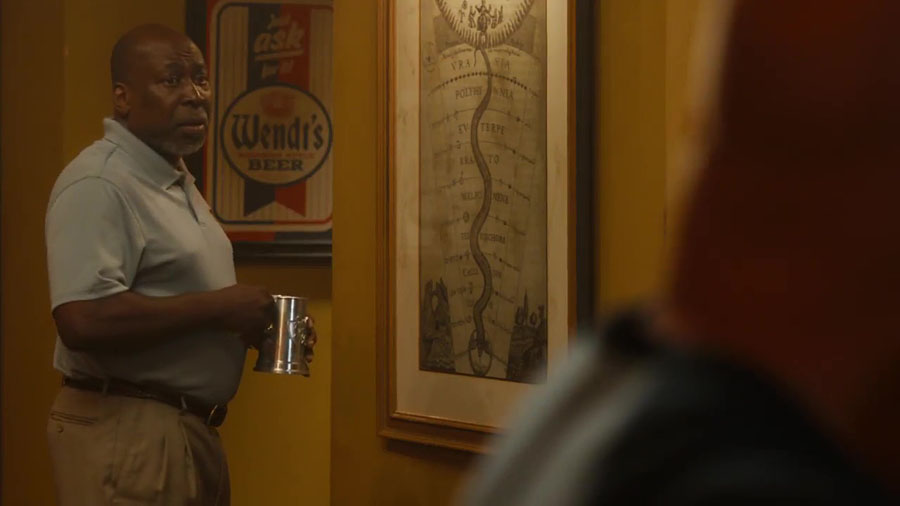
Ernie (Brent Jennings) has just been contemplating a print from the Ars Magna Lucis (1665) by Athanasius Kircher. Near the end of the second series he leaps through an image from the same book.

Lodge 49 presents a unique mélange of alchemy, surfing, secret societies, aerospace engineering, pool cleaning and cryptocurrency, with the added bonus of songs by the much-missed Broadcast being woven into the narrative. The series is consistently funny, humour being another essential Pynchonian ingredient, while the episodes are littered with references to (or correspondences with) Pynchon’s oeuvre: two of the main characters are an ex-surfer and an ex-sailor; the defunct aerospace company, Orbis, is modelled on Pynchon’s Yoyodyne from V. and Lot 49; there’s a trip to Mexico, a visit to an auction, and mention of a Remedios Varo exhibition (Lot 49 again); there are even references to Antarctic mysteries (V.), the Hollow Earth (Mason and Dixon) and the V-2 rocket (Gravity’s Rainbow). And those are only a few of the things I happened to catch as a first-time viewer. This is unusual territory for a small-scale television series, even if American TV has loosened up in recent years to allow a more eclectic range of material.

L49-03.jpg

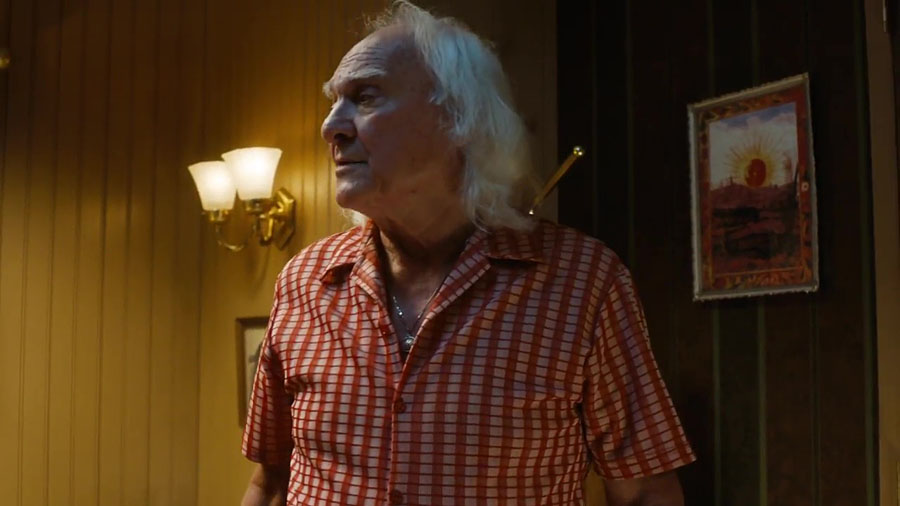
Larry (Kenneth Welsh) in the Sanctum Sanctorum with a plate from the Splendor Solis on the wall.

The Lodge 49 of the title is part of a global network of lodges that form the Ancient & Benevolent Order of the Lynx, a cross between a Masonic order and an occult cabal, founded by one Harwood Fritz Merrill, a Scottish alchemist, writer and explorer. (Merrill’s biography and the history of the Order of the Lynx is detailed here [PDF].) Alchemy is a persistent theme in the series but remains in the background for the most part, literally so inside Lodge 49 (Long Beach, California) and Lodge 1 (London) where the walls are decorated with prints of alchemical engravings. It would have been tempting to identify all of these pictures but most of them can be found in Taschen’s excellent Alchemy and Mysticism picture book so it’s easier to direct the curious to the Taschen volume. The prints also seemed to be there more to provide suitable set decoration rather than be significant in themselves, with one notable exception (see below).

L49-04.jpg

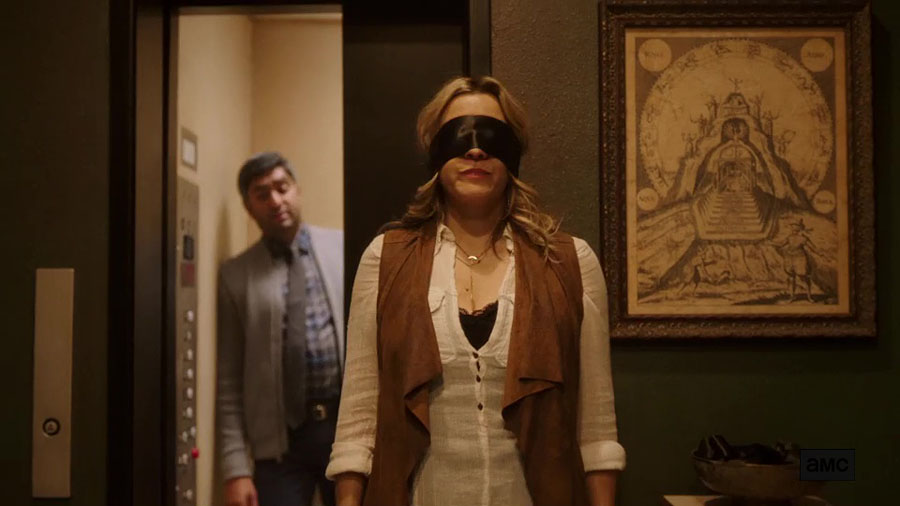
Connie (Linda Edmond) going deeper into the mysteries of Lodge 1. The print is from Cabala, Spiegel der Kunst und Natur: in Alchymia (1615) by Stephan Michelspacher.

More intriguing was the appearance of several paintings which did seem significant although they might equally have been there to generate audience speculation. Film and TV drama is made today in the full awareness that every detail is liable to be screen-grabbed and scrutinised by obsessive viewers, a situation that offers the potential for directors and designers to incorporate details that may have no special significance but are simply there to fuel online chatter. It’s difficult to tell if this is what Gavin and co. were doing, especially when the prematurely truncated series contains so many loose ends and unexplained moments. But paranoia is in part the search for a significance that may not exist outside the mind of the paranoiac so a small degree of concern about being gamed by the creators of Lodge 49 seems warranted here, as well as adding to the general Pynchon factor. Despite all the Pynchoniana mentioned above the series is light on the paranoia that’s a constant in Pynchon’s novels so why not cultivate a little paranoia in the audience itself?

Continue reading “Esoterica 49”

Music for people with three ears

teb.jpg

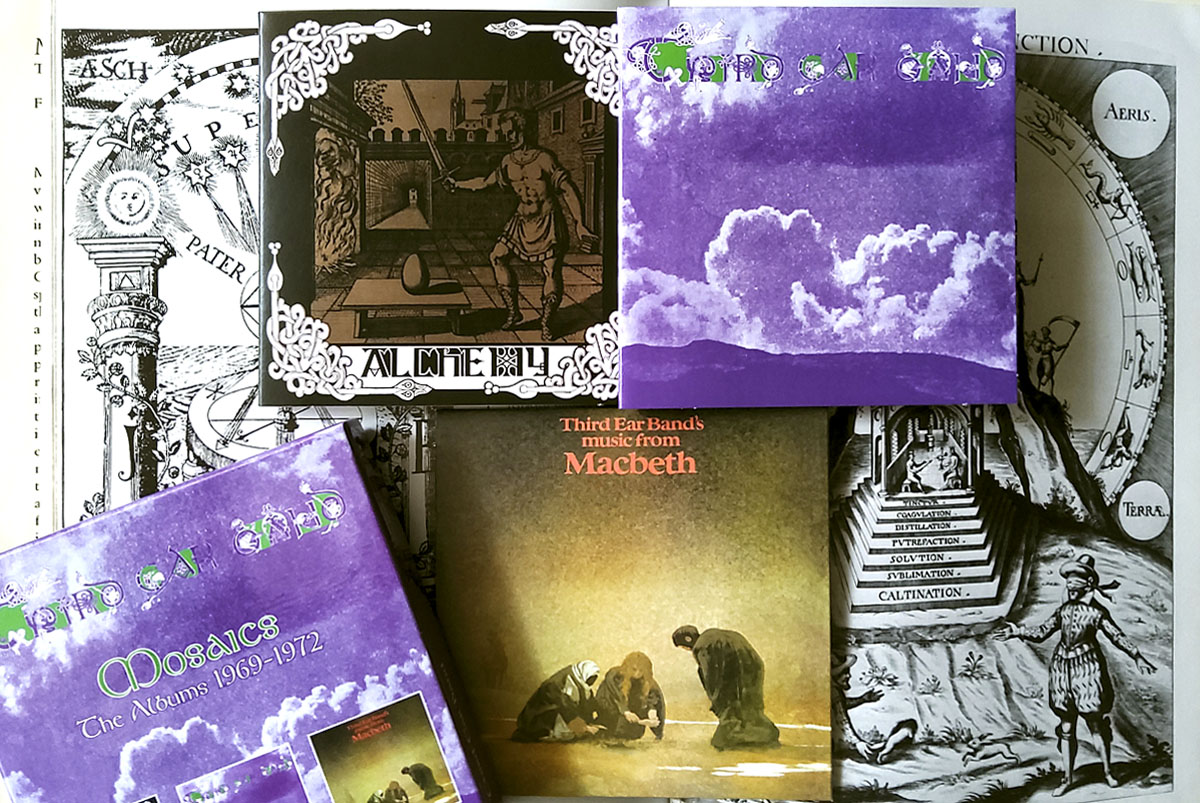
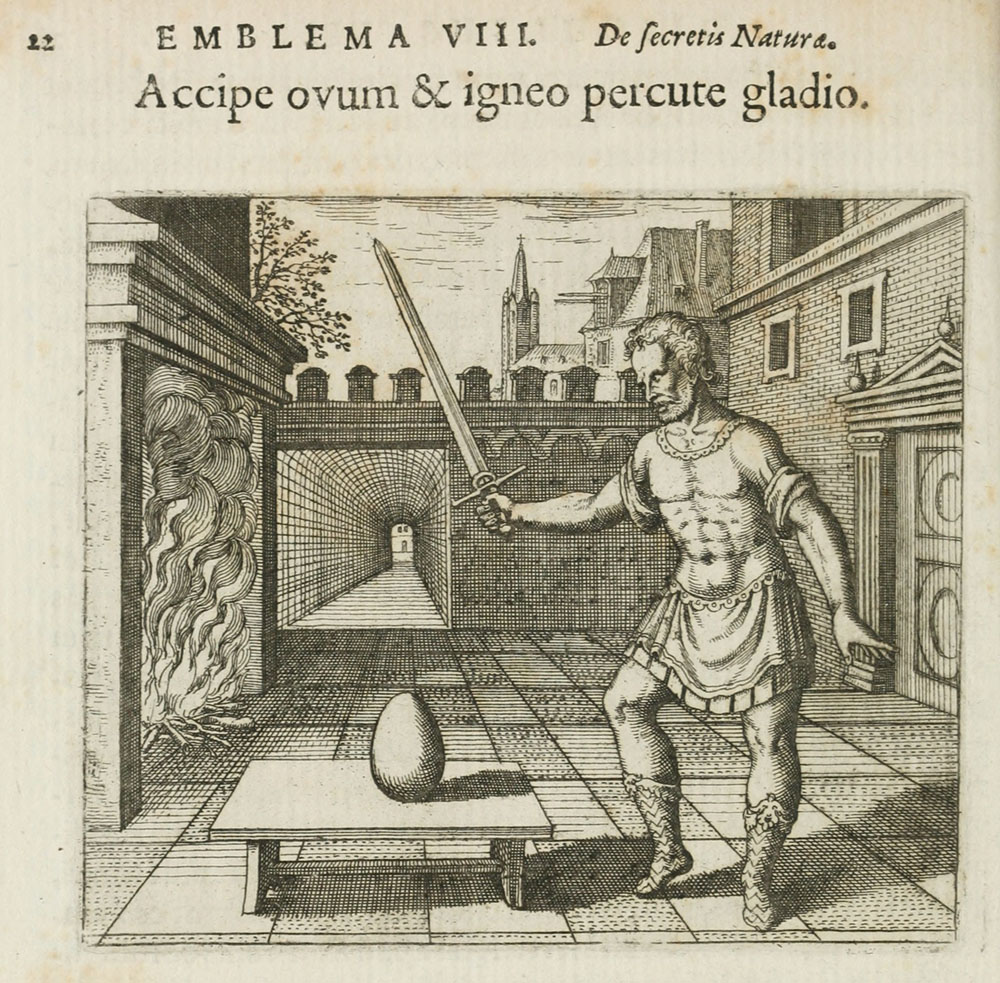
Cherry Red Records this month reissues the first three albums by the unique and wonderful Third Ear Band. I like CDs, and I especially like having them collected into boxes with Japanese-style facsimile sleeves, so this collection is irresistible. The group’s first two albums, Alchemy (1969) and Third Ear Band (1970), still sound timeless despite being products of their time, with the track you’d most expect to sound dated, Ghetto Raga, being free of sitars or Indian pastiche. Third Ear Band music is a kind of improvised folk, predominantly the product of oboe, violin and percussion, which sounds like something the group might have tuned into when they were playing for Druids at ancient sites (Stone Circle and Druid One are further track titles). The first two albums also have the additional attraction for this listener of a heavy emphasis on medieval mysticism, from the Atalanta Fugiens illustration by Matthäus Merian on the cover of Alchemy, and the symbols and astrological diagrams that fill out the inside cover of the second album, to the titles of that album which continue the alchemical theme: Air, Earth, Fire and Water. The group also borrowed some graphics from Aubrey Beardsley when they issued their musical manifesto in 1969.

merian.jpg

Music From Macbeth (1972) is constrained in comparison to the albums that precede it, being subservient to Roman Polanski’s feature film, although there’s more music here than was used in the film. It’s also closer to rock music in places, with occasional fuzzed guitar, a Mellotron, and rumbles from a VCS 3 synthesizer played by a future member of Hawkwind, Simon House. The cover painting by Roger Dean isn’t one of his best. In Views Dean complains that Polanski “got the imagery wrong” for the scenes with the witches, a comment I’ve never understood. Polanski’s film is a naturalistic interpretation of the play which is well-served by the Third Ear Band’s drones and medievalisms. Incidentally, I’m sure the phrase “music for people with three ears” was used on a Harvest records press ad but if it was I’ve been unable to find any evidence of it. Anyone out there know the source?

Previously on { feuilleton }
Night’s black agents
Atalanta Fugiens