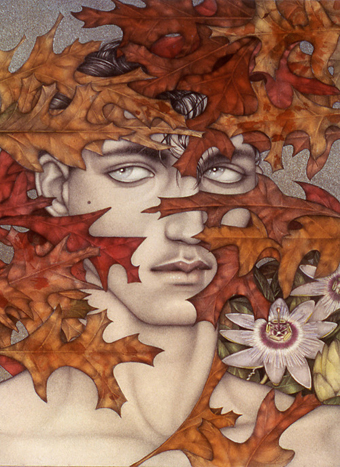
A Q&A with artist Mel Odom

odom1.jpg

First Eyes (1982).

I’ve emphasised the artist label to distinguish this Mel Odom from the very prolific writer of the same name. The artist received a fleeting mention here in the Gay artists archive but for many years he’s been a highly regarded book and magazine illustrator, with a Gold Medal from the American Society of Illustrators among his accolades. (By coincidence, one of his covers was for an Ellen Datlow horror collection, and I happen to be illustrating a new Ellen Datlow collection of horror stories this week.) More recently Odom has gained a very different audience for his doll designs which are mentioned in passing below. I’m grateful again to John Wisniewski for offering me this piece. Thanks to John and to Mel, more of whose gorgeous art can be seen at his website.

*

John Wisniewski: When did you begin drawing and painting?

Mel Odom: I’ve been drawing since I was about 4 years old and painting since my early teens. I have scribbles in an early picture book of mine that I’m sure were my first attempts at drawing.

JW: Whom are some of your favorite artists?

MO: I like so many different artists. The Pre-Raphelites were a huge influence on me as well as artists like Edward Hopper and Georgia O’Keefe. Aubrey Beardsley has been an early and constant favorite of mine. Representational art moves me more than the abstract for the most part. Disney animation also shaped what I still think of as being beautiful.
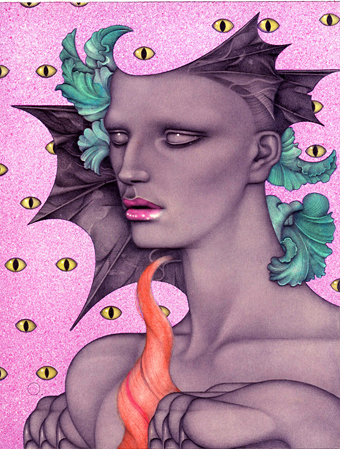
odom2.jpg

JW: Have you had any exhibitions? If so, what was the reaction to your work?

MO: I’ve really never had a one-man exhibition. When I was illustrating I was too busy to bother and illustration was not considered gallery worthy. Then when I quit illustrating to create Gene [Marshall] there was simply no time to even consider it. I’ve been in tons of group shows where the reaction has been everything from adoring to dismissive. I’ve been working on a series of oil paintings towards a show.

JW: Your work is easily recognizable to those in the art world, Mel. Did you expect this to happen, when you began?

MO: When I started out I knew my drawings didn’t look like anyone else’s, but it wasn’t a conscious ploy for recognition. I devised my style by the process of elimination. I knew what I didn’t want them to look like. I just drew with a vision that made me need to see what the drawing looked like completed. My drawings were always based on a very personal sense of beauty.
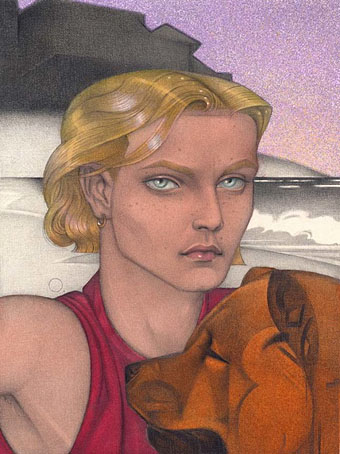
odom3.jpg

Hello, I Lied (1997).

Continue reading “A Q&A with artist Mel Odom”

Birth of a Zimbu

zimbu1.jpg

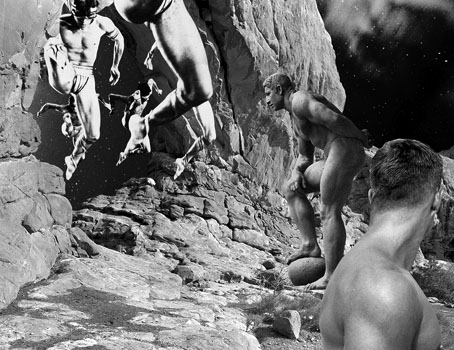
Birth of a Zimbu by Christopher Schulz is another addition to the growing collection of artworks based on William Burroughs’ The Wild Boys (1971), in this case a 52-page collection of “visual reveries made from collaged parts of dated gay porn, ancient ruins, and other various unrelated sources.” The book costs $10 and may be previewed and ordered here.

zimbu2.jpg

The Zimbus are Burroughs’ solution to the problem of reproduction (or regeneration) among the Wild Boys, his army of eternal teenage boys at war with the world at large in a dystopian 1988. Warfare means casualties so in order to maintain their homosocial, homoerotic tribal existence they gather at special times to perform sex-magic rituals that summon the “Zimbu” spirit forms of dead Wild Boys. The Zimbus are incarnated as new Wild Boys after being inseminated and fully materialised.

Burroughs wasn’t short on fantastic concepts but his ideas are often delivered and dismissed in a few lines. By contrast, the creation of the Zimbus is given pages of detailed description, the separatist, semi-human world of the Wild Boys being one to which he devoted a great deal of imaginative attention. I’ve linked before to Phil Hine’s essay, Zimbu Xototl Time, which examines the Zimbu idea at some length, drawing comparisons to similar ideas in anthropology and other fiction. If I ever get round to finished the long-gestating Wild Boys portfolio I may be able to show some Zimbu manifestations of my own.

Elsewhere on { feuilleton }
The William Burroughs archive

Weekend links 244

scarpulla.jpg

MMOB :: Far West (2013) by Alison Scarpulla.

• “…although same-sex love is as old as love itself, the public discourse around it, and the political movement to win rights for it, arose in Germany in the late nineteenth and early twentieth centuries. This message may surprise those who believe that gay identity came of age in London and New York, sometime between the Oscar Wilde trials and the Stonewall riots.” Alex Ross reviewing Robert Beachy’s Gay Berlin: Birthplace of a Modern Identity. Beachy talks about his book here.

• “I was in a room with tube synthesizers, where you had to tune them up to play them. It was unbelievable.” John Carpenter talking to Joseph Stannard about composing with electronics. Carpenter’s album of new music, Lost Themes, may be previewed here.

• From 2010: John Ridpath on Mervyn Peake’s illustrations for Lewis Carroll’s Alice Through the Looking Glass and Alice in Wonderland. Related: “The most twisted version of Alice in Wonderland you’ll ever see.”

I was brought up in a world where art was something owned and insured—usually inherited: but seldom if ever made by anyone one I knew.

I had an early inkling that there was fun to be had over the hill, like the feeling when faced with a sunset that someone’s throwing a mega awesome party just beyond the nearest cloud, and I set off to join the caravan. Let’s just say I was in search of company, headed towards the glow, and I found it.

Tilda Swinton‘s speech at the Rothko Chapel

• “Her art often touches on alchemy and magic; and in her memoir of insanity she writes of misreading an Imperial Chemicals sign as ‘chemistry and alchemy’.” Charlotte Higgins on Leonora Carrington.

Shadows Over Main Street, an anthology of small-town Lovecraftian terror, is out this week from Hazardous Press. 20 stories and poems plus interior illustrations including a contribution of my own.

• “With Fantastic Planet, I felt torn about using it, because it’s…the title of an animated film.” Guitarist Sarah Lipstate, aka Noveller, talks to Ned Raggett about her new album.

Jim Jupp of Belbury Poly and the Ghost Box record label answers 15 questions.

• A DeLorean driving through a Tron cityscape: Retrowave by Florian Renner.

• Powell & Pressburger’s Tales of Hoffmann (1951) has been restored.

Music from Forbidden Planet (1956) by Louis & Bebe Barron | The Four Horsemen (1972) by Aphrodite’s Child | Assault on Precinct 13 (Main Theme) (1976) by John Carpenter

Weekend links 243

burgoyne.jpg

Genesia (2011) by Bette Burgoyne.

• “…so I started buying these old gay porn novels, just for the covers and kept on collecting them.” Maitland McDonagh on the underexamined world of gay pulp. McDonagh’s 120 Days Books is reprinting some of these scarce titles. More gay erotica: Plans are afoot to republish Des Grieux, the rare prequel to Teleny or The Reverse of the Medal (1893), a novel often attributed (without much evidence) to Oscar Wilde.

Merricat is the name under which the Turrell Brothers, John & Tom, produce their atmospheric “nacht music”. Albums with titles such as Oneiros, Widdershins and Zerkalo give an idea of the spheres of interest. They also make short films, clips from which may be seen here.

• “Fascists don’t like satire. They don’t like it at all. And they especially don’t enjoy visual satire. Because of its unique power to communicate.” Ralph Steadman talking to Robert Chalmers about recent events.

There is an unexamined commonplace now floating around the social media, which has it that satire derogates its proper function when it stops targeting the powerful, and targets the relatively powerless instead. Theodor Adorno has also been cited here and there with his remarks on satire in the Minima Moralia of 1951, but few have noticed that the account he offers there stands in direct contradiction to the current received wisdom. For Adorno, satire is in its essence wistful and traditionalist. It looks back to something that has been lost, and dismisses the straight-facedness of everyone who attempts, against all evidence, to maintain the illusion that there is anything respect-worthy about the present state of things. It targets not just elected officials, but the yokels who elected them; not just the honcho who runs the saloon, but the sucker who hands over his last possessions at the poker table. There is a need for this: the yokels and the suckers need it most of all. There is redemption in it, and I confess to harboring whatever amount of traditionalism it takes to appreciate this redemptive quality.

Paris, 2015: a lengthy meditation by Justin EH Smith on the responses of left and right to the Charlie Hebdo killings

• “When the surface of the world is so overloaded with competing narratives…there is an understandable impulse to go underground.” Iain Sinclair on the excavation of London.

• More German music: Sinai Desert (1981) and Kailash, Pilgerfahrt Zum Thron Der Götter (no date), two films with music by Popol Vuh.

Kim Fowley: Sins & Secrets of the Silver Sixties. UglyThings Magazine makes available its definitive Fowley interview from 2001.

• More electronica and mix of the week: the FACT guide to the Yellow Magic Orchestra and associates.

• Vegetable-snake Undersea Beings: Allen Ginsberg writes to the Paris Review about LSD in 1966.

• The Edge Question for 2015: What do you think about machines that think?

Life of Cats: Selections from the Hiraki Ukiyo-e Collection.

Lake Baikal frozen over

Serial Killer Barbie

NGC 891 (1974) by Edgar Froese | Overture (1974) by Tangerine Dream | PA 701 (1976) by Edgar Froese

Weekend links 242

kroll.jpg

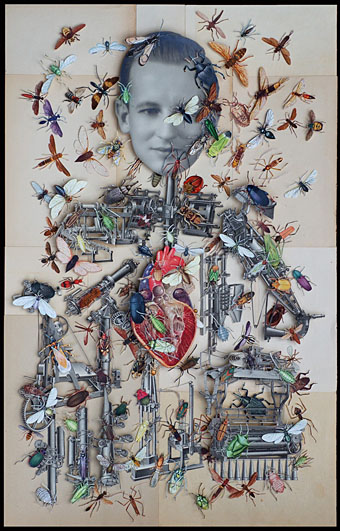
Ghost in the Machine (2012) by Hope Kroll.

Nothing Here Now But The Recordings, an album of William Burroughs’ personal tapes originally released by Industrial Records is reissued on vinyl this month. Andrew Spragg reviews it here. Burroughs’ readings fill several collections but this one was the first I owned, and it’s always been a favourite. The album features recordings of early texts such as The Last Words of Hassan I Sabbah, as well as cut-up tape experiments which fuelled some of the chapters in the Nova Trilogy.

• The Melancholy of Perversion: a study of Caitlín R. Kiernan’s Metamorphosis A by Scott Dwyer. More weird fiction: “Written with real psychological depth, these enigmatic tales rise far beyond straightforward ghost stories.” Chris Power on Robert Aickman.

• At Dangerous Minds: Gay Semiotics, a taxonomy of San Francisco life in the 1970s. Related: The case of One, a gay magazine from Los Angeles prosecuted for obscenity in 1958.

Poe’s mind was by no means commonplace. In the last year of his life he wrote a prose poem, Eureka, which would have established this fact beyond doubt—if it had not been so full of intuitive insight that neither his contemporaries nor subsequent generations, at least until the late twentieth century, could make any sense of it. Its very brilliance made it an object of ridicule, an instance of affectation and delusion, and so it is regarded to this day among readers and critics who are not at all abreast of contemporary physics. Eureka describes the origins of the universe in a single particle, from which “radiated” the atoms of which all matter is made. Minute dissimilarities of size and distribution among these atoms meant that the effects of gravity caused them to accumulate as matter, forming the physical universe.

Marilynne Robinson on Edgar Allan Poe

Vanished City: London’s Lost Neighbourhoods, a book by Tom Bolton with photographs by SF Said.

• Mix of the week: Secret Thirteen Mix 143, a selection of soundtrack music by Las CasiCasiotone.

• “I am in Brussels, numbering the Bruegels.” Toby Ferris conducts a Brueg[h]el Census.

Mothmeister “taxidermy collector & curiosity cabinet”.

Ben Zurawski collects and makes flip books.

Akira Kurosawa’s 100 favourite films

The Trip (1965) by Kim Fowley | The Trip (1966) by Donovan | The Trip (1967) by Park Avenue Playground