The Horse of the Invisible

carnacki1.jpg

Can Carnacki make any claim to be taken seriously as a detective? If he solves anything it is by force of will, rather than the application of deductive powers. He is no Sherlockian ironist, no high-domed mental traveller. He stands as close to Holmes as Mike Hammer does to Philip Marlowe. His methods are enthusiastic but basic: good old-fashioned head-in-the-door stuff. He is not so much a “ghostbuster” as a self-starting lightning rod for psychic phenomena that has not yet been housebroken.

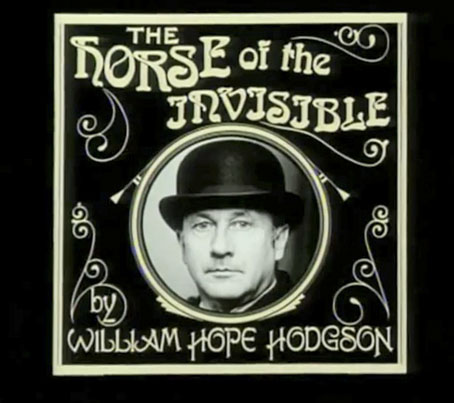
Thus Iain Sinclair in a typically acerbic afterword to the 1991 Grafton paperback of Carnacki, the Ghost-Finder by William Hope Hodgson. Holmes would indeed look askance at Carnacki’s methods but that didn’t prevent the occult investigator being drafted as one of The Rivals of Sherlock Holmes in the first television series of that name in 1971. I was reminded of this dramatisation following last week’s discussion of Hodgsonian cinema; I’ve known about the episode for years—notable for having Donald Pleasence in the role of Thomas Carnacki—but hadn’t watched it until this week courtesy of YouTube.

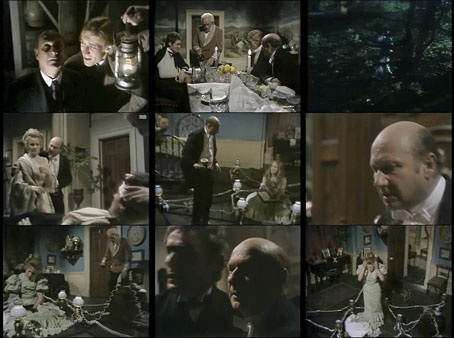
Philip Mackie wrote the script for The Horse of the Invisible, and Alan Cooke was the director. Their adaptation is interesting mostly for seeing a Hodgson story dramatised; as a piece of television the presentation is serious and well-acted but looks rather creaky today, suffering from the over-lit artificiality that always blighted studio-shot productions attempting to create any kind of atmosphere. Donald Pleasence is his typical lugubrious self which doesn’t really suit Carnacki’s bull-headed enthusiasm but I don’t mind that, Pleasence was a good actor so it’s a treat to see him play the part. And we do get to see Carnacki’s “electric pentacle” in action (Carnacki enjoys his Edwardian gadgets) in the midst of which the beleaguered Michele Dotrice is forced to spend the night. The most successful Carnacki stories are those that play to Hodgson’s strengths as a writer of supernatural dread, stories such as The Gateway of the Monster or The Hog. The Horse of the Invisible doesn’t attain the heights of those tales but then it would be a doomed venture trying to conjure Hodgson’s cosmic horrors on a limited budget. With this story you get a taste of the supernatural, which no doubt sets it apart from the other “Rivals”, whilst staying within the bounds of credibility.
carnacki2.jpg

There’s one curious detail worth mentioning: in both the story and the dramatisation the character of the fiancé is named “Charles Beaumont”. There was a real Charles Beaumont, a screenwriter responsible for many scripts for The Twilight Zone TV series, as well as for some of the superior American horror films of the 1960s, including Night of the Eagle, The Haunted Palace (Roger Corman’s adaptation of The Case of Charles Dexter Ward) and The Masque of the Red Death. In last week’s discussion I mentioned John Carpenter’s The Fog as a good example of Hodgsonian cinema on account of its ghost pirates. My memory may be playing tricks but I’m sure that Carpenter has a reference to a “Charlie Beaumont” in either The Fog or Halloween, both films being littered with significant character names. (There’s a “Mr Machen” in The Fog). Donald Pleasence was in Halloween, of course, playing a doctor with a name lifted from Psycho. I’ve searched in vain for the Beaumont reference; does this ring a bell for any Carpenter-philes?

Both series of The Rivals of Sherlock Holmes are available from Network DVD.

Previously on { feuilleton }
Tentacles #2: The Lost Continent
Tentacles #1: The Boats of the ‘Glen Carrig’
Hodgson versus Houdini
Weekend links: Hodgson edition
“The game is afoot!”
Druillet meets Hodgson

Tentacles #2: The Lost Continent

lost4.jpg

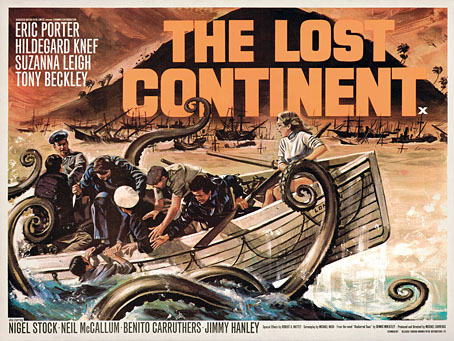
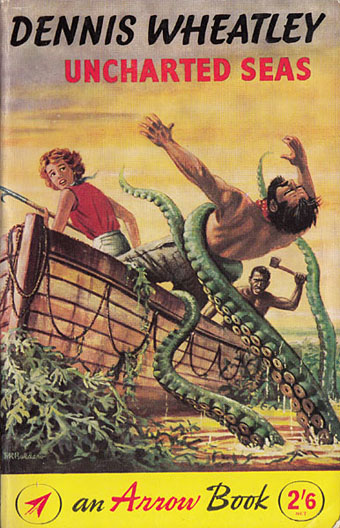
If William Hope Hodgson’s The Boats of the ‘Glen Carrig’ represents the Sublime of tentacular sea fiction then The Lost Continent, a 1968 Hammer film based on Dennis Wheatley’s 1938 novel Uncharted Seas, is the correspondingly Ridiculous end of the subgenre. The Lost Continent is an irritating film for Hodgson enthusiasts since it’s still the most Hodgsonian film out there, at least where the Sargasso side of things is concerned.

uncharted1.jpg

Illustration by SR Boldero (1960).

Despite its Wheatley origins the similarities to Hodgson’s sea stories are no coincidence: Wheatley chose two Hodgson titles—Carnacki, the Ghost-Finder and The Ghost Pirates—for the Dennis Wheatley Library of the Occult series that Sphere Books published in the 1970s. In the introductions Wheatley notes that Hodgson was a favourite writer whose work he discovered in the 1920s; he also mentions having collected a set of Hodgson first editions. Wheatley could have justifiably claimed that the “Weed-World” as a location wasn’t unique to Hodgson but Uncharted Seas also features the giant crabs, marauding octopuses and besieged castaways familiar from The Boats of the ‘Glen Carrig’ and the short stories.

Continue reading “Tentacles #2: The Lost Continent”

Weekend links 127

whirlpool.jpg

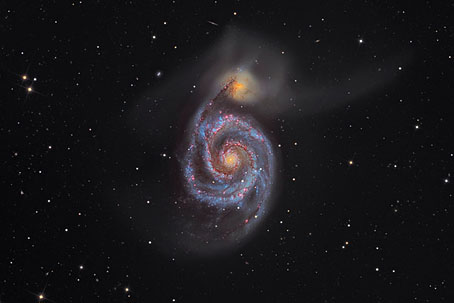
M15, The Whirlpool Galaxy photographed by Martin Pugh. The overall and deep space winner of Astronomy Photographer of the Year, 2012.

The Final Academy, the series of William Burroughs-themed events that took place in London and Manchester in 1982, will be celebrated at the Horse Hospital, London, on 27th October. Academy 23, a publication edited by Matthew Levi Stevens, will include my report on the Manchester Haçienda performances.

• “Architects are the last people who should shape our cities,” says the thrillingly pugnacious Jonathan Meades in a piece from his new writing collection Museums Without Walls. Andy Beckett reviews the book here.

• Ex-Minimal Compact singer/bassist Malka Spigel talks about her new album, Every Day Is Like The First Day, which can be streamed in full here.

What’s new about the current acknowledgments page is that it’s unsolicited—it appears like an online pop-up ad, benefiting no one but the author and his comrades. This is surely why these afterwords are often so garrulously narcissistic and strewn with clichés. The most radical experimentalist adheres to the most mindless acknowledgments-page formula; the most stinging social critic suddenly becomes Sally Field winning an Oscar.

Sam Sacks at the New Yorker on the blight of novelists’ acknowledgments pages. DG Myers at Commentary Magazine piles on.

• Another streaming album: Composed by Jherek Bischoff. Try Insomnia, Death & The Sea featuring Dawn McCarthy.

• Film of Lindsay Kemp being interviewed in 1977 about his production of Salomé.

Electronic Performers (2004): a video by Machine Molle for the song by Air.

djuna.jpg

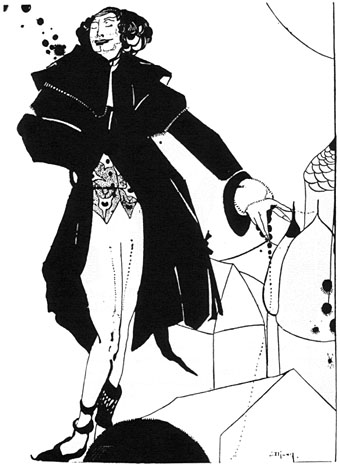
One of a series of Beardsley-like drawings by Djuna Barnes posted at Strange Flowers. The resurgent Ms. Barnes is mentioned three times in this Terry Castle review of All We Know: Three Lives by Lisa Cohen.

Fictitious Dishes, meals from novels photographed by Dinah Fried.

• Life, the Dinosaurs & Everything: Cosmicomics by Italo Calvino.

The Baby Died: Morbid Curiosities found in Old Newspapers.

• Portishead’s Adrian Utley gives a tour of his synth collection.

• Minimal Compact: Babylonian Tower (1982) | Not Knowing (1984) | When I Go (1985) | Nil Nil (1987).

Dom by Walerian Borowczyk and Jan Lenica

dom.jpg

Dom.

Having referred this week to individual animated films by Borowczyk and Lenica here’s their ten-minute collaboration from 1959. “Dom” means “house”, with the house in question providing a vague framing device for otherwise disconnected episodes, some of which repeat themselves. It’s more of a curio than anything, most interesting (again) for the moments that would be better explored by future directors. In addition to further collage animation there’s a short sequence which gives octopoid life to a human wig that’s very reminiscent of Jan Švankmajer. Watch the whole thing here.

Previously on { feuilleton }
Les Jeux des Anges by Walerian Borowczyk
Labirynt by Jan Lenica
Short films by Walerian Borowczyk

S. Latitude 47°9′, W. Longitude 126°43′

shipattack.jpg

Then, driven ahead by curiosity in their captured yacht under Johansen’s command, the men sight a great stone pillar sticking out of the sea, and in S. Latitude 47°9′, W. Longitude 126°43′, come upon a coastline of mingled mud, ooze, and weedy Cyclopean masonry which can be nothing less than the tangible substance of earth’s supreme terror—the nightmare corpse-city of R’lyeh, that was built in measureless aeons behind history by the vast, loathsome shapes that seeped down from the dark stars. There lay great Cthulhu and his hordes, hidden in green slimy vaults and sending out at last, after cycles incalculable, the thoughts that spread fear to the dreams of the sensitive and called imperiously to the faithful to come on a pilgrimage of liberation and restoration.

HP Lovecraft, The Call of Cthulhu (1928)

“Great Cthulhu and his hordes…” People never mention the hordes, do they? I’m pleased to say that the loathsome horde gathered in my forthcoming Cthulhu Calendar are in situ at last, since I’ve found the time this week to get everything finished. I still need to write a couple of new web pages then upload all the images to CafePress. I’ll be doing that over the weekend so Monday will be the launch day.

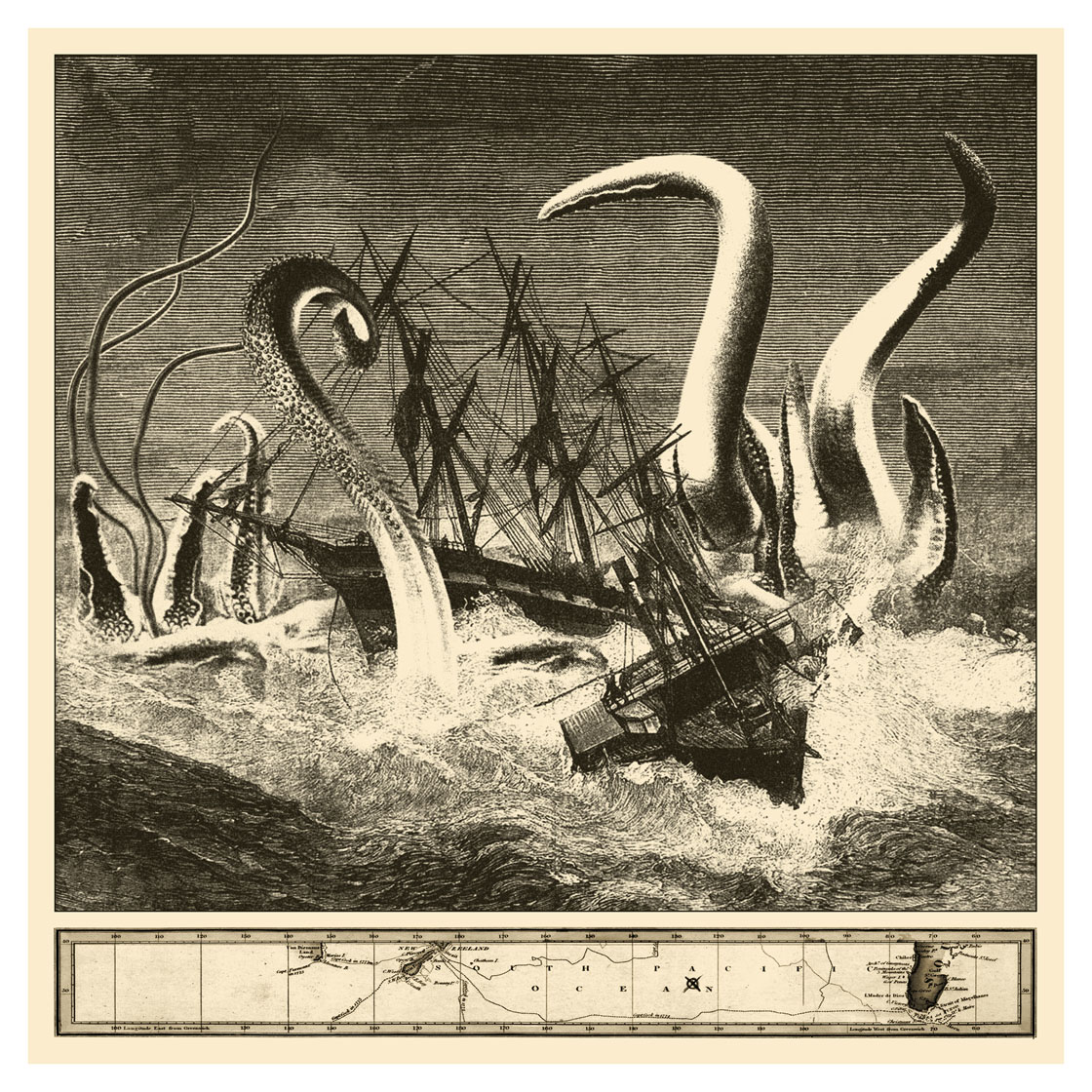
For the final piece I decided against doing another portrait in favour of a picture of an attack at sea as it might have appeared in a 19th-century newspaper. This kind of imagery will now make many people think of the Kraken scenes in the second Pirates of the Caribbean film but it predates cinema, of course, as it also predates Lovecraft. Despite Lovecraft’s indelible association with monstrous tentacles there are a lot more incidents of this nature in William Hope Hodgson’s stories and novels than in the Cthulhu Mythos. In which case this scene, which will be the page for December, can be regarded as a tip of the hat to William as much as to Howard.

Elsewhere on { feuilleton }
The Lovecraft archive