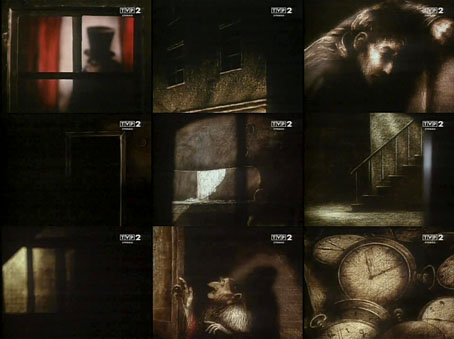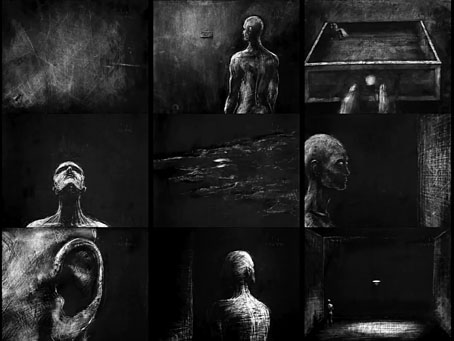
Crime and Punishment, a film by Piotr Dumala

dumala2.jpg

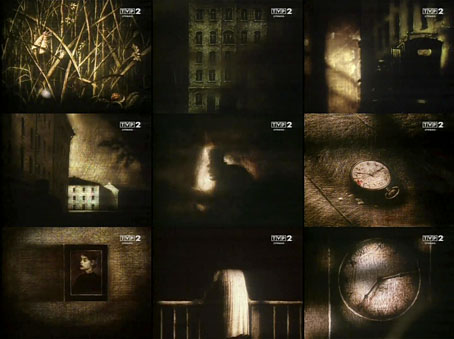
More from the Polish animator, and a stunning, wordless adaptation of Dostoevsky’s novel. Crime and Punishment dates from 2000, and utilises the same technique as Dumala’s earlier films—images scratched into a plaster ground—only this time there’s a muted colour palette and considerable depth achieved through cast shadows and blurred objects layered over the drawings. Yuri Norstein achieved a similar sense of depth in Hedgehog in the Fog (1975) and Tale of Tales (1979), and Dumala’s film also shares the latter’s umber tones and sombre lighting. The story is pared to its bones, as it would be with a running time of 30 minutes, but it’s still a marvellous adaptation. There’s even a nod to Walls when an omnipresent fly disappears for a moment into a hole in the wallpaper.

dumala3.jpg

Previously on { feuilleton }
Walls, a film by Piotr Dumala
Academy Leader Variations
Yuri Norstein animations
Screening Kafka

Walls, a film by Piotr Dumala

dumala.jpg

Polish animator Piotr Dumala was among the filmmakers contributing to Academy Leader Variations, the short anthology that was the subject of a recent post. He also received a mention in the Screening Kafka post for his memorable animated portrait of Franz Kafka. Walls (1988) is another short film made just after Academy Leader Variations, and like all of Dumala’s films the images are created by scratching lines into painted plaster. The cross-hatching that results from this means the animated images are much closer to drawings than the vaguely similar pinscreen animations of Alexandre Alexeieff and Claire Parker. Walls is moody, inexplicable, and may be watched here.

Previously on { feuilleton }
Academy Leader Variations
Screening Kafka

Weekend links 228

moss.jpg

White, Red and Black (1949) by Marlow Moss.

• British television’s greatest director, Alan Clarke, rates on the cult scale here for his work on Penda’s Fen but his career was long, uncompromising and still hasn’t received the full appraisal it deserves. His more violent dramas—Scum, Made in Britain, The Firm, etc—have all appeared on DVD but many of his less notorious films can be hard to find. Paul Duane looks back at the remarkable Contact (1985), an hour-long study of the conflict in Northern Ireland, and a better film about soldiering than any number of big-budget features.

• I’ve wondered for years why one of the Daft Punk helmets seemed so familiar. It’s because they swiped the design from industrial designer and visual futurist, Syd Mead. Mark Wilson talked to Mead about wearable technology; Mr Mead, it seems, isn’t impressed by the French popsters. Related: paintings from Mead’s Sentinel (1979), and Syd Mead designs at Pinterest.

• Remembering that time in 1982 when Alan Moore interviewed Hawkwind. More interviews: Adam Bychawski talks to Jenny Hval about “sonic extremity, the violence of voyeurism and inhabiting bodies”, and Laurent Fintoni talks to (that man again) Bernard Szajner about Visions Of Dune, laser shows, and finding his way back to music.

Our attitudes towards work are extremely schizophrenic: we secretly aspire to sloth, while we loudly praise work. There isn’t an election poster that doesn’t promise more jobs. The call for more work is similar to the Stockholm syndrome, in which the victims of hostage-taking eventually develop a positive relationship with their captors.

Patrick Spaet on the universal employment fetish

• “Marlow Moss was one of Britain’s most important Constructivist artists…a radical lesbian and Drag King,” says Dal Chodha. An exhibition of Moss’s work has just opened at Tate Britain. Related: Marlow Moss: forgotten art maverick.

Yuki Koshimoto plays the Hang, aka the Spacedrum. Via Metafilter where there are more Hang links. The instrument was prominently featured in the score Cliff Martinez wrote for Solaris (2002).

• Broadcast’s Trish Keenan would have been 46 last week. James Cargill posted two demo songs for her birthday.

• At the BFI: Exclusive materials from the making of Powell and Pressburger’s The Tales of Hoffmann.

• Of Tutus and Tortures: Thoughts on the Decadent and the Weird by Christopher Burke.

Faber has launched a Modern Classics imprint with some smart cover designs.

• At Dangerous Minds: Good to see big scans of the Surrealists’ playing cards.

• Mix of the week: Afrofuturist Flowering by Nigel Rampant.

• Writer and editor Russ Kick has a new website.

Infographic: Why Readers Still Prefer Paper.

Superficial Music 1–3 (1981) by Bernard Szajner | Fahrenheit 451 (1982) by Hawkwind | Black Lake (2014) by Jenny Hval & Susanna

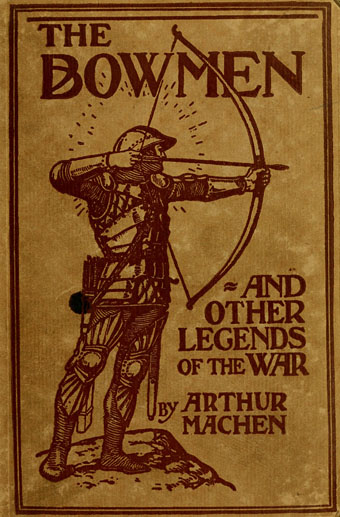
The Bowmen by Arthur Machen

bowmen.jpg

The Bowmen was a short piece of fiction by Arthur Machen published in a London newspaper, The Evening News, on the 29th September, 1914. By Machen’s standards it’s not one of his best pieces, written at a time when he was working at the paper as a journalist. The First World War was in its early days, and the story was conceived as a Kipling-like morale-boost following the retreat of British forces at Mons a few weeks before. The stories for which Machen is remembered today had never provided the success he hoped for so it must have been a surprise when his invention of angelic bowmen appearing during the battle gained him national attention:

On the last Sunday in August, 1914, Machen read in his morning paper of the retreat from Mons.

“I no longer recollect the details, but I have not forgotten the impression that was then made on my mind. I seemed to see a furnace of torment and death and agony and terror seven times heated, and in the midst of the burning was the British army: in the midst of the flame, consumed by it, scattered like ashes and yet triumphant, martyred and for ever glorious.”

That was the way, indeed, in which the English thought about the army at the beginning of the Great War; since then we have come to take a less romantic view of warfare. With this picture in his mind, Machen conceived and wrote a story called The Bowmen, told, as most stories are, as if it were true—that is, he did not begin by saying: “what you are about to read is all my own invention”—in which St. George with an army of English mediaeval bowmen appeared at the critical moment to cover the British retreat. Not, to be sure, a very probable story nor, as Oswald Barron pointed out, was it likely that the Agincourt bowmen, most of whom came from Wales, would use the French expressions Machen evokes from them: and Machen himself felt he had not done justice to his original conception.

“But if I had failed in the art of letters, I had succeeded, unwittingly, in the art of deceit.”

The Bowmen appeared in The Evening News on September 29th, 1914, at a moment when people were looking for a miracle, and many promptly embraced it as an account of one. That such journals as The Occult Review and Light should fasten on it, might have been anticipated; but it was taken up by parish magazines all over the country, and people came forward on every side to say that they had friends and relatives who had seen the “Angels of Mons” with their own eyes. As a result, Machen became, for the first time in his life, a man of nation-wide fame. To thousands of people, the idea, whether true or false, gave consolation or hope, but when Machen protested that his story was entirely the child of his own imagination, the fame threatened to turn to notoriety; he was rebuked for his impudence at claiming originality for the tale. Nevertheless a legend had been born and a shoal of publications appeared to satisfy public demand—On the Side of the Angels (Harold Begbie), Guardian Angels (GP Kerry—a sermon reprinted), Angels, Saints and Bowmen of Mons (IE Taylor, Theosophical Publishing Society).

Aidan Reynolds & William Charlton in Arthur Machen: A Short Account of His Life and Work (John Baker, 1963)

Continue reading “The Bowmen by Arthur Machen”

Weekend links 227

grim.jpg

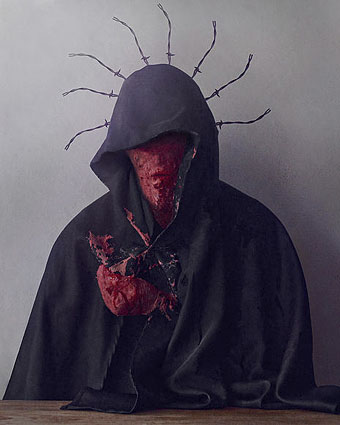
A Follower by Jason Grim.

Haunted Futures, a multi-genre anthology from Ghostwoods Books, will feature stories by Warren Ellis, John Reppion, Liesel Schwarz, Chuck Wendig, Richard Kadrey, Stephen Blackmoore and others. It will also feature some of my illustrations but only if this this Kickstarter fund is successful.

• “…at issue here is restriction versus potential: protect a specific set of choices versus open the field to the exploration of everything.” Sam Potts offers a refutation of Robert Bringhurst’s design textbook The Elements of Typographic Style.

• “I discovered that if one looks a little closer at this beautiful world, there are always red ants underneath.” Morgan Meis quoting David Lynch in a review of David Lynch: The Unified Field, a new exhibition of Lynch’s paintings.

But among these novels only Moravagine, first discovered for English-speaking readers by Henry Miller and a direct ancestor of Céline’s Voyage au bout de la nuit, has survived as an underground classic. A monstrous admixture of Lautréamont’s Maldoror, Feuillade’s Fantômas, Nietzsche’s Superman, Jack the Ripper and (according to the Cendrars scholar Jay Bochner) the deranged Jung and Freud disciple Otto Gross, Moravagine remains Cendrars’s most nihilistic and darkly comic other.

Richard Sieburth on Blaise Cendrars and his “Dada update of Dostoevsky”, coincidentally the subject of a post here earlier in the week.

• “…the duchess became enthralled with the idea of creating a garden of plants that could kill instead of heal.” Natasha Geiling on Jane Percy’s Poison Garden.

• Mix of the week: Kosmik Elektronik [part 3] by The Kosmische Club. More Kosmische musik: Agitation Free on French television in 1973.

• At Dangerous Minds: Secret Weapons (1972), 22 minutes of made-for-TV dystopian science fiction directed by David Cronenberg.

Project Praeterlimina, “a journal of daemonology, magic, and the human condition”.

The NOS Project: download Shed’s score for Murnau’s Nosferatu.

• At Lambda Literary: Toy, a poem by Evan J. Peterson.

Drew Daniel doesn’t want to play the listicle game.

Surrealism and Magic

Stuff in old books

Haunted Island (1973) by Agitation Free | Haunted Heights (1977) by Peter Baumann | Haunted Dancehall (1994) by The Sabres of Paradise