The Incredible Robert Baldick

baldick1.jpg

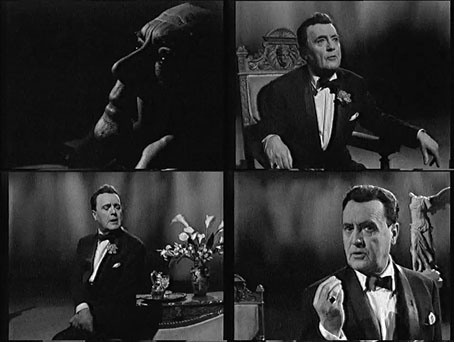
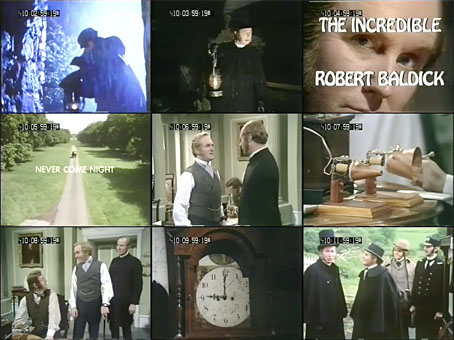
This is an odd one-off TV drama whose title I’ve known for years but which I hadn’t seen until this week. The Incredible Robert Baldick was broadcast in 1972 in a slot used by the BBC to test dramas that might later become series. The writer was Terry Nation, creator of Doctor Who and the dour post-apocalypse series, Survivors. Robert Hardy plays Robert Baldick, an aristocratic occult detective who we’re informed “cannot resist the inexplicable”. We’re also told he’s one of the finest scientific minds in 19th-century Britain. The exact period is vague but we first see Baldick and cohorts playing with an “electrical telepathy” communication device which would fix the time around the turn of the century. Baldick has a country estate, a bulletproof Russian train (“The Tsar”), a valet who is also an expert in Classics and ancient languages, a gamekeeper with preternatural senses, and a pet owl named Cosmo.
baldick2.jpg

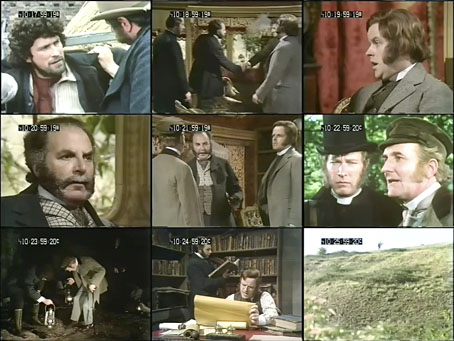
The one-and-only 50-minute episode is entitled Never Come Night, and plays like something Nigel Kneale might have written, a combination of supernatural horror, suspicious yokels and archaeology, with an abrupt swerve into outright science fiction at the end. The cast features many familiar faces from film and television of the period: James Cossins as a fearful clergyman, Barry Andrews playing the same type of rustic he also played in Blood on Satan’s Claw, Julian Holloway as Thomas the valet, and John Rhys-Davies (Gimli in The Lord of the Rings) as Caleb the gamekeeper. All the ingredients are in place for what might have been a promising series along the lines of The Rivals of Sherlock Holmes, the first season of which had been running on another channel the year before, and which may have been an inspiration. A shame that the only women in the cast are a couple of barely visible servants and a corpse; even Holmes and Watson had Mrs Hudson. The timecoded copy on YouTube has evidently been hijacked from the BBC archives but it’s watchable enough.

Previously on { feuilleton }
The Horse of the Invisible
“The game is afoot!”

The weekend artists, 2014

crystal.jpg

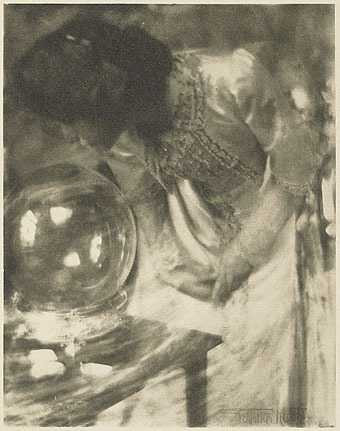
The Crystal Gazer (or The Magic Crystal, 1904) by Gertrude Käsebier.

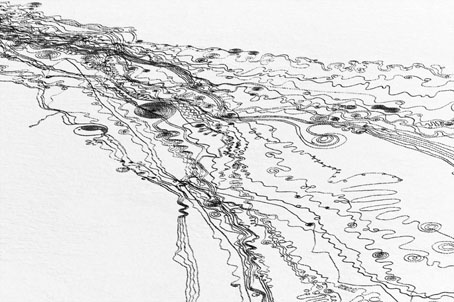
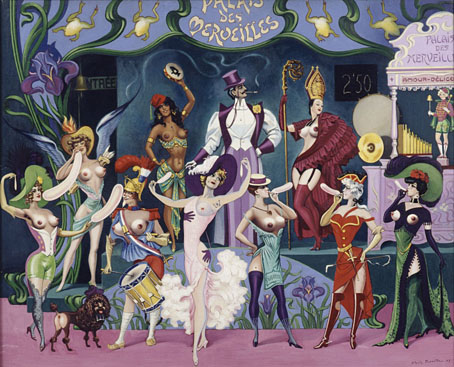
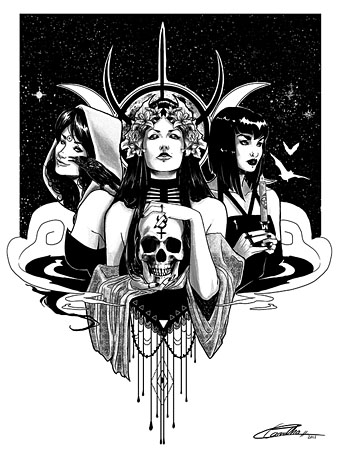
Once again the annual review of artists/designers/photographers featured in the weekend posts arrives at the beginning of the new year rather than the end of the old. Scroll down to see what caught my attention over the past twelve months.

hinrichsen.jpg

We Are The Water – Snow Drawings Project, Colorado (2014) by Sonja Hinrichsen with 50 volunteers.

trouille.jpg

Le Palais des Merveilles, 1907 – 1927 – 1960 by Clovis Trouille.

carvalho.jpg

The Three Witches (2014) by Lorena Carvalho.

Continue reading “The weekend artists, 2014”

The Importance of Being Oscar

macliammoir1.jpg

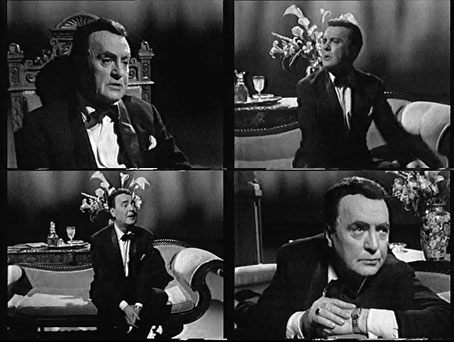
Picking up where we left off, I was thrilled to find that Micheál MacLiammóir’s one-man dramatised biography of Oscar Wilde had finally made it to YouTube. The Importance of Being Oscar was MacLiammóir’s 100-minute magnum opus, an acclaimed condensation of Wilde’s life and work first performed at the Gate Theatre, Dublin, in 1960. Hilton Edwards produced for partner MacLiammóir who subsequently took his show around the world, including performances on Broadway.

MacLiammóir’s monologue interleaves sketches of Wilde’s life with substantial extracts from the major works—An Ideal Husband, The Picture of Dorian Gray, The Importance of Being Earnest, De Profundis, and The Ballad of Reading Gaol—with the actor/writer often taking two roles in the same scene. The readings are deeply felt; this would have been a very personal project, not only for its subject being a fellow Irishman and playwright but also for MacLiammóir and Edwards’ status as gay men in Ireland at a time when they could never be open about their private lives. (Or openly secretive: Barbara Leaming’s biography of Orson Welles makes it clear that iniquitous laws did nothing to stifle the pair in their pursuit of other men.) Accounts of Wilde’s post-trial life are inevitably sombre but MacLiammóir notes that even prison couldn’t suppress Wilde’s sense of humour. A literary conversation with one of the warders is recounted, along with the famous barb thrown at Marie Corelli: “Now don’t think I’ve anything against her moral character, but from the way she writes she ought to be in here.” If MacLiammóir’s performance seems a little overwrought in the television studio it would have appeared less so on the stage.

macliammoir2.jpg

The BBC filmed The Importance of Being Oscar in the mid-60s, and I think that recording may be the one linked here, a version I recall being shown during an evening of Wilde-related TV in the late 1980s. Prior to this MacLiammóir had played Wilde himself for a televised dramatisation of the courtroom appearances broadcast by the BBC in 1960. This was a key year for reappraisals of Wilde’s reputation which also saw the cinema release of Oscar Wilde (with Robert Morley) and The Trials of Oscar Wilde (with Peter Finch). The latter is the superior film and performance even if Finch looks nothing like Wilde. Public attitudes were changing but all the films and TV plays at this time remained evasive about the precise nature of Wilde’s infractions. The Importance of Being Oscar follows this pattern with a fade to black after Wilde’s arrest; the second act opens with MacLiammóir as the judge passing sentence on Wilde and procurer Alfred Taylor. Circumspection doesn’t detract from the power of the monologue which has been revived in recent years, most notably by Simon Callow, another great Wilde enthusiast and also the biographer of MacLiammóir’s young protégé, Orson Welles.

Now that MacLiammóir’s monologue has resurfaced I’ll be hoping someone uploads John Hawkesworth’s Oscar (1985), a three-part television biography with Michael Gambon playing Wilde.

Elsewhere on { feuilleton }
The Oscar Wilde archive

Return to Glennascaul, a film by Hilton Edwards

glennascaul.jpg

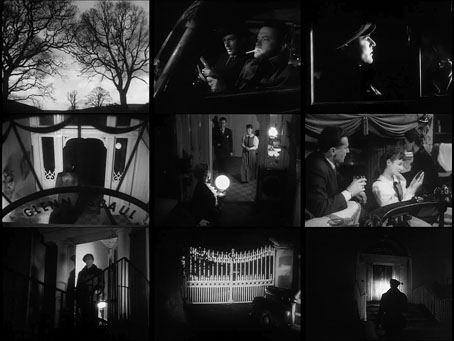
Another return, and another short ghost story. Return to Glennascaul (1951) has been presented at times as Orson Welles’ Ghost Story even though it was written and directed by Welles’ friend, Hilton Edwards. Welles is the narrator, and plays himself in the framing section. The story is a version of the old “Vanishing Hitchhiker” urban legend reworked as “a story that is told in Dublin”. What’s most interesting for Welles enthusiasts is that the film reunited Orson with both Hilton Edwards and Micheál MacLiammóir, the directors of Dublin’s Gate Theatre who gave Welles his professional theatre debut at the age of 16. The young Welles had been a keen actor and director of his school’s drama productions so while hiking through Ireland one summer he turned up at the Gate Theatre smoking a cigar and declared himself ready for any leading roles they might have. Edwards and MacLiammóir were amused by his audacity so they took him on. Return to Glennascaul was an opportunistic byproduct of Welles’ film production of Othello (alluded to in the opening scene) for which MacLiammóir had been cast in the role of Iago. MacLiammóir published a very entertaining diary account of the making of the film, Put Money in Thy Purse in 1952. He’s also named as co-producer of Return to Glennascaul which may be watched here.

As usual { feuilleton } will be taking a break for a few days so the archive feature will be summoning posts from the past. Have a good one, and mind how you go.

The Return: a ghost story

thereturn.jpg

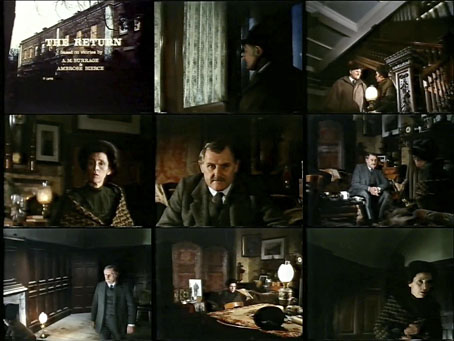
Another obscure film, The Return (1973) isn’t a television drama, more a miniature for the cinema, and as such may have been produced as a double-feature short. Director and co-writer Sture Rydman only has one other film to his credit but the music for The Return is by film composer Marc Wilkinson while the photography is the work of the very distinguished Douglas Slocombe.

The story is a blend by Rydman and fellow writer Brian Scobie of two ghost stories: Nobody’s House by AM Burrage, and The Middle Toe of the Right Foot by Ambrose Bierce. Nobody’s House is surprisingly one of the few Burrage stories I have on the shelves, and it provides the bulk of the script, the Bierce story being a very different piece concerning a duel in an abandoned building. Rydman’s film is a two-handed affair for two very good actors: Rosalie Crutchley, here playing a less sinister housekeeper than she did in The Haunting, and Peter Vaughan who the year before had been the lead in one of the best of the BBC’s MR James adaptations, A Warning to the Curious. The Return runs for 30 minutes, and to say much more would be to spoil it. The copy at YouTube does Slocombe’s photography no favours but you can at least watch it here.

Previously on { feuilleton }
Nigel Kneale’s Woman in Black
“Who is this who is coming?”