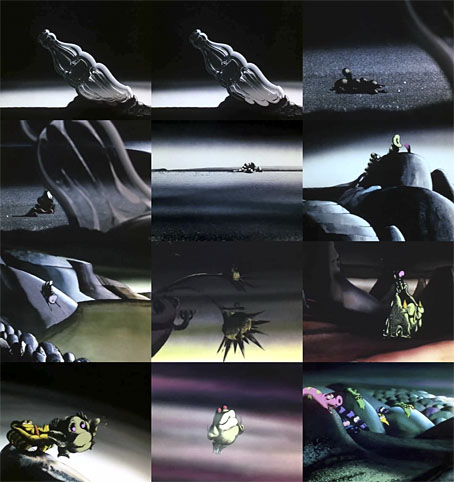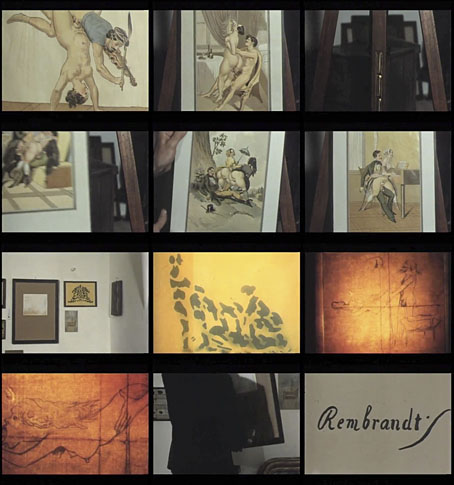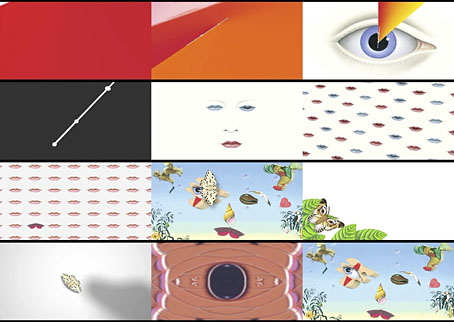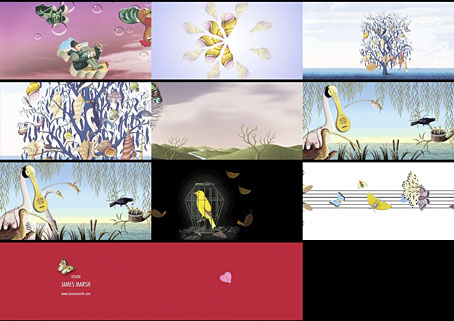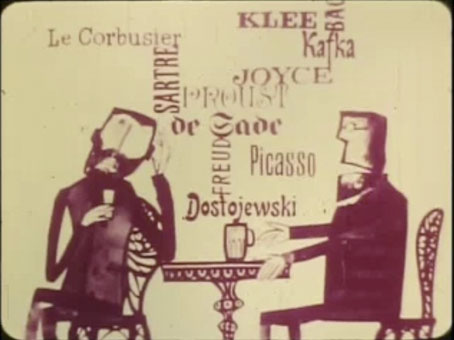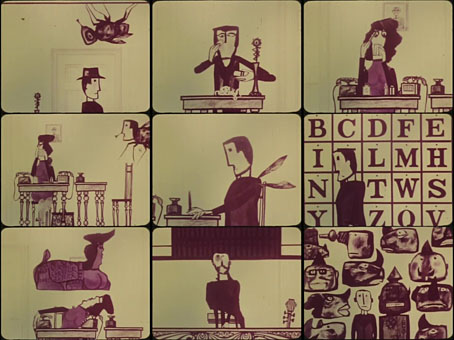
In which artist James Marsh animates the paintings of his which appear on Talk Talk’s album covers. This is a promo film for Spirit Of Talk Talk, a cover version collection released last year on Fierce Panda. Thanks to Thom for the tip!
Category: {animation}
Animated films
Rhinoceros by Jan Lenica
As noted here last year, Polish artist Jan Lenica (1928–2001) was also an animator as well as a celebrated poster designer. Die Nashörner (1964) is an 11-minute condensation of Eugène Ionesco’s Rhinoceros that no doubt works best if you’re familiar with the play but which nevertheless contains some funny moments, especially when “Rhinocerosism” starts to spread. The film is free to download at the Internet Archive.
Previously on { feuilleton }
• Repulsion posters
• Dom by Walerian Borowczyk and Jan Lenica
• Labirynt by Jan Lenica
Chronopolis by Piotr Kamler

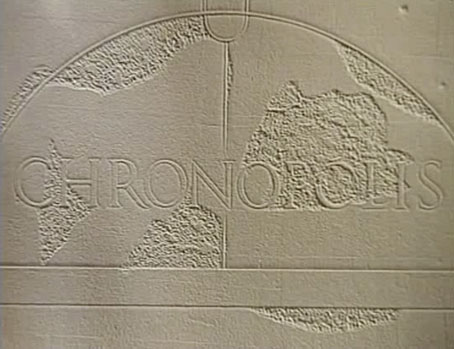
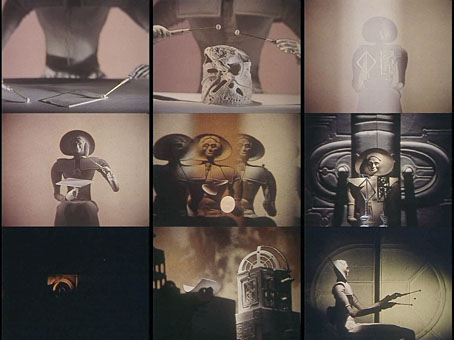
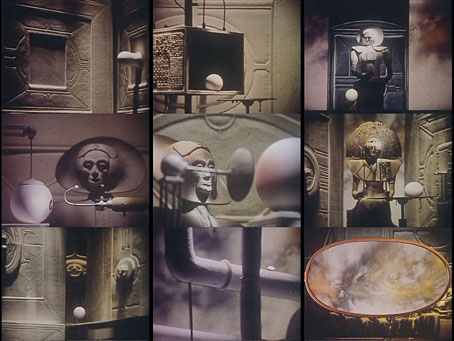
Another gem at Ubuweb, and nothing to do with JG Ballard’s SF story of the same name, Piotr Kamler’s Chronopolis (1983) is a 50-minute animated science fiction film, albeit science fiction of a much more abstract variety than one usually finds in cinema. I’m generally exasperated by the way film and TV SF does little more than play Cowboys & Indians in space so it’s refreshing to see something that’s unashamedly strange and doesn’t feel the need to explain itself. There is apparently a version of this with some English narration for those benighted American audiences everyone feels a need to pander to but the Ubuweb version is wordless, and if you can’t read French then you won’t understand the few lines of text prologue at the opening.

Accompanying Kamler’s beautifully crafted and quite inexplicable scenes there’s an electronic score by composer Luc Ferrari, mostly analogue timbres whose origin is as mysterious as the events taking place on-screen. Kamler’s statuesque figures remind me of the gods and aliens that Moebius and co. were drawing in Métal Hurlant during the 1970s. Chronopolis was a French production begun in 1977 so it’s possible that French comics were an influence. Moebius himself worked on another animated SF film during this period, René Laloux’s Time Masters (1982). Chronopolis is closer in tone to the weirdness of Laloux’s earlier Fantastic Planet (1973), and all the better for it.

Previously on { feuilleton }
• Les Jeux des Anges by Walerian Borowczyk
• Les Temps Morts by René Laloux
Quay Brothers: On Deciphering the Pharmacist’s Prescription for Lip-Reading Puppets

It’s not exactly the most appropriate moment to be recommending an exhibition in New York given the chaos in the city following the recent hurricane. However… Quay Brothers: On Deciphering the Pharmacist’s Prescription for Lip-Reading Puppets has been running at MoMA since August, and will continue into early 2013. A copy of the catalogue turned up this week, a slim volume of 64 pages that’s nevertheless an essential item for Quay obsessives such as myself.

Set design for A Flea in Her Ear (1989).
I’ve written before that while the Quays’ films are the most visible part of their oeuvre, much of their early output as artists and designers remains either obscure or unavailable. So it’s a pleasure to find a number of their early drawings, poster designs and book covers reproduced here. The catalogue also features examples of gallery installations and their designs for the stage. Ron Magliozzi, the curator, and Edwin Carels contribute essays while the Quays themselves are “interviewed” by Heinrich Holtzmüller “who was once real and now only exists under the glass of a museum vitrine in Nürnberg”. An appendix includes a thorough listing of their film works, giving me more things to chase at a later date.

In addition the Quays have also designed parts of the book, notably the title pages which feature their idiosyncratic typography. The catalogue may be purchased direct from the museum.

Grand Box, decor for Street of Crocodiles (1986).
Elsewhere on { feuilleton }
• The Quay Brothers archive
Gloves
A Glove: Anxieties (1881) by Max Klinger.
Although the Glove‘s scenario was given its due Germanic explication by contemporary critics, it defies rational analysis. The last picture, which was seen as a kind of happy ending to the glove’s peregrinations, is particularly ambiguous and leaves the whole meaning of the series in doubt. The story is a parable of loss based on a trivial lost article, like the lost keys in Bluebeard and in Alice, like Desdemona’s missing handkerchief, or like the philosopher’s spectacles in Klinger’s own Fantasy on Brahms, which have slid out of their proprietor’s reach just as he was nearing the summit of a kind of Matterhorn. There are overtones of erotic symbolism and fetishism in the glove and the phalloid monster who abducts it, heightened for a modern viewer by the Krafft-Ebing period costumes and décors (the engravings appeared in 1881, and the drawings were apparently finished in 1878).
John Ashbery describing Max Klinger’s extraordinary series of etchings A Glove (aka Paraphrase on the Finding of a Glove) which in their inexplicable narrative of fetishist obsession anticipate Surrealism. See the entire sequence here or here. For A Glove in print there’s The Graphic Works of Max Klinger from Dover Publications.

The Song of Love (1914) by Giorgio de Chirico.
Ashbery begins by discussing Giorgio de Chirico’s enthusiasm for Klinger’s work, a passion and influence that provides one of the many connections between the Symbolists and the Surrealists. This “metaphysical” painting looks back to Klinger and forward to Magritte.
The Pleasures of the Glove, 3 (1974) by Duane Michals.
The enigmatic encounter of ‘The pleasures of the glove’ follows the lead character as he fantasises about a pair of gloves on the hands of a mannequin in a shopfront window. The perverse pleasure of desiring the gloves but not acquiring them leads him on a surreal adventure of first imagining his own glove as a queer furry tunnel that swallows his hand to the fantasy of stroking the naked body of a woman he sees on the bus with her own glove. (more)
A more contemporary take on the same idea, albeit without the intercession of a pterodactyl-like thief. If Klinger is pre-Surrealism then this is the post- version; Michals photographed René Magritte, and many of his other works run in a distinctly Surreal direction. (Thanks to Anne Billson for the tip!)
The Vanished World of Gloves (1982) by Czech animator Jiří Barta features sex, Surrealism and a lot more besides, all in the space of 16 minutes. A can of film is unearthed which contains a series of short episodes pastiching different cinematic styles: Chaplinesque slapstick, swashbuckling romance, Buñuel Surrealism, a war film, a Fellini orgy and a science fiction apocalypse. All the parts are played by gloves, of course, and if you didn’t see the credits you might take this at first for a Svankmajer short.
The Vanished World of Gloves: part one | part two
Update: I knew I’d forgotten something… Added de Chirico’s The Song of Love.
Previously on { feuilleton }
• More Golems
• Max Klinger’s New Salomé
• Barta’s Golem