Weekend links 635

bubble.jpg

A close-up image of the surface of a soap bubble. The image reveals ‘lipid islands’ of soap floating on a very thin film of water. The film on which the soap floats is so thin that it does not interfere with the light hitting it, therefore allowing the light to pass through. This creates an appearance of a black abyss. Magnification x250.”

• Coming soon from Strange Attractor Press: Everything Keeps Dissolving, Conversations with Coil edited by Nick Soulsby. I helped out a little with this one so I’m looking forward to seeing it. And since the cult fervour around the group remains undiminished, anyone interested in buying a copy is advised to do so sooner rather than later.

• There are over 90 stories in The Complete Short Stories of JG Ballard (quantities vary according to edition) but few of them have been adapted into other media. The Drowned Giant is an exception, an animated short directed by Tim Miller.

• “You could spend your life exploring its dream logic without arriving at a definitive destination.” Anne Billson on the mysteries of Lucile Hadžihalilović’s Earwig.

• Meta-mix of the week: links to yearly mixes of favourite ambient releases by A Strangely Isolated Place.

• At Spoon & Tamago: Matchstick cookies keep the flame of tradition alive.

• At Dennis Cooper’s: George A. Romero Day.

Felicia Atkinson’s favourite music.

• RIP Wolfgang Petersen.

Das Boot: Titel (1981) by Klaus Doldinger | Martin (1983) by Soft Cell | Everything Keeps Dissolving (2000) by Coil

Three short films by Pascal Baes

baes1.jpg

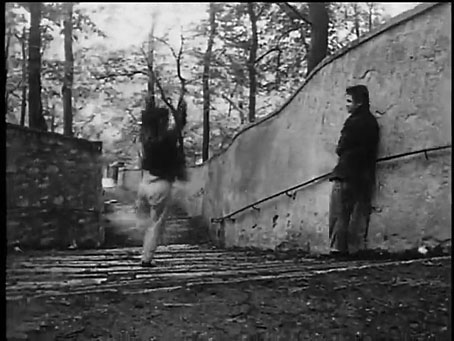
Topic I (1990).

Black-and-white film, a handful of dancers, and the streets of old Prague (plus a Parisian courtyard). I linked to Topic II in a weekend post some time ago but since all three films in the series are on Vimeo I thought they deserved a post of their own.

baes2.jpg

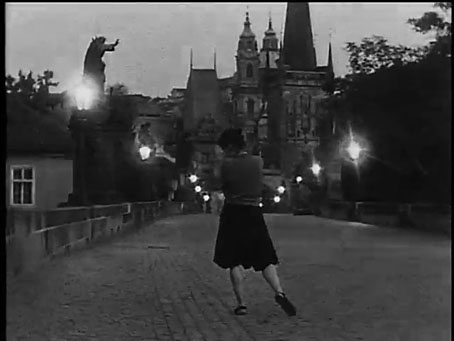
Topic II (1990).

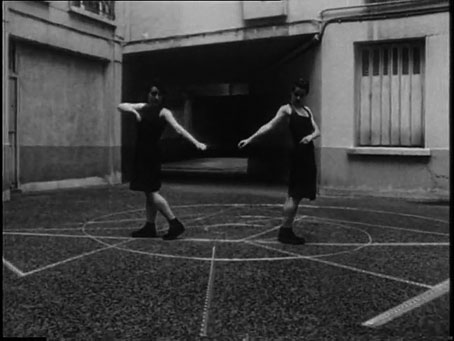
Pascal Baes is a French film-maker who may have created something unique here by combining the dance film with pixilation, the animation technique in which people move frame-by-frame like live action puppets. The technique is an old one that was generally used for comic effect, at least until the arrival of the music video; Baes’ innovation is to give us dance pieces that can exist only in the camera. One of the attractions for this viewer is the Prague settings, especially those in the best film of the three, Topic II, in which a pair of dancers glide up the labyrinthine streets leading to the castle that dominates the city.

baes3.jpg

46bis (1988).

Previously on { feuilleton }
Jan Švankmajer: The Animator of Prague
Stone Glory, a film by Jirí Lehovec
The Face of Prague
Josef Sudek
The panoramic towers of Prague
Prague panoramas
Steven Soderbergh’s Kafka
Karel Plicka’s views of Prague

Weekend links 631

desgoffe.jpg

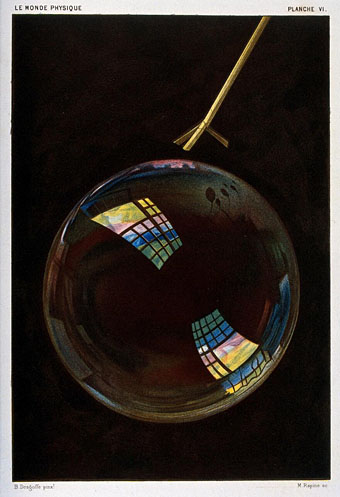
Soap Bubble (1882) by Alexandre-Blaise Desgoffe. Via.

• “…there is not now, has never been, and will never be a single Platonic form of the paragraph to which all others must conform.” Richard Hughes Gibson on the history of the paragraph.

• At Spoon & Tamago: imaginary covers by international illustrators for The Tokyoiter, a New Yorker-style magazine about the Japanese capital.

• New music: tick tick tick by Stephen Mallinder, and A Vibrant Touch by Aleksandra Slyz.

The Kat had a cult following among the modernists. For Joyce, Fitzgerald, Stein, and Picasso, all of whose work fed on playful energies similar to those unleashed in the strip, he had a double appeal, in being commercially nonviable and carrying the reek of authenticity in seeming to belong to mass culture. By the thirties, strips like Blondie were appearing daily in roughly a thousand newspapers; Krazy appeared in only thirty-five. The Kat was one of those niche-but-not-really phenomena, a darling of critics and artists alike, even after it stopped appearing in newspapers.

Amber Medland on George Herriman, EE Cummings and Krazy Kat

35mm.online: Polish feature films, documentaries and animations, all free to view.

• At Dennis Cooper’s: Spotlight on…Georges Bataille Erotism: Death and Sensuality.

• Inside the Espai Corberó, the home/gallery of the late Xavier Corberó.

Strange Attractor Journal Five.

• RIP Claes Oldenburg.

Krazy Kat (1928) by Frankie Trumbauer & His Orchestra | Krazy Kat (1949) by Artie Shaw | Krazy Kat (1975) by Teddy Lasry

Weekend links 627

aldridge.jpg

Cover art by Alan Aldridge for The Secret Life of Plants, 1975. Via.

• At Aquarium Drunkard: Alice Coltrane and band in a furious live performance at the Berkeley Community Theatre, 1972. The audio is on YouTube, and was also released on (unofficial) vinyl a couple of years ago, but you can download the whole set at Dimeadozen. (Free membership required.)

• “Black Square is tragic; it’s absurd; it can be bewildering or funny; it’s certainly metaphysical; and now it serves as a precursor for works and projects yet to be imagined.” Andrew Spira on the precursors of Black Square by Kazimir Malevich.

• “The possibility of plant consciousness cuts two ways, depending on whether you see plants as friend or foe, benevolent or threatening.” Elvia Wilk on the secret lives of plants.

• New/old music: Robot Riot by Stereolab. A previously unreleased recording from the mid-90s which will appear on the fifth instalment in the Switched-On compilation series.

• “Dare’s good, but Love And Dancing broke the mould and kicked off the whole modern dance scene.” Ian Wade on 40 years of remix albums.

• Coming soon from Strange Attractor: Arik Roper: Vision of The Hawk.

• At Unquiet Things: Deborah Turbeville’s unseen Versailles.

• “Thinking like a scientist will make you happier”.

• At Dennis Cooper’s: Karel Zeman Day.

Plantasia (1976) by Mort Garson | Musik Of The Trees (1978) by Steve Hillage | The Secret Life Of Plants (1979) by Stevie Wonder

Weekend links 626

conformist.jpg

Czech poster for Bernardo Bertolucci’s The Conformist. Art and design by Miroslav Pechánek, 1972.

• “Acknowledgements are not part of the novel; in fact, they break the spell the author has spent 200 or more pages weaving. We should take a book on its merits, knowing as little about the author as possible. As one reader put it to me, ‘the end of a book is time for thinking about the book, not for an acceptance speech’.” John Self on dedications and acknowledgements.

• Mixes of the week: a Power Ambient mix by A Strangely Isolated Place, and a mix for The Wire by Nexcyia.

• At Spoon & Tamago: 3D-scanned stones create vessel for human-made interventions.

Weeks turned into months. Slowly it dawned on me that I was performing the role of Boswell for a man who might be: a) a put-on maestro or arcane troll; b) a fiction writer slash performance artist; or c) a lunatic. But by his own admission King had tagged me with a familiar spirit. Whether or not he was telling the truth was irrelevant at this point. I could feel something squatting on my soul. I needed to see what it was.

Kent Russell on looking for demons in a disenchanted world

• A trailer for Mad God, Phil Tippett’s 30-years-in-the-making animated feature.

• New music: Vesta by Azu Tiwaline, and Right, Right, Right by Nils Frahm.

• At Dennis Cooper’s: Max Hattler Day.

• “Marcel Duchamp was not a thief.”

• RIP Jean-Louis Trintignant.

Demons Of Rage (1972) by Nik Raicevic | Shall Come Forth The Demons (1991?) by Yuri Morozov | Angels Of Darkness, Demons Of Light (2011) by Earth