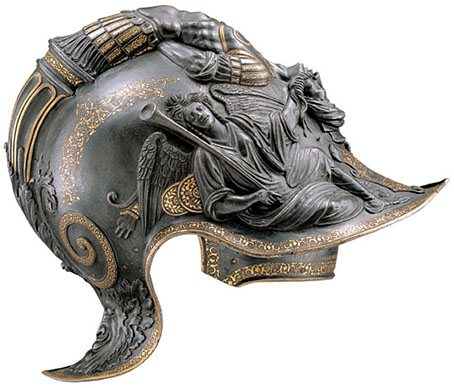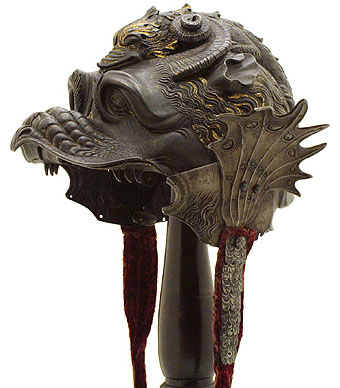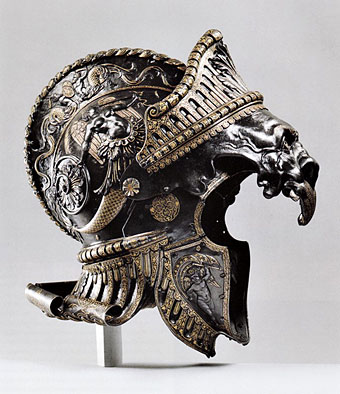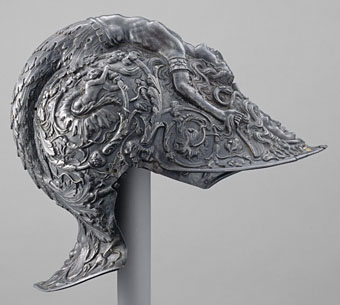
Burgonets by Filippo Negroli

negroli1.jpg

Parade burgonet of Emperor Charles V (1545).

burgonet a. A very light casque, or steel cap, for the use of the infantry, especially pikemen. b. A helmet with a visor, so fitted to the gorget or neck-piece, that the head could be turned without exposing the neck.

Filippo Negroli (c. 1510–1579) was a Renaissance master of ceremonial armour as is evident from these few examples. Fascinating seeing the kind of elaborate grotesquerie more commonly found in engraved prints rendered into wearable three-dimensional form. Burgonet number four can be viewed in detail at the Google Art Project. There’s more of Negroli’s work at Flickr.

negroli2.jpg

Burgonet (c. 1532–35).

negroli3.jpg

Burgonet Alla Romana Antica (no date).

negroli4.jpg

Burgonet (1543).

Previously on { feuilleton }
Leonardo’s warrior

Zeppelinology

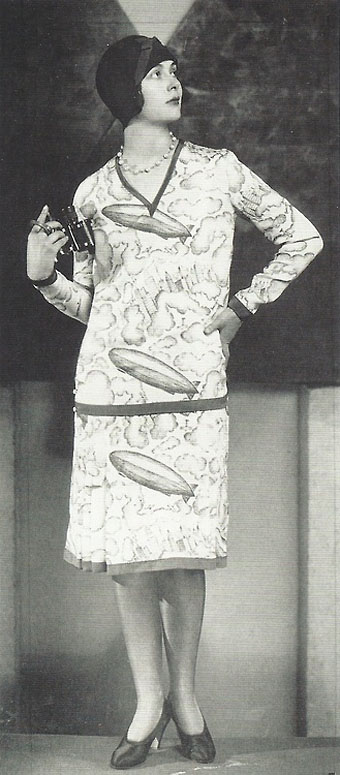
zeppelin1.jpg

Robe dans le style Zeppelin, Berlin, vers 1930.

So after you’ve donned your very best Zeppelin dress (and grabbed a pair of binoculars)…

zeppelin2.jpg

…you can head on over to the Zep Diner for lunch.

zeppelin3.jpg

Try some of the Zeppelin Bread: it’s light as air!

zeppelin4.jpg

Afterwards (if it’s not too early) you can relax with a martini prepared in a Hindenburg shaker

zeppelin5.jpg

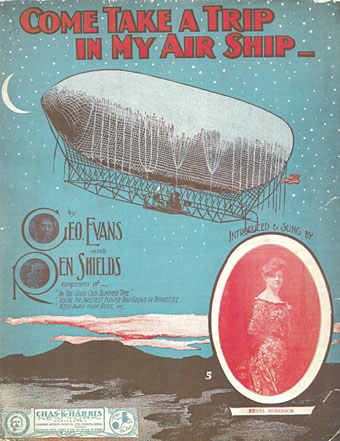
…whilst listening to Billy Murray singing a song about his (male) sweetheart, Come Take A Trip In My Airship, and browsing colour photographs of the Hindenberg interior.

(Thanks to Thom for starting the ball rolling with his new Paris/Berlin tumblr!)

Previously on { feuilleton }
Vickers Airship Catalogue
The Air Ship
Dirigibles
The Airship Destroyer
Zeppelin vs. Pterodactyls

Weekend links 104

cummings.jpg

Prettiest Star (2004) by Timothy Cummings.

I Want Your Love, a feature film directed by Travis Mathews catches my attention for having been described as “the gay Shortbus” even though (as the director notes) Shortbus was pretty gay to begin with.

• I’ve always found Hans Christian Andersen’s story of The Tinderbox—a tale of spectral dogs with enormous eyes—to be rather weird. But these illustrations by Heinrich Strub for a 1956 edition beat everything.

• “From an early age, however, I became in secret the slave of certain appetites.” The line that Robert Louis Stevenson deleted from The Strange Case of Dr Jekyll and Mr Hyde.

Scientific American: Homophobes might be hidden homosexuals. Not exactly fresh news but always worth bearing in mind when someone starts ranting about those evil gays.

Minimal Wave: The 80s synth-pop underground. The Minimal Wave label releases a vinyl compilation by Hard Corps this month.

• “Blame the Victorians for making menswear boring.” Alex Jung on the endless tyranny of the suit-and-tie combination.

• Women, Vaginas and Blood: Breaking menstrual taboos with artist Sarah Maple.

London’s lost rivers (again): the hidden history of the city’s buried waterways.

Vincenzo Pacelli says the Knights of Malta murdered Caravaggio.

Street style 1906: Edward Linley Sambourne’s fashion blog.

Architectural Stationery Vignettes at BibliOdyssey.

Hans Bellmer & Unica Zürn at Ubu Gallery, NYC.

Pam Grossman admits to being a “candle hooch”.

Dirty (1986) by Hard Corps | Lost Rivers Of London (1996) by Coil | The Tinderbox (2009) by Patrick Wolf.

The recurrent pose 46

pluard.jpg

Something I’d had bookmarked for ages then overlooked, French photographer Bertrand Le Pluard borrows the Flandrin pose for a Raf Simons shoes feature in Wad Magazine. In addition to another shot avec génitales at the Le Pluard site there’s also a feature here and here for German gay mag Kaiserin celebrating those queer hippies known as The Cockettes. Via Homotography.

Elsewhere on { feuilleton }
The recurrent pose archive

Previously on { feuilleton }
Flamboyant excess: the art of Steven Arnold

Weekend links 96

nunez.jpg

Sin título (monstruas) (2008) by Marina Núñez.   

• Salon asks Christopher Bram “Is gay literature over?” Bram’s new book, Eminent Outlaws: The Gay Writers Who Changed America, is reviewed here.

Robert Montgomery is profiled at the Independent as “The artist vandalising advertising with poetry.”

In addition to aesthetics, McCarthy noted a deeper link between great science and great writing. “Both involve curiosity, taking risks, thinking in an adventurous manner, and being willing to say something 9/10ths of people will say is wrong.” Profound insights in both domains also tend arise from a source beyond the limits of analytic reason. “Major insights in science come from the subconscious, from staring at your shoes. They’re not just analytical.”

Nick Romeo meets Cormac McCarthy at the Santa Fe Institute.

• For FACT mix 316 Julia Holter mixes radio broadcasts, street recordings and music.

• This week in the Tumblr labyrinth: fin de siècle art and graphics from Nocnitsa.

“There’s a widespread cultural barrenness across art and political culture. But there are some pockets of resistance on the extreme margins, like the techno-savvy protest movements, small press, the creator-owned comics, that seem to be getting some signs of hope for the future,” he says. “All of the genuinely interesting work is being done on the margins, with independent companies, self-producing, and alternative distribution networks.”

Alan Moore on Watchmen’s “toxic cloud” and creativity v. big business.

Stone Tape Shuffle, a 12” LP of readings by Iain Sinclair. Limited to 400 copies.

Monolake on how we cope with death: mythologies, rituals, drugs and Ghosts.

Kraftwerk perform at New York’s Museum of Modern Art in April.

Kathy Acker (in 1988?) interviewing William Burroughs.
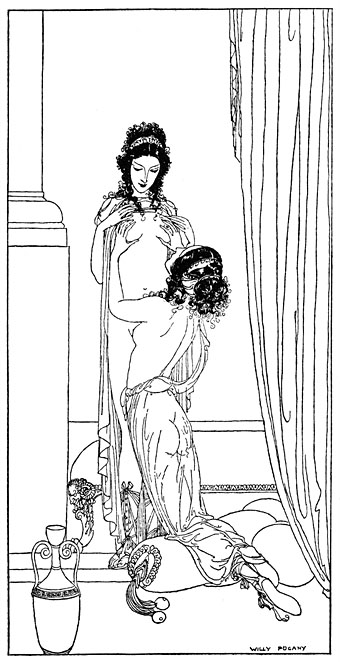
pogany.jpg

Willy Pogány’s erotica: illustrations for a 1926 edition of The Songs of Bilitis by Pierre Louÿs.

• Nicholas Lezard on David Lynch: director of dreams.

Did otherworldly music inspire Stonehenge?

Coilhouse has an Eyepatch Party.

Tanzmusik (1973) by Kraftwerk | The Model (1992) by the Balanescu Quartet | Trans Europe Express (2003) by the Wiener Sinfonie Orchestra & Arnold Schönberg Choir.