Lodela, a film by Philippe Baylaucq

lodela.jpg

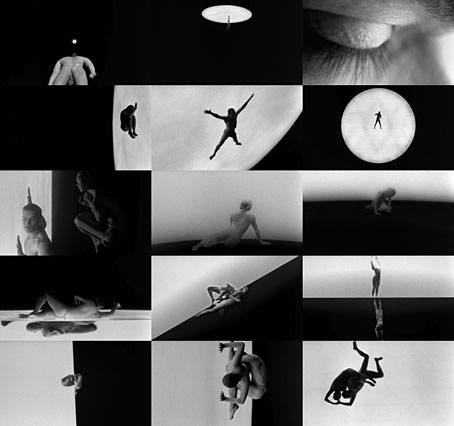
The soul leaves the body. Drawn by intense light, the spirit discovers its twin self, its feminine side…its guide in the beyond. Inspired by the myths of the afterlife, this allegorical dance piece illuminates the soul’s quest by exploring movement and the human body in new and astonishing ways. An evocation of the origins of the world. A hymn to the beauty of the human form. A celebration of movement.

Lodela (1996) was a production for the National Film Board of Canada, and in many ways it acts as a response to (or evolution from) an earlier NFBC film, Norman McLaren’s justly-celebrated Pas de Deux (1968). Both films depict an encounter between two dancers in an abstract black-and-white space; both films also take advantage of their medium to present dance in a manner that would be impossible on a stage. In McLaren’s film the dancers’ movements are multiplied via optical printing, a process that gives their gestures a liquid, hallucinatory grace.

For Lodela Philippe Baylaucq has his dancers (José Navas and Chi Long) situated on an illuminated circle surrounded by the dark, one side of which is shown in negative. He also does some simple things with the camera which are nevertheless strikingly effective and unusual in a dance piece, such as filming the dancers upside down, and attaching the camera to their bodies for dizzying close-ups. Choreographers (and dancers, for that matter) often get agitated if dancers’ bodies aren’t shown in full so this latter piece of direction is very unusual. Watch the film here. Pas de Deux, incidentally, is also on the National Film Board of Canada’s Vimeo channel, and in much better quality than earlier YouTube versions. Watch them together.

Previously on { feuilleton }
Pas de Deux by Norman McLaren
Norman McLaren

Weekend links 214

/sfsound.jpg

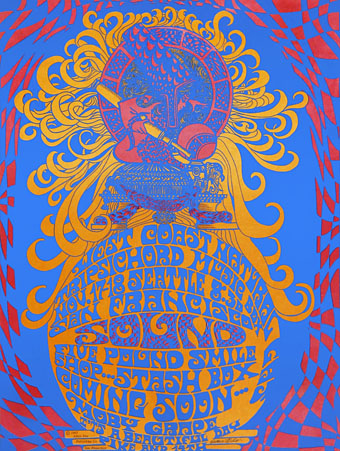
San Francisco Sound (1967). Art by Wallace Studio, Seattle.

• RIP gay porn pioneer Peter de Rome. BUTT posted de Rome’s surprisingly daring Underground (1972), a film in which two men have an unfaked sexual encounter on a New York subway train. That film and others are available on the BFI’s DVD collection. Related: Brian Robinson remembers a director of films whose supporters included Andy Warhol, William Burroughs and John Gielgud.

• “My stuff is implicitly critical of television as it is now,” explains Jonathan [Meades], “Television used not to be as openly moronic as it has become…” A lengthy and typically pugnacious Meades interview with Remy Dean.

Thurston Moore remembers the Burroughs-themed Nova Convention staged in New York in 1978. William Burroughs 100—Nova Convention is a retrospective exhibition running at Red Gallery, London, next month.

How are we expected to take seriously…any work which appears to have engaged less than the whole passionate attention of its author? To be fobbed off, at the last, with something which we feel to be less true than the author knew it to be, challenges the importance of the whole art of writing, and instead of enlarging the bounds of our experience, it leaves them where they are.

Katherine Mansfield was also a book reviewer.

• JG Ballard’s Crash is reissued in August by Fourth Estate with an introduction by Zadie Smith. There’s a tantalising extract from the intro at the NYRB or you can read the whole thing if you’re a subscriber.

• “Between 1959 & 1980 Shirley Collins changed the course of folk music in England & America. Thirty years after disappearing, she’s back.”

Photos by Anne Billson of one of the more attractive Parisian arcades. Related (in a flâneur sense): Christina Scholz‘s Vancouver dérive.

• “Why did Borges hate soccer?” asks Shaj Matthew. Related: George Orwell on the same subject.

• Mixes of the week: FACT mix 447 by Forest Swords, and Programme 13 from Radio Belbury.

• At Dangerous Minds: Roland Topor’s cheerfully violent illustrations from Les Masochistes.

• Rainy Day Psychedelia: Ben Marks on Seattle’s neglected 1960s poster scene.

• Strange Flowers looks at Oskar Schlemmer‘s Triadic Ballet designs.

• A Journey to Avebury: Stewart Lee interviews Julian Cope.

It’s All Over Now (1963) by The Valentinos featuring Bobby Womack | It’s All Over Now (1964) by The Rolling Stones | It’s All Over Now (1974) by Ry Cooder

Mannen kunst

wezenaar1.jpg

Landscape II (1994) by Rick Wezenaar.

Dutch photographer Rick Wezenaar writes that he’s now in business again after several years away from the field. Among his work there’s a substantial collection of male art photography featuring a variety of nudes and semi-nudes. Some of the models are dancers which will no doubt interest those who are always arriving here after searching for ballet boys. There’s also a call for new models if you’re in the Amsterdam area, and suitably photogenic.

wezenaar2.jpg

Wet (1995) by Rick Wezenaar.

Einstein on the Beach

einstein1.jpg

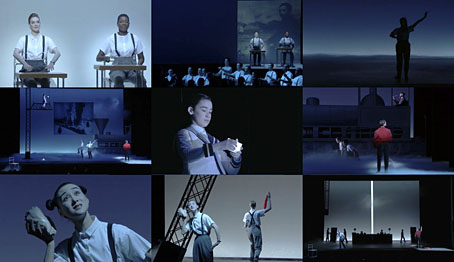
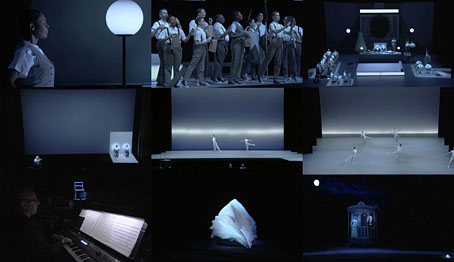
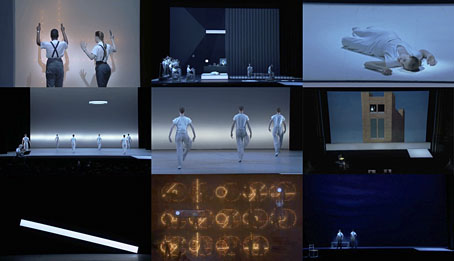
Well this was a revelation. Einstein on the Beach (1976) is Philip Glass’s first opera, a collaboration with theatrical producer Robert Wilson, and the only Glass opera with which I’m familiar. With a running-time of almost five hours it’s not light listening, and when many of the pieces consist of little more than slabs of keyboard or choral arpeggios it’s always been evident that visuals are required to augment music that otherwise threatens to outstay its welcome.

einstein2.jpg

The opera has been revived several times, and in 2012 a touring presentation was staged. Despite it being one of the most celebrated works by Glass and Wilson a complete performance has never been filmed, until this month, that is, a staging at the Theatre du Chatelet in Paris. The shots here are from a video stream of the entire four-and-a-half hour show, and it’s astonishing to discover how much your appreciation is elevated—and the music enhanced—by the performance and the production.

Einstein’s life is the ostensible subject but it’s up to the audience to interpret the many allusive symbols and motifs that may (or may not) be derived from either the man’s biography or his scientific theories. The libretto is strictly formal and fragmented, and while the score alone may drive some listeners to distraction the visuals change continually, maintaining the interest while the text and music work through their cycles. Philip Glass had this to say about the work in 2012:

The opera isn’t a narrative about Einstein’s life. What connected Bob and I was how we thought about time and space in the theatre. We worked first with the time—four hours—and how we were going to divide it up. Then we thought about the images, and then the staging. I discovered that Bob thinks with a pencil and paper; everything emerged as drawings. I composed music to these, and then Bob began staging it.

Yet the piece is actually full of Einstein. Practically every image comes from Einstein’s life or ideas: trains, spaceships, clocks. And I suggested we have a musician taking his part, because Einstein played the violin—although he was such an amateur musician he couldn’t possibly have played the music I composed for him. (more)

einstein3.jpg

I’ve seen many photos of Wilson’s designs for the opera in the past but static views do nothing to convey the drama and impact of his designs when you see them coming together on the stage. The same goes for the performers, many of whom are required to be trained dancers as well as actors: several scenes are elaborate dance pieces. It’s been a pleasure to see at last the presentation of the mysterious “Knee Play” sections which separate the four acts. And I was surprised by the similarity—intentional or not—of some sequences to the shots of the slaving workers in Fritz Lang’s Metropolis, especially the climactic (and incredible) “Spaceship” scene where the whole stage erupts into light and movement. It’s easy to see why New York’s art crowd were so beguiled by this opera following its first performances in the 1970s, it really is a remarkable piece of work. The streaming version will apparently remain active for a while (there’s also a DVD release planned), and while I wouldn’t want anyone to indulge in piracy I’ll note that there’s currently a torrent of the entire video circulating if you know where to look. If you’ve any time for Philip Glass I can’t recommend this too highly. (Via Metafilter.)

Previously on { feuilleton }
Milton Glaser album covers

Balanchine, Lynes and Orpheus

lynnes3.jpg

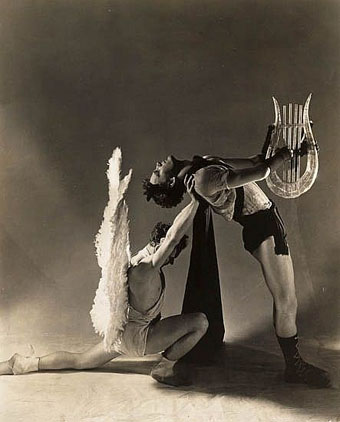
The photo above has appeared here before—it’s one of a number of dance photos taken by the great George Platt Lynes—but its subject has (for me at least) always been the source of some confusion. Since I dislike being nagged by petty conundrums I make a cursory search every so often to see if more details might be found. Five years ago all I knew was that the picture appeared in Philip Core’s Camp: The Lie that Tells the Truth (1984) where it was credited as showing dancers from Balanchine’s Icarus. Additional confusion was sown by a photo site showing the picture below with a statement that it was a) a Lynes photo (correct), and b) from Balanchine’s Die Fledermaus (wrong). No dates were given. The presence of a lyre made Orpheus seem a more likely subject: Balanchine wrote an Orpheus ballet for a Stravinsky score in 1948 but photos of that production showed very different dancers and costumes.

lynnes2.jpg

It turns out that these photos are indeed for a Balanchine ballet on the Orpheus theme, a short-lived production, Orpheus and Eurydice, from 1936 based on music from Gluck’s opera. The dancers are Lew Christensen, William Dollar and Daphne Vane. What’s most surprising now is having found a photo that’s almost but not quite the one from the Core book; photos from this session are elusive, with searches hampered by other photos taken by Lynes of Balanchine’s later ballets. There may be more in this series.

Pinterest is a good place to see more of Lynes’ photos which range from fashion shoots and celebrity portraits to moody, and occasionally surreal, homoerotica.

lynes1.jpg

lynes2.jpg

lynes3.jpg

Previously on { feuilleton }
The end of Orpheus
The recurrent pose 17
George Platt Lynes