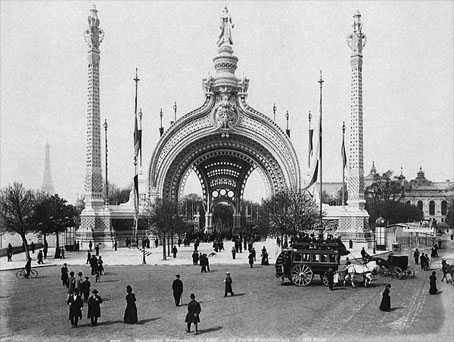
Exposition Universelle, 1900

exposition1.jpg

La porte monumentale.

Was the Paris Exposition of 1900 the most gloriously excessive of them all? Judging by these photos it certainly looks it. I should have linked to these earlier when I had a post about the Palais du Trocadéro which was one of the buildings raised for the occasion. The Eiffel Tower was built for the 1889 exposition (and was famously intended to be a temporary structure) but became the centrepiece of the 1900 fair. Wikipedia has a large plan of the entire layout and two of the halls, the Grand and Petit Palais, are still in existence and used as exhibition spaces.

Continue reading “Exposition Universelle, 1900”

Set in Stone

allchurch.jpg

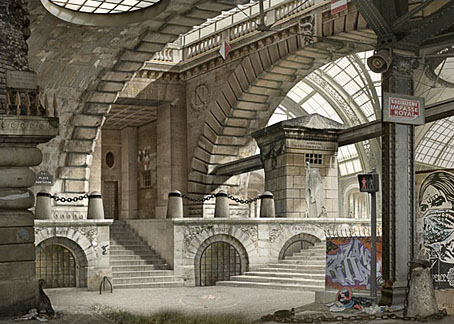
Urban Chiaroscuro 6: Paris (after Piranesi) (2007) by Emily Allchurch.

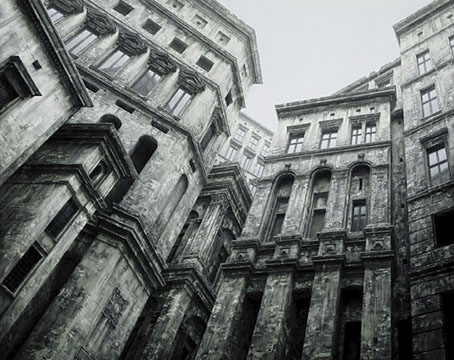
Pitzhanger Manor-House in Ealing, London, hosts an exhibition with architecture as its theme, a suitable subject given that the house was designed by notable 18th century architect (and friend of Piranesi) Sir John Soane. Artist Emily Allchurch has some meticulous and clever photo-collage reworkings of Piranesi on display while painter Stefan Hoenerloh—whose work I hadn’t seen before—is worthy of a dedicated post here seeing as he produces exactly the kind of imaginary architectural renderings I love. Some of his paintings could be colour views of similar scenes by Gérard Trignac.
hoenerloh.jpg

Via Subalterna (1990) by Stefan Hoenerloh.

Set in Stone runs from 28 March–26 April 2008.

Artists: Emily Allchurch, Stephen Carter, Michael Durning, Stefan Hoenerloh and Ben Johnson.

PM Gallery present the work of five artists who share a fascination in the power and importance of architecture, as an inspiration for works in paint and photography.

Emily Allchurch makes collages from many photographs to create a seamless new ‘view’, creating imaginary buildings or recreating buildings that no longer exist. A series of works, inspired by the 16th Century (sic) artist Giovanni Battista Piranesi’s ‘Carceri d’Invenzione’ (Imaginary Prisons), seamlessly constructs Piranesi’s original work but shows buildings constructed in a mass of architectural styles, complete with warning signs, CCTV cameras, razor wire and security mirrors to give a sense of foreboding and claustrophobia. In ‘Crystal Palace, (recomposed)’, she took what remains of the platform as a basis to recreate the palace, using architectural details of the period, such as at the Palm House at Kew Gardens and Paddington Station.

The detail of London’s Westway has been examined by Stephen Carter, with a series of paintings taken from photographs shot beneath the huge concrete flyover. Carter sees the Westway as representing both an escape for city dwellers to the beauty of the countryside and for country dwellers to get to the exciting heart of the city. But this optimism is tempered by the fact that the perspective is often viewed from below the Westway in a forgotten, uncelebrated and polluted part of the city.

Michael Durning’s beautiful paintings of neglected and broken monuments and buildings, question attitudes to Scottish heritage and culture. Often buildings are shown in relation to Scotland’s grand landscapes and unforgiving weather, reducing their prowess in the face of the natural environment.

German painter Stefan Hoenerloh creates monumental buildings with accurate, detailed architectural features, in oil and acrylic. The works appear photographic, but in fact are all invented by Hoenerloh. The buildings loom, often so large that the viewer is only able to see part of them within the frame of the picture. There is little sign of life in these structures, which appear old and weather-beaten, but solid in the face of everything they have withstood over the years since they were built.

Ben Johnson paints calm, often majestic interiors and large city panoramas. Although painted in meticulous detail, Johnson ‘ investigates’ the built space, to create far more than simple photo-realism, allowing the viewer to gain an intense experience of the presented space. Here we show work dating from 1973 to 2007.

Elsewhere on { feuilleton }
• The etching and engraving archive
• The fantastic art archive

Previously on { feuilleton }
• The art of Gérard Trignac
• Aldous Huxley on Piranesi’s Prisons
Jessie M King’s Grey City of the North

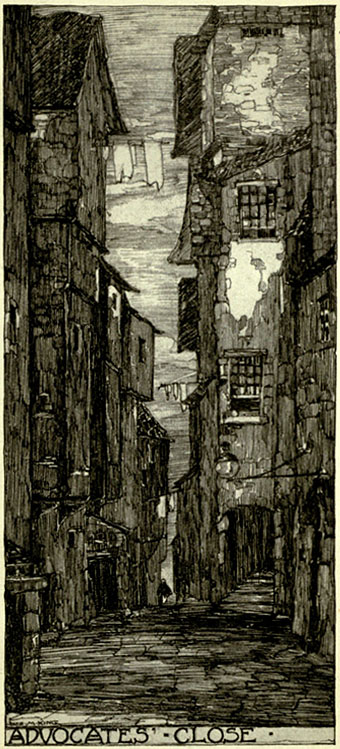
advocates.jpg

“This dark and steep alley took its name from Sir James Stewart of Goodtrees, Lord Advocate of Scotland, 1692–1713, whose mansion stood at the foot of the close. It was a fashionable quarter in the early 18th century, and here resided Andrew Crosby, the famous lawyer, the original of Scott’s ‘Andrew Pleydell,’ Lord Westhall, John Scougall, the painter of George Heriot, and many well-known people of the time.”

Another book scan from the Internet Archive, this time a title which plays to my fetish for Old Edinburgh. The illustration work of Jessie M King (1875–1949) was featured here in September with a delicate piece from A House of Pomegranates by Oscar Wilde. The Grey City of the North (1910) is quite a departure from her usual style, being a collection of monochrome views of buildings, streets and closes of the Old Town. Very nice lettering on all the plates which perhaps shows some influence from her colleague Charles Rennie Mackintosh.

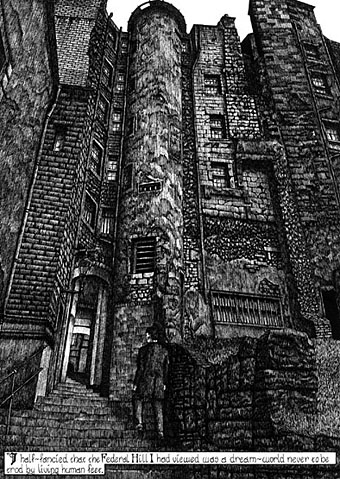
Advocates’ Close has particular significance for me since I copied a view of the alley for my adaptation of HP Lovecraft’s The Haunter of the Dark in 1986. Providence looks nothing at all like Edinburgh, of course, but I couldn’t find adequate reference at the time so used photographs of Scotland by Edwin Smith instead. You can see Smith’s photograph and my rendering of it below. Among the Internet Archive’s other Jessie King books there’s a follow-up to the Edinburgh volume, The City of the West; 24 drawings in photogravure of Old Glasgow.

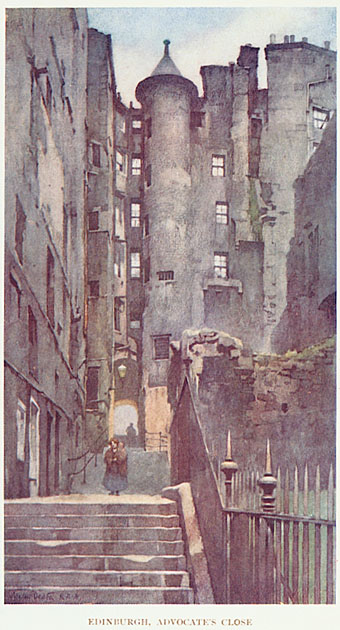
advocates2.jpg

Another view of the close from Edinburgh and The Lothians by Francis Watt; illustration by Walter Dexter (1912).

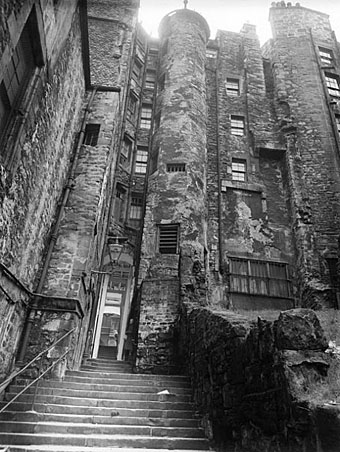
advocates3.jpg

Advocates’ Close by Edwin Smith from Scotland (1955).

This book of photographs was an early Thames & Hudson title using their typically excellent photogravure reproduction. My copy was rescued from a waste bin near Manchester University and I’ve used it so much for reference over the years I’ve often wondered what I would have done without that chance encounter. You can see from my copy below (drawn with a 0.2mm Variant pen) how much detail I skimped and how much I embellished. I skimped rather more than I remember, as it happens. I think if I’d have drawn this a couple of years later I might have been more faithful to the original.

advocates4.jpg

Elsewhere on { feuilleton }
• The illustrators archive

Previously on { feuilleton }
• Ephemeral architecture
• The Essex Street Water Gate

Bruges-la-Morte

rodenbach.jpg

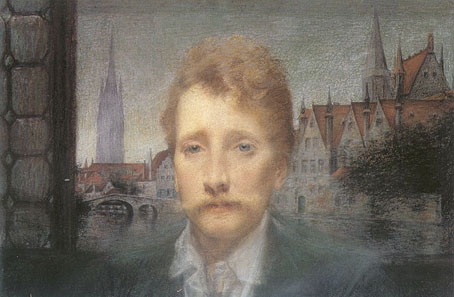
Portrait of Georges Rodenbach by Lucien Lévy-Dhurmer (1895).

Georges Rodenbach’s short, atmospheric novel is one of the key texts of Symbolism, not only for its themes but also for the art it either inspired or complemented. Bruges-la-Morte was first published in 1892 and the recent Dedalus Books edition, edited by Alan Hollinghurst and with a new translation by Mike Mitchell and Will Stone, was reprinted late last year.

Bruges-la-Morte…concerns the fate of Hugues Viane, a widower who has turned to the melancholy, decaying city of Bruges as the ideal location in which to mourn his wife and as a suitable haven for the narcissistic perambulations of his inexorably disturbed spirit. Bruges, the ‘dead city’, becomes the image of his dead wife and thus allows him to endure, to manage the unbearable loss by systematically following its mournful labyrinth of streets and canals in a cyclical promenade of reflection and allusion. The story itself centres around Hugue’s obsession with a young dancer whom he believes is the double of his beloved wife. The consequent drama leads Hugues onto a plank walk of psychological torment and humiliation, culminating in a deranged murder. This is a poet’s novel and is therefore metaphorically dense and visionary in style. It is the ultimate evocation of Rodenbach’s lifelong love affair with the enduring mystery and haunting mortuary atmosphere of Bruges.

Continue reading “Bruges-la-Morte”