Alexey Titarenko

titarenko.jpg

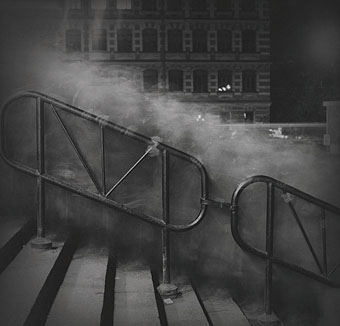
Untitled (Crowd 1) (1993).

Like Atta Kim, Alexey Titarenko makes use of time-lapse and/or multiple exposure in his photographs. Of the two I prefer Titarenko’s work, not least because of his moody and spectral evocations of the streets of Havana and St Petersburg. His blurring of human figures takes on a sinister cast with the Time Standing Still and City of Shadows series which turn mundane Russian crowds into a parade of ghosts from a Gogol nightmare.

Via Ze Frank.

Previously on { feuilleton }
• Abelardo Morell’s camera obscura
• Eugene de Salignac
• Atta Kim: On-Air
The ruins of Detroit

detroit1.jpg

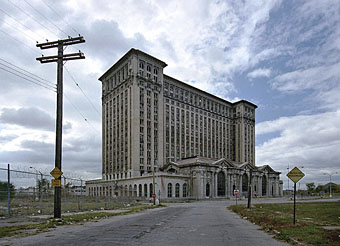
Michigan Central Station.

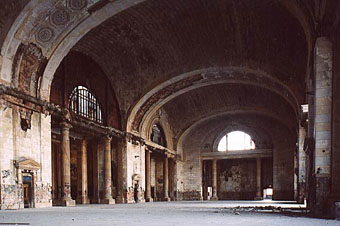
Photos from Yves Marchand & Romain Meffre (above) and Forgotten Detroit (below), the latter being an extensive catalogue of urban dereliction.

detroit2.jpg

The station waiting room.

Update: Environmental Graffiti today has a post speculating which American cities might be the lost cities of the future. Detroit is number three; go here to see which others they choose.

Previously on { feuilleton }
• Ephemeral architecture
• The temples of Angkor
• St Pancras in Spheroview
• Adolph Sutro’s Gingerbread Palace
• Hungarian water towers

Atelier Elvira

elvira1.jpg

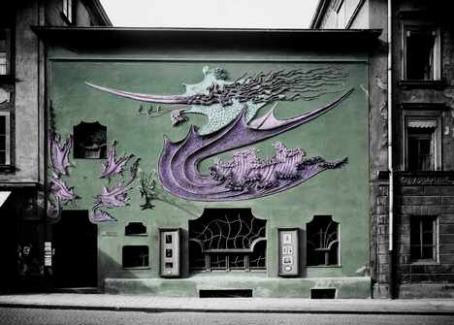
Atelier Elvira (1897-98).

Seeing as there’s been a run of Art Nouveau-related posts here it’s worth mentioning a location that’s familiar to students of the Jugendstil but less well-known to the world at large. August Endell’s Atelier Elvira was a Munich studio building whose exterior decoration of a very stylised dragon creature manages to be even more exaggerated than similar work by Antoni Gaudí. Munich was the centre of German arts and crafts and produced much home-grown Art Nouveau but this eruption of bizarre plasterwork in an otherwise mundane street was still surprising. The façade was painted green, as in the tinted photo above, and the dragon painted different colours each year, yellow, red and so on.

elvira3.jpg

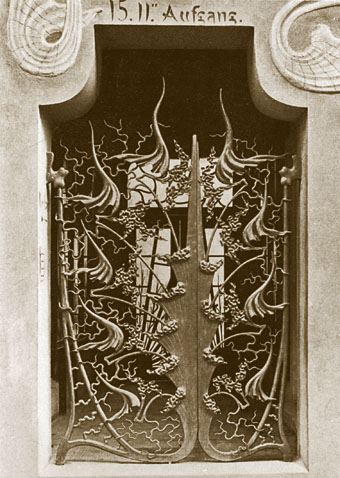
The ironwork street entrance.

Needless to say, not everyone looked upon this kind of challenging décor favourably. In 1937 the Nazi Oberbürgermeister complained about the “hideous façade disrupting the character of the rest of the street” and had the dragon design chipped off the wall. Allied bombs did for the rest a few years later so these pictures are all that we have left.

Continue reading “Atelier Elvira”

The Palais Lumineux

lumineux.jpg

A final visit to the Exposition Universelle of 1900 with this photograph of the Palais Lumineux, a piece of period Chinoiserie built in the Champ de Mars close to the Eiffel Tower. I forget where I found this tinted view but Wikipedia has what appears to be the same photograph coloured so as to resemble a night scene.

Previously on { feuilleton }
• Louis Bonnier’s exposition dreams
• Exposition Universelle, 1900
• The Palais du Trocadéro
• The Evanescent City
• Winsor McCay’s Hippodrome souvenirs

Louis Bonnier’s exposition dreams

bonnier1.jpg

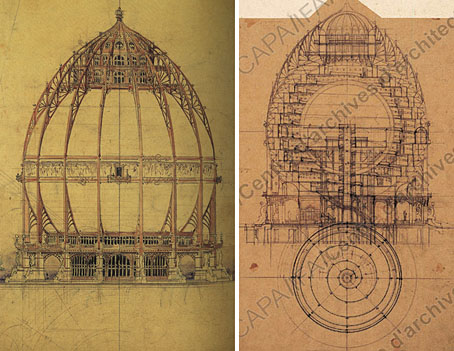
Globe terrestre.

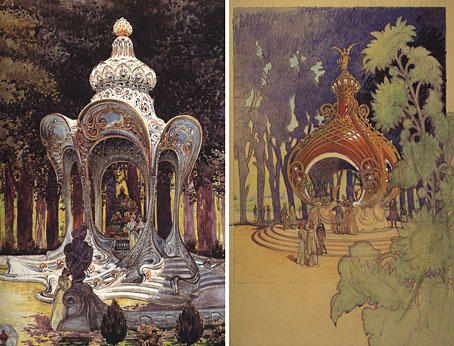
More exposition mania. The Paris Exposition Universelle of 1900 would have been more grand/fabulous/excessive (delete as appropriate) if architect Louis Bonnier had been given free reign. The building above was intended to stand before the Palais du Trocadéro and house a huge globe which visitors could peruse from surrounding galleries. Bonnier also designed a series of kiosks (below) for different exhibitors which look more like over-sized Art Nouveau ornaments than pieces of architecture.

Three of these pictures are scanned from a book; the only site I found with examples of Bonnier’s work was this one which unfortunately spoils the pictures with enormous watermarks.

bonnier2.jpg

Exposition kiosks.

Previously on { feuilleton }
• Exposition Universelle, 1900
• The Maison Lavirotte
• The Palais du Trocadéro