The art of Sydney R Jones, 1881–1966

jones1.jpg

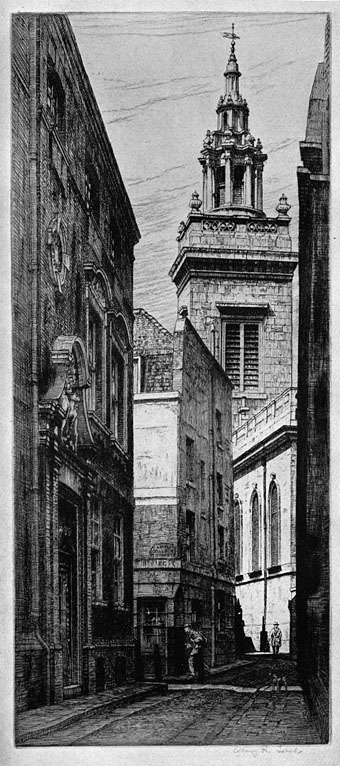
Church of St Michael Paternoster Royal and Innholder’s Hall (1927).

One of the better secondhand book discoveries of the past couple of years was London Triumphant, a collection of etchings and pencil drawings of the city’s streets and buildings by Sydney R Jones. The etchings immediately seized my attention, being the kind of closely-hatched architectural renderings which I enjoy, but the book as a whole is very good as it details the artist’s wanderings with a young student friend through the city. Jones established himself as an illustrator of books with titles like The Manor Houses of England and The Charm of the English Village. His London book appeared in July 1942 and collected many of his earlier views of the city as a deliberate morale boost for the populace who were watching the capital’s historic buildings yield to the bombs of what he calls “the foul Hun”. Jones catalogues the destruction with dismay as he recounts the history of the city from Roman times but ends on a note of defiant optimism, wondering what new metropolis might rise from the destruction. He mentions in passing that cult locale of mine, the Essex Street Water Gate, but doesn’t provide a drawing unfortunately. The book proved to be very popular, and the copy I found is a fifth printing from 1947.
jones2.jpg

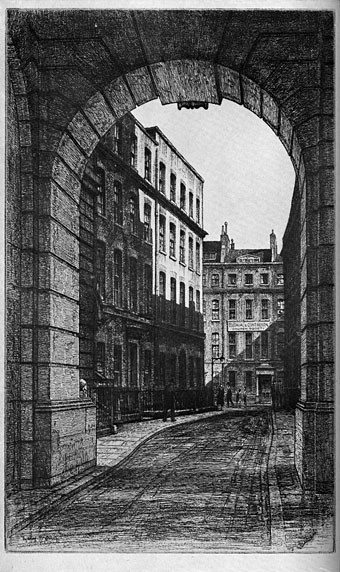
Serjeant’s Inn, Fleet Street (1926).

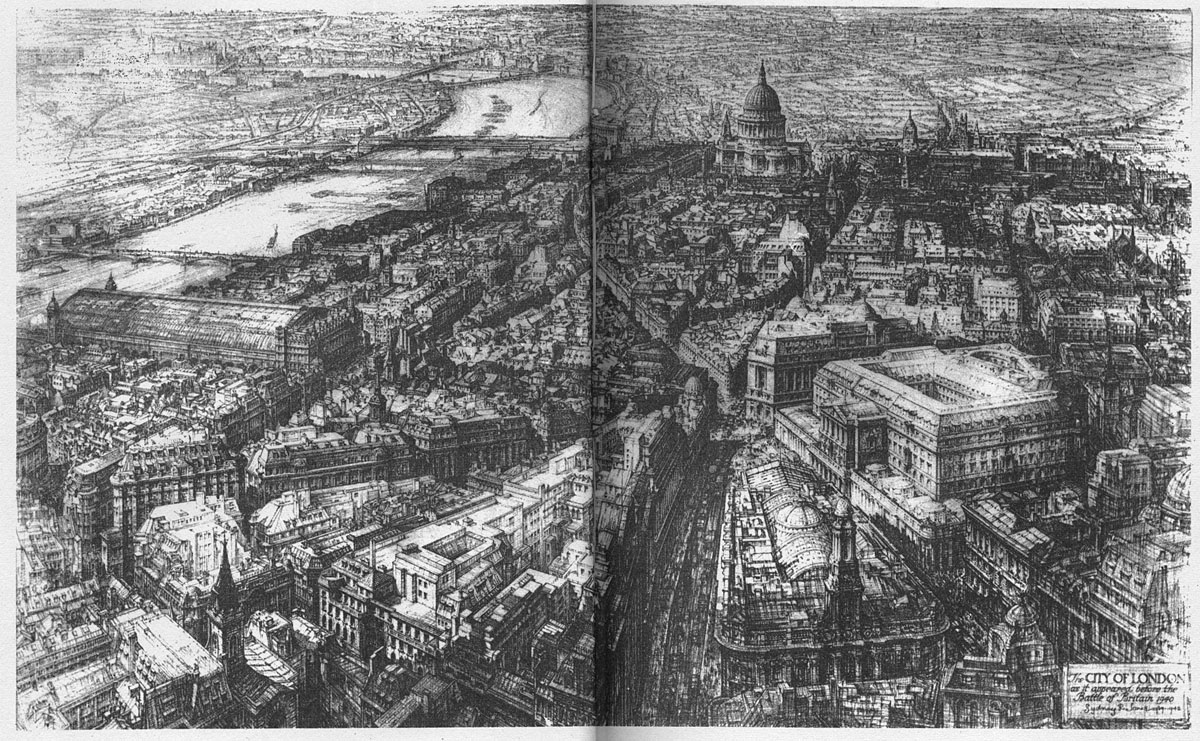
This week’s book purchase was a welcome find, then, being London Triumphant‘s sequel, Thames Triumphant, in which Jones follows the course of the river from its spring at Coberley, through Oxford and on down to Greenwich. There aren’t as many dramatic views this time, and many of the country scenes have that kind of polite blandness about them which you find in much book illustration of the period. But Jones does provide a couple of his speculative and spectacular views over the city, including the one below which shows the City of London as it was in 1939. Much of the foreground was bombed flat during the war so a drawing such as this provides a valuable record of how London’s financial centre looked before the arrival of the Luftwaffe and the office blocks. Jones lived to see much of the subsequent reconstruction—I can’t help but wonder what he made of it all.
city.jpg

The City of London, 1939; click for a bigger view.

Elsewhere on { feuilleton }
• The etching and engraving archive
• The illustrators archive

Previously on { feuilleton }
• Pite’s West End folly
• Jessie M King’s Grey City of the North
• Architectural renderings by HW Brewer
• The Essex Street Water Gate, London WC2
Drowned worlds

rockman1.jpg

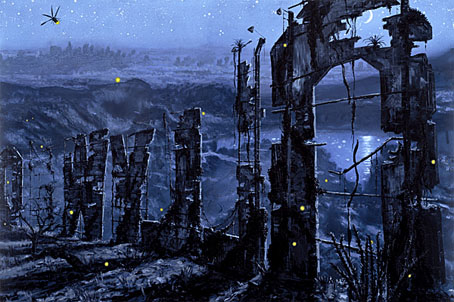
Hollywood at Night (2006).

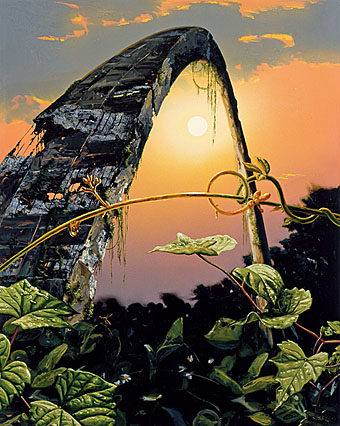
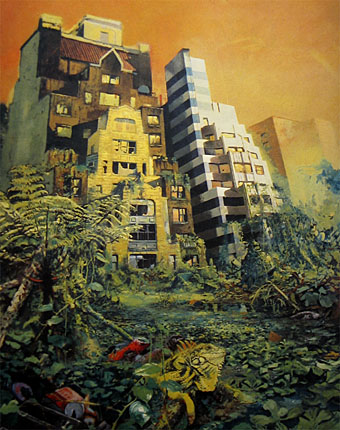
Alexis Rockman‘s paintings of swamped or ruined American landmarks present views which are a novelty in contemporary art galleries whilst being very familiar to science fiction readers. Many of these could well be illustrations for JG Ballard’s 1981 novel, Hello America, which imagined a depopulated United States reclaimed by flora and fauna. Others would suit The Drowned World, of course, and they bear favourable comparison with Dick French’s illustrated edition (below) which was also published in 1981.

rockman2.jpg

Gateway Arch (2005).

Rockman’s hothouse atmospheres remind me of earlier paintings of Brazilian wildlife by another American artist, Martin Johnson Heade (1819–1904), many of whose tropical landscapes only require a distant ruin or two to match Rockman’s work. (Tip via Design Observer.)

french.jpg

The Drowned World by Dick French (1981).

While we’re on the subject, Ballardian has posted the first of three features about my colleagues at Savoy Books, beginning with a Michael Butterworth interview which discusses some of Ballard’s connections with Savoy. One of the subsequent posts should see yours truly discussing the visual dimension of the Savoy world. More about that later.

Previously on { feuilleton }
• The coming of the dust
• Ballard and the painters

The coming of the dust

sydney1.jpg

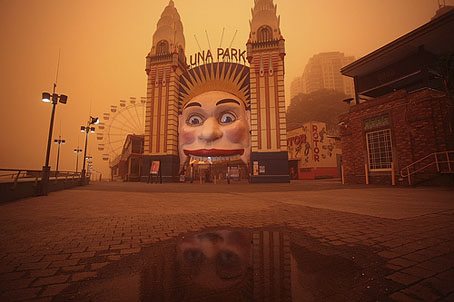
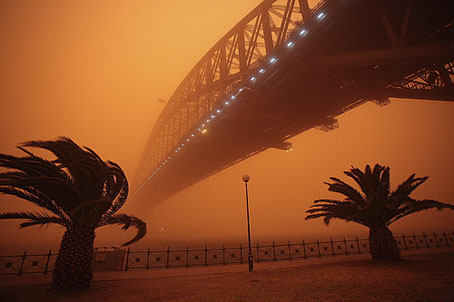
Impossible to avoid thoughts of either JG Ballard or various apocalyptic horror and science fiction scenarios when looking at these photos of Sydney, Australia, taken a few hours ago. A cloud of red dust passed over the city in the early morning and the depopulated views only add to the eerie atmosphere. These are from a Red Dust Flickr gallery. The Other Andrew writes about the inundation on his blog. I’m looking forward now to the reaction of another Sydney Melbourne resident, Simon Sellars, who runs Ballardian.

Update: The Red Sydney Project—Dust Storm Days

sydney2.jpg

Previously on { feuilleton }
• Apocalypse now

Echoes of the Cities

echo1.jpg

Mysterieux retour du Capitaine Nemo.

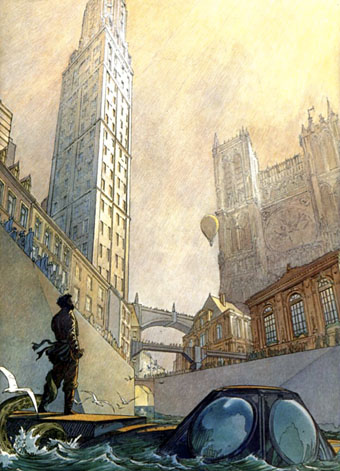
This week has been incredibly hectic work-wise but I’ve managed to keep these posts going, so here’s the last one devoted to an appreciation of the Cités Obscures of François Schuiten and Benoît Peeters. A week of posts barely scratches the surface of their vast and involved creation of alternate worlds, fantasy design and architecture, and Borges-like metaphysical speculation. When I try to explain my disaffection with the popular end of American comics, it’s works such as these which I offer as an alternative. The problem, of course, is that only a handful of the books have been translated into English, a detail which tells you all you need to know about English-speaking comics publishers and—since demand fuels the market—their readers.

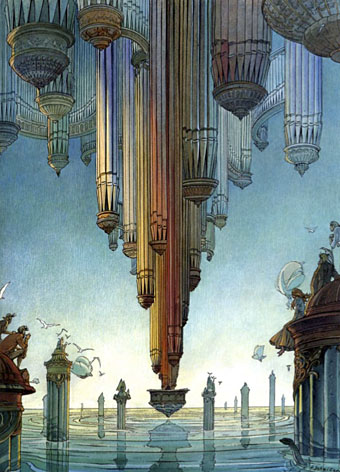
This final set of pictures is a selection from Schuiten and Peeters’ L’Echo des Cités (1993), a facsimile edition of the main newspaper which serves the cities of the Obscure World. Unfortunately, this remains untranslated but the bulk of the book is full-page illustrations, many of which are among Schuiten’s best. A number of these were later reprinted as limited lithograph prints.

echo2.jpg

Les rêves engloutis d’Oscar Frobelius.

Continue reading “Echoes of the Cities”