The art of William T. Horton, 1864–1919

horton01.jpg

After mentioning William T. Horton last week I went looking for more of his artwork. The Internet Archive has a book I hadn’t seen before, William Thomas Horton: A Selection Of His Work by Roger Ingpen, but this has been uploaded with all the pages upside-down, a novel error even by the erratic standards of that site. I can correct things like this by downloading all the page scans then batch-rotating them using the Mac’s Automator application but few people would bother doing this (or know how to).
horton02.jpg

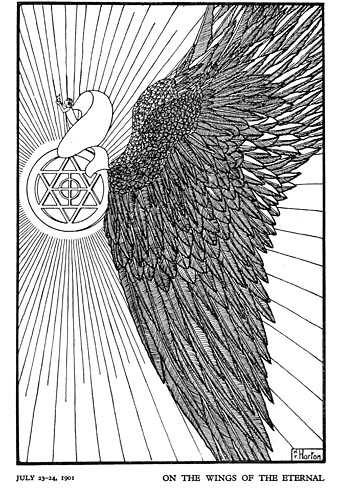
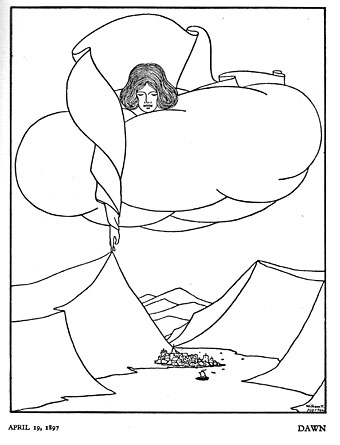
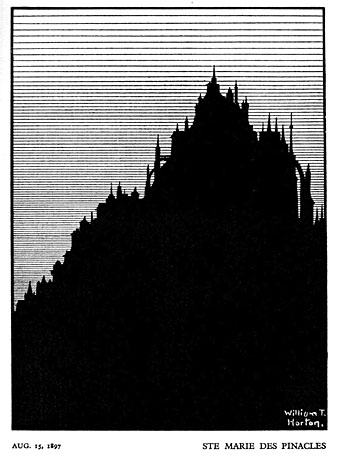
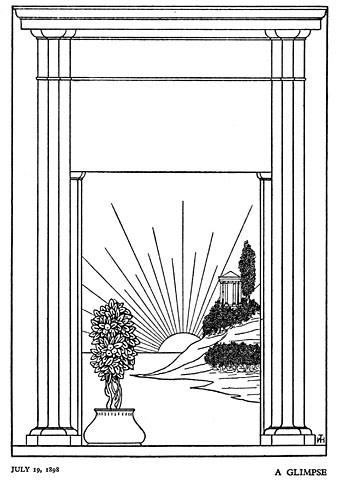
Happily, Wikimedia Commons has most of the artwork in a substantial Horton gallery. Horton never achieved the popularity of his contemporaries so if you’re not a book collector his art hasn’t always been easy to find. Some of his drawings can be crude or amateurish but at his best he had a flair for hieratic, mystical compositions in black-and-white that makes him a kind of British equivalent to Ephraim Moses Lilien. The Wikimedia gallery includes a section that purports to be Horton’s designs for a set of Tarot cards but I’m sceptical of the attribution. The drawings may have the names of the Major Arcana appended to them but all of the drawings (like the one below) appear to have been created for other reasons.

horton03.jpg

horton04.jpg

horton05.jpg

Continue reading “The art of William T. Horton, 1864–1919”

Weekend links 655

brauner.jpg

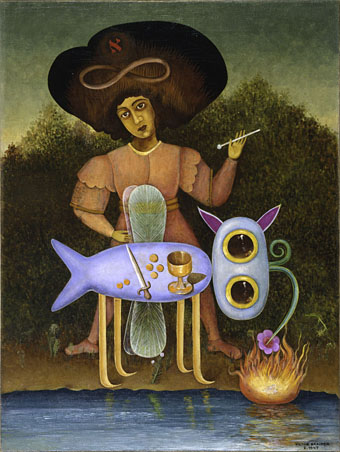
The Surrealist (1947) by Victor Brauner.

• At Dennis Cooper’s: Terry Ratchett presents…18 needlessly obscured avant-garde films by Thomas White, Teinosuke Kinugasa, George Barry, Standish Lauder, Helge Schneider, Dusan Makavejev, Oliver Herrmann, Mauricio Kagel, Mamoru Oshii, Gian Carlo Menotti, Pat O’Neill, Vera Chytilová, Shozin Fukui, Willard Maas, Djouhra Abouda and Alain Bonnamy, Juraj Herz, and Jay Schlossberg-Cohen.

• “When I’m convinced that a certain type of book is completely beyond the capacities of my temperament and my technical skills, I sit down at my desk and start writing it.” Italo Calvino discussing his approach to writing in 1983. The essay, The Written World and the Unwritten World, gives its title to a collection of previously unavailable Calvino pieces translated by Ann Goldstein. John Self reviewed the book.

• New music: Komplett Kollaps (A Dedication To Jóhann Jóhannsson) by Rúnar Magnússon, and Composition 1 by Deathprod.

Brann’s new book sweeps across the vast range of things that hold her interest. It thus invites us to enjoy the life of the mind and to live from our highest selves. A thoughtful encounter with this book will make you, I swear, a better person. The book includes chapters on Thing-Love, the Aztecs, Athens, Jane Austen, Plato, Wisdom, the Idea of the Good. The first half provides an on-ramp to the chapter titled “On Being Interested,” which falls in the dead centre of the book. This central chapter serves as more than a cog in the wheel: it is an ars poetica. Addressing issues of attention, focus, and interest itself, as well as how and where to deploy these functions throughout our lives, “Being Interested” offers a solution for any seeker intrigued by the notion that happiness is not an accident but a vocation. Brann characterizes the pursuit of happiness as “ontological optimism […] to be maintained in the face of reality’s recalcitrance.”

Peggy Ellsberg reviewing The Habit of Interestedness by Eva Brann

• “God told me I should take more LSD.” Sari Soininen on her acid-induced photographs.

• At Public Domain Review: The Procession of the Months by Walter Crane.

• At Smithsonian Magazine: See the chilling beauty of winter on Mars.

• Steven Heller’s font of the month is Edie & Eddy Slab.

• RIP Michael Snow, film-maker and musician.

Kollaps (1981) by Einstürzende Neubauten | Feed The Collapse (1992) by Main | Collapsing Inwards (2014) by Jóhann Jóhannsson

Weekend links 654

crm.jpg

Drawing for a New Year’s Card (c. 1900) by Charles Rennie Mackintosh.

• “Almanacs appealed to the perennial lust for wonder and weirdness in the world. They were the fantastic literature of the day.” Mark Valentine on English Almanacs 1500–1800. Reading this had me wondering whether Old Moore’s Almanac is still being published. Yes, it is.

• “Meet the designer of the fanciful subway entrances to the Paris Métro.” Susannah Gardiner on the architecture, design and anarchist philosophy of Hector Guimard.

• “Apocalypse is not alien to HR Giger,” says Steven Heller, reviewing Atomkinder, a book of the artist’s early cartoons for which he also provided an introduction.

• “Nabokov loved film, hopelessly.” Luke Parker on a short poem, The Cinema (1928), from Vladimir Nabokov’s Berlin years.

• From Loki to Behemoth: waves of the English coastline photographed by Rachael Talibart.

• Mix of the week: Winter Solstice 4: “In C” by ambientblog.

• At Dennis Cooper’s: Grace Zabriskie Day.

Atom Sounds (1978) by Jackie Mittoo | Atom Blaster (1985) by Vangelis | Atomic Buddha (1998) by Techno Animal

The Dillons at Caedmon

dillons18.jpg

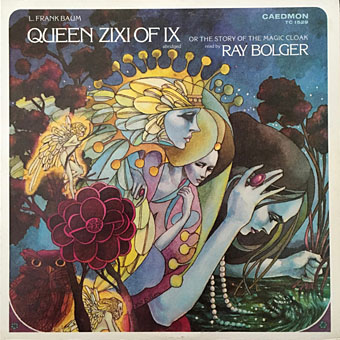
L. Frank Baum: Queen Zixi Of Ix (Or The Story Of The Magic Cloak) Read By Ray Bolger (1977).

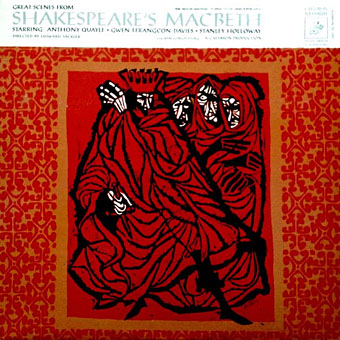
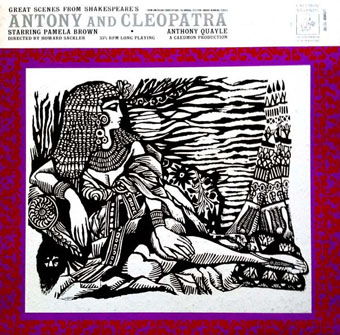
There’s a lot you could write about illustrators Leo and Diane Dillon. They were very prolific for a start, creating many book covers and interior illustrations in a variety of styles and different media. They also maintained a long-running association with Harlan Ellison whose praise for the pair was never less than fulsome. Like Bob Pepper and other versatile illustrators, they created art for album covers as well as books, with regular commissions from Caedmon Records, a label that specialises in spoken-word recordings.

dillons12.jpg

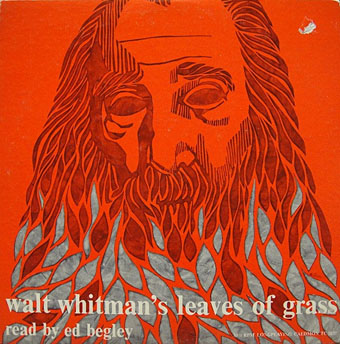
Walt Whitman’s Leaves Of Grass Read By Ed Begley (1959).

During the time the Dillons were working for Caedmon most of the label’s releases were on vinyl, a format that tended to restrict the readings to poetry, short stories or extracts from novels and plays. The format was limited for writers and listeners but beneficial for book illustrators, giving them a larger canvas to work on. These examples are a small selection of the Dillons’ output, more of which may be seen at Discogs. Not everything on Caedmon looked this good. I used to own the David McCallum reading of The Dunwich Horror, an album whose cover art was so amateurish it might have been drawn by Wilbur Whateley himself. The Dillons’ cover for The Rats in the Walls is much better, with a gnawing figure that resembles the woodcut-style illustrations the pair created for Harlan Ellison’s Dangerous Visions anthologies. I’ve never read anything about the Dillons’ techniques so can’t say whether their woodcut style was a product of actual wood engraving rather than linocut, a more convenient medium. I’d guess the latter since the end results look pretty much the same, but if anyone knows the answer then please leave a comment.

dillons01.jpg

The Stories Of Kafka Read By Lotte Lenya (1962).

dillons07.jpg

Great Scenes From Shakespeare’s Macbeth: Anthony Quayle, Gwen Ffrangcon-Davies, Stanley Holloway (1962).

dillons06.jpg

Great Scenes From Shakespeare’s Antony And Cleopatra: Pamela Brown And Anthony Quayle (1963).

Continue reading “The Dillons at Caedmon”

The Ravening Deep

ravening.jpg

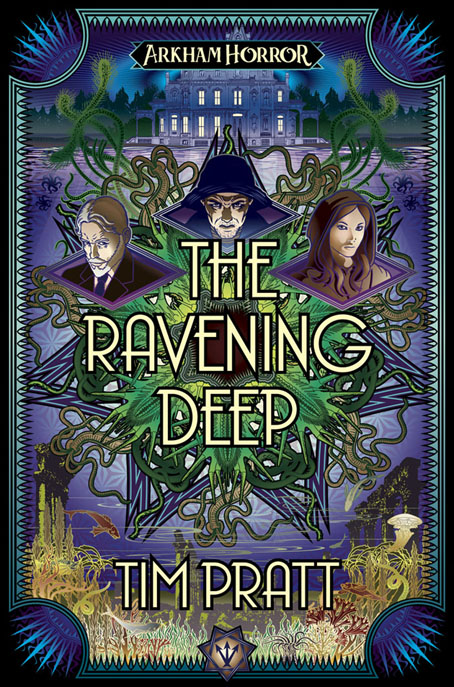
Presenting my latest cover in the Arkham Horror spin-off series for Aconyte. The Lovecraftian menace this time is oceanic:

When dissolute fisherman Abel Davenport discovers an ancient temple in the deep ocean, he falls under the influence of a long dead god. In his attempts to restore the god’s cult, Abel unleashes a plague of twisted doppelgangers on Arkham. Horrified by the consequences, Davenport realizes that he alone cannot stop the monsters from resurrecting the Ancient One.

Sometimes the only way to end one cult is to start another… Teaming up with redeemed cultist Diana Stanley and notorious thief Ruby Standish is the first step. The second is convincing Carl Sanford, the powerful leader of Arkham’s Silver Twilight Lodge, to join their cause. Together they might be the only hope of averting a cataclysmic eldritch invasion.

This was more of a challenge than some of my earlier covers for the series since there was a lot to fit in. That star shape in the background is an interlaced pattern like the sigil underneath the author’s name but it ended up being covered over, something I wasn’t intending but I always let these things grow organically rather than try and force everything into a preconceived design. As before, everything has been put together in Illustrator which presents its own challenges when you’re trying to achieve Photoshop-style airbrush effects. I like the way Illustrator restricts the graphical treatment to shapes, colours and hard edges, something which is perfect for these Deco-style covers. With Photoshop there’s always the temptation to start making everything more like a painting. A few of the aquatic details are adapted from Maurice Verneuil’s L’Animal dans la Decoration (1897), a book for artists showing stylised treatments of various animals and plants. I’ve had Verneuil’s book for a while as a Dover reprint but never found much use for it before.

This isn’t the last cover I’ve done this year, there’s another one still to be made public but it won’t be ready now until early in the new year. The Ravening Deep will be published in August 2023.

Elsewhere on { feuilleton }
The Lovecraft archive

Previously on { feuilleton }
Diamonds
The Devourer Below
Litany of Dreams
The Last Ritual