Steampunk Horror Shortcuts

steampunk.jpg

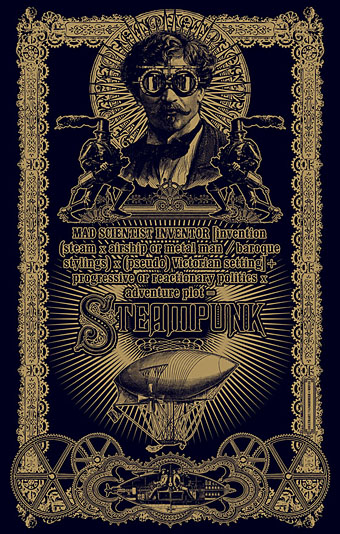
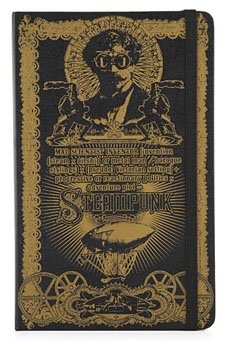
steampunk2.jpgTime again for some work updates and other news. I mentioned in August that this Steampunk design—created to illustrate a formula definition of the genre by Jeff VanderMeer—was originally going to be a T-shirt. That idea fell by the wayside when an opportunity arose to submit it to Modofly who were asking for Steampunk-related work for a new line of their laser-etched Molekin books.

I’m pleased to announce that the books are now done and on sale at the Modofly store. These are available in two sizes, large (5.25ins x 8.25ins; 13.3cm x 20.9cm) and small (3.5ins x 5.5ins; 8.9cm x 13.9cm), $36 USD and $22 USD respectively.

penny_blood.jpg

Next up is issue 11 of Penny Blood, an American horror magazine due out shortly which includes a feature on David Britton’s Lord Horror character and runs through the often tormented history of Savoy Books. Savoy’s Mike Butterworth and I were both interviewed and the piece should also include some comments from Keith Seward whose Savoy title, Horror Panegyric, examines the Lord Horror mythos. They don’t say yet when the magazine is out but it’s available for pre-order now.

While we’re on the subject of his lordship, I recently updated my pages for the Reverbstorm comics with a lot more samples taken from the re-scanned and re-lettered artwork. Work is still progressing on assembling the definitive single-volume edition of Reverbstorm as time permits. I’ve finished work on all seven published issues and am now engaged with the eighth and final section. More about that, and Reverbstorm itself, at a later date.

shortcuts.jpg

Finally, there’s another new CD design out, my fourth this year and there are more on the way; I’m starting to feel prolific. As can be seen from the cover, this was a very minimal job. A Made Up Sound is a pseudonym of Dave Huismans, aka 2562, whose excellent Aerial album I also designed. Shorctuts is a collection of electronic sketches and Dave took the moodily anonymous photographs himself.
Welcome to Mars

welcometomars.jpg

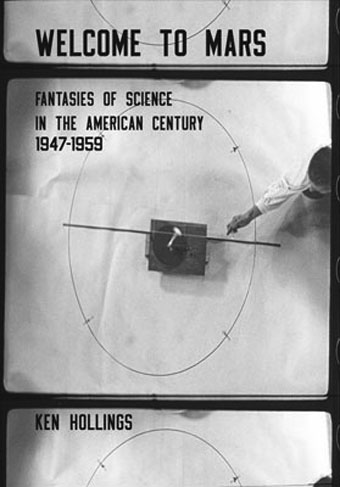
Arriving today—and barely surviving the postman’s attempts to cram it through the letterbox—is the latest volume from Strange Attractor, Welcome to Mars by Ken Hollings. I’m really looking forward to reading this since it touches on areas of interest which span the development of Cold War technologies to pulp science fiction, examining the interconnections between these disparate zones; most histories of the period prefer to stay in one area or the other. A glance at the chapter titles immediately pushes my buttons: “1947 Rebuilding Lemuria”, “1951 Absolute Elsewhere”. If all that wasn’t enough there’s an intro by Erik Davis and the first 250 copies come with a CD of “classy analogue Outer Space exotica” by Simon James. Order from the SA Shoppe and get a free postcard!

Welcome to Mars is a map of the post-war Zone, a non-fiction Gravity’s Rainbow that follows the arc of Germany’s V2 rocket to the end of the rainbow – to America.’ Erik Davis

Welcome to Mars is an iconoclastic, penetrating and darkly humorous history of America from 1947-1959, the decade in which the nation defined its image and created the blueprint for the world we live in today.

Welcome To Mars draws upon newspaper accounts, advertising campaigns, declassified government archives, old movies and newsreels from this unique period when the future first took on a tangible presence. Ken Hollings depicts an unsettled time in which the layout of Suburbia reflected atomic bombing strategies, bankers and movie stars experimented with hallucinogens, brainwashing was just another form of interior decoration and strange lights in the sky were taken very seriously indeed.

Seamlessly interweaving developments in technology, popular culture, politics, changes in home life, the development of the self, collective fantasy and overwhelming paranoia, Hollings has produced an alarming and often hysterically funny vision of the past that would ultimately govern all of our futures.

“Ken Hollings shows brilliantly how the extraordinary web of technologies that drove the Cold War have shaped not just our culture but the very way we think of ourselves as human beings. Welcome to Mars offers a rare and fascinating glimpse of the roots of the strange humanoid culture we live in today.” Adam Curtis

‘Ken Hollings has placed his critical focus at the precise point where the high technologies of information control and social manipulation intersect the passionate search for scientific ways to probe the human mind. Welcome to Mars is a searingly accurate and deeply disturbing exposé of the fantasies of American modernism that have inspired the many nightmares and the few hopeful visions of our new Millennium.’ Dr Jacques Vallée

Previously on { feuilleton }
SAJ again
Strange Attractor Journal Three
How to make crop circles

Coulthart Calendar 2009

calendar1.jpg

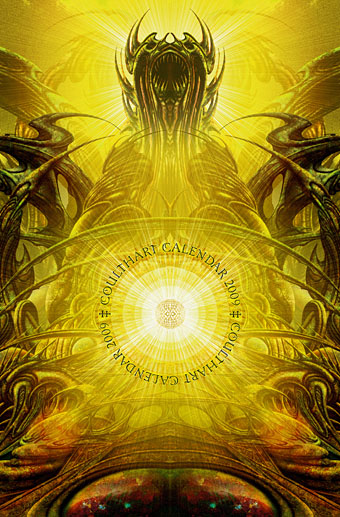
I’ve been a bit late with the new calendar this year but it’s finally available at CafePress. I’ve also been somewhat remiss in reusing last year’s pages rather than uploading new ones. Preparing 12 pages of art takes time even if you’re using old images—they have to be the right dimensions, after all—and I’ve been preoccupied this year with too many other things. So while the cover is new (based on this HP Lovecraft-derived picture), the pages are the same tinted versions of the art for The Great Old Ones from my Haunter of the Dark book. Considering the popularity of these pictures I’m guessing that some people will be quite happy with that; a selection from the series also appeared in the enormous Lovecraft Retrospective from Centipede Press earlier this year.

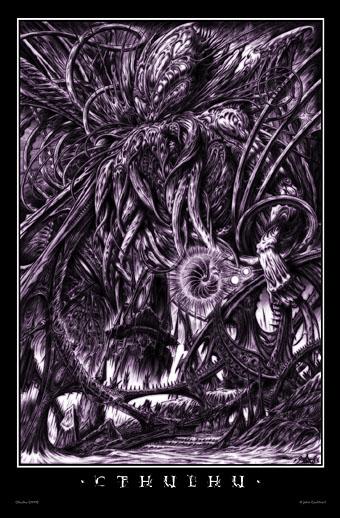
In other Lovecraft-related news, I’ve been slowly drawing a new Cthulhu portrait since demand for Cthulhoid work remains high. I’m not sure when this will be finished yet as other work takes precedence but this is where you’ll hear about it first.

calendar2.jpg

calendar3.jpg

Previously on { feuilleton }
The monstrous tome

Last in Line by Light Syndicate

ls1.jpg

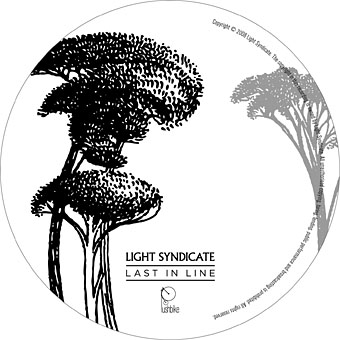
Last in Line is the debut album by Manchester band Light Syndicate and the CD packaging is something I put together after being asked to rescue a design which wasn’t quite working. I kept the band’s original idea of black trees on a red background but substituted their drawing with an adaptation of a 1910 folk tale illustration by Reginald Lionel Knowles. Knowles’ name is an obscure one today, his most visible work being the florid endpaper design which the Everyman Library used on their books up to 1935.

Last in Line is available locally from today (I guess that means Piccadilly Records) and nationwide from January 12th.

ls2.jpg

ls3.jpg

ls4.jpg

Elsewhere on { feuilleton }
The illustrators archive